Adverse Claim
Description

Get your form ready online
Our built-in tools help you complete, sign, share, and store your documents in one place.
Make edits, fill in missing information, and update formatting in US Legal Forms—just like you would in MS Word.
Download a copy, print it, send it by email, or mail it via USPS—whatever works best for your next step.
Sign and collect signatures with our SignNow integration. Send to multiple recipients, set reminders, and more. Go Premium to unlock E-Sign.
If this form requires notarization, complete it online through a secure video call—no need to meet a notary in person or wait for an appointment.
We protect your documents and personal data by following strict security and privacy standards.

Make edits, fill in missing information, and update formatting in US Legal Forms—just like you would in MS Word.

Download a copy, print it, send it by email, or mail it via USPS—whatever works best for your next step.

Sign and collect signatures with our SignNow integration. Send to multiple recipients, set reminders, and more. Go Premium to unlock E-Sign.

If this form requires notarization, complete it online through a secure video call—no need to meet a notary in person or wait for an appointment.

We protect your documents and personal data by following strict security and privacy standards.
Looking for another form?



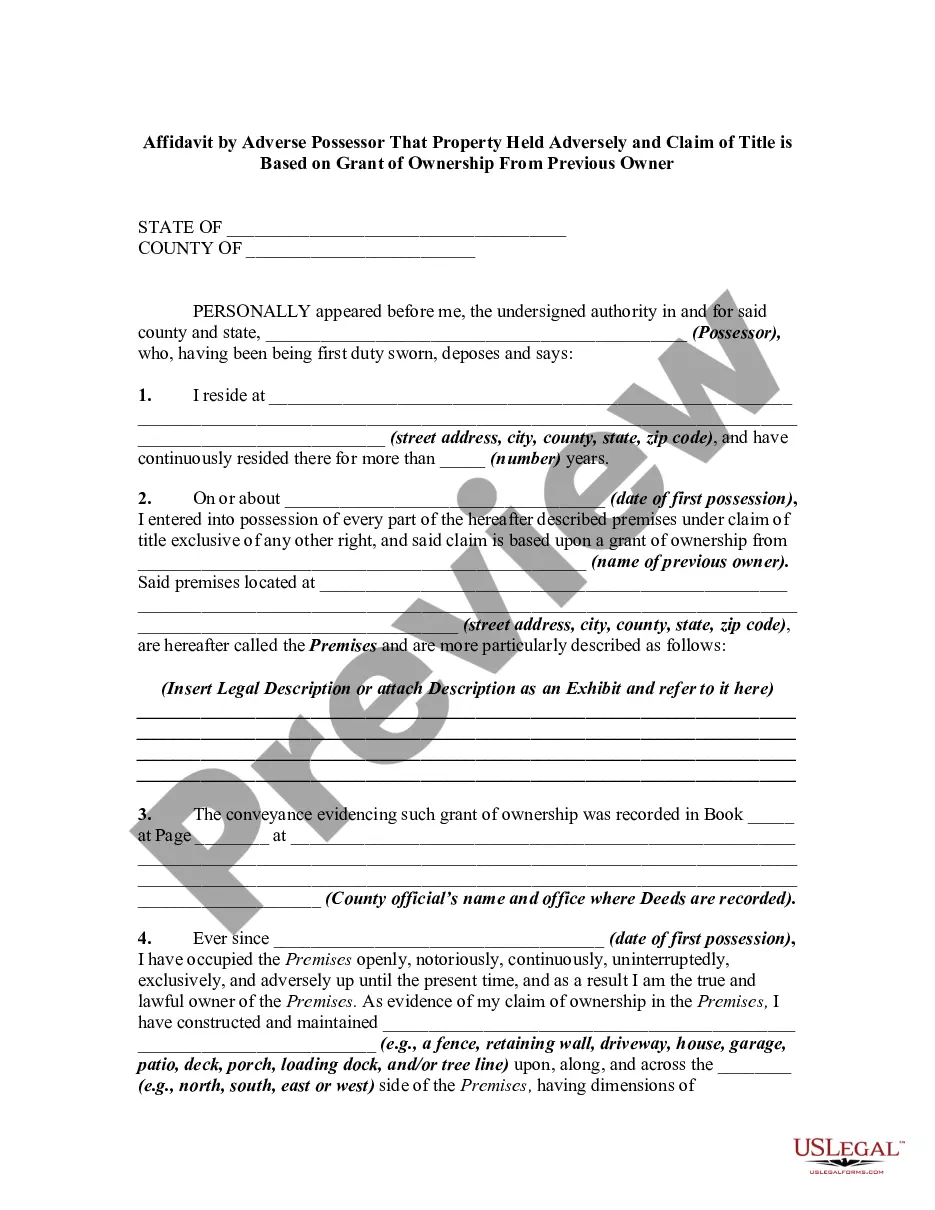
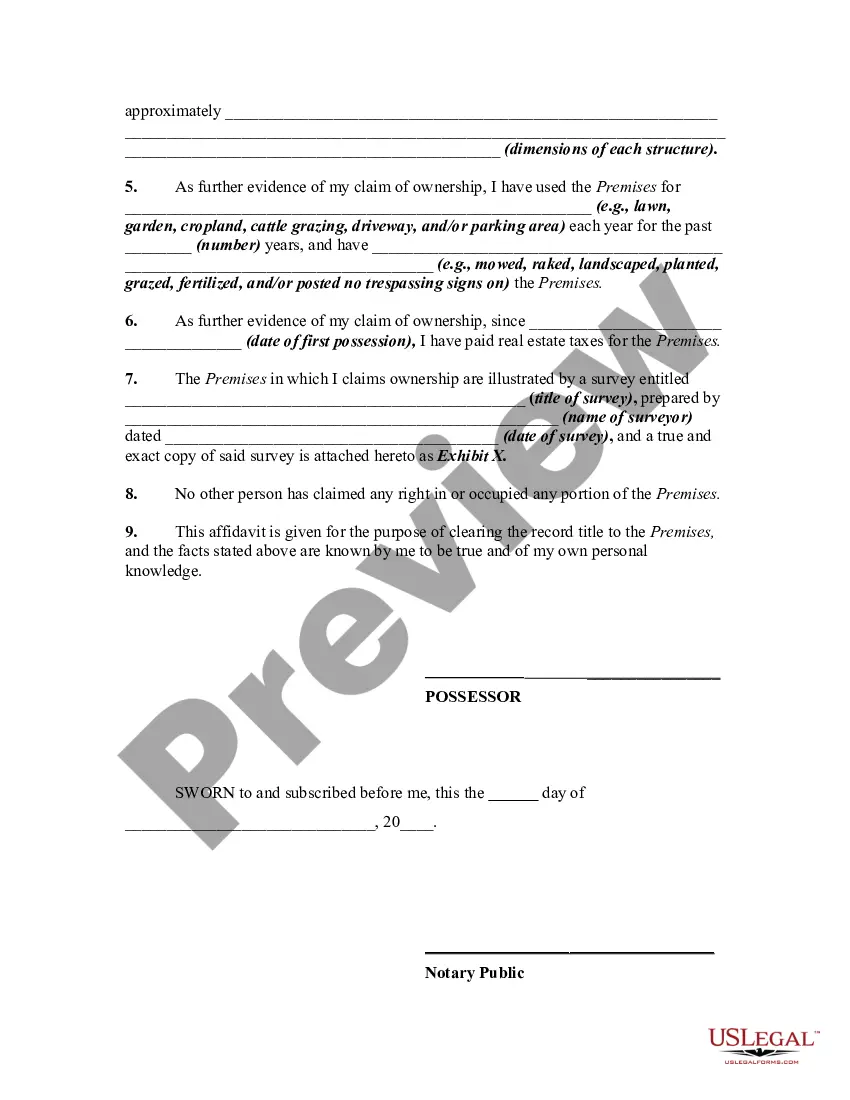
How to fill out Affidavit By Adverse Possessor That Property Held Adversely And Claim Of Title Is Based On Grant Of Ownership From Previous Owner - Squatters Rights?
- Log in to your US Legal Forms account if you have previously used the service, and check the status of your subscription. If it has expired, renew it according to your payment plan.
- For first-time users, begin by browsing our extensive library. Check the Preview mode and read the form descriptions to ensure you select the correct template tailored to your needs and local jurisdiction.
- If necessary, utilize the Search tab to find additional templates that meet your requirements. If you find a suitable option, proceed to the next step.
- Select the template you wish to purchase by clicking the Buy Now button and choose a subscription plan that fits your needs. You will need to create an account to access our extensive legal library.
- Complete your purchase by entering your payment details or utilizing your PayPal account to finalize the subscription.
- Once your purchase is confirmed, download your adverse claim form and save it to your device. You can also access it anytime through the My Forms section of your profile.
Obtaining legal forms doesn’t have to be daunting. With US Legal Forms, you’ll find a comprehensive selection at competitive prices, backed by expert assistance when needed.
Start your journey today and secure the adverse claim form you need with ease!
Form popularity
FAQ
An adverse claim is a formal assertion by one party against another's interest in property, typically challenging the property's title. This claim can create legal disputes and may eventually lead to court proceedings if not resolved amicably. It's important to address these claims promptly to protect your rights. Platforms like USLegalForms can help you manage and understand the nuances of an adverse claim, providing necessary legal documentation and resources.
An example of an adverse possession claim occurs when a person occupies land owned by another for a specific period. If the occupation is open, continuous, and without permission, the possessor may claim legal ownership through adverse possession. This concept illustrates how rights to property can shift due to prolonged or unchallenged use. It is essential to understand this as you navigate potential disputes surrounding an adverse claim.
In legal terms, 'adverse' refers to a situation or action that opposes or contradicts someone else's rights. This can apply in various contexts, including property disputes and claims. Understanding adverse impacts in law is crucial when assessing issues related to ownership. An adverse claim often arises when someone asserts a right against another's property.
To successfully claim adverse possession in Texas, certain requirements must be met. First, the possession must be actual and open, meaning you must physically occupy the property in a visible manner. Second, your possession needs to be continuous for a minimum of ten years. Third, the use of the property must be hostile, indicating that you claim ownership without permission from the original owner. Fourth, the possession should be exclusive, meaning you should not share control of the property with others. Finally, you need to have a claim that is not based on the original owner's lease or agreement. Understanding these five requirements enables you to approach an adverse claim confidently.
In the Philippines, the duration for filing an adverse claim can vary depending on the specific circumstances of the case. Generally, an adverse claim must be filed before the expiration of the 30-year period for registering a property, which can create challenges for potential claimants. You have to ensure that all necessary documents are prepared and submitted promptly to protect your interests. Platforms like US Legal Forms provide useful templates and guidance that can simplify the process of filing an adverse claim.
To successfully defeat an adverse claim, property owners should gather evidence proving their ownership and contest the elements of the adverse possession criteria. This may include photographs, documentation of property use, or witness statements. Additionally, understanding local laws and utilizing platforms like US Legal Forms can provide guidance on filing the necessary counterclaims to protect your rights.
Many might wonder what does not constitute a requirement for an adverse claim. One common misconception is that payment of property taxes is not necessary in every jurisdiction. While it can strengthen a claim, many states do not mandate tax payments as a condition for claiming adverse possession.
To establish an adverse claim, you need to demonstrate that you have possessed the property in a manner that is open, continuous, exclusive, and hostile to the interests of the true owner. This means you must show clear and direct evidence of your occupancy and use of the land for the statutory period set by state law. It’s important to gather proper documentation and testimonies to support your case.
An example of adverse possession occurs when someone occupies a piece of land without the permission of the owner for a specific period. For instance, if a neighbor builds a fence encroaching on your property and maintains it for several years, they might claim that portion of land under the concept of adverse claim. This can often lead to legal disputes regarding rightful ownership.