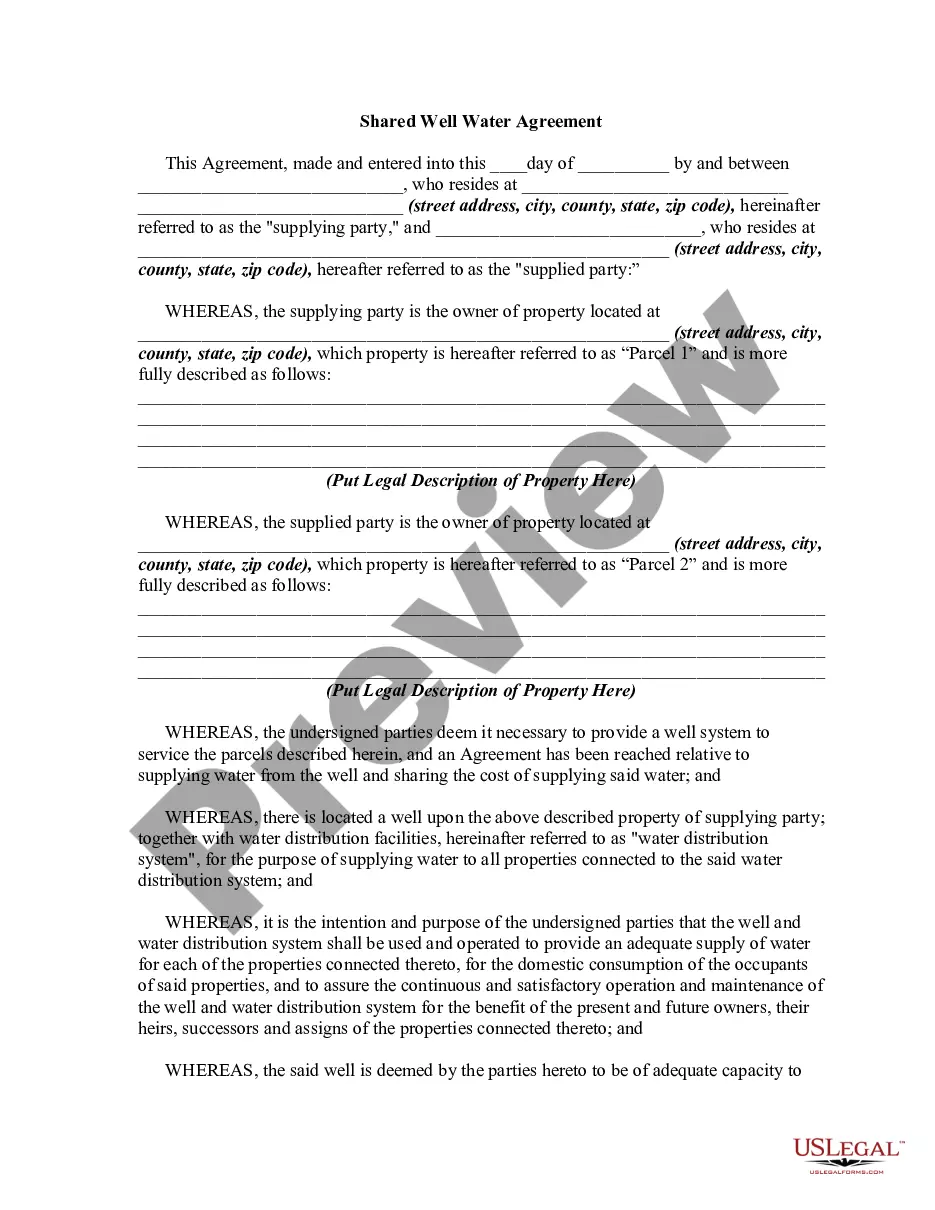
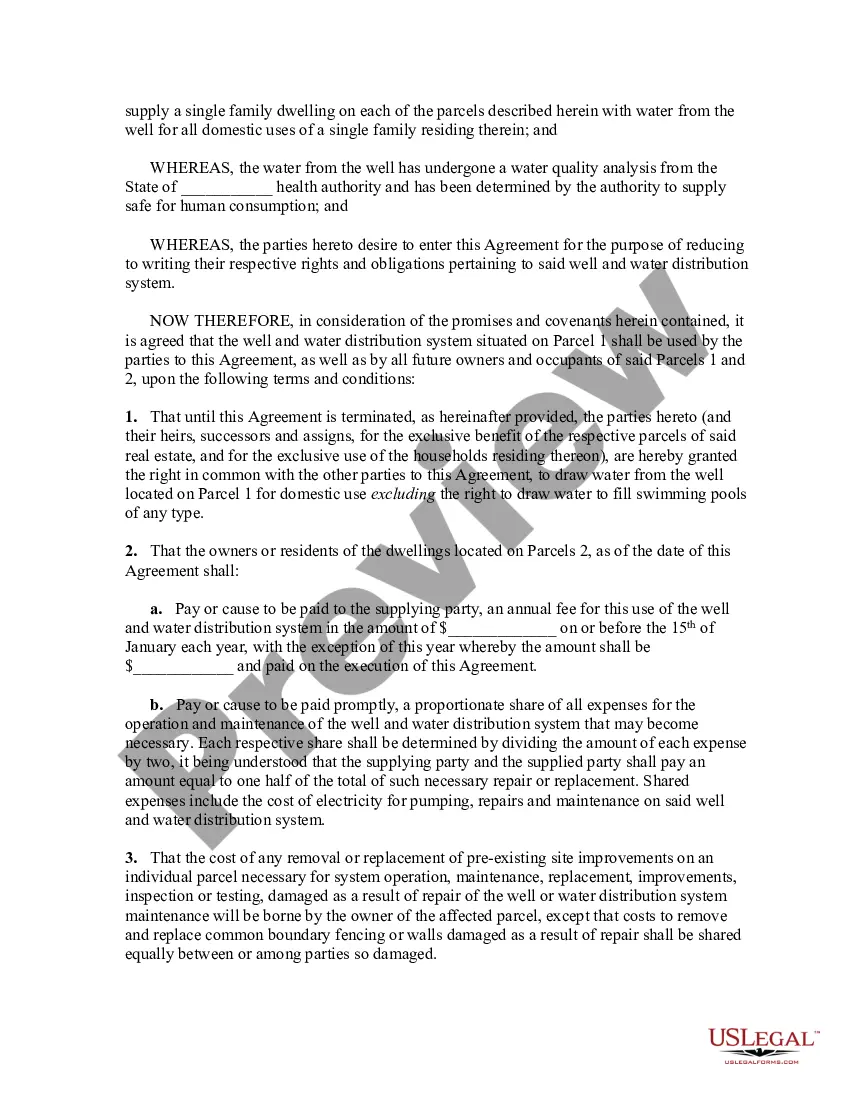
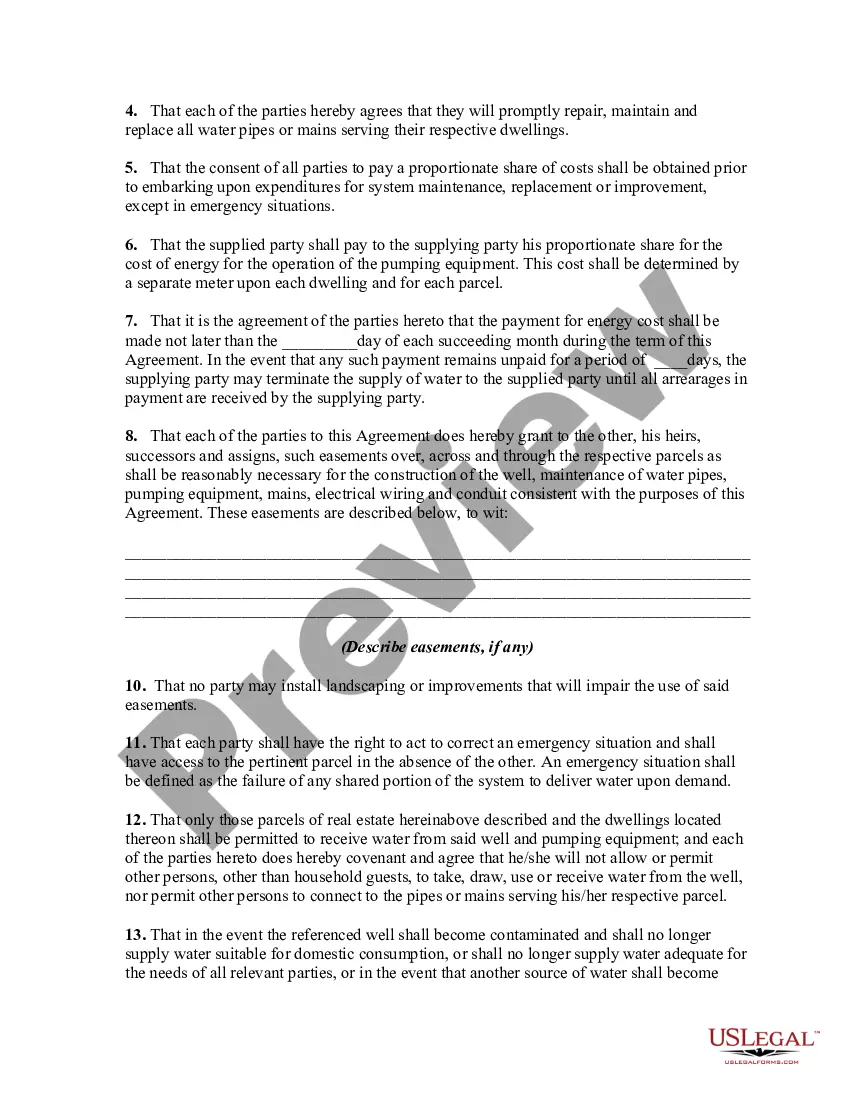
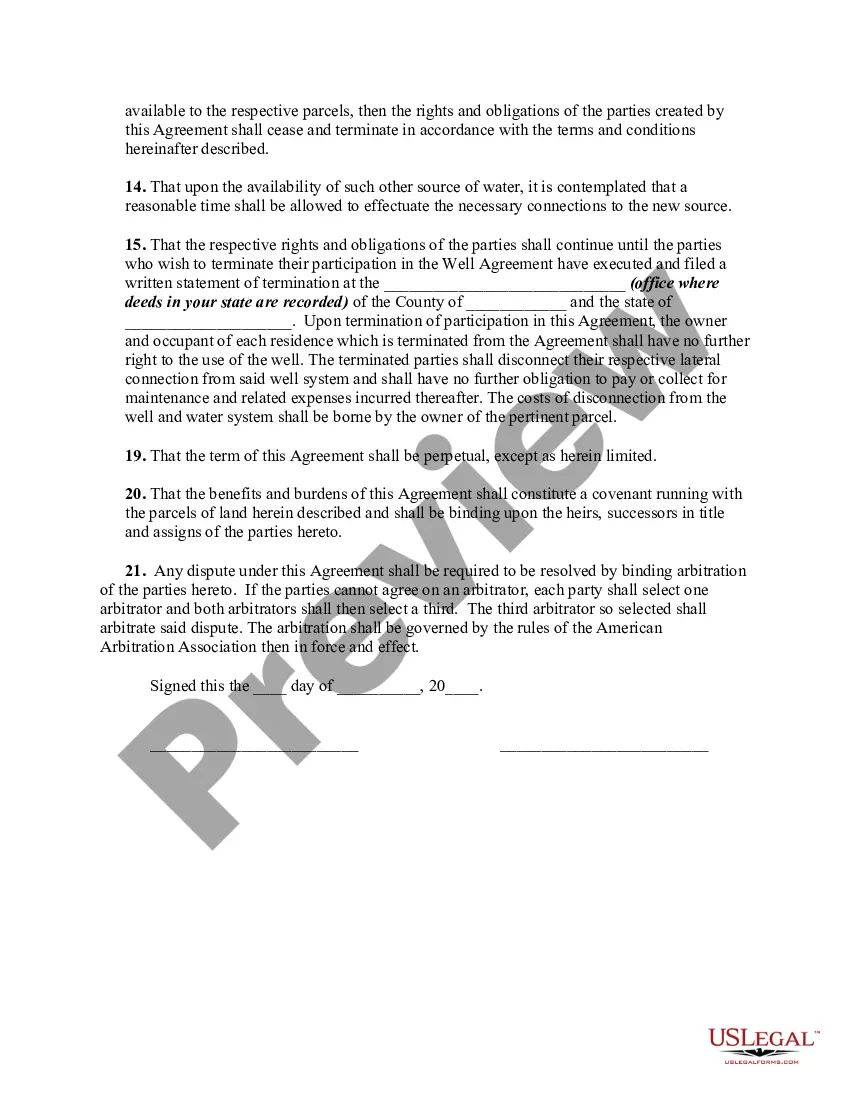
Shared Well Agreement Washington State Form 17
Description
Get your form ready online
Our built-in tools help you complete, sign, share, and store your documents in one place.
Make edits, fill in missing information, and update formatting in US Legal Forms—just like you would in MS Word.
Download a copy, print it, send it by email, or mail it via USPS—whatever works best for your next step.
Sign and collect signatures with our SignNow integration. Send to multiple recipients, set reminders, and more. Go Premium to unlock E-Sign.
If this form requires notarization, complete it online through a secure video call—no need to meet a notary in person or wait for an appointment.
We protect your documents and personal data by following strict security and privacy standards.

Make edits, fill in missing information, and update formatting in US Legal Forms—just like you would in MS Word.

Download a copy, print it, send it by email, or mail it via USPS—whatever works best for your next step.

Sign and collect signatures with our SignNow integration. Send to multiple recipients, set reminders, and more. Go Premium to unlock E-Sign.

If this form requires notarization, complete it online through a secure video call—no need to meet a notary in person or wait for an appointment.

We protect your documents and personal data by following strict security and privacy standards.
Looking for another form?


How to fill out Shared Well Water Agreement?
Regardless of whether it's for corporate reasons or personal affairs, everyone must confront legal matters at some point in their lives.
Filling out legal paperwork requires meticulous care, starting with selecting the appropriate template form.
With a vast collection of US Legal Forms available, you won't need to waste time searching for the correct sample across the web. Take advantage of the library's easy navigation to find the right template for any occasion.
- For instance, if you select an incorrect version of a Shared Well Agreement Washington State Form 17, it will be denied once submitted.
- Thus, it's vital to have a trustworthy supplier of legal documents like US Legal Forms.
- To obtain a Shared Well Agreement Washington State Form 17 template, follow these straightforward steps.
- 1. Acquire the required sample by utilizing the search field or browsing the catalog.
- 2. Review the details of the form to ensure it aligns with your circumstances, state, and locality.
- 3. Click on the form's preview to inspect it.
- 4. If it turns out to be the incorrect document, return to the search function to locate the Shared Well Agreement Washington State Form 17 sample you need.
- 5. Download the file when it suits your requirements.
- 6. If you already possess a US Legal Forms account, click Log in to access previously stored templates in My documents.
- 7. If you have yet to create an account, you can obtain the form by clicking Buy now.
- 8. Select the appropriate pricing plan.
- 9. Fill out the profile registration form.
- 10. Choose your payment method: either a credit card or a PayPal account.
- 11. Select the document format you prefer and download the Shared Well Agreement Washington State Form 17.
- 12. Once downloaded, you can fill in the form using editing software or print it out to complete it by hand.
Form popularity
FAQ
Form 17 disclosure in Washington state is a document that outlines a property's condition and any known issues by the seller. This form is crucial for buyers, as it details repairs and specific features of the property, including shared elements. Understanding this form is essential when navigating agreements like the Shared well agreement Washington state form 17.
In Washington, sellers do not have to disclose if someone died in a house unless it was due to a violent act or crime. However, being transparent may help create trust with potential buyers. Including this information can be crucial, especially when disclosing aspects related to shared agreements like the Shared well agreement Washington state form 17.
Yes, seller disclosure is mandatory in Washington State. Sellers must provide a disclosure statement to buyers before they finalize a sale. This requirement also covers properties with shared resources, such as those under a Shared well agreement Washington state form 17, ensuring that buyers are fully informed about the property's condition.
The seller's disclosure statement is designed to inform potential buyers about the condition of a property. This document often includes crucial information about repairs, issues, and overall maintenance history. In the context of a Shared well agreement Washington state form 17, it helps clarify any shared resources related to the well and associated responsibilities.
To dissolve a shared well agreement, all parties need to agree to the termination of the contract. It's essential to document the decision and any agreements regarding outstanding responsibilities or shared costs. Utilizing a shared well agreement Washington State form 17 can simplify this process by clearly outlining the steps to dissolve the agreement.
Disadvantages of a shared well include potential limited water access, especially during dry seasons, and the need for cooperation among users. Issues may arise if one neighbor does not uphold their maintenance duties. A comprehensive shared well agreement Washington State form 17 can help mitigate these risks and ensure fair resource distribution.
One downside of a shared well is the potential for disputes among users regarding water usage. If one party uses more water than agreed, it can lead to conflicts. Additionally, shared maintenance responsibilities can create challenges if not clearly defined in a shared well agreement Washington State form 17.
You can sell a house with a shared well, but you must disclose the shared well agreement to potential buyers. Buyers will want to understand their rights and responsibilities regarding the shared well. Having a clear shared well agreement Washington State form 17 can make the sales process smoother and more attractive.
Yes, neighbors can share a well, provided they have a clear agreement in place. This arrangement can benefit all parties by distributing costs and ensuring a reliable water source. It's advisable to create a shared well agreement Washington State form 17 to detail usage rights and responsibilities.
Shared well agreements outline the terms under which multiple parties can access and use a single well. These documents define each party's rights and responsibilities concerning water usage, maintenance, and costs. A shared well agreement Washington State form 17 serves as a formal contract, ensuring everyone involved understands their obligations.