Cost-plus-fixed-fee Contract Advantages And Disadvantages
Description

Get your form ready online
Our built-in tools help you complete, sign, share, and store your documents in one place.
Make edits, fill in missing information, and update formatting in US Legal Forms—just like you would in MS Word.
Download a copy, print it, send it by email, or mail it via USPS—whatever works best for your next step.
Sign and collect signatures with our SignNow integration. Send to multiple recipients, set reminders, and more. Go Premium to unlock E-Sign.
If this form requires notarization, complete it online through a secure video call—no need to meet a notary in person or wait for an appointment.
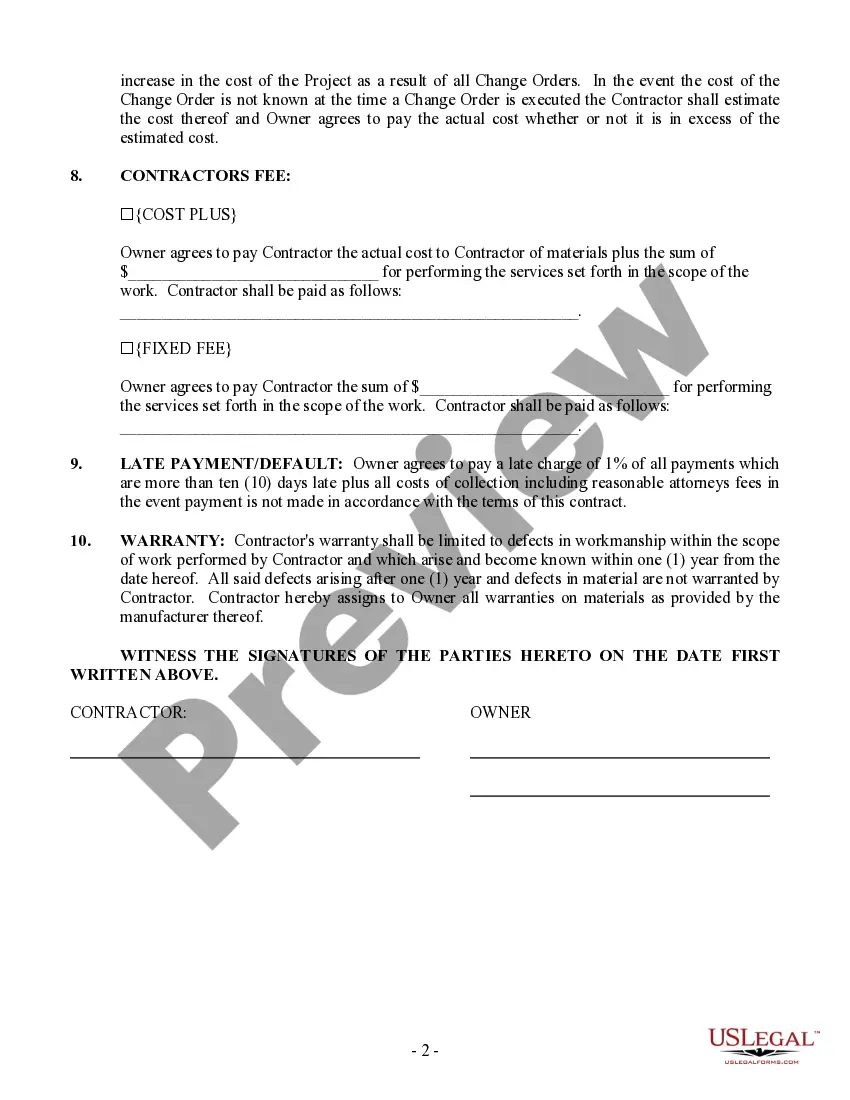
We protect your documents and personal data by following strict security and privacy standards.

Make edits, fill in missing information, and update formatting in US Legal Forms—just like you would in MS Word.

Download a copy, print it, send it by email, or mail it via USPS—whatever works best for your next step.

Sign and collect signatures with our SignNow integration. Send to multiple recipients, set reminders, and more. Go Premium to unlock E-Sign.

If this form requires notarization, complete it online through a secure video call—no need to meet a notary in person or wait for an appointment.

We protect your documents and personal data by following strict security and privacy standards.
Looking for another form?









How to fill out Construction Contract For Home - Fixed Fee Or Cost Plus?
The Cost-plus-fixed-fee Contract Pros and Cons you observe on this site is a reusable official template crafted by experienced attorneys in accordance with federal and local regulations.
For over 25 years, US Legal Forms has supplied individuals, enterprises, and lawyers with more than 85,000 validated, state-specific documents for any professional and personal circumstance. It’s the fastest, simplest, and most dependable way to acquire the necessary paperwork, as the service ensures the utmost level of data protection and anti-malware safeguards.
Select the format you prefer for your Cost-plus-fixed-fee Contract Pros and Cons (PDF, DOCX, RTF) and download the example onto your device.
- Search for the document you require and review it.
- Examine the sample you located and preview it or review the form description to verify it meets your requirements. If it doesn’t, use the search feature to find the appropriate one. Click Buy Now once you have found the template you need.
- Register and Log In.
- Choose the pricing plan that fits you and set up an account. Employ PayPal or a credit card to make a swift payment. If you already possess an account, Log In and check your membership to continue.
- Access the editable template.
Form popularity
FAQ
Calculating a cost-plus-fixed-fee contract involves determining the total allowable costs of the project and then adding a predetermined fixed fee. This fixed fee remains unchanged regardless of the total project cost, which offers predictability for the contractor. To get an accurate estimate, review all direct and indirect costs carefully. Knowing how to calculate this contract type shines light on the cost-plus-fixed-fee contract advantages and disadvantages.
One major disadvantage of a cost-plus-fixed-fee contract is the potential for cost overruns. Since the contractor is reimbursed for all allowable costs plus a fixed fee, this can encourage inefficiency and increased spending. Additionally, these contracts can complicate project management, as both parties must continuously track costs. Understanding the cost-plus-fixed-fee contract advantages and disadvantages helps you prepare for these challenges.
The risks of a cost-plus contract include budget overruns and communication issues between the contractor and client. There can also be a lack of firm commitment to cost control, leading to inflated expenses. By understanding these risks alongside the cost-plus-fixed-fee contract advantages and disadvantages, project stakeholders can better prepare and manage expectations.
plus contract offers advantages like flexibility in project scope and the ability to adjust as requirements change. However, it comes with disadvantages such as budget uncertainty and potential for excess spending. Balancing these factors is essential for making informed decisions about the costplusfixedfee contract advantages and disadvantages based on your project needs.
Specific disadvantages of a cost-plus-fixed-fee contract include the reliance on accurate reporting of expenses and the possibility of diminishing contractor motivation. If contractors know their fees are fixed regardless of effort, it may lead to reduced efficiency. Understanding these factors is essential in evaluating cost-plus-fixed-fee contract advantages and disadvantages.
Disadvantages of cost-plus contracts include unpredictability in total project costs and potential conflicts between the contractor and client. Since costs are reimbursed, clients may feel they are losing control over their budget. Effectively managing these relationships is crucial, especially when weighing the cost-plus-fixed-fee contract advantages and disadvantages.
Cost-plus contracts often have limitations, particularly in scope and budget predictability. They may lack clear parameters, which can lead to scope creep as additional services or materials are requested. Moreover, without a strict budget, project costs can spiral out of control. A thorough analysis of the cost-plus-fixed-fee contract advantages and disadvantages can clarify these limitations.
One significant disadvantage of a cost-plus-fixed-fee contract is that it can lead to cost overruns. Since contractors are reimbursed for expenses, there may not be as much incentive to control costs transparently. This can result in the overall project costs exceeding the initial budget. Evaluating cost-plus-fixed-fee contract advantages and disadvantages helps in understanding these potential pitfalls.
plusfixedfee contract operates by reimbursing the contractor for their allowable expenses, plus a fixed fee. This fixed fee is agreed upon before the project begins and does not change regardless of the total cost incurred. Typically, this arrangement benefits the contractor, as they can expect consistent earnings without the pressure of managing costs tightly. Understanding the costplusfixedfee contract advantages and disadvantages can help in deciding its use.
Employing a cost-plus-fixed-fee contract can be beneficial in specific situations. You should consider this type of contract when project requirements are uncertain, or when it is difficult to estimate costs accurately. The cost-plus-fixed-fee contract advantages and disadvantages come into play when balancing the contractor's incentive to control costs while ensuring thorough project completion. Utilizing a platform like US Legal Forms can help you navigate these contracts more effectively.