Employee Handbook Laws In Los Angeles
Description
















Get your form ready online
Our built-in tools help you complete, sign, share, and store your documents in one place.
Make edits, fill in missing information, and update formatting in US Legal Forms—just like you would in MS Word.
Download a copy, print it, send it by email, or mail it via USPS—whatever works best for your next step.
Sign and collect signatures with our SignNow integration. Send to multiple recipients, set reminders, and more. Go Premium to unlock E-Sign.
If this form requires notarization, complete it online through a secure video call—no need to meet a notary in person or wait for an appointment.
We protect your documents and personal data by following strict security and privacy standards.
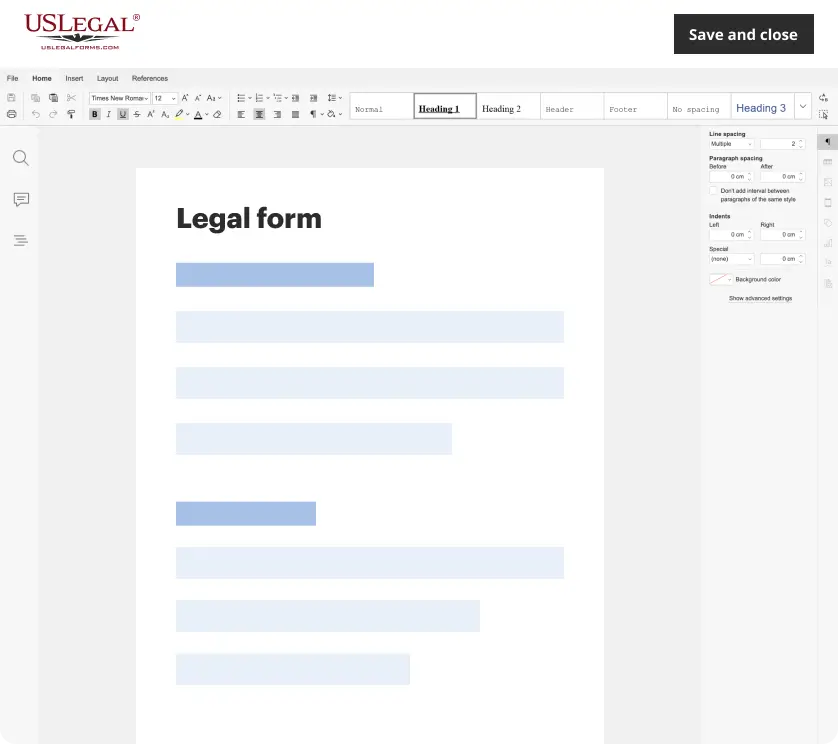
Make edits, fill in missing information, and update formatting in US Legal Forms—just like you would in MS Word.
Download a copy, print it, send it by email, or mail it via USPS—whatever works best for your next step.
Sign and collect signatures with our SignNow integration. Send to multiple recipients, set reminders, and more. Go Premium to unlock E-Sign.
If this form requires notarization, complete it online through a secure video call—no need to meet a notary in person or wait for an appointment.
We protect your documents and personal data by following strict security and privacy standards.
Looking for another form?


Form popularity
FAQ
Most employers are surprised to learn that California does not require companies to have an employee handbook.
Building or updating an employee handbook and ensuring it complies with all federal and state policies can take as long as 8 weeks without the right tools.
It has been worth it for me! I was entry level when I took it and it helped me get into that mid level and now managing HR. I'd say it gave me an extra 3 years of experience worth of credibility. Overall, I think it's just a signal that you are genuinely interested in the field and know your stuff.
Employee handbooks are not legally binding unless they explicitly state that they are. However, certain statements in the handbook can be interpreted as contractual promises if they are specific enough and imply mutual obligations between employer and employee.
Once the employer has updated the policies and formalized the common practices, legal counsel should review them, and HR should use these final policies for developing the employee handbook. Employers should also consider the National Labor Relations Board (NLRB) rulings and guidance pertaining to employee handbooks.
And if your company doesn't have a handbook, managers and employees will need to rely on the company's “institutional memory” to ensure that policies are consistently applied. Work policies and expectations also take on more importance and are more likely to be followed when you codify them in an official handbook.
Very few employees read the Employee Handbook they get when they start a new job, but they should. An Employee Handbook can set the expectations for the employee and also what is required by law for the employer. It often clarifies various obligations the employer has both under the law and which it agrees to take on.
Effective July 1, 2024, California law requires most California employers to create a written workplace violence prevention plan, a workplace violence incident log (consistent with OSHA standards), a workplace violence prevention curriculum specific to the employer, and annual training for all employees concerning ...
Are employee handbooks required by law? It's not legally required to provide an employee handbook.
