Notice Meeting Format In Maryland
Description
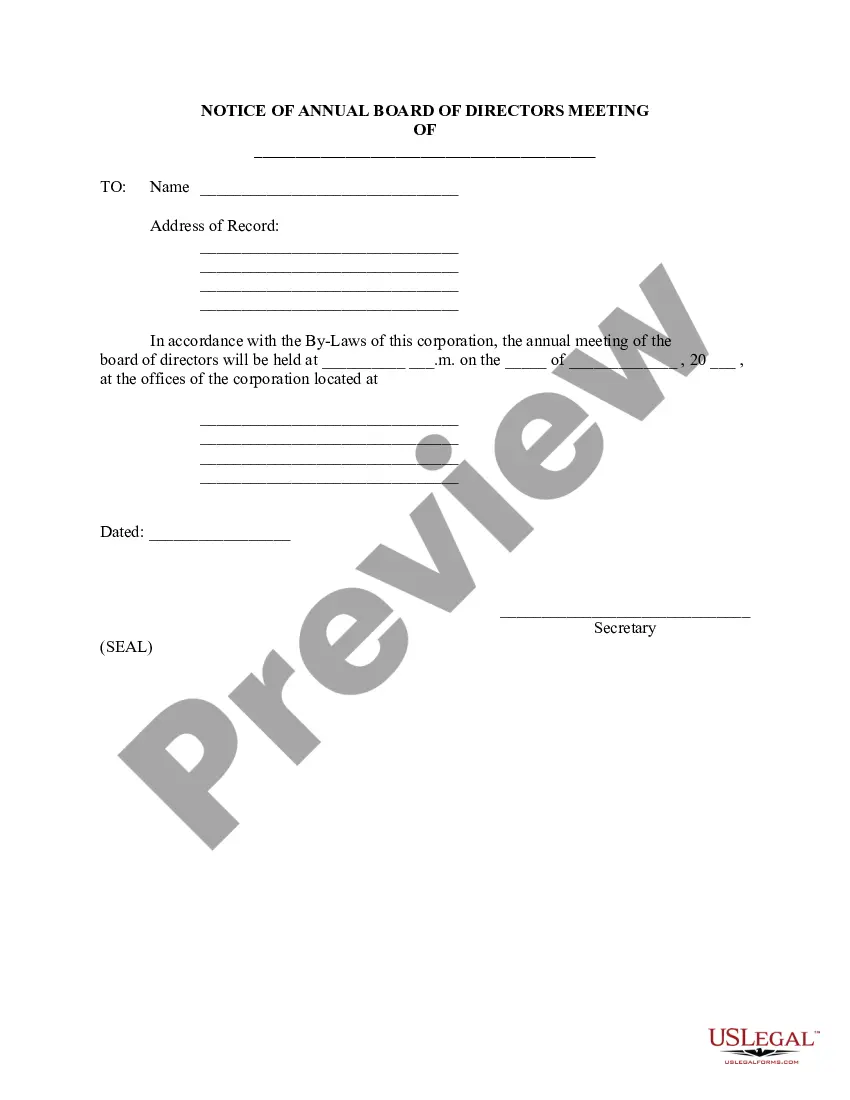


Get your form ready online
Our built-in tools help you complete, sign, share, and store your documents in one place.
Make edits, fill in missing information, and update formatting in US Legal Forms—just like you would in MS Word.
Download a copy, print it, send it by email, or mail it via USPS—whatever works best for your next step.
Sign and collect signatures with our SignNow integration. Send to multiple recipients, set reminders, and more. Go Premium to unlock E-Sign.
If this form requires notarization, complete it online through a secure video call—no need to meet a notary in person or wait for an appointment.
We protect your documents and personal data by following strict security and privacy standards.

Make edits, fill in missing information, and update formatting in US Legal Forms—just like you would in MS Word.

Download a copy, print it, send it by email, or mail it via USPS—whatever works best for your next step.

Sign and collect signatures with our SignNow integration. Send to multiple recipients, set reminders, and more. Go Premium to unlock E-Sign.

If this form requires notarization, complete it online through a secure video call—no need to meet a notary in person or wait for an appointment.

We protect your documents and personal data by following strict security and privacy standards.
Looking for another form?


Form popularity
FAQ
Maryland's Open Meetings Act is a statute that requires many State and local public bodies to hold their meetings in public, to give the public adequate notice of those meetings, and to allow the public to inspect meetings minutes. The Act permits public bodies to discuss some topics confidentially.
This provision establishes that, although the Maryland Sunshine Law is the touchstone by which public bodies are to conduct their meetings, the statute is not exclusive in its application. The statute only outlines the minimum requirements for conducting open meetings. . . .
Common types of nonprofits that are subject to open meeting laws are: State, local and federal boards, commissions and authorities. State educational institutions. Private entities receiving public funds.
The notice for an annual meeting must state the time of the meeting, the place of the meeting, if any, and the means of remote communication, if any, by which stockholders and proxy holders may be deemed to be present and entitled to vote at the meeting. Quorum and Presence at the Meeting.
A quorum is a majority of the public body's members unless the law applicable to that particular public body sets a different number.
Meetings must: Be noticed in advance; Include only business described in the agenda; Take place within agency boundaries; Be completely accessible by the public. Notice and agenda for regular meeting must be: Posted 72 hours in advance; Posted in an accessible location; Mailed to persons who request notice.
When the Open Meetings Act applies, what does it require the public body to do? The Act requires the public body to give “reasonable advance notice” of its meetings, to make an agenda available in advance except in cases of emergency, to hold its meetings openly, to adopt minutes, and to retain them for 5 years.
How to file a Complaint. Send a complaint letter by mail or e-mail to the Open Meetings Compliance Board at this address: Open Meetings Compliance Board, c/o Attorney General's Office, 200 St. Paul Place, Baltimore, MD 21202, or OpenGov@oag.state.md. You must sign your complaint and include a return address.
Call the Consumer Protection Division Hotline at (410) 528-8662 Mon. -Fri. 10am - 2pm.
Upon finding a violation of the Open Meeting Law, the Attorney General may impose a civil penalty upon a public body of not more than $1,000 for each intentional violation.
