Petition To Remove and Reinter Remains - Burial
What is this form?
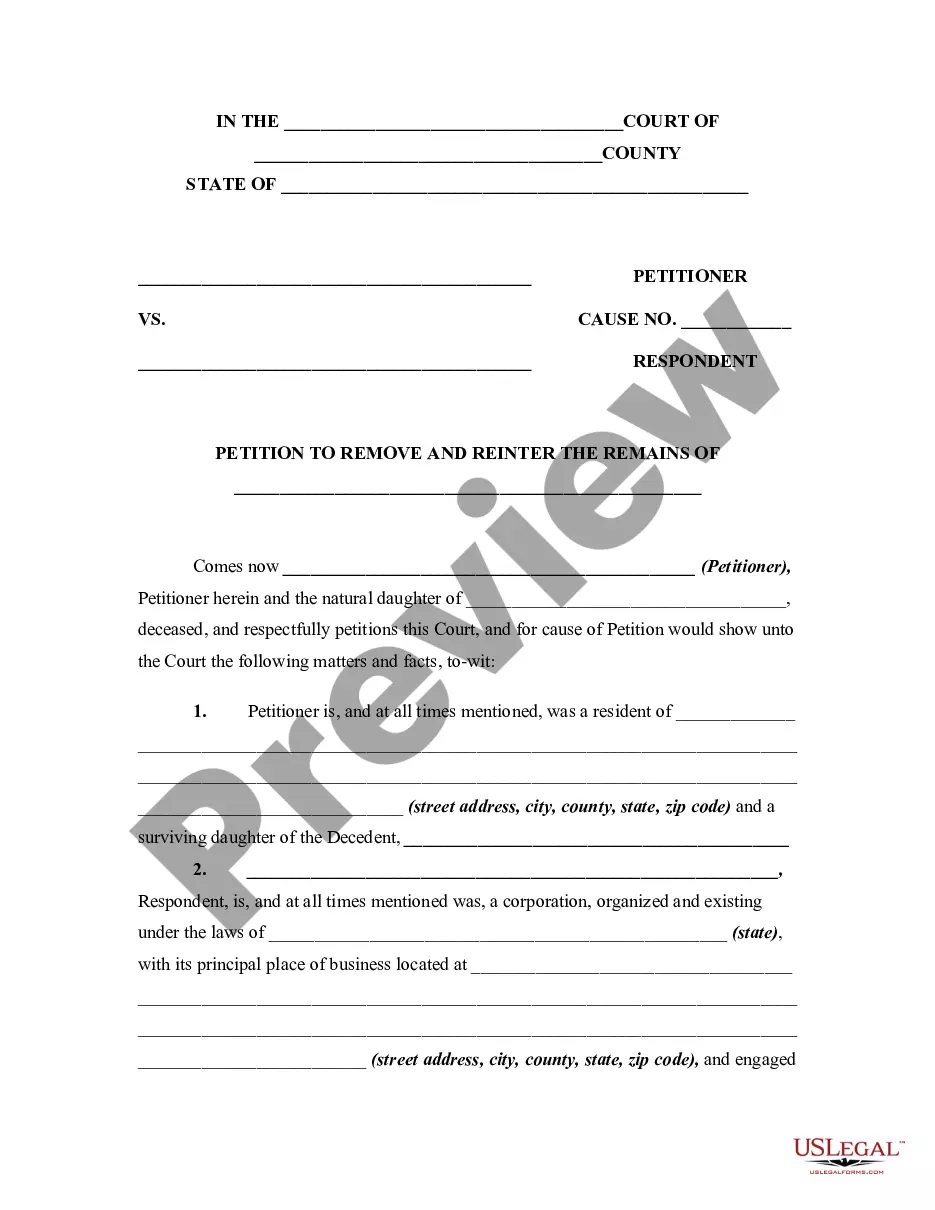
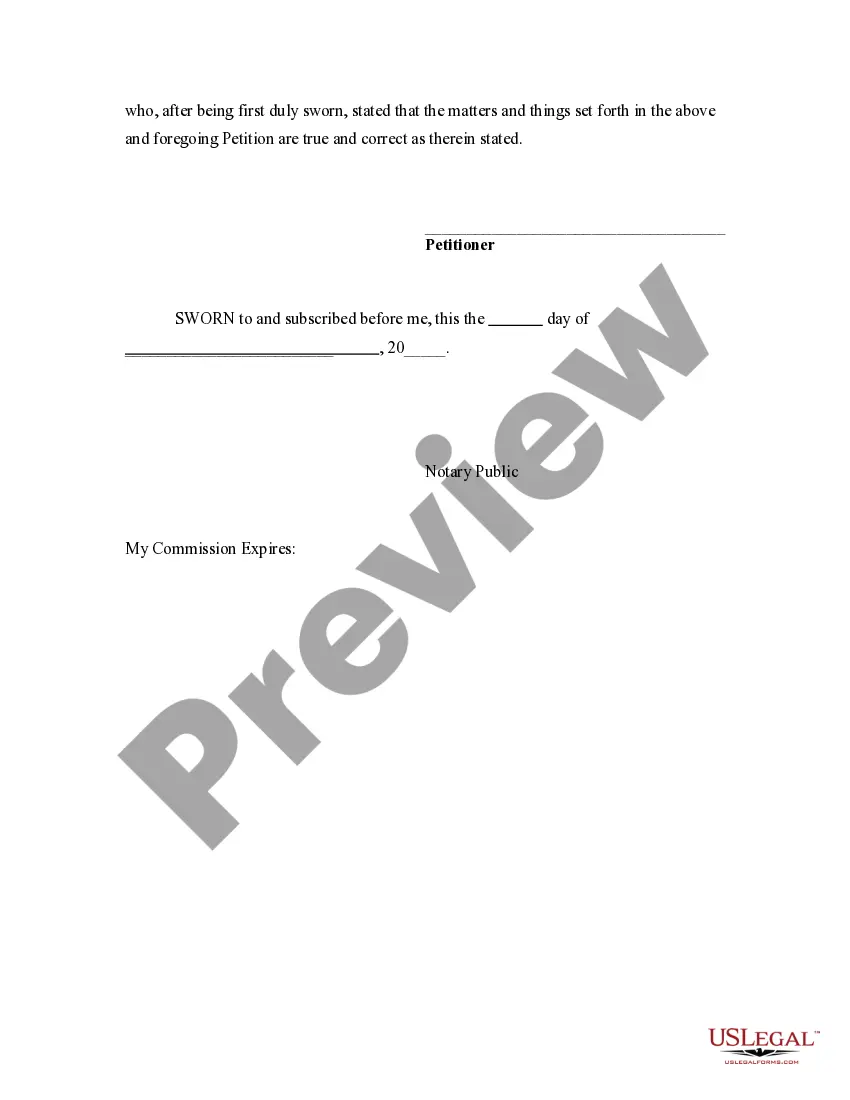
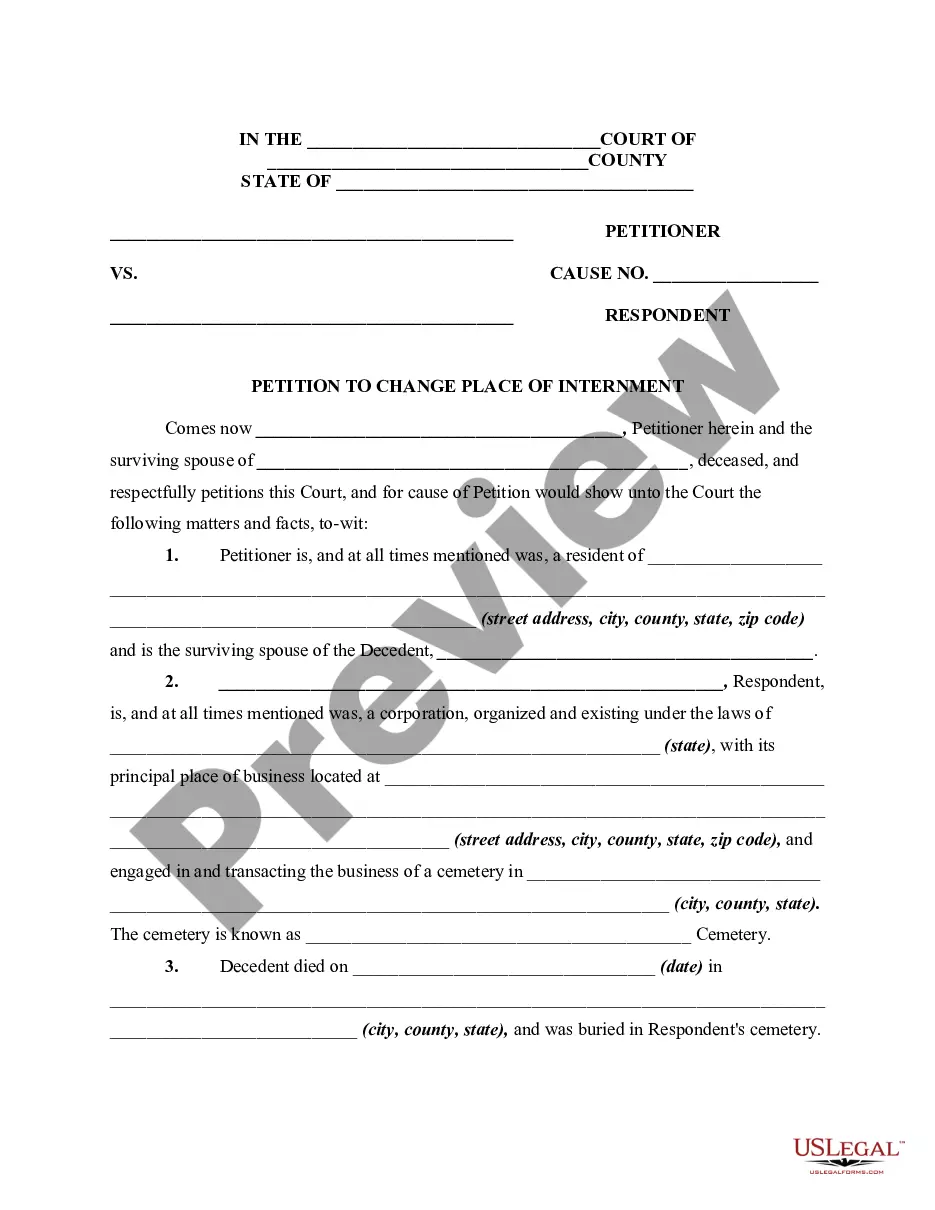
The Petition to Remove and Reinter Remains is a legal document used to request the relocation of a deceased person's remains from one cemetery to another. This form addresses situations where the cemetery has failed to uphold its responsibilities for the care of the grave, such as allowing it to become overgrown or neglected. It is essential in situations where family members seek to ensure the respectful treatment of their loved one's final resting place.
Form components explained
- Identification of the petitioner and their relationship to the deceased.
- Details about the respondent, typically the cemetery, and its responsibilities.
- Information about the decedent, including burial details and date of death.
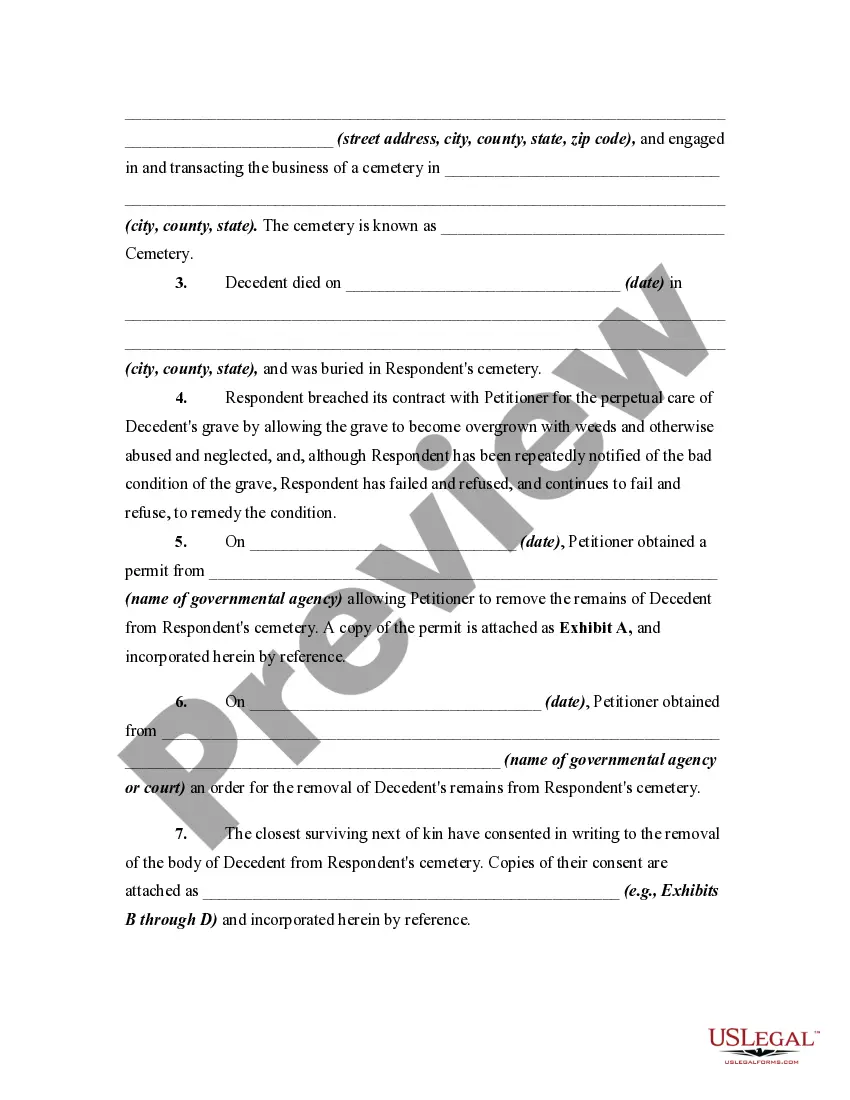
- Evidence of contract breach by the cemetery regarding grave care.
- Permits and approvals obtained for the removal of remains.
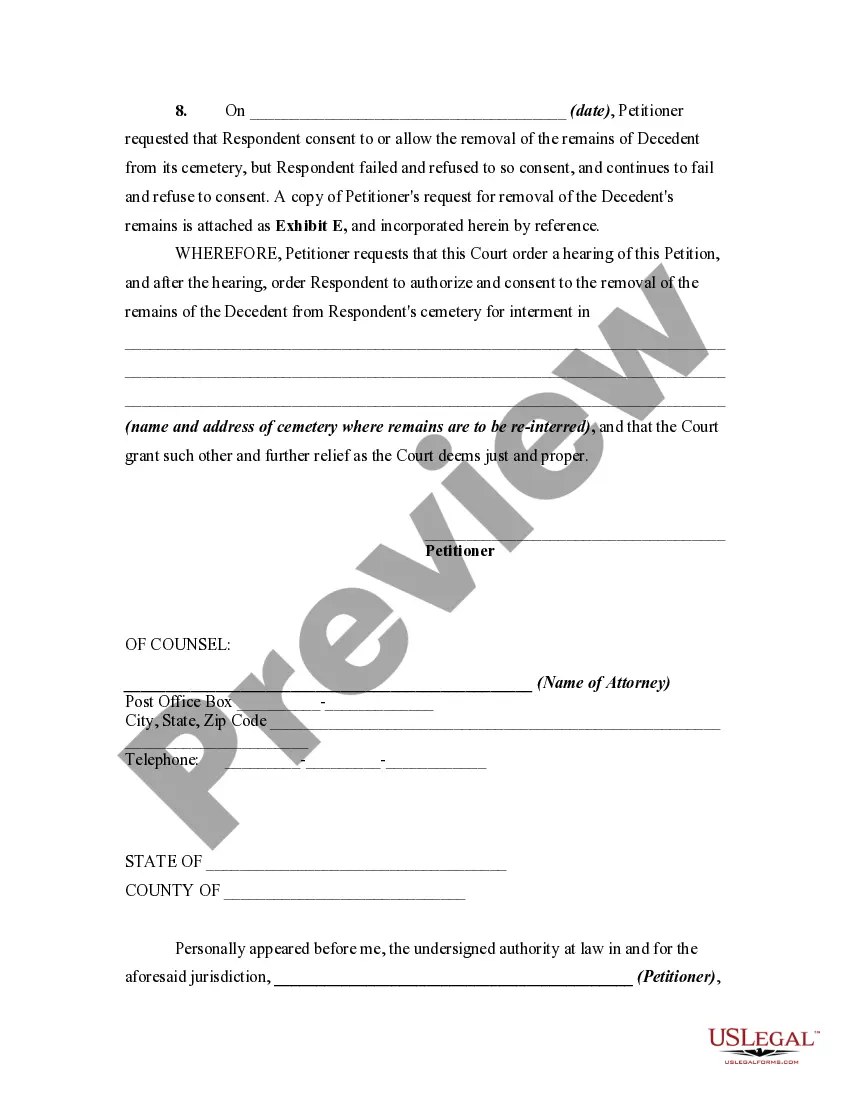
- Consents from closest surviving next of kin for the removal.
- Request for court authorization to relocate the remains.

When this form is needed
This form is necessary when a cemetery has neglected the maintenance of a grave, and the family wishes to relocate the decedent's remains to a different location. It is often used in cases where relatives have made several attempts to address the situation with the cemetery but have received no satisfactory response. The petition serves to seek legal redress and ensure compliance with care obligations by the cemetery.
Who can use this document
- Families of deceased individuals whose graves have been neglected by a cemetery.
- Surviving relatives looking to relocate remains for better care or to a more suitable location.
- Individuals acting on behalf of the deceased's estate or family, such as legal representatives or heirs.
Completing this form step by step
- Identify the parties involved, including the petitioner and the cemetery.
- Provide the decedent's details, including their name and date of death.
- Document the reasons for seeking removal, emphasizing the breach of care by the cemetery.
- Attach copies of relevant permits and consents from next of kin.
- Submit the completed petition to the appropriate court for review and hearing.
Is notarization required?
To make this form legally binding, it must be notarized. Our online notarization service, powered by Notarize, lets you verify and sign documents remotely through an encrypted video session.
Get your form ready online
Our built-in tools help you complete, sign, share, and store your documents in one place.
Make edits, fill in missing information, and update formatting in US Legal Forms—just like you would in MS Word.
Download a copy, print it, send it by email, or mail it via USPS—whatever works best for your next step.
Sign and collect signatures with our SignNow integration. Send to multiple recipients, set reminders, and more. Go Premium to unlock E-Sign.
If this form requires notarization, complete it online through a secure video call—no need to meet a notary in person or wait for an appointment.
We protect your documents and personal data by following strict security and privacy standards.

Make edits, fill in missing information, and update formatting in US Legal Forms—just like you would in MS Word.

Download a copy, print it, send it by email, or mail it via USPS—whatever works best for your next step.

Sign and collect signatures with our SignNow integration. Send to multiple recipients, set reminders, and more. Go Premium to unlock E-Sign.

If this form requires notarization, complete it online through a secure video call—no need to meet a notary in person or wait for an appointment.

We protect your documents and personal data by following strict security and privacy standards.
Typical mistakes to avoid
- Failing to include all necessary documentation, such as permits and consents.
- Not clearly stating the reasons for the petition or failing to demonstrate the cemetery's neglect.
- Missing signatures or incorrect identification of involved parties.
Benefits of using this form online
- Convenient access to legal forms that can be downloaded and completed from home.
- Editability allows for customization to fit specific situations and jurisdictions.
- Reliable legal templates drafted by licensed attorneys ensure compliance with legal standards.
Quick recap
- The Petition to Remove and Reinter Remains addresses property neglect by a cemetery.
- This form requires personal identification, evidence of neglect, and consent from family members.
- It is crucial to verify state-specific laws regarding reinterment and documentation.
- Completing this form accurately is essential to facilitate the legal process for removing remains.
Looking for another form?
Form popularity
FAQ
There may be paperwork you must fill out to obtain permission to exhume the body. Be aware that exhumation of a body is quite expensive.An embalmed body can be cremated. My mother wanted my father to be visible at his visitation, so at her wishes he was embalmed and shown at the funeral home.
To repatriate exhumed remains you will be required to provide an exhumation license application, a letter from the airline or shipping company that would be transporting the remains confirming their role in the repatriation, and a letter from the cemetery that the deceased will be reinterred in.
Exhumation Costs$1,000 or more. You may need state permits. Cost varies state-to-state. If the body is recently buried in a vault or metal coffin $3,000 $5,000 for the exhumation itself.
So, in answer to the question: the exhumation of cremation ashes is usually unlawful without permission from the Ministry of Justice and the Ministry prefer to have the consent of the next of kin.
Under the Burial Act 1857, once a person has been buried it is unlawful to disturb or remove the body without lawful authority. The exhumation of cremation ashes on consecrated ground can only be authorised by a Faculty from the local Diocese.
Under the Burial Act 1857, once a person has been buried it is unlawful to disturb or remove the body without lawful authority. The exhumation of cremation ashes on consecrated ground can only be authorised by a Faculty from the local Diocese.
Exhumation Costs$1,000 or more. You may need state permits. Cost varies state-to-state. If the body is recently buried in a vault or metal coffin $3,000 $5,000 for the exhumation itself.
You will need to contact the current cemetery and the new cemetery to coordinate plans for the transfer of the body. When having a body disinterred and moved, you may need to purchase a new casket for the transportation and reburial. (A very basic casket starts at $500 and up.)
Exhuming a Body: Reasons and Methods With roots in the Latin word exhumare (literally translated to 'out of the ground'), exhumation is the process of unearthing buried human remains for any number of reasons.