District of Columbia Statutory Uniform Donor Card for Anatomical Gift Act Donation
What is this form?
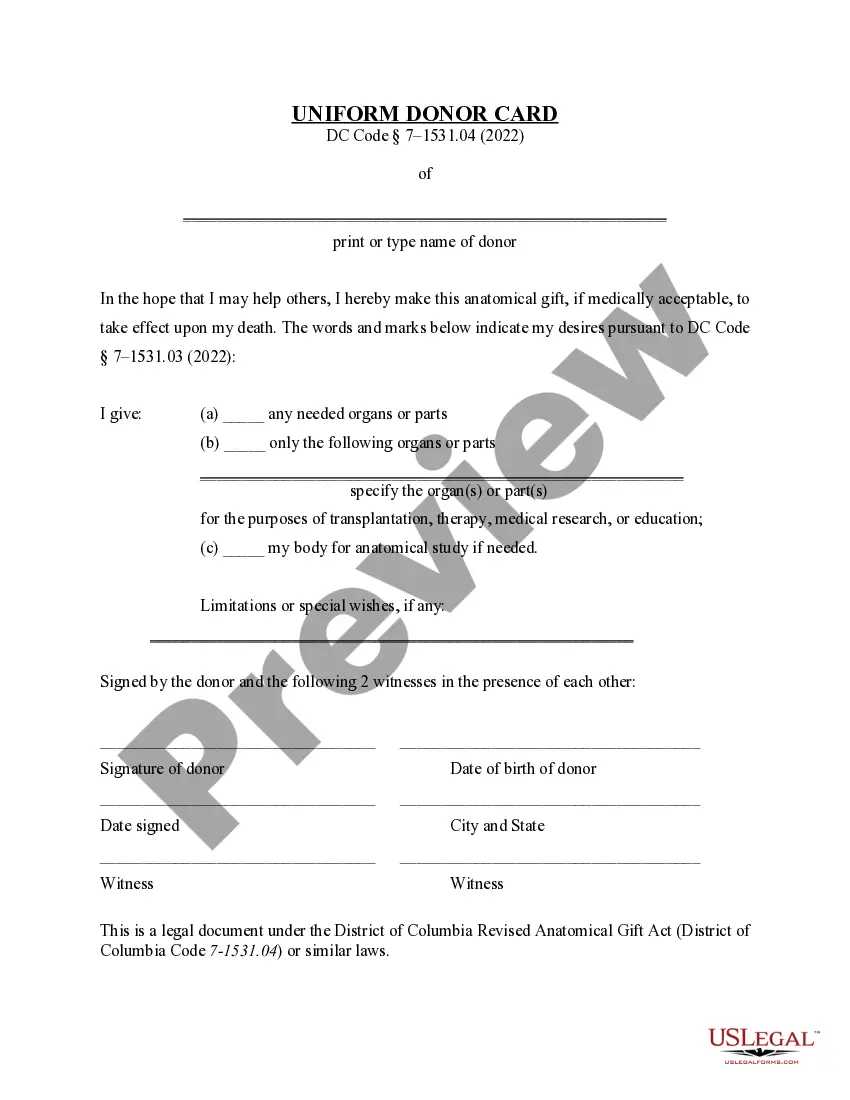
The Statutory Uniform Donor Card for Anatomical Gift Act Donation is a legal document that allows individuals to designate specific body parts or organs they wish to donate upon their death. This form is distinct from other donation forms in that it is governed by the Anatomical Gift Act, ensuring that your wishes regarding organ donation are clearly articulated and legally binding. It is designed for those who wish to make an anatomical gift to help others, whether for transplantation, medical research, or education.
Key components of this form
- Donor's name: Personal identification of the individual making the anatomical gift.
- Gift specifications: Options to donate any needed organs or specify particular ones.
- Purpose of donation: Indicates whether the gift is for transplantation, therapy, research, or education.
- Witness signatures: Requires signatures from two witnesses for validation.
- Limitations or special wishes: A section for the donor to express any specific instructions regarding the donation.
When to use this form
You should use the Statutory Uniform Donor Card for Anatomical Gift Act Donation when you wish to make your intentions regarding organ donation clear. This form is particularly important for individuals aged 18 years and older who want to ensure that their desires regarding the use of their body parts after death are respected. This can include situations where someone wants to contribute to life-saving transplants, medical advancements, or educational purposes.
Who should use this form
- Individuals aged 18 years or older wishing to designate their preferences for organ donation.
- People who want to contribute to medical research, education, or therapy through organ donations.
- Anyone seeking to ensure their anatomical gift wishes are legally documented and acknowledged.
How to prepare this document
- Provide your full name at the top of the form.
- Indicate your desire to donate either any needed organs or specify particular organs.
- Clearly state the purpose of your donation, whether for transplantation, therapy, research, or education.
- List any limitations or special wishes regarding your donation.
- Sign the document in the presence of two witnesses, who must also sign.
- Include your date of birth, date signed, and the city and state where the document is executed.
Does this document require notarization?
This form usually doesn’t need to be notarized. However, local laws or specific transactions may require it. Our online notarization service, powered by Notarize, lets you complete it remotely through a secure video session, available 24/7.
Get your form ready online
Our built-in tools help you complete, sign, share, and store your documents in one place.
Make edits, fill in missing information, and update formatting in US Legal Forms—just like you would in MS Word.
Download a copy, print it, send it by email, or mail it via USPS—whatever works best for your next step.
Sign and collect signatures with our SignNow integration. Send to multiple recipients, set reminders, and more. Go Premium to unlock E-Sign.
If this form requires notarization, complete it online through a secure video call—no need to meet a notary in person or wait for an appointment.
We protect your documents and personal data by following strict security and privacy standards.

Make edits, fill in missing information, and update formatting in US Legal Forms—just like you would in MS Word.

Download a copy, print it, send it by email, or mail it via USPS—whatever works best for your next step.

Sign and collect signatures with our SignNow integration. Send to multiple recipients, set reminders, and more. Go Premium to unlock E-Sign.

If this form requires notarization, complete it online through a secure video call—no need to meet a notary in person or wait for an appointment.

We protect your documents and personal data by following strict security and privacy standards.
Common mistakes
- Failing to have the document witnessed correctly.
- Not specifying which organs or parts you wish to donate.
- Neglecting to state any limitations or special wishes.
Quick recap
- The form allows individuals to make binding decisions about organ donation.
- It must be witnessed and notarized to ensure legal validity.
- Clear instructions and specifications are crucial to avoid misunderstandings.
Looking for another form?


Form popularity
FAQ
An anatomical gift is a donation of organs or tissues for medical purposes, such as transplantation. The District of Columbia Statutory Uniform Donor Card for Anatomical Gift Act Donation provides a legal framework for individuals to make these gifts. This act allows donors to outline their wishes regarding organ donation clearly and directs healthcare providers in honoring those decisions. Understanding anatomical gifts can empower you to make informed choices about organ donation and help save lives.
DBD stands for deceased donor, while DCD refers to donations after cardiac death. In the context of the District of Columbia Statutory Uniform Donor Card for Anatomical Gift Act Donation, DBD involves organ recovery after the donor is declared brain dead. In contrast, DCD occurs when the donor’s heart stops beating, making both types crucial for enhancing the number of available organs for transplantation.
Yes, filling out paperwork is a required step to formalize your intent to be an organ donor. This can be done through the DMV or by using resources found on uslegalforms, which can guide you through the District of Columbia Statutory Uniform Donor Card for Anatomical Gift Act Donation. Ensure that your documentation is complete and legible, as this is essential for the legal acknowledgment of your wishes.
Registering as an organ donor is a straightforward process. You can visit the DMV and indicate your willingness to donate or use online services such as uslegalforms to fill out the District of Columbia Statutory Uniform Donor Card for Anatomical Gift Act Donation. Make sure to provide accurate personal details and check that your registration is up to date to ensure your wishes are honored.
To obtain your organ donor card, you can complete your registration at the DMV or through an online resource like uslegalforms, which provides easy access to the District of Columbia Statutory Uniform Donor Card for Anatomical Gift Act Donation. After filling out your information, you usually receive the card by mail or can print it directly from the website. Keeping this card with you can help communicate your donation intentions in case of an emergency.
Becoming an organ donor starts with understanding your wishes and sharing them with your family. Next, you should register through your state's registry or by using the District of Columbia Statutory Uniform Donor Card for Anatomical Gift Act Donation. Finally, make sure your intention to donate is clearly documented, as this will help ensure your wishes are honored when the time comes.
To complete the organ donor registration process, you can visit your local Department of Motor Vehicles (DMV) or check online platforms like uslegalforms for comprehensive forms. You will need to provide some personal information and express your willingness to donate through the District of Columbia Statutory Uniform Donor Card for Anatomical Gift Act Donation. Once you submit the required documentation, you will receive confirmation of your registration.
The Uniform Organ Donor Card Act is legislation that provides individuals with a simple means to express their intent to donate organs after their death. This act aligns with the principles of the Uniform Anatomical Gift Act, promoting awareness and conversation about organ donation. The District of Columbia Statutory Uniform Donor Card for Anatomical Gift Act Donation can serve as your official record, ensuring your wishes are documented and respected. Understanding this act helps you take proactive steps in planning for the future.
The Uniform Anatomical Gift Act has been adopted by all 50 states and the District of Columbia, making it a crucial piece of legislation for organ and tissue donation nationwide. This act streamlines the process and simplifies the legal aspects of making anatomical gifts. The wide acceptance of the District of Columbia Statutory Uniform Donor Card for Anatomical Gift Act Donation reflects the collective effort to enhance organ donation efforts. Knowing that all states support this act encourages broader participation in donation programs.
The Uniform Anatomical Gift Act does not impose a strict age limit for making anatomical gifts, but individuals must usually be at least 18 years old to make legally binding decisions. Minors can express their wishes regarding donation, but typically they require parental or guardian consent to formalize the process. The District of Columbia Statutory Uniform Donor Card for Anatomical Gift Act Donation accommodates this guideline, highlighting the importance of understanding the legalities surrounding age and consent. Awareness of these rules ensures that you make informed choices about anatomical gifts.