District of Columbia Revised Uniform Anatomical Gift Act Donation
About this form
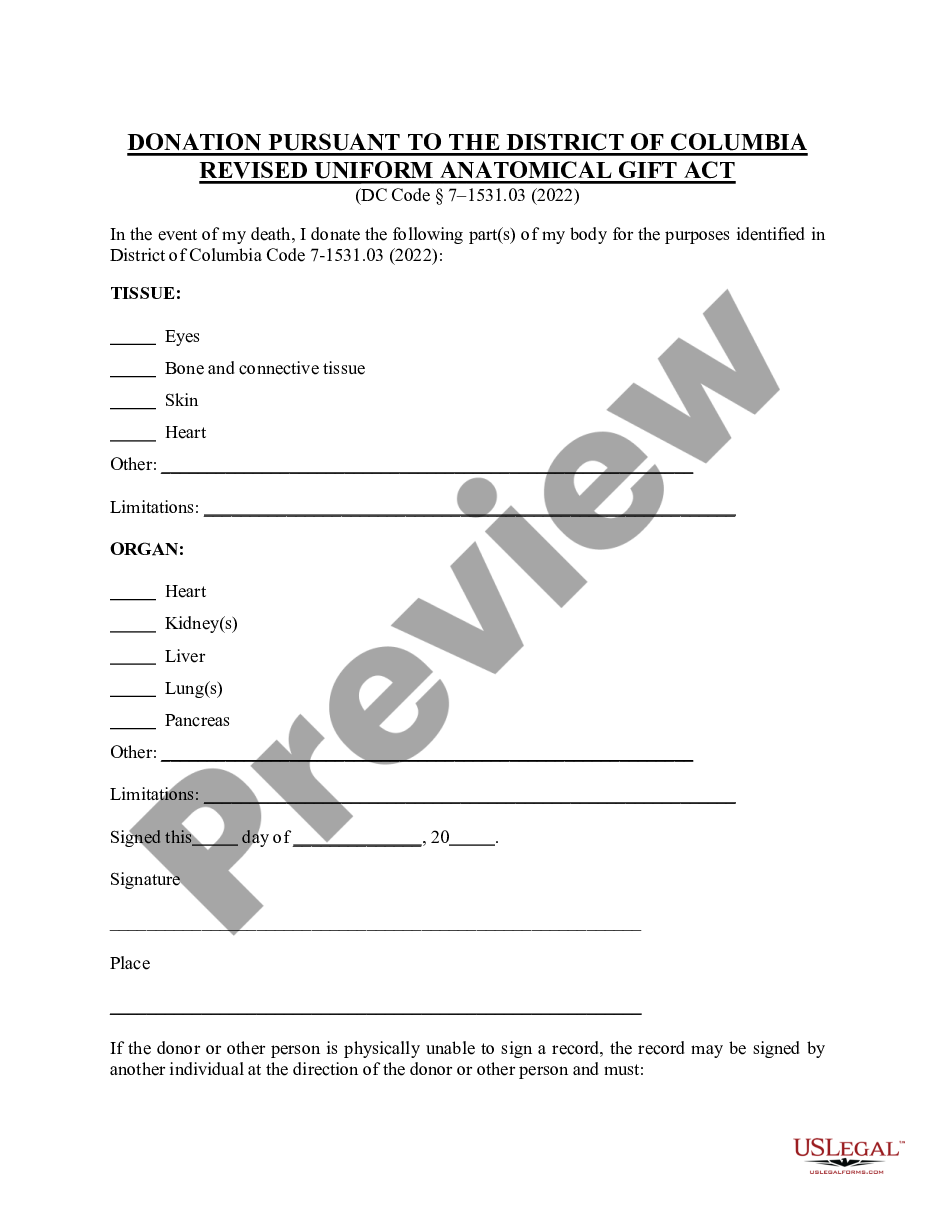
The Revised Uniform Anatomical Gift Act Donation form allows an individual to specify which body parts or organs they wish to donate upon their death. Unlike other legal documents, this form directly addresses anatomical gifts and the intentions of the donor, ensuring that their wishes are respected and followed. This form is essential for anyone wishing to make a charitable contribution through organ or tissue donation at the time of death.
Key components of this form
- Donor's information: Identification of the individual making the donation.
- Donation specifications: Clear indication of which body parts or organs are being donated.
- Signature of the donor: A formal agreement that acts as proof of intent.
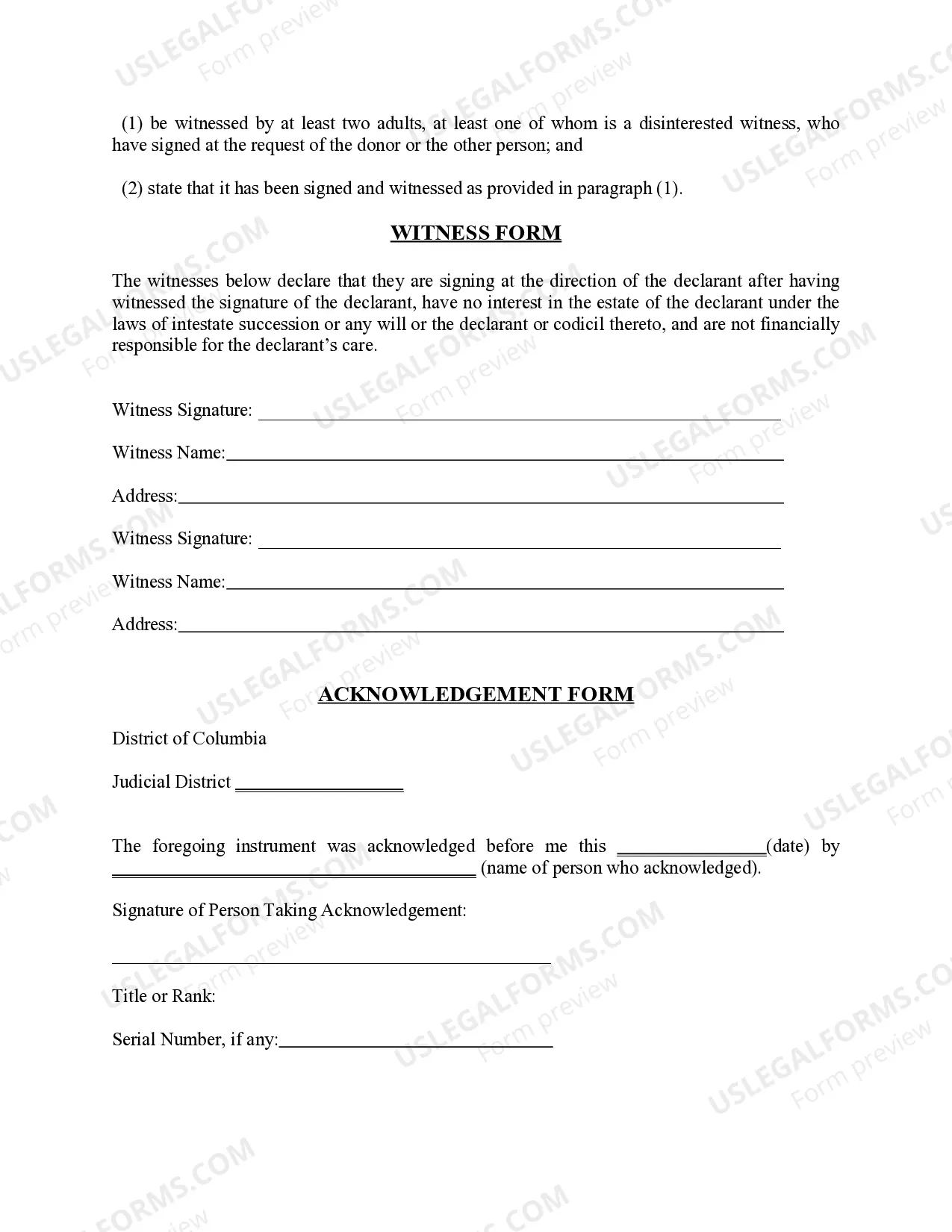
- Witness section: Verification by at least two adults to validate the donation intent.
- Notarization clause: Requirement for a notary public to sign, ensuring legal compliance.
Common use cases
This form should be used when an individual over the age of 18 decides to donate their organs or body parts for medical purposes after their death. It is specifically relevant during discussions about end-of-life decisions, and when completing health care directives or advanced directives. Having this form on file can streamline the donation process, providing clarity to medical personnel and family members during difficult times.
Who this form is for
This form is suitable for:
- Individuals aged 18 and older wishing to donate their organs or body parts.
- People who have discussed or considered organ donation with family or medical professionals.
- Anyone wanting to take proactive steps in ensuring their wishes regarding organ donation are known and legally recognized.
How to complete this form
- Enter your personal information in the designated fields.
- Clearly specify which body parts or organs you wish to donate in the donation section.
- Sign the form in the presence of at least two witnesses, one of whom must be a disinterested witness.
- Have the witnesses sign the form to validate your intentions.
- Take the completed form to a notary public for notarization, if required.
Notarization guidance
In most cases, this form does not require notarization. However, some jurisdictions or signing circumstances might. US Legal Forms offers online notarization powered by Notarize, accessible 24/7 for a quick, remote process.
Get your form ready online
Our built-in tools help you complete, sign, share, and store your documents in one place.
Make edits, fill in missing information, and update formatting in US Legal Forms—just like you would in MS Word.
Download a copy, print it, send it by email, or mail it via USPS—whatever works best for your next step.
Sign and collect signatures with our SignNow integration. Send to multiple recipients, set reminders, and more. Go Premium to unlock E-Sign.
If this form requires notarization, complete it online through a secure video call—no need to meet a notary in person or wait for an appointment.
We protect your documents and personal data by following strict security and privacy standards.

Make edits, fill in missing information, and update formatting in US Legal Forms—just like you would in MS Word.

Download a copy, print it, send it by email, or mail it via USPS—whatever works best for your next step.

Sign and collect signatures with our SignNow integration. Send to multiple recipients, set reminders, and more. Go Premium to unlock E-Sign.

If this form requires notarization, complete it online through a secure video call—no need to meet a notary in person or wait for an appointment.

We protect your documents and personal data by following strict security and privacy standards.
Typical mistakes to avoid
- Failing to complete all sections of the form, especially the donation specifications.
- Not having the form witnessed by the required number of individuals.
- Skipping the notarization step, if necessary, which may invalidate the form.
- Not discussing your wishes with family members before filling out the form.
Why complete this form online
- Convenient accessibility from any location at any time.
- Easy to fill out and edit, allowing for clarity in your donation intentions.
- Documents drafted by licensed attorneys ensure compliance with legal standards.
What to keep in mind
- The Revised Uniform Anatomical Gift Act Donation form enables you to formally designate organ or tissue donations.
- It is vital for individuals over 18 who wish to have their organ donation wishes respected after death.
- Proper completion, witness signatures, and notarization are critical to ensure its legality.
Looking for another form?



Form popularity
FAQ
The District of Columbia Revised Uniform Anatomical Gift Act Donation form lets a DC resident age 18 or older specify which organs or body parts they wish to donate after death. It records the donor’s intent under the RUAGA and helps ensure those wishes are respected. The form collects donor information, donation specifications, the donor’s signature, plus two adult witnesses and a notary if required to validate the donation.
The most important clause generally confirms the donor’s expressed consent to donate organs or tissue at death and authorizes medical use of those gifts. For this DC form, the donation specifications section records exactly which parts are donated, while the signature, witness, and notarization requirements help enforce that consent under DC rules.
Complete by filling the donor information and clearly specifying the donation parts in the donation specifications. Then sign the form and ensure at least two adults witness the signature. In DC, you may need to have the document notarized to further verify and record your consent.
The form requires at least two adult witnesses to verify the donor’s signature and intent. Their attestation confirms the donation decision was voluntary and informed, reducing disputes during end-of-life decisions. This, together with the donor’s signature and any notarization, strengthens the form’s legal validity in DC.
Yes. The form includes a notarization clause requiring a notary public to sign, helping verify legal compliance and making the donor’s intent officially recorded in DC. Notarization adds an additional layer of authentication to support the donor’s wishes if the document is later challenged.
It is DC-specific and tailored to implement the RUAGA within the District, with clearly defined donor information, donation specifications, a required signature, two adult witnesses, and a notarization clause. This combination ensures the donor’s death-time donation wishes are recognized under DC procedures.