California Quitclaim Deed from Individual to Corporation
What is this form?
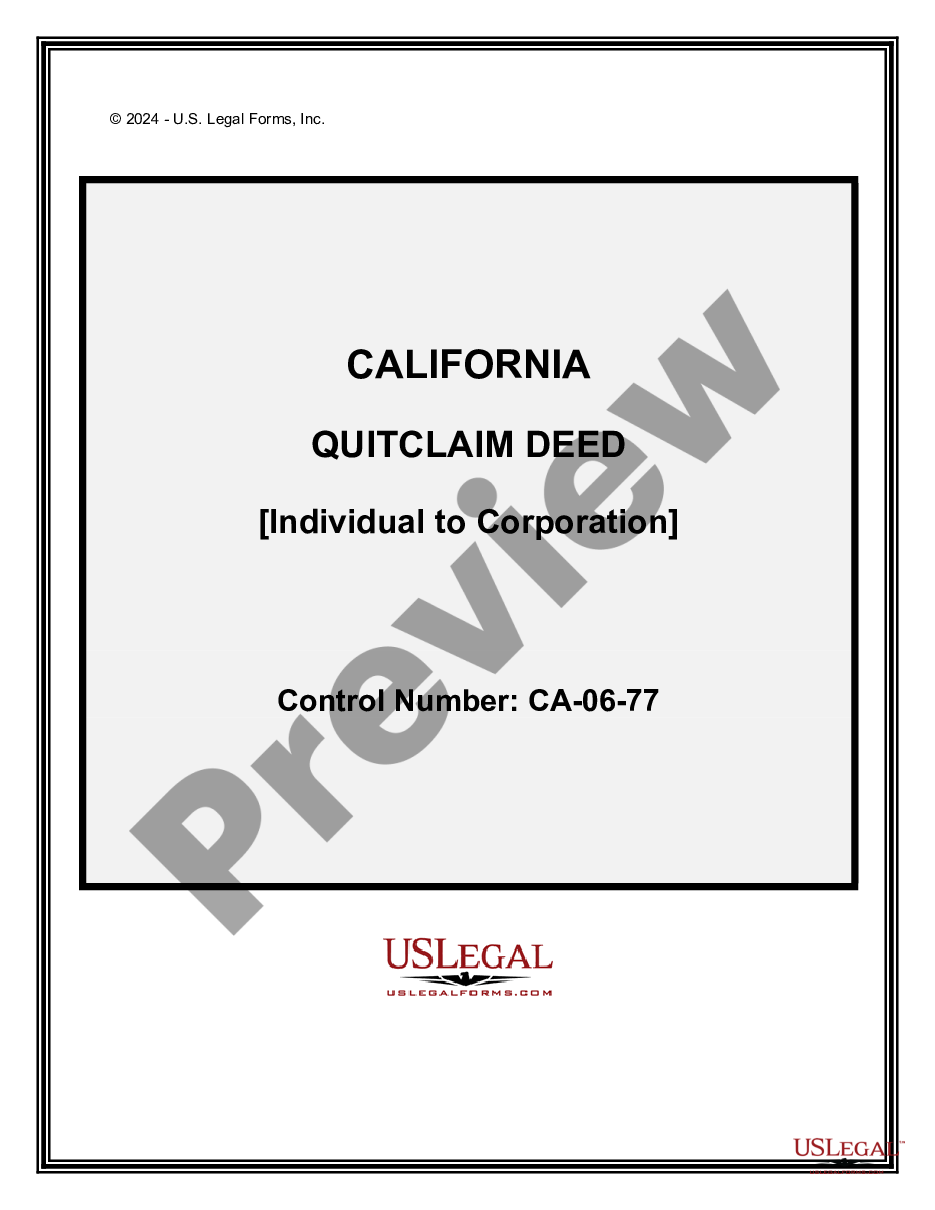
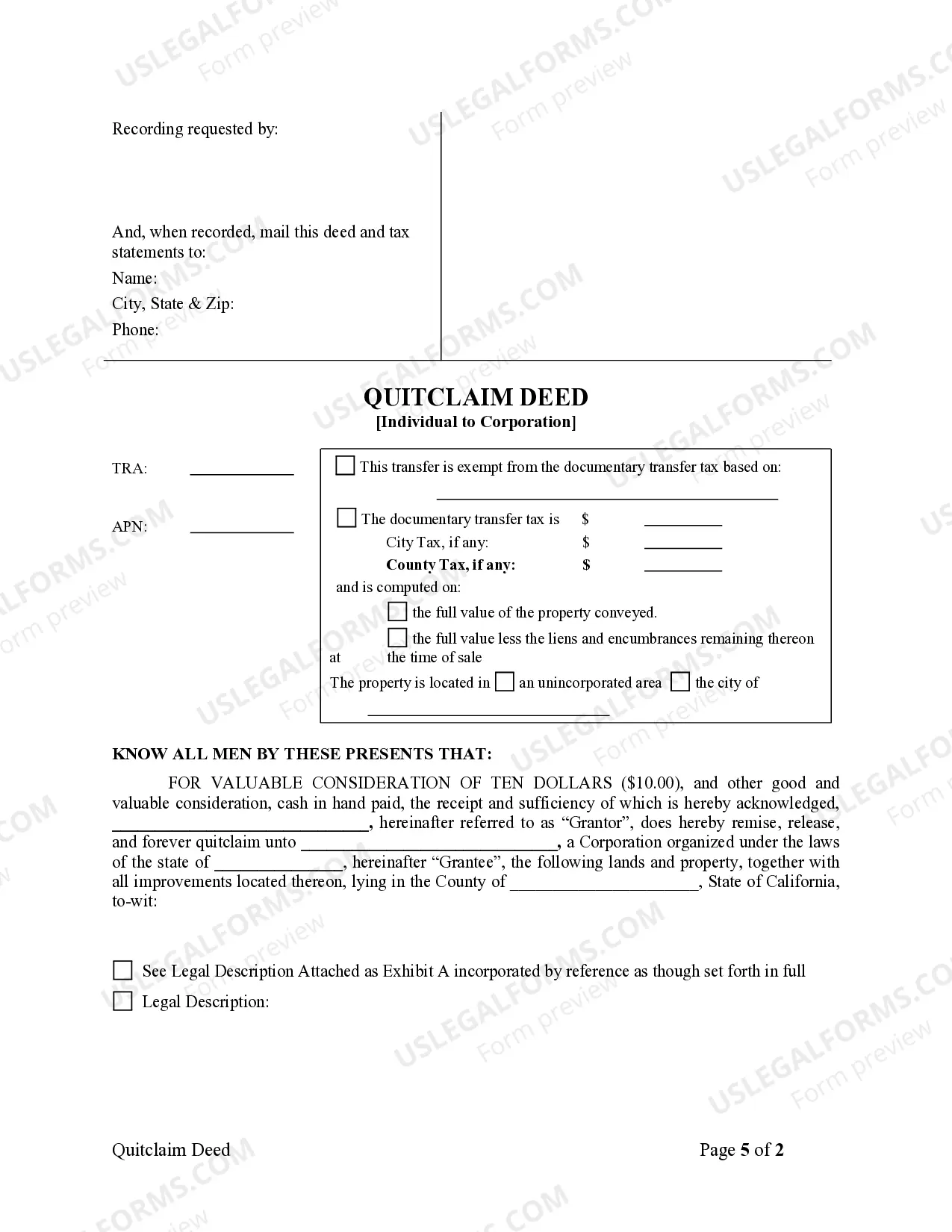
The Quitclaim Deed from Individual to Corporation is a legal document that allows an individual, known as the grantor, to transfer ownership of property to a corporation, the grantee. This form primarily conveys the property without guaranteeing that the grantor holds clear title. It is different from other types of deeds, like warranty deeds, because it does not provide any warranties or guarantees regarding the title's validity. This form is typically used in situations where the grantor is transferring property without expecting a sale or in transactions between related parties.
Form components explained
- Identification of the grantor (individual) and grantee (corporation).
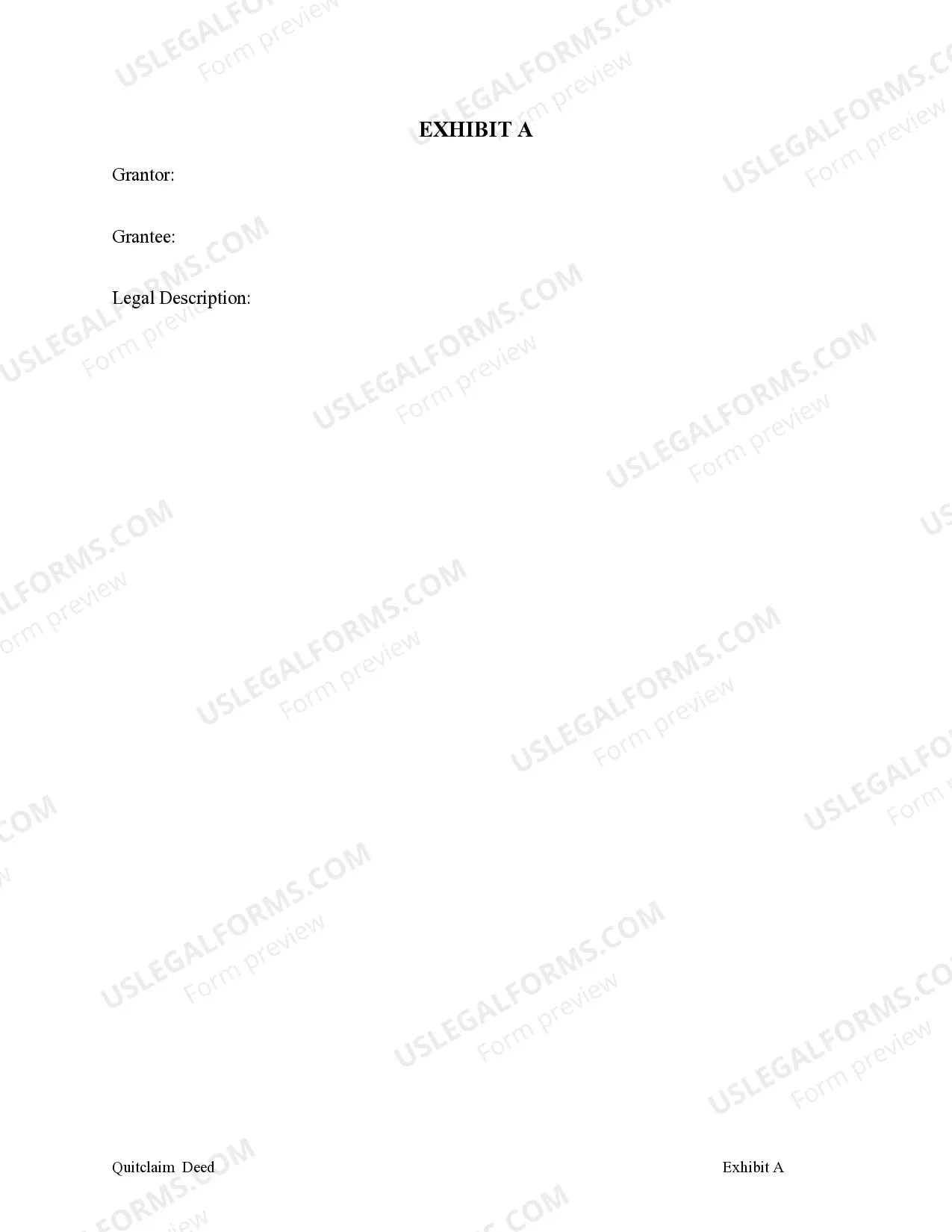
- Description of the property being transferred.
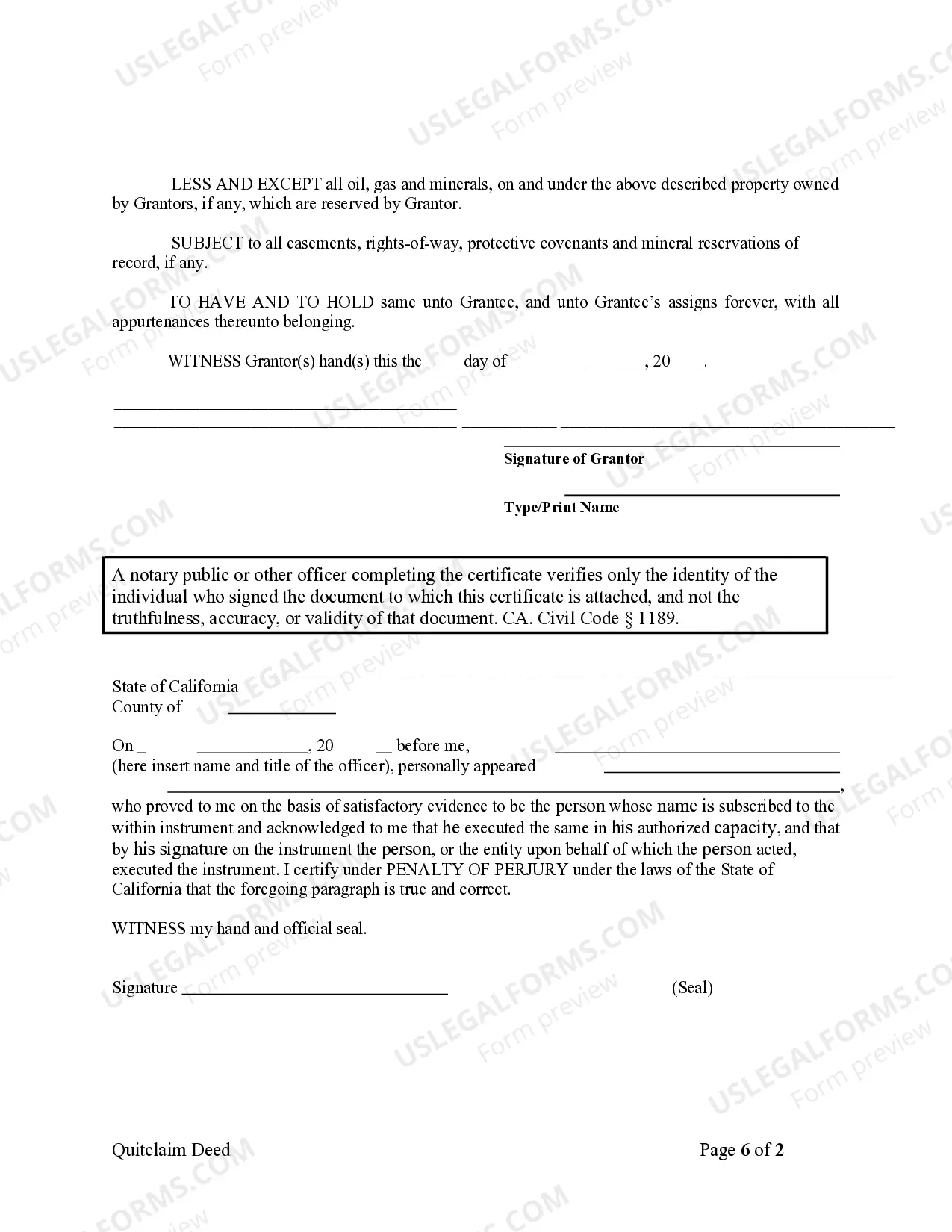
- Statement regarding the reservation of minerals, oil, and gas, if applicable.
- Space for the grantor's signature and the date of transfer.
- Notarial acknowledgment section, if required.


When this form is needed
This quitclaim deed should be used when an individual wishes to transfer property to a corporation without making any warranties about the title's quality. Common scenarios include family members transferring property to a family business, or when an individual is organizing business assets into a corporate entity. It is also used in situations where speed and simplicity are paramount, such as informal property transactions.
Who can use this document
- Individuals transferring real property to a corporation.
- Business owners needing to clarify ownership of business-related real estate.
- Real estate professionals facilitating property transfers in business contexts.
- Family members managing inherited property within a corporate structure.
Steps to complete this form
- Identify and input the names of the grantor and grantee in the designated fields.
- Provide a complete legal description of the property being transferred.
- Specify any reservations concerning oil, gas, and mineral rights in the provided section.
- Enter the date of the transfer and have the grantor sign the document.
- If required, complete the notarial acknowledgment section by having a notary witness the signature.
Does this form need to be notarized?
To make this form legally binding, it must be notarized. Our online notarization service, powered by Notarize, lets you verify and sign documents remotely through an encrypted video session.
Get your form ready online
Our built-in tools help you complete, sign, share, and store your documents in one place.
Make edits, fill in missing information, and update formatting in US Legal Forms—just like you would in MS Word.
Download a copy, print it, send it by email, or mail it via USPS—whatever works best for your next step.
Sign and collect signatures with our SignNow integration. Send to multiple recipients, set reminders, and more. Go Premium to unlock E-Sign.
If this form requires notarization, complete it online through a secure video call—no need to meet a notary in person or wait for an appointment.
We protect your documents and personal data by following strict security and privacy standards.

Make edits, fill in missing information, and update formatting in US Legal Forms—just like you would in MS Word.

Download a copy, print it, send it by email, or mail it via USPS—whatever works best for your next step.

Sign and collect signatures with our SignNow integration. Send to multiple recipients, set reminders, and more. Go Premium to unlock E-Sign.

If this form requires notarization, complete it online through a secure video call—no need to meet a notary in person or wait for an appointment.

We protect your documents and personal data by following strict security and privacy standards.
Avoid these common issues
- Failing to provide a complete legal description of the property.
- Not having the deed notarized when required by law.
- Leaving out the reservation of mineral rights if applicable.
- Using incorrect names or details for the grantor and grantee.
Benefits of using this form online
- Convenient access to the form that can be filled out and downloaded from anywhere.
- Editable fields allow for easy input of information.
- Available 24/7, ensuring you can complete the form on your schedule.
- Reviewed by licensed attorneys for accuracy and compliance with the law.
Looking for another form?





Form popularity
FAQ
To quitclaim a LLC deed, you complete a California Quitclaim Deed from Individual to Corporation that identifies the LLC as the grantee. Ensure that the deed contains accurate descriptions of the property and includes necessary signatures from LLC members. Once completed, the deed must be filed with the county recorder's office. Tools like USLegalForms can provide templates and ensure compliance with legal standards.
To remove a co-owner from a property deed in California, you typically execute a California Quitclaim Deed from Individual to Corporation. By doing this, the co-owner relinquishes their rights to the property. The deed must be signed, notarized, and then recorded with the county recorder’s office to ensure legal acknowledgment. If you're uncertain about the process, consider using USLegalForms to simplify the steps.
To transfer a deed in California, you need to execute a California Quitclaim Deed from Individual to Corporation. This involves filling out the deed form accurately and signing it in the presence of a notary public. After signing, you must record the deed with the county recorder's office where the property is located. It's advisable to check local requirements or use a reliable service like USLegalForms for guidance.
Yes, a title company can manage the preparation and recording of a quitclaim deed in California. They often provide expert services that ensure the deed meets all legal requirements. By choosing to work with a title company, you can benefit from their experience, which can streamline the process of transferring property ownership, particularly in a California Quitclaim Deed from Individual to Corporation.
In California, anyone can prepare a Quitclaim Deed, including individuals or professionals such as attorneys and notaries. However, utilizing a reliable platform like US Legal Forms can simplify the process with ready-made documents, ensuring they comply with California state laws. By using a reputable source, you can minimize the risk of errors and ensure the deed effectively transfers ownership. This can be particularly useful in a California Quitclaim Deed from Individual to Corporation.
In a California Quitclaim Deed from Individual to Corporation, the deed must be signed by an authorized representative of the corporation. This individual could be a corporate officer or someone designated by the corporation's bylaws. It's important for the signature to be executed properly to avoid challenges in the transfer of ownership. Ensuring the right person signs helps maintain the integrity of the deed.
To transfer a deed from an individual to an LLC using a California Quitclaim Deed from Individual to Corporation, you must first prepare the deed document accurately. The individual must sign the quitclaim deed and ensure that it is notarized to validate the transfer. After signing, file the deed with the county recorder in the county where the property is located, which completes the transfer process and updates the property records.
A quitclaim deed might not be the best choice in situations where a property has complex title issues or disputes. For instance, if there are existing liens or claims against the property, a California Quitclaim Deed from Individual to Corporation does not provide the warranties typical of a grant deed. Instead, you may want to consider using a warranty deed to ensure that you receive clear title and protection against future claims.
When a corporation transfers ownership of a property using a California Quitclaim Deed from Individual to Corporation, the deed must be signed by an authorized officer of the corporation. This individual typically holds a position such as president or secretary, ensuring that the transfer is legally valid and binding. Additionally, the corporation's official seal may need to be affixed to the deed to confirm its authenticity and to meet state requirements.