California Quitclaim Deed from Corporation to Husband and Wife
What this document covers
The Quitclaim Deed from Corporation to Husband and Wife is a legal document that allows a corporation (the grantor) to transfer property ownership to a married couple (the grantees). This type of deed does not guarantee that the title is free of claims; it simply conveys whatever interest the corporation has in the property. Unlike other deeds, a quitclaim deed does not provide warranties about the status of the title, making it crucial when the transfer is between parties who are familiar with each other's interests.
Key parts of this document
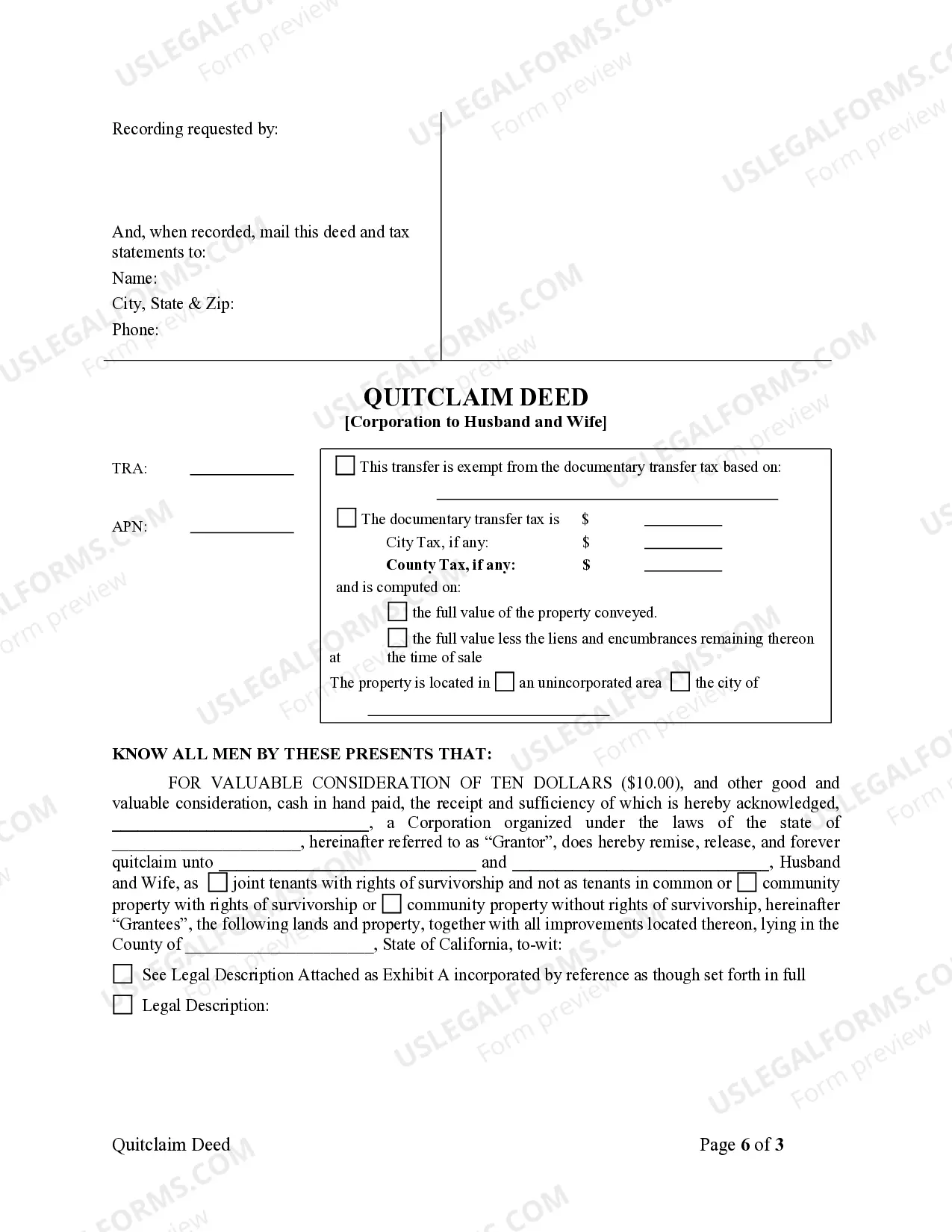
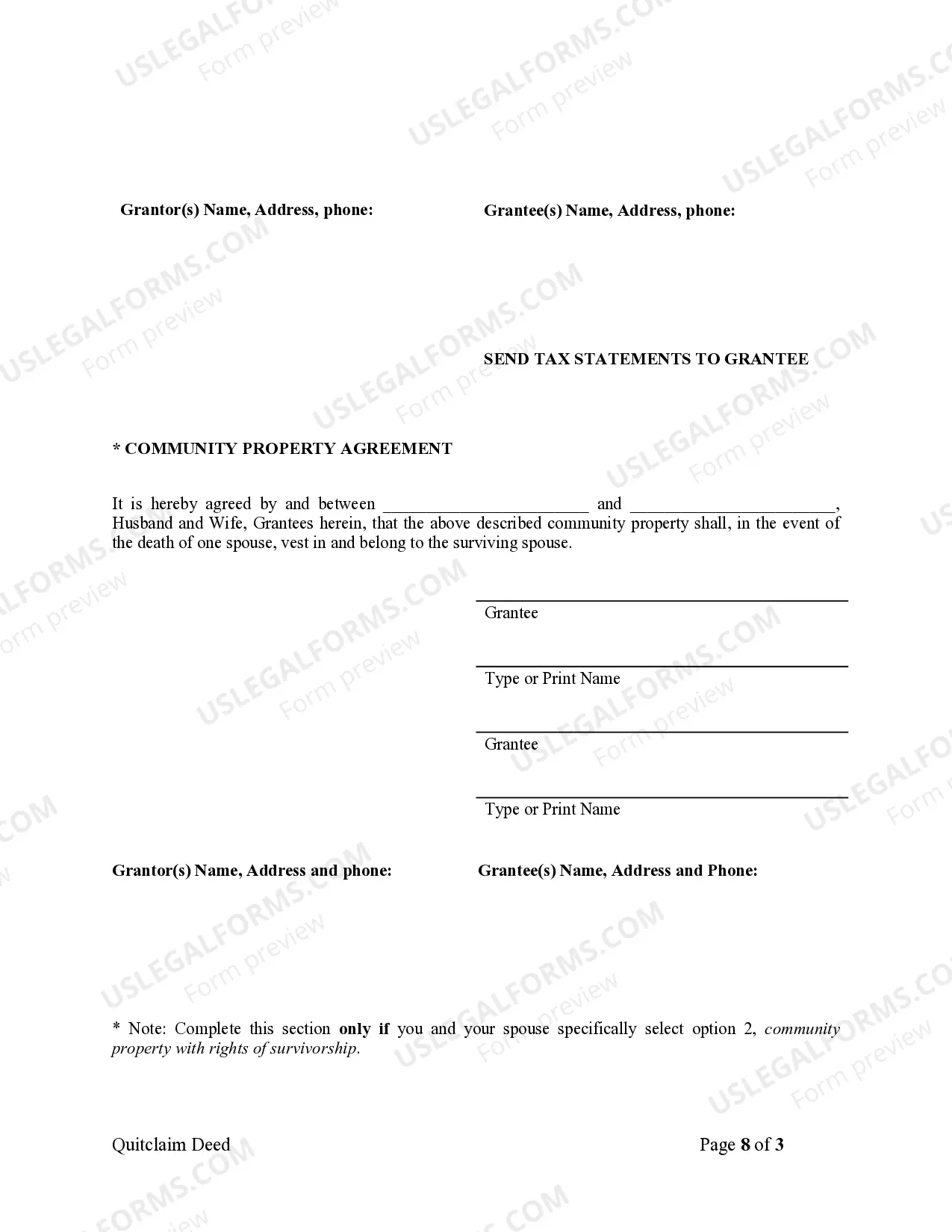
- Grantor and grantee information: Details of the corporation transferring the property and the names of the husband and wife receiving it.
- Property description: A legal description of the property being transferred.
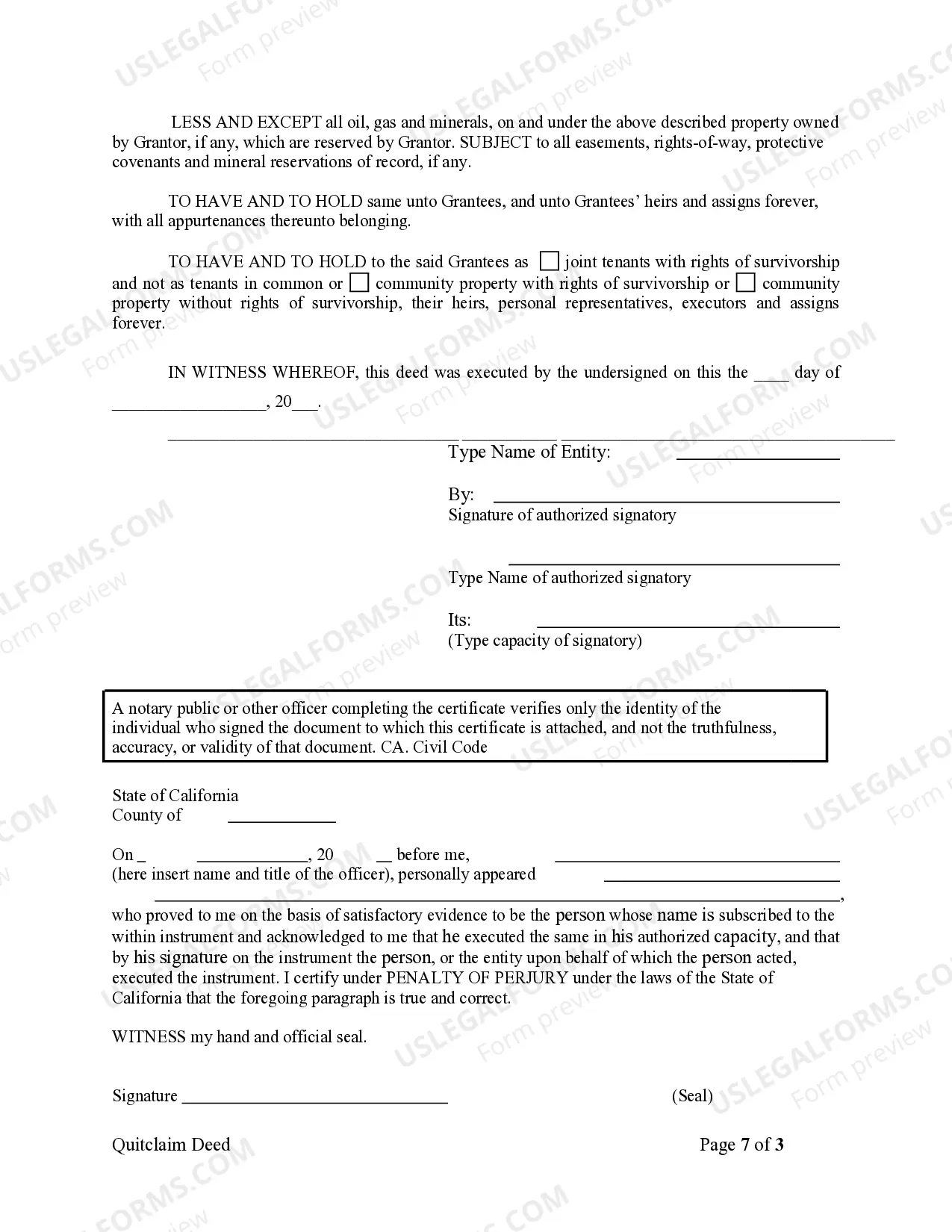
- Reservation clause: Any reservations of rights, such as oil, gas, and mineral rights, retained by the grantor.
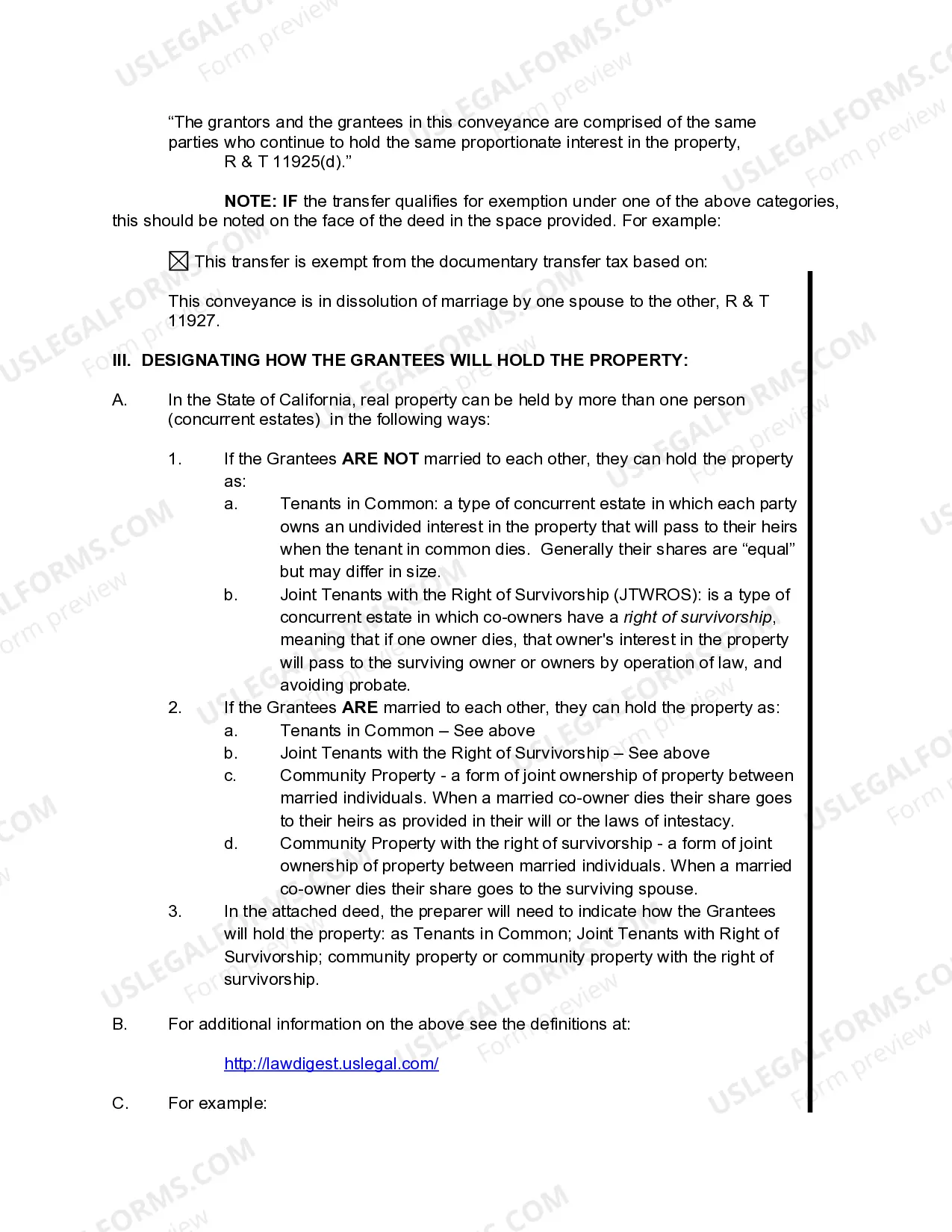
- Title holding designation: Specifies how the grantees will hold the property, such as community property or joint tenants with rights of survivorship.
- Signature and seal: Required signature of the grantor, along with any necessary notarization.





When to use this document
This form is typically used when a corporation is transferring real estate to a married couple, often during transactions where no cash or consideration is involved. It is especially relevant in situations such as estate planning, asset division during divorce, or when consolidating property ownership between spouses. It is also beneficial when a corporation wishes to dissolve its interest in a property to the married couple who may have been managing it.
Who can use this document
- Corporations looking to transfer property to a married couple.
- Husbands and wives who are receiving property from a corporation.
- Individuals involved in real estate transactions where a quitclaim deed is appropriate.
Completing this form step by step
- Identify the parties involved: Enter the names and addresses of the grantor (corporation) and grantees (husband and wife).
- Describe the property: Provide a legal description of the property being conveyed.
- Specify any reservations: Indicate any rights, such as oil, gas, and mineral rights, being retained by the grantor.
- Designate how to hold the title: Choose how the grantees will hold the property, such as community property or joint tenancy.
- Obtain signatures: Execute the document with the necessary signatures and any designated seals.
Does this document require notarization?
Yes, this form must be notarized to be legally valid. Notarization helps verify the identities of the parties involved and ensures that the document is executed in compliance with state laws. US Legal Forms offers integrated online notarization services, providing secure video calls and legal equivalence, so you won't need to travel.
Get your form ready online
Our built-in tools help you complete, sign, share, and store your documents in one place.
Make edits, fill in missing information, and update formatting in US Legal Forms—just like you would in MS Word.
Download a copy, print it, send it by email, or mail it via USPS—whatever works best for your next step.
Sign and collect signatures with our SignNow integration. Send to multiple recipients, set reminders, and more. Go Premium to unlock E-Sign.
If this form requires notarization, complete it online through a secure video call—no need to meet a notary in person or wait for an appointment.
We protect your documents and personal data by following strict security and privacy standards.

Make edits, fill in missing information, and update formatting in US Legal Forms—just like you would in MS Word.

Download a copy, print it, send it by email, or mail it via USPS—whatever works best for your next step.

Sign and collect signatures with our SignNow integration. Send to multiple recipients, set reminders, and more. Go Premium to unlock E-Sign.

If this form requires notarization, complete it online through a secure video call—no need to meet a notary in person or wait for an appointment.

We protect your documents and personal data by following strict security and privacy standards.
Common mistakes to avoid
- Failing to provide a complete legal description of the property.
- Not specifying how the title will be held by the grantees.
- Omitting required signatures or notarization, where necessary.
- Forgetting to indicate any reservations of rights retained by the grantor.
Benefits of using this form online
- Convenience: Downloadable forms save time and provide instant access to legal documents.
- Editability: These forms can be completed digitally, making it easier to fill in the necessary information accurately.
- Reliability: Legal forms are drafted by licensed attorneys, ensuring they comply with applicable laws.
Looking for another form?






Form popularity
FAQ
Filling out the interspousal transfer deed requires providing essential details about the property and both spouses. Be clear and precise in listing the names, the property’s legal description, and the type of transfer, like a California Quitclaim Deed from Corporation to Husband and Wife. Consider using platforms like uslegalforms to access templates that simplify this process.
To fill out an interspousal transfer deed, start by clearly stating the names of both spouses and the property description. Ensure you include the type of transfer you are making, like a California Quitclaim Deed from Corporation to Husband and Wife. Following your state’s specific guidelines can help minimize obstacles and ensure a smooth transition of ownership.
Filling out a deed involves providing specific information, such as the names of the parties involved and a description of the property. You should also include details about the transfer and the type of deed, like a California Quitclaim Deed from Corporation to Husband and Wife. It's important to review local laws to ensure your deed meets all requirements and is legally effective.
Yes, a title company can assist with preparing and recording a quit claim deed. Many title companies offer services that simplify the process of transferring property ownership, such as a California Quitclaim Deed from Corporation to Husband and Wife. They can help ensure that all legal requirements are met, making the process less stressful for you.
An interspousal transfer deed allows one spouse to transfer ownership of property to the other spouse. This deed is often used in marriage situations or for estate planning. If you are considering a California Quitclaim Deed from Corporation to Husband and Wife, this deed helps streamline property management between spouses. It clarifies ownership and can help avoid disputes over property rights.
A quitclaim deed in California can be prepared by the property owner, a legal professional, or obtained through document preparation services, such as uslegalforms. These platforms ensure that the deed meets all legal requirements and is tailored to your specific situation. While it's possible to prepare the deed independently, having a professional can minimize errors and ensure compliance with local laws.
Yes, in California, it is generally advisable for both spouses to be on the house title to protect both parties' rights. This arrangement embeds each spouse’s ownership rights and contributes to the equitable distribution of assets in the event of divorce or legal separation. Additionally, having both names on the title can facilitate smoother decisions about the property later. It's a good practice to review your options with a legal expert.
An interspousal transfer deed allows one spouse to transfer their interest in a property to the other spouse without reassessment for property tax purposes in California. This type of deed helps both spouses maintain equal ownership while avoiding increased taxes. It is often used in divorce settlements or to simplify property ownership in marriage. Consulting an expert can guide you through this process smoothly.
Submitting a quitclaim deed in California involves completing the deed accurately and then filing it at your local county recorder's office. Make sure to include all relevant information, like property details and the names of the parties involved. After filing, you should receive a stamped copy of the deed, which serves as legal proof of the transfer. Using platforms like uslegalforms can simplify this process for you.
To add your spouse to your deed in California, you will need to draft a California Quitclaim Deed from Corporation to Husband and Wife. This document transfers ownership rights and can be filled out online or with the help of a professional. After completing the deed, you must file it with your county's recorder office to finalize the process and ensure both names are correctly recorded on the property.