Wisconsin Transfer on Death or TOD to Beneficiary - Official Form Used to Record Beneficiary's Interest Following Death of Grantor
About this form
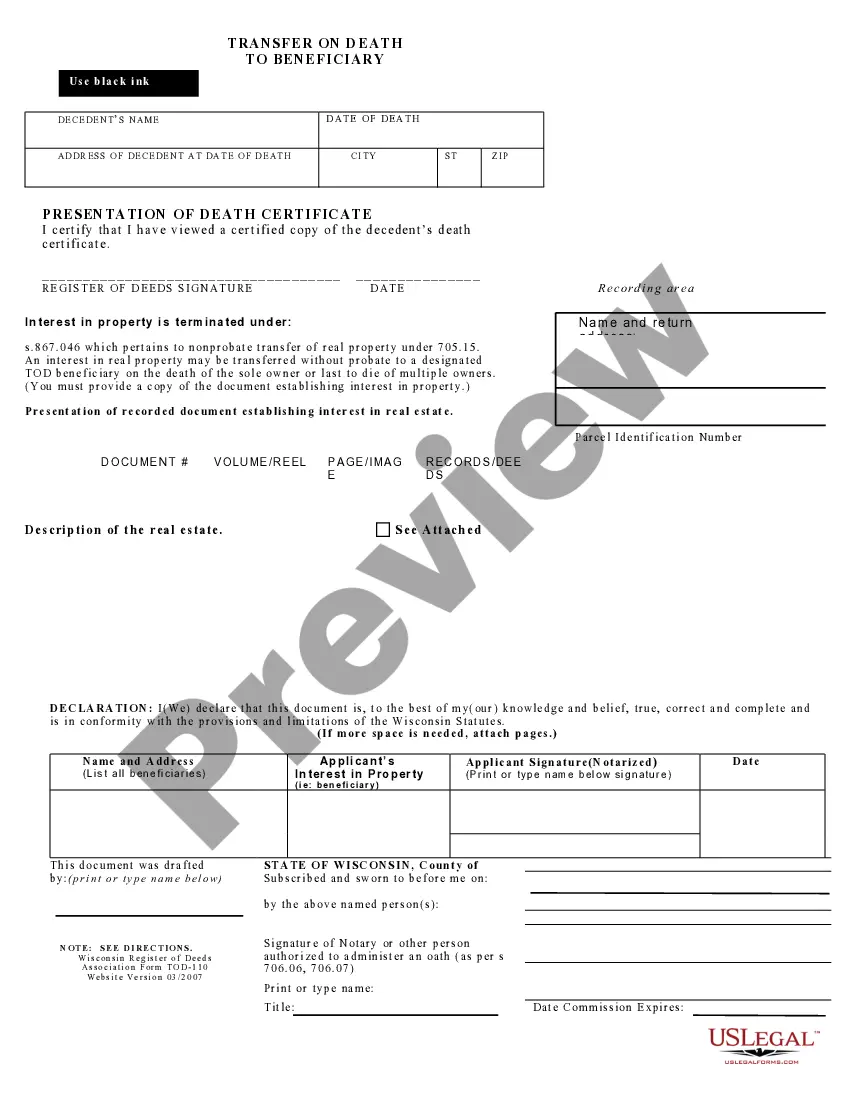
The Transfer on Death (TOD) to Beneficiary is an official form used in Wisconsin to document a beneficiary's interest in property following the death of the grantor. Unlike the typical transfer on death deed, this form is specifically meant for recording the beneficiary's claim to the property with the Register of Deeds. It is essential for ensuring that the designated beneficiary can assert their rights to the property without going through probate.
Key components of this form
- Name and address of all beneficiaries.
- Interest in property designated for each beneficiary.
- Applicant's signature, which must be notarized.

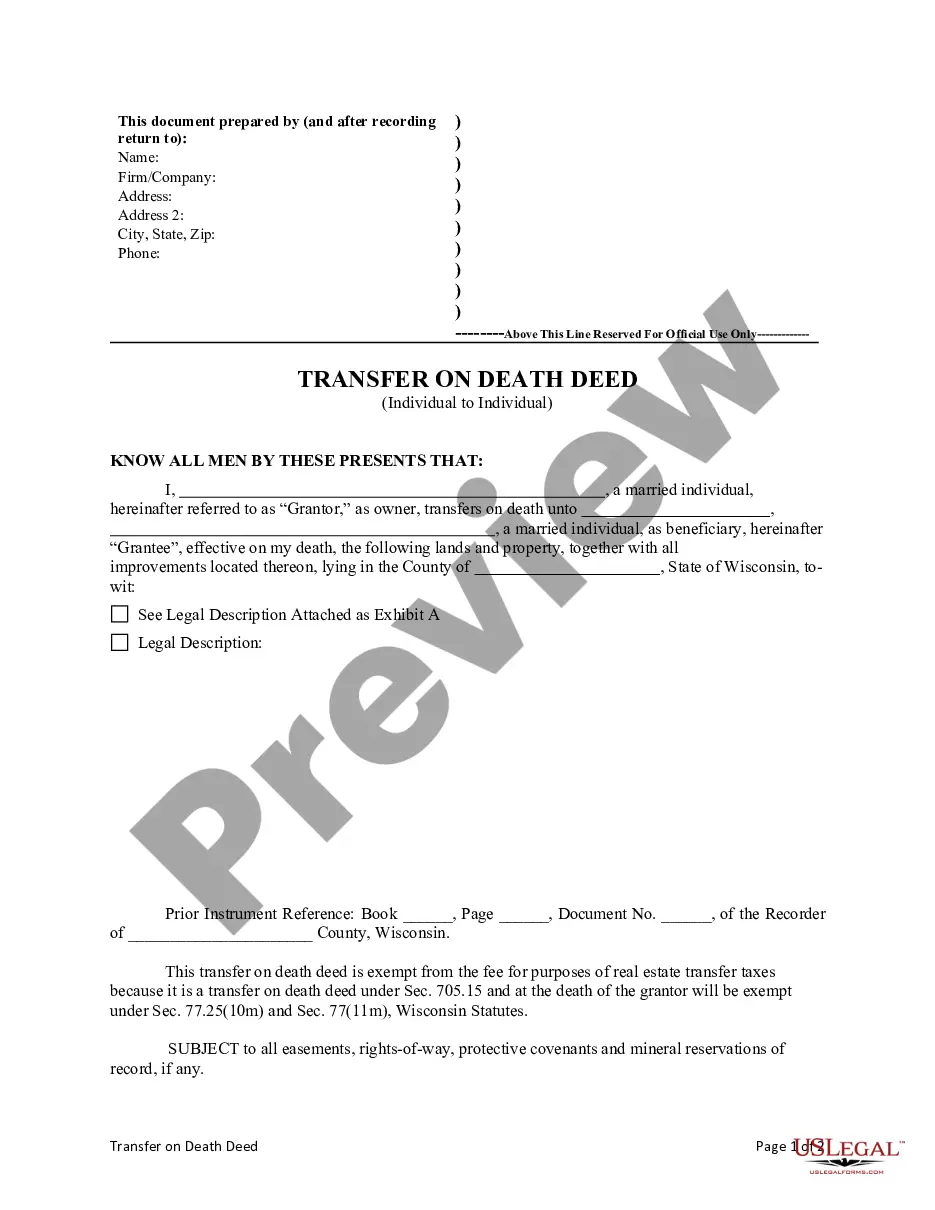
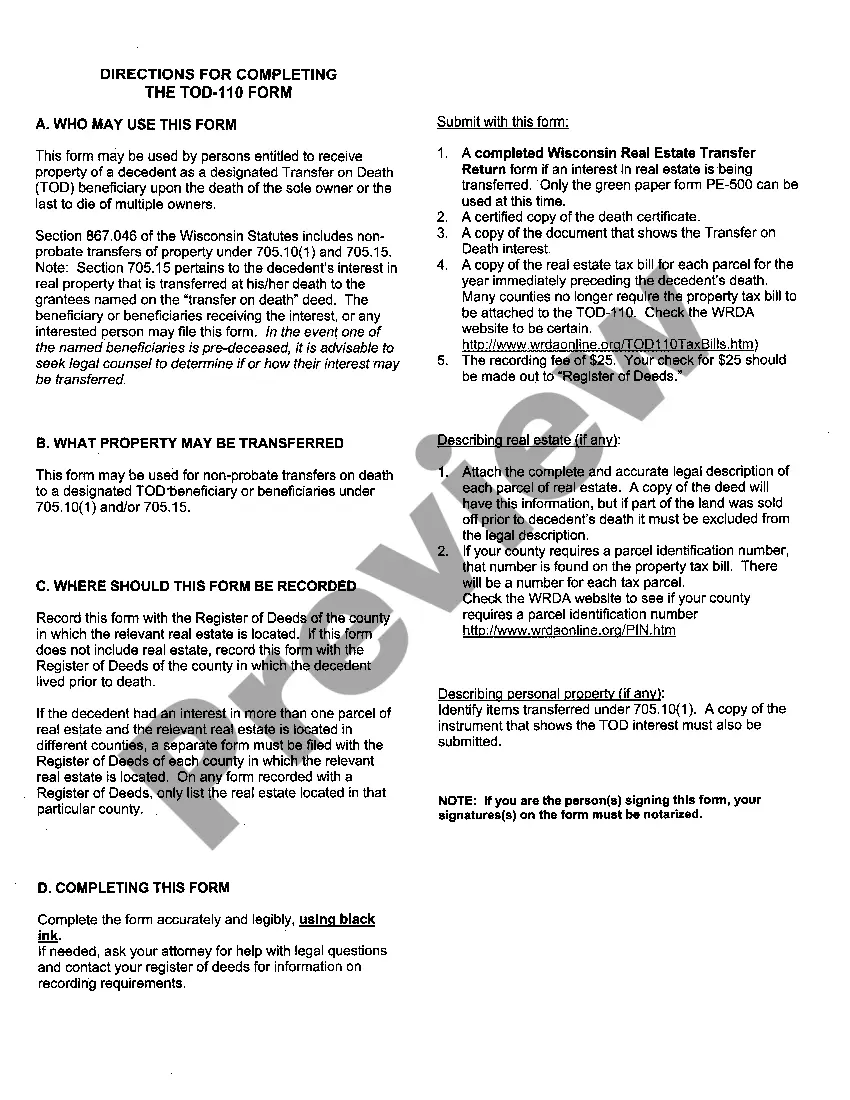
Situations where this form applies
You should use this form when you want to formally establish a beneficiary's claim to real estate that will transfer automatically upon your death. This is useful if you are the sole owner or the last surviving owner of a property and wish to avoid probate for your real estate assets.
Who needs this form
- Individuals who own real estate in Wisconsin.
- Property owners who wish to designate one or more beneficiaries to receive their property upon their death.
- Individuals looking to facilitate a smooth transfer of property without the probate process.
How to prepare this document
- Identify the beneficiaries by providing their names and addresses.
- Clearly state the interest each beneficiary has in the property.
- Sign the form as the applicant, ensuring your signature is notarized.
Is notarization required?
This form needs to be notarized to ensure legal validity. US Legal Forms provides secure online notarization powered by Notarize, allowing you to complete the process through a verified video call, available anytime.
Get your form ready online
Our built-in tools help you complete, sign, share, and store your documents in one place.
Make edits, fill in missing information, and update formatting in US Legal Forms—just like you would in MS Word.
Download a copy, print it, send it by email, or mail it via USPS—whatever works best for your next step.
Sign and collect signatures with our SignNow integration. Send to multiple recipients, set reminders, and more. Go Premium to unlock E-Sign.
If this form requires notarization, complete it online through a secure video call—no need to meet a notary in person or wait for an appointment.
We protect your documents and personal data by following strict security and privacy standards.

Make edits, fill in missing information, and update formatting in US Legal Forms—just like you would in MS Word.

Download a copy, print it, send it by email, or mail it via USPS—whatever works best for your next step.

Sign and collect signatures with our SignNow integration. Send to multiple recipients, set reminders, and more. Go Premium to unlock E-Sign.

If this form requires notarization, complete it online through a secure video call—no need to meet a notary in person or wait for an appointment.

We protect your documents and personal data by following strict security and privacy standards.
Common mistakes
- Failing to include the names and addresses of all beneficiaries.
- Not specifying the interest in property correctly.
- Neglecting to have the form notarized before submission.
Why use this form online
- Convenient access from anywhere with internet connectivity.
- Editable format allows you to customize details as needed.
- Reliability in ensuring that all legal requirements are met for recording.
Quick recap
- The Transfer on Death form is essential for estate planning in Wisconsin.
- It allows for property transfer directly to beneficiaries without probate.
- Notarization is required for the form to be valid.
Looking for another form?
Form popularity
FAQ
If the property is to be transferred to a beneficiary the Executor or Administrator will need to submit a document called an 'Assent' to the Land Registry, with a copy of the Grant of Representation. The Land Registry will then transfer the property into the name of the new owner.
In most cases, the surviving owner or heir obtains the title to the home, the former owner's death certificate, a notarized affidavit of death, and a preliminary change of ownership report form. When all these are gathered, the transfer gets recorded, the fees are paid, and the county issues a new title deed.
Wisconsin's Transfer on Death Deed. Wisconsin's Transfer on Death Deed (TOD Deed) allows for the non-probate transfer of real property upon death. This seemingly simple law, Wisconsin Statute 705.15, can be used as a powerful estate planning tool, in the right circumstances.
If you'd like to avoid having your property going through the probate process, it's a good idea to look into a transfer on death deed. A transfer on death deed allows you to select a beneficiary who will receive your property, but only when you've passed away.
A TOD designation supersedes a will. For bank accounts, you can set up a similar account known as payable-on-death, sometimes referred to as a Totten trust. Your beneficiaries can't touch the account while you're alive, and you're free to change beneficiaries or close the accounts at any time.
If the deceased was sole owner, or co-owned the property without right of survivorship, title passes according to his will. Whoever the will names as the beneficiary to the house inherits it, which requires filing a new deed confirming her title. If the deceased died intestate -- without a will -- state law takes over.
When a joint owner dies, the process is relatively simple you just need to inform the Land Registry of the death. You should complete a 'Deceased joint proprietor' form on the government's website and then send the form to the Land Registry, with an official copy of the death certificate.
The California TOD deed form allows property to be automatically transferred to a new owner when the current owner dies, without the need to go through probate. It also gives the current owner retained control over the property, including the right to change his or her mind about the transfer.
Once you obtain a transfer-on-death deed, complete the form to name a beneficiary. The transfer deed will ask you to name the person(s) you wish to inherit your property. You can name multiple people as the beneficiary, as well as an organization. List the beneficiary's complete name and avoid titles.