Utah Notice of Intent to Reconvey
What this document covers
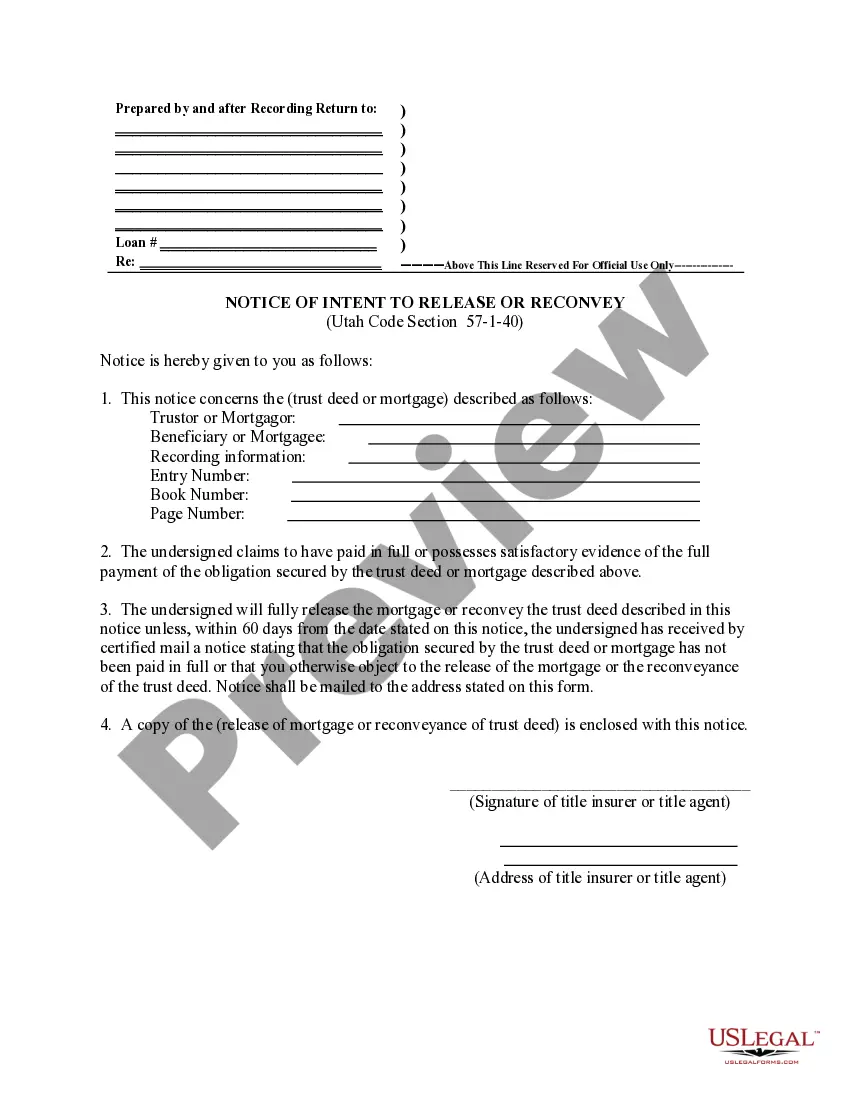
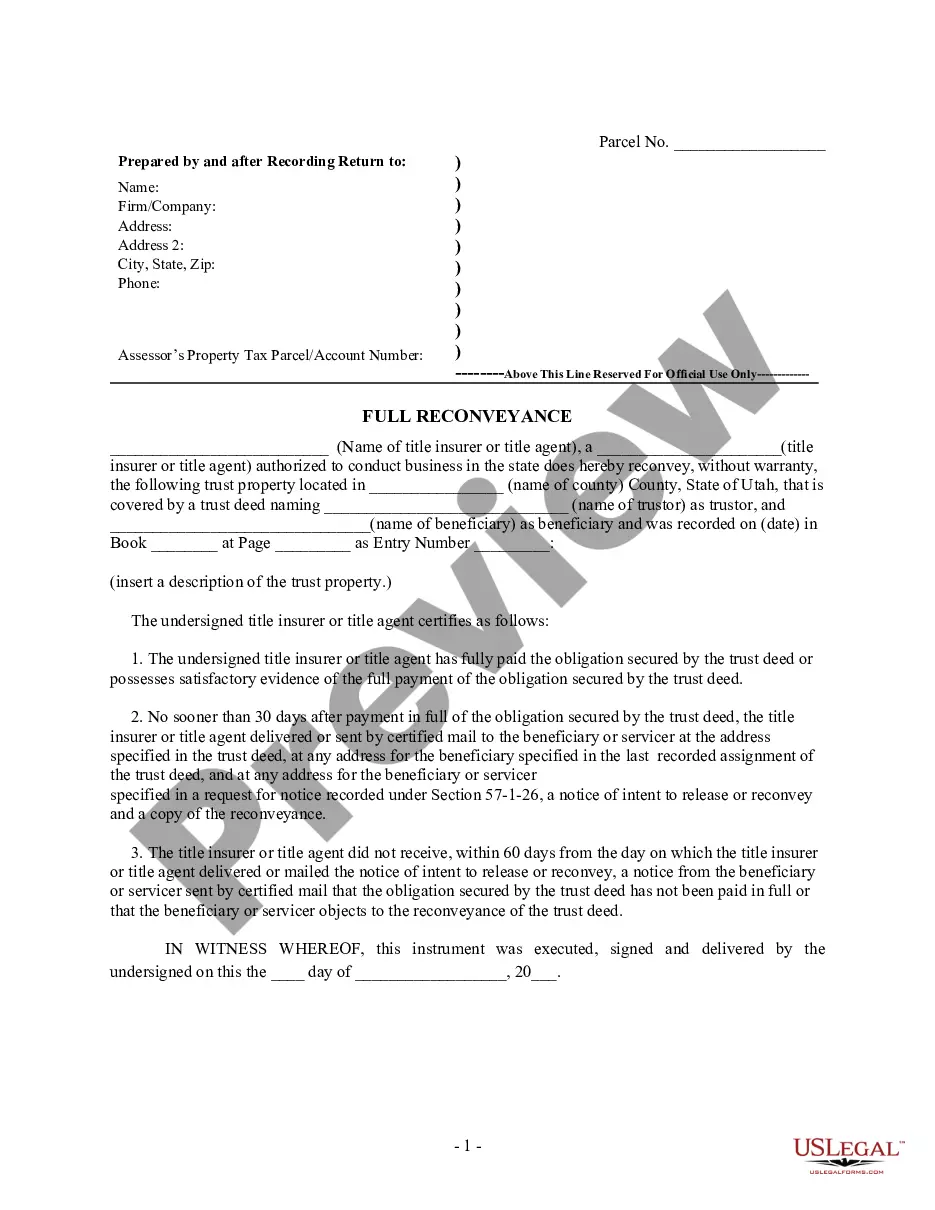
The Notice of Intent to Reconvey is a legal document used in Utah property transactions related to mortgages and deeds of trust. This form serves as a notification that the lender or title insurer intends to release the mortgage or reconvey the trust deed unless the borrower objects within a specified timeframe. This form is crucial for managing the closure of a loan or mortgage obligation and distinguishes itself from other real estate forms by focusing specifically on the intent to release a lien on property.
Key parts of this document
- Signature of the title insurer or title agent confirming the release of the mortgage or reconveyance.
- Specific details regarding the property and the mortgage or trust deed subject to reconveyance.
- Deadline for the borrower to object to the reconveyance, typically 60 days from the date of notice.
- Instructions for submitting any objections by certified mail.
- Enclosure of the release of mortgage or reconveyance of trust deed with the notice.
When to use this document
This form should be used when a property owner has paid off their mortgage or wishes to initiate the process of releasing a deed of trust. It is essential in situations where the lender needs to inform the property owner about the impending release and allow for any final objections before the lien is officially removed. Situations might include refinancing, selling the property, or clearing past obligations.
Who needs this form
- Property owners who have completed their mortgage payments.
- Lenders or title insurers who need to formally acknowledge the release of a lien.
- Title agents involved in the reconveyance process of a deed of trust.
- Anyone involved in a real estate transaction that requires the release of a mortgage or trust deed.
How to prepare this document
- Identify the parties involved in the mortgage or trust deed.
- Specify the address and details of the property associated with the mortgage.
- Enter the date on which you are issuing the notice.
- Include your signature as the title insurer or title agent.
- Attach a copy of the release of mortgage or reconveyance document with the notice.
Does this form need to be notarized?
This form does not typically require notarization unless specified by local law. However, it is advisable to check specific legal requirements or consult an attorney to ensure compliance with your jurisdictionâs regulations.
Get your form ready online
Our built-in tools help you complete, sign, share, and store your documents in one place.
Make edits, fill in missing information, and update formatting in US Legal Forms—just like you would in MS Word.
Download a copy, print it, send it by email, or mail it via USPS—whatever works best for your next step.
Sign and collect signatures with our SignNow integration. Send to multiple recipients, set reminders, and more. Go Premium to unlock E-Sign.
If this form requires notarization, complete it online through a secure video call—no need to meet a notary in person or wait for an appointment.
We protect your documents and personal data by following strict security and privacy standards.

Make edits, fill in missing information, and update formatting in US Legal Forms—just like you would in MS Word.

Download a copy, print it, send it by email, or mail it via USPS—whatever works best for your next step.

Sign and collect signatures with our SignNow integration. Send to multiple recipients, set reminders, and more. Go Premium to unlock E-Sign.

If this form requires notarization, complete it online through a secure video call—no need to meet a notary in person or wait for an appointment.

We protect your documents and personal data by following strict security and privacy standards.
Common mistakes
- Failing to include the deadline for objections, which can lead to confusion.
- Omitting the required signatures, making the form invalid.
- Not sending the notice via certified mail or not ensuring proper address details.
- Using incorrect or outdated property details that do not match the original mortgage documents.
Why use this form online
- Instant access to downloadable and customizable legal templates.
- Convenient form completion from home or office without the need for an attorney until necessary.
- Reliable formatting ensures all necessary legal requirements are met in your state.
- Easy revisions allow you to adjust the form as needed before finalizing.
Looking for another form?
Form popularity
FAQ
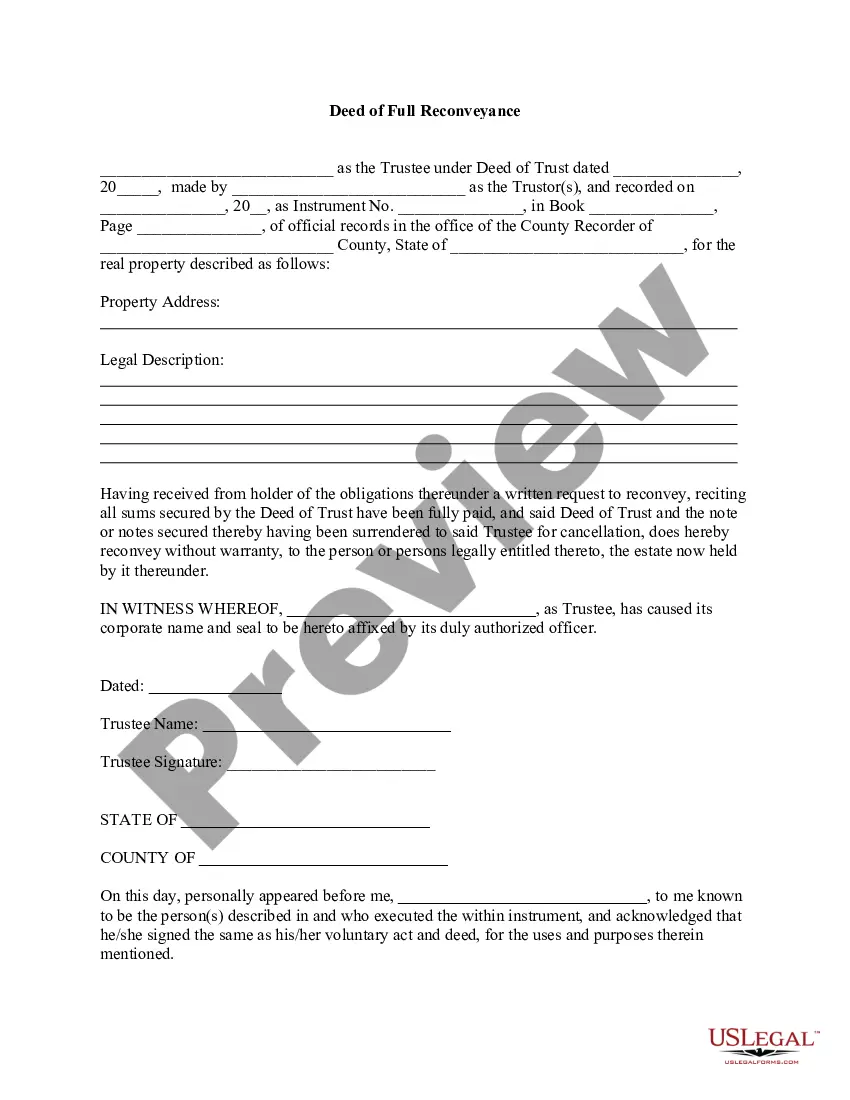
A reconveyance is the official transfer of the property title after the mortgage has been paid in full. The processing time can vary based on the county in which the property is located and can take up to three months. You will need to contact your county for questions on their specific processing time.
Reconveyance is the transfer of a title to the borrower after a mortgage has been fully paid.
A mortgage holder issues a deed of reconveyance to indicate that the borrower has been released from the mortgage debt. The deed transfers the property title from the lender, also called the beneficiary, to the borrower. This document is most commonly used when a mortgage has been paid in full.
A mortgage holder issues a deed of reconveyance to indicate that the borrower has been released from the mortgage debt. The deed transfers the property title from the lender, also called the beneficiary, to the borrower. This document is most commonly used when a mortgage has been paid in full.
When a deed of trust/mortgage is paid in full, you can record a Full Reconveyance from the trustee stating publicly that the loan has been paid. The Full Reconveyance Form. is completed and signed by the trustee, whose signature must be notarized.
To convey again. to convey back to a previous position or place.
A document known as a substitution of trustee and full reconveyance identifies the person who has the authority to reconvey the property and remove the lien.Once the document is registered, it establishes the borrower as the sole owner of the property, which is now free and clear of the previous mortgage.
Complete the top area of the reconveyance deed. Enter the name of and address of the person who executed the deed of trust, the borrower or debtor. Refer to the original deed of trust for the name spelling. Complete the middle section, the trustee's name and address.