West Virginia Last Will and Testament for Divorced Person Not Remarried with No Children
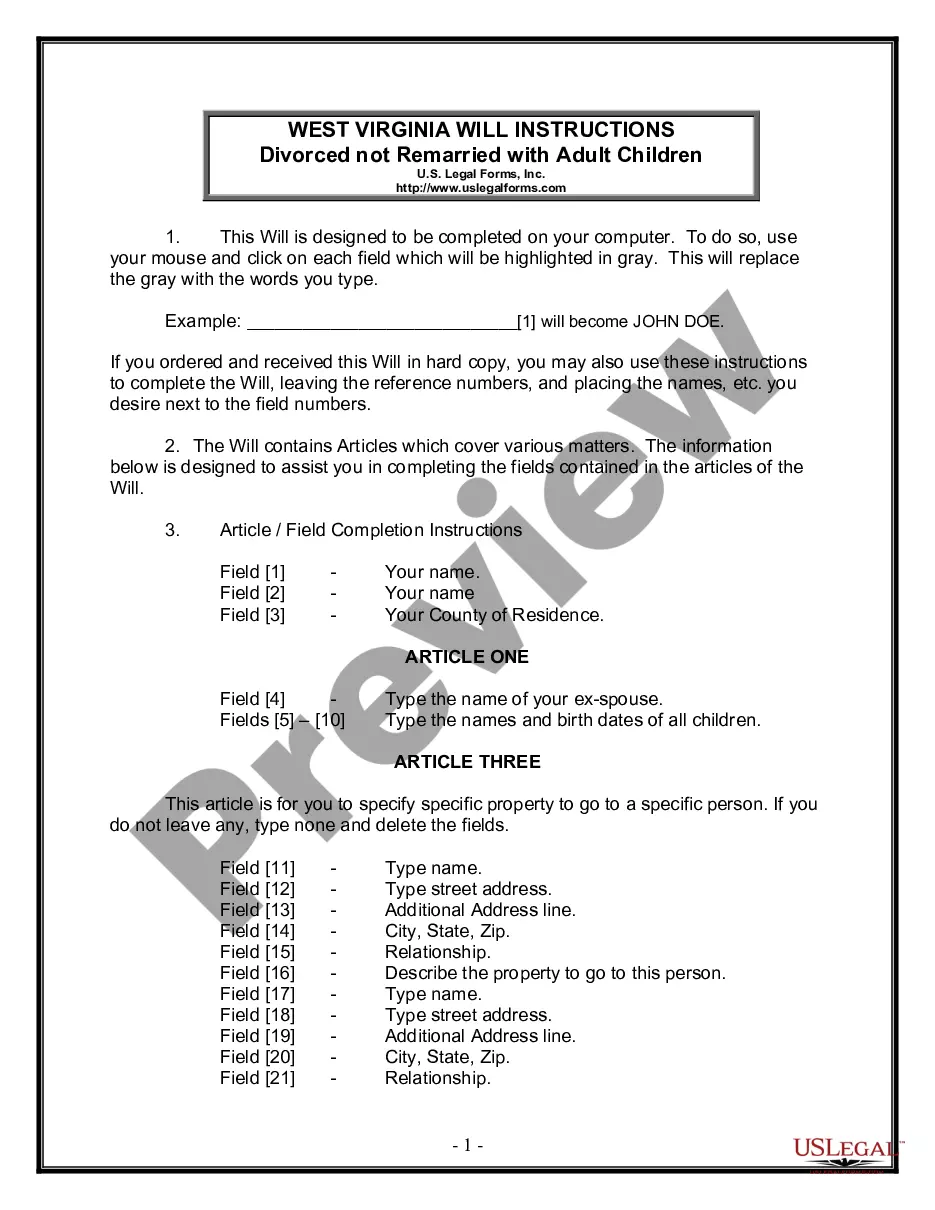
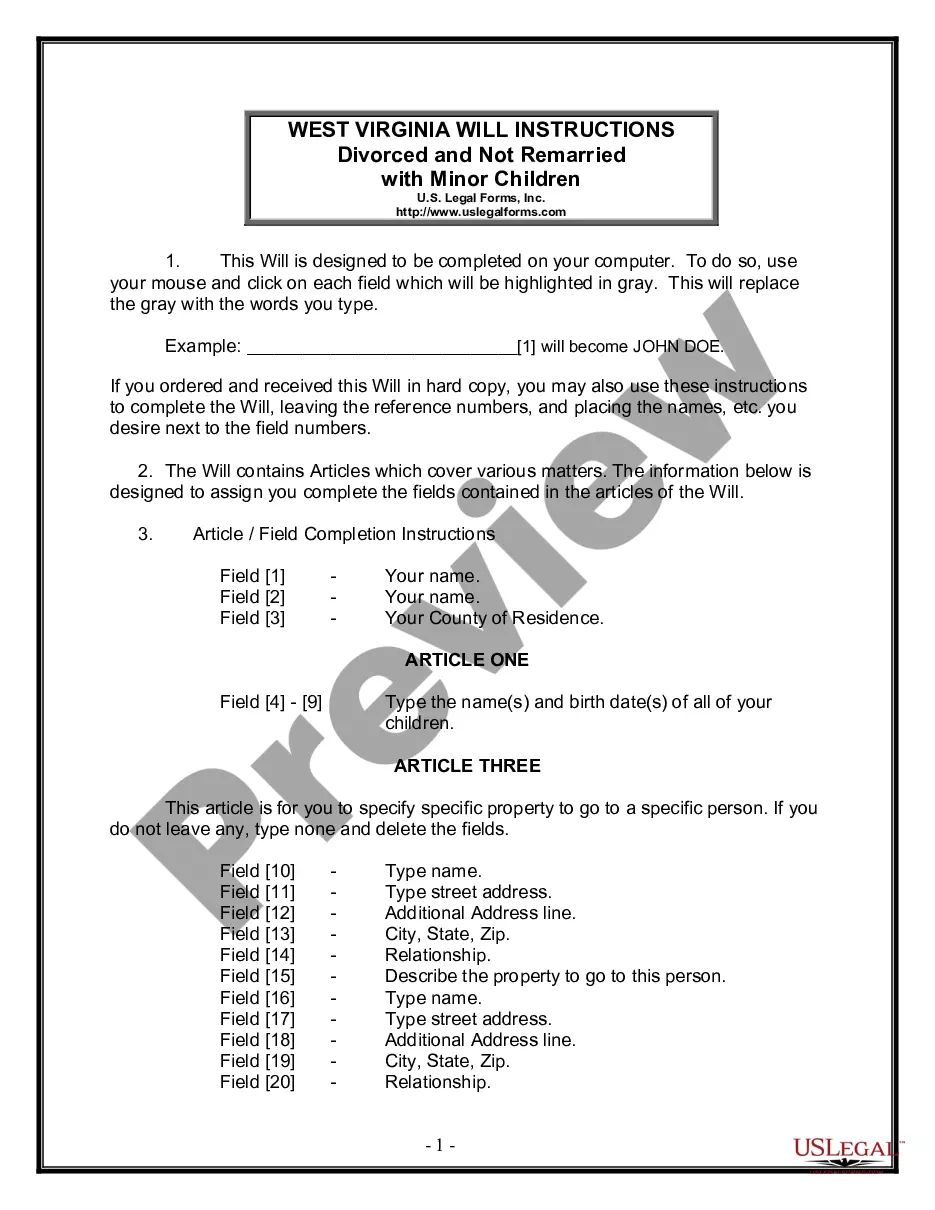
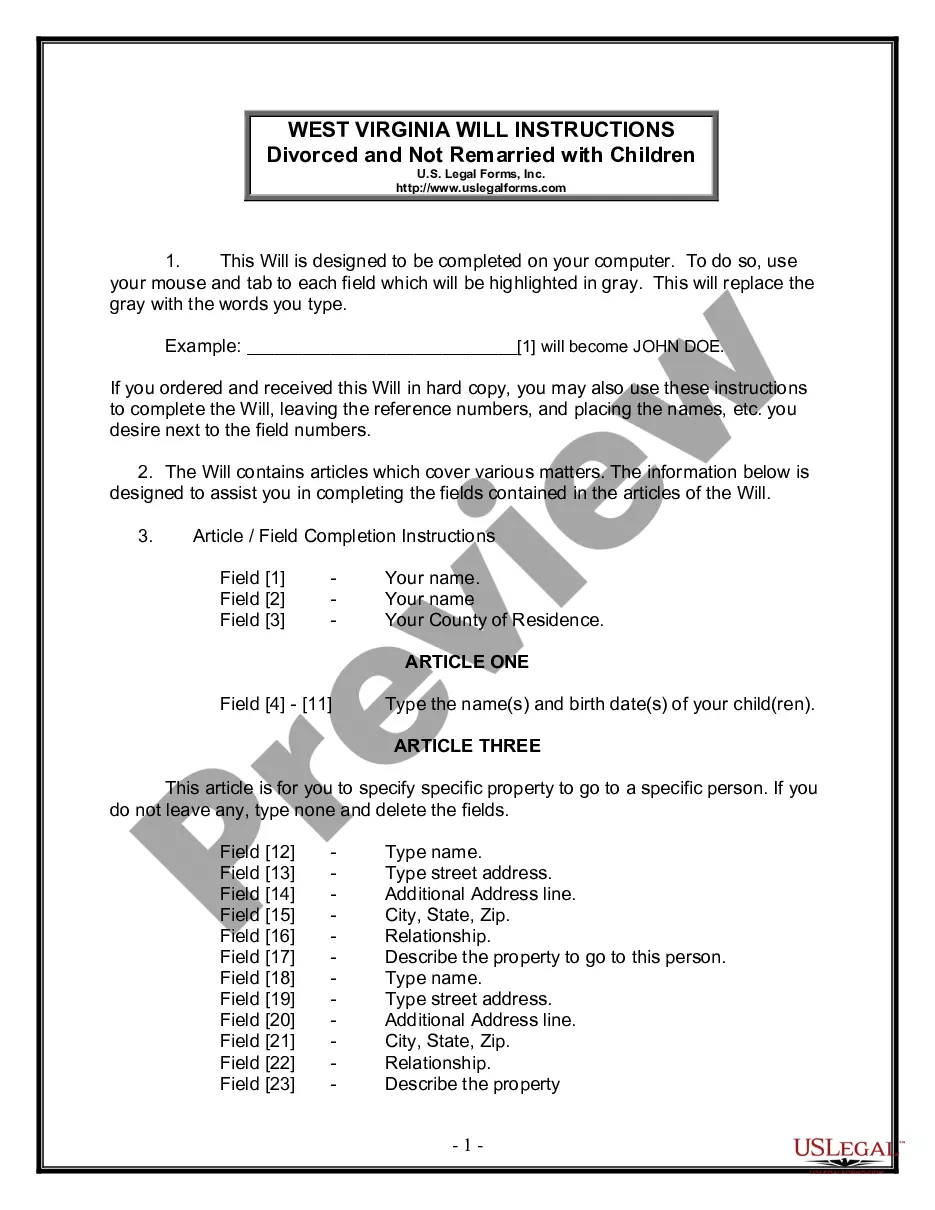
Overview of this form
This Last Will and Testament form is specifically designed for individuals who are divorced, not remarried, and have no children. It outlines how your property will be distributed upon your death and allows you to appoint a personal representative to oversee your estate. Unlike other wills, this version considers your unique circumstances, ensuring that your assets are passed on according to your wishes without complications related to children or a current spouse.
Key components of this form
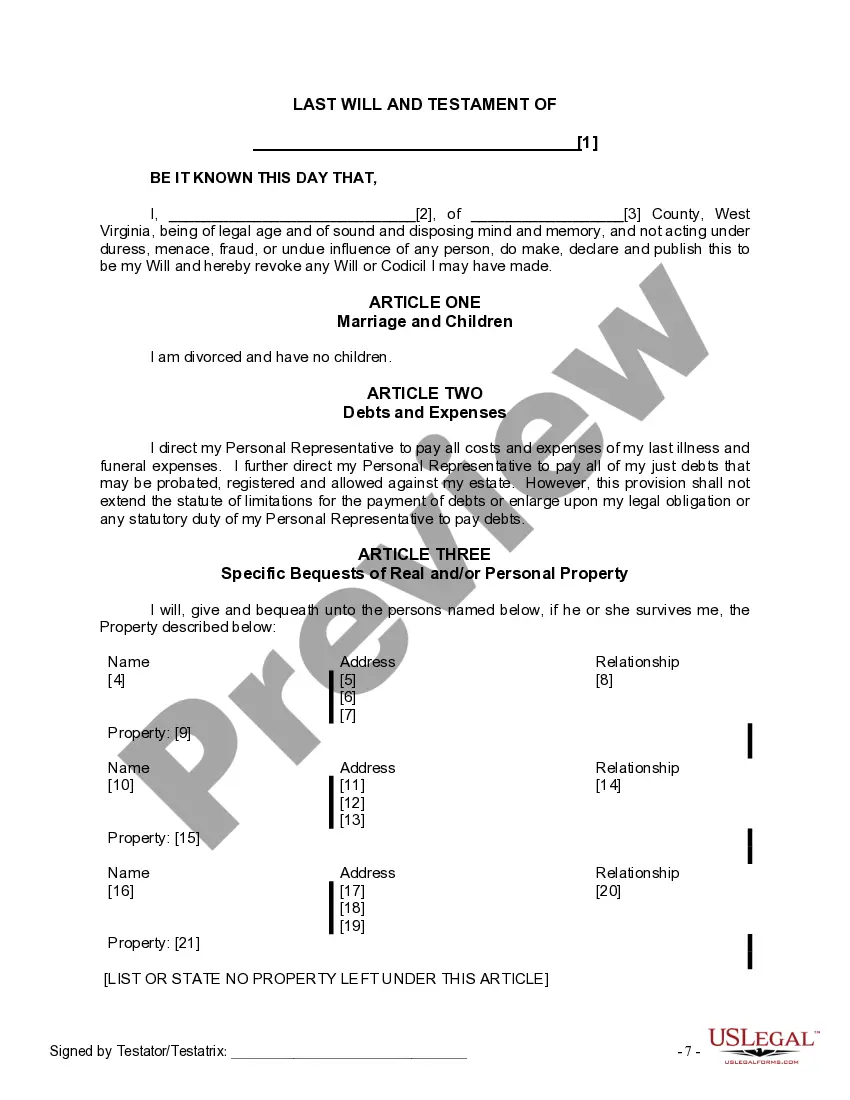
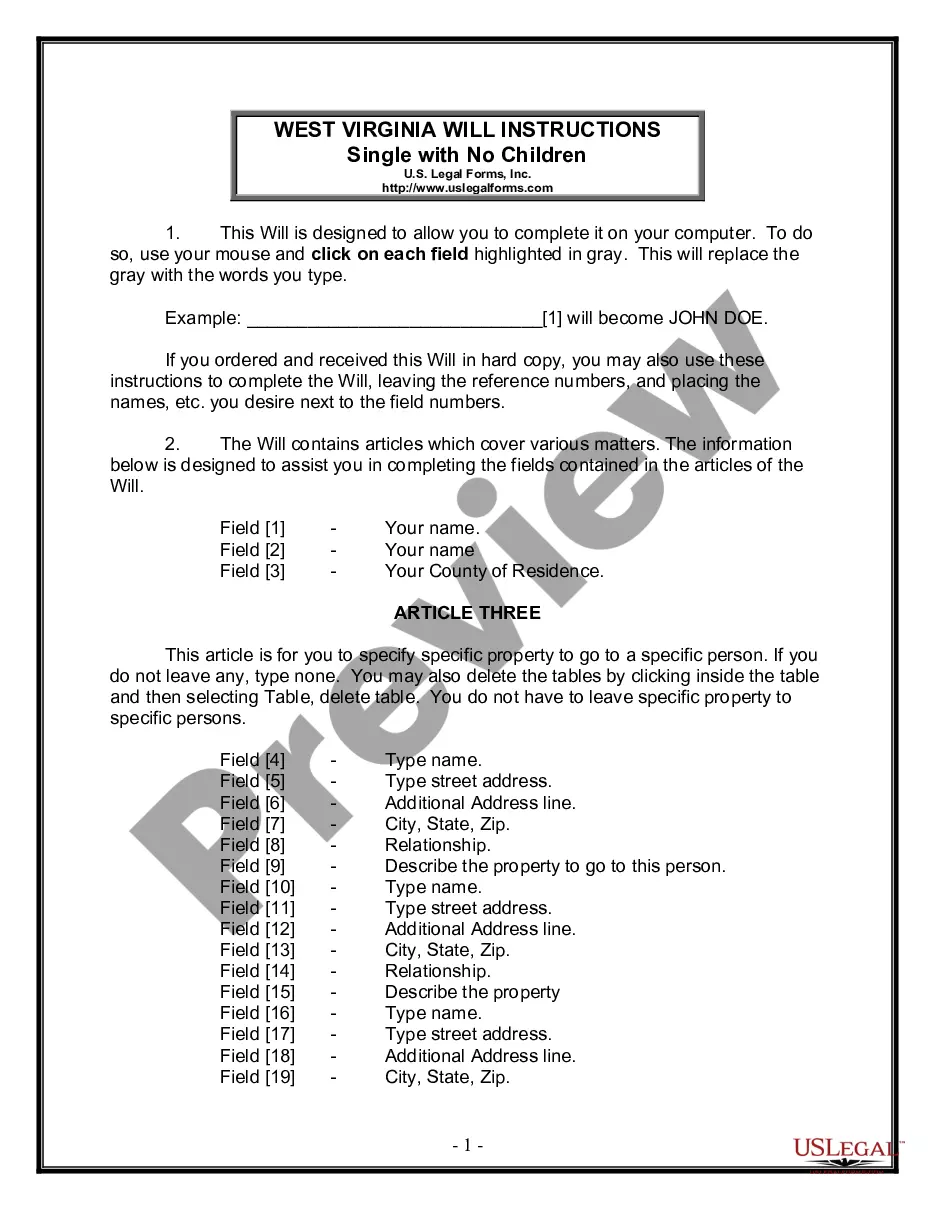
- Your name and county of residence.
- Specification of property to be bequeathed to specific individuals.
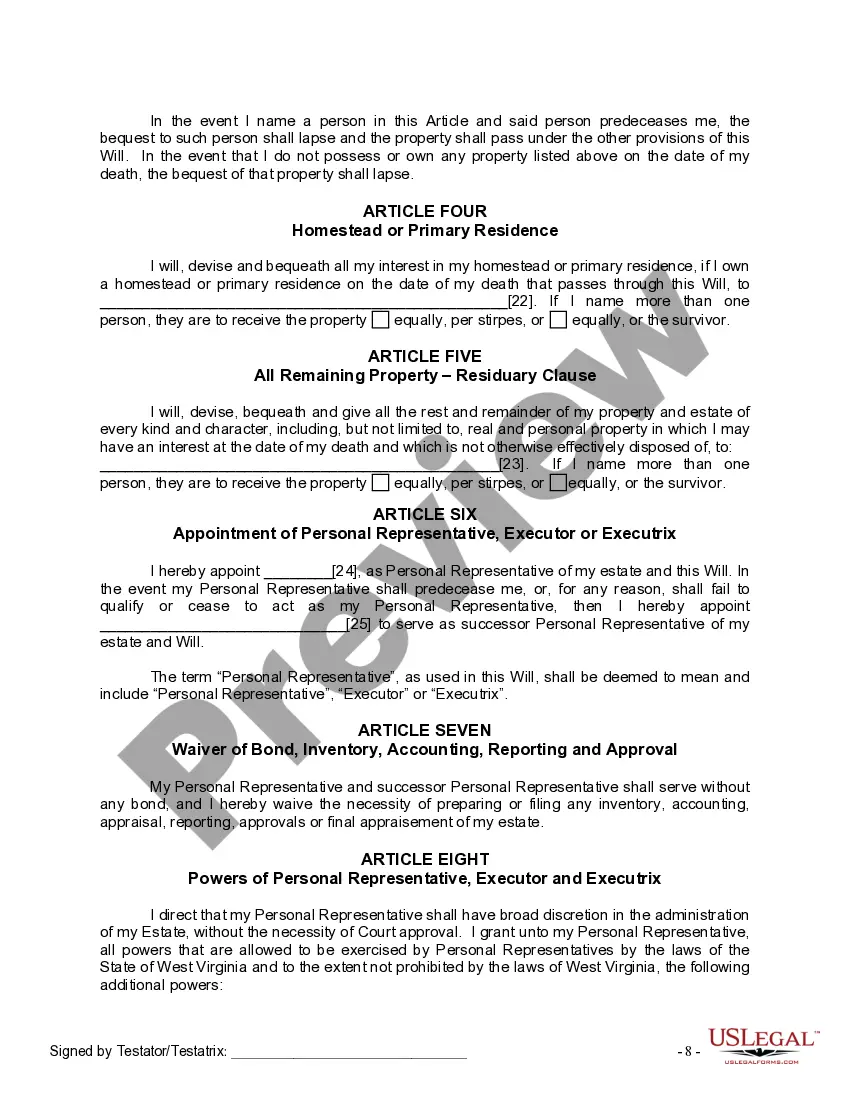
- Appointment of a personal representative to administer your estate.
- Provisions for your homestead or primary residence.
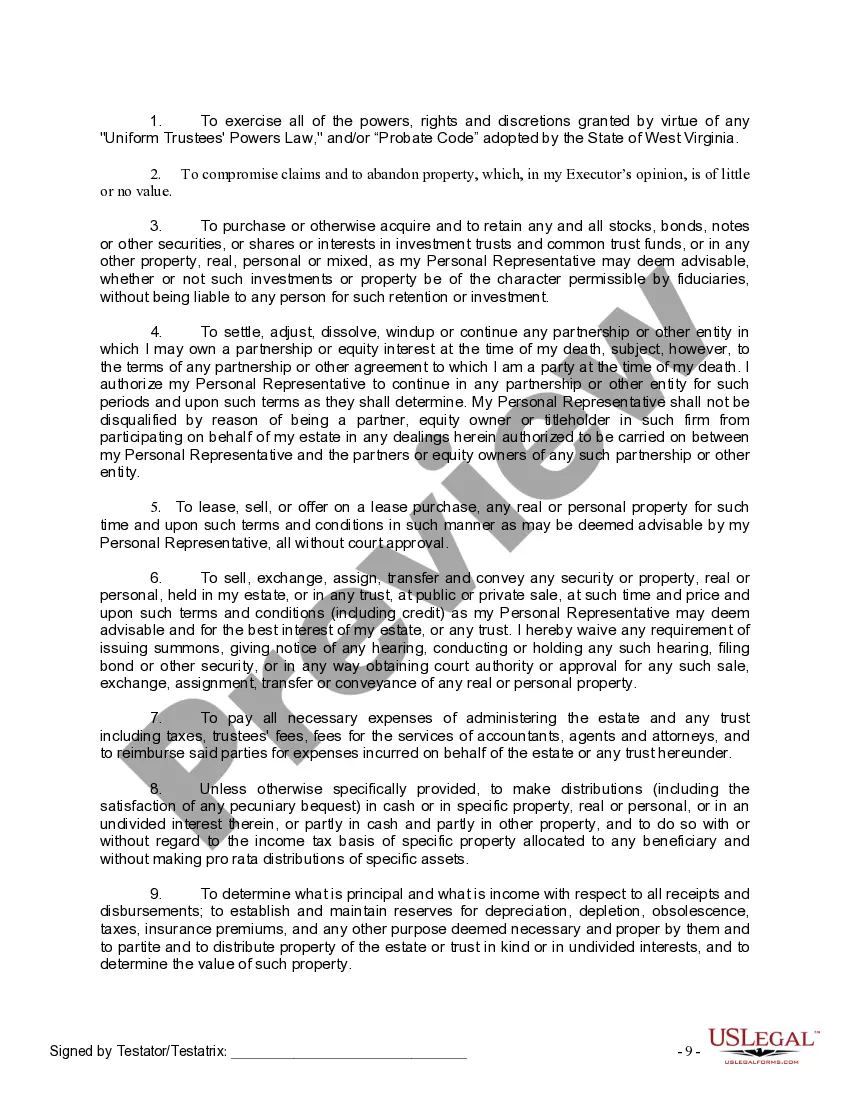
- Clauses addressing debt payments and executor powers.
- Signature requirements including witness signatures.


When to use this form
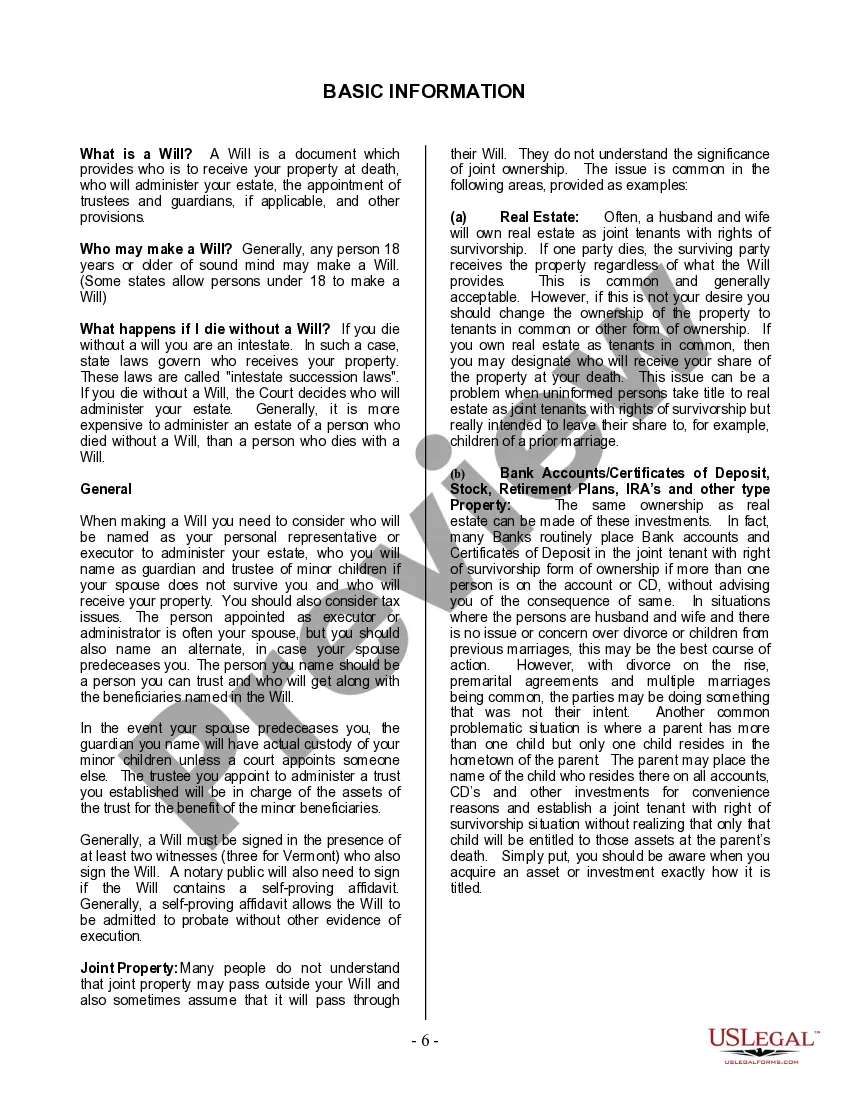
This form is essential to use when a divorced individual without children wishes to ensure that their assets are distributed according to their preferences after death. If you have specific wishes regarding any property or assets, or if you want to appoint someone to manage your estate, this will is the appropriate choice. It is particularly useful for individuals who want to avoid intestacy laws, which govern the distribution of assets when someone dies without a will.
Intended users of this form
- Divorced individuals who are not remarried.
- People without children who wish to specify how their property is distributed.
- Anyone looking to appoint a personal representative to manage their estate after death.
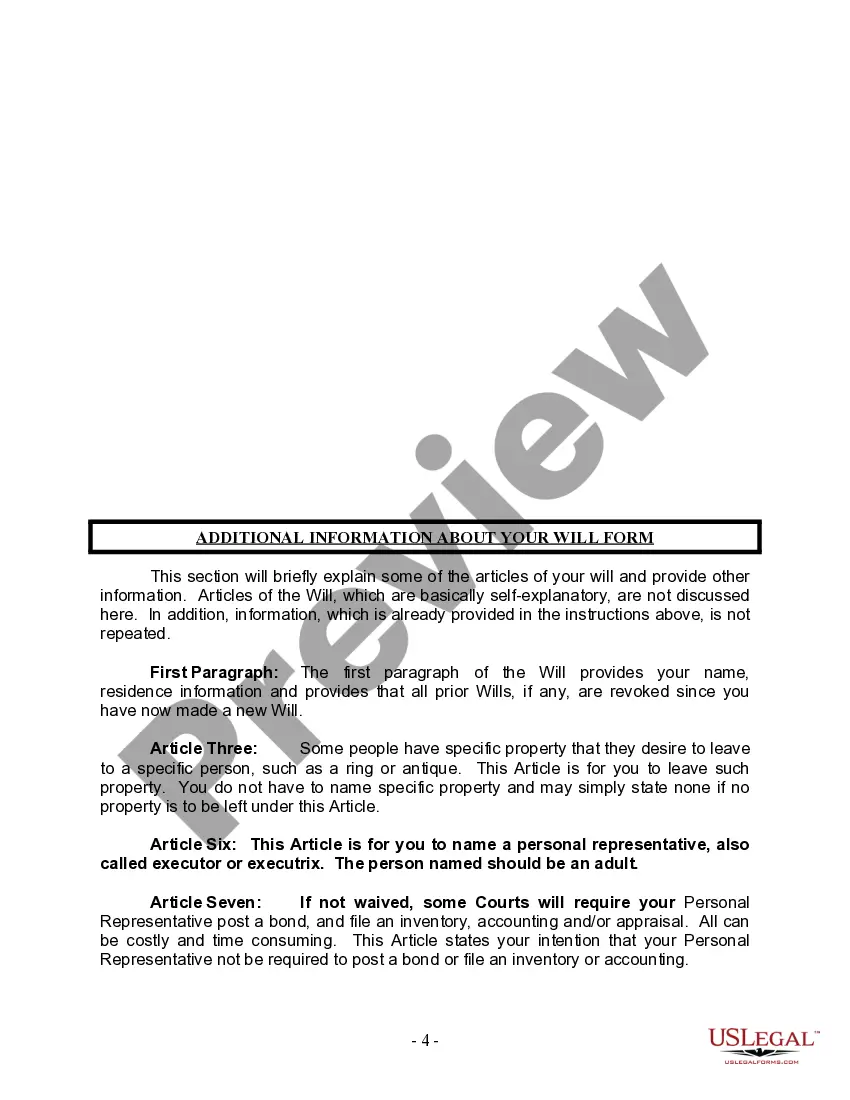
How to prepare this document
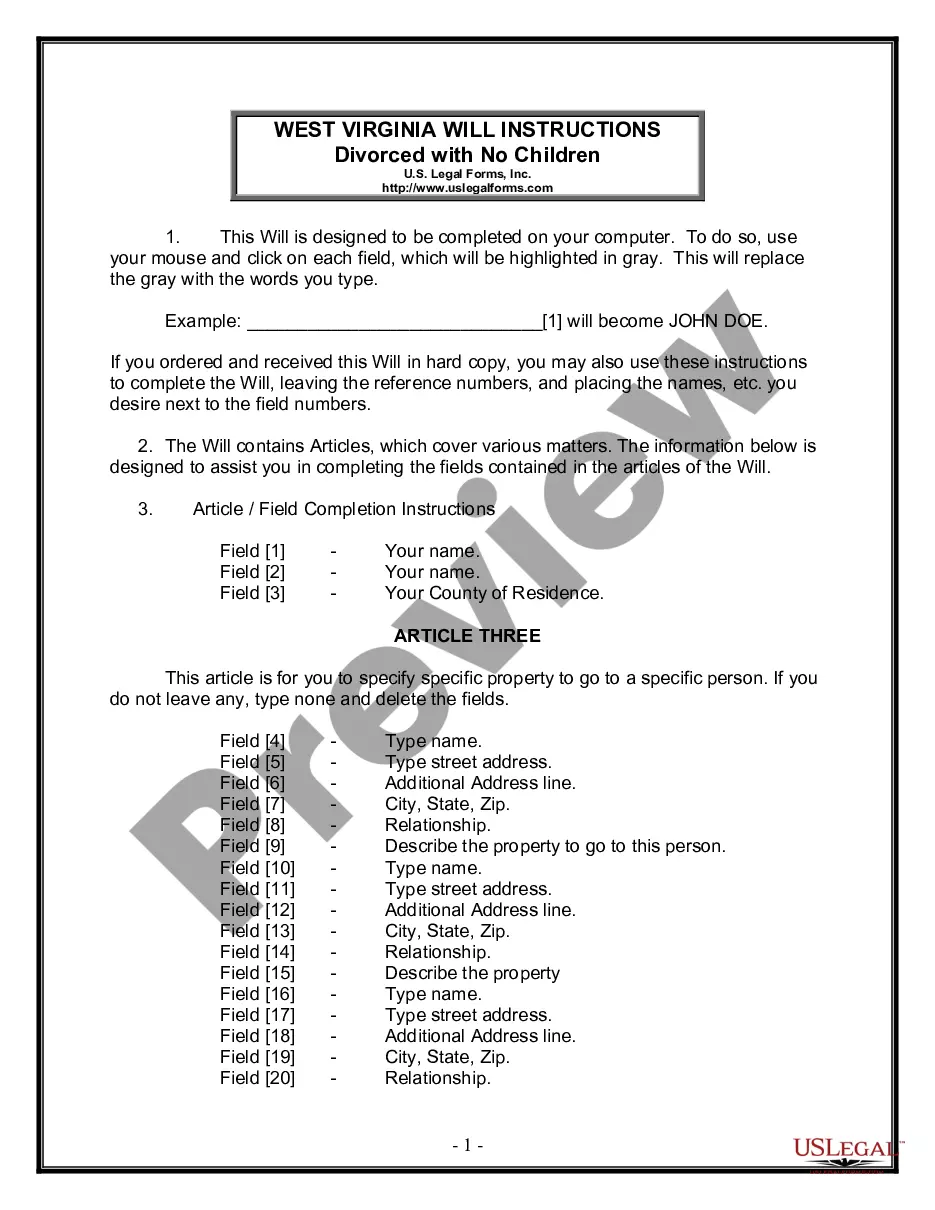
- Enter your name and county of residence in the designated fields.
- Specify any property you wish to leave to specific individuals, along with their addresses and relationship to you.
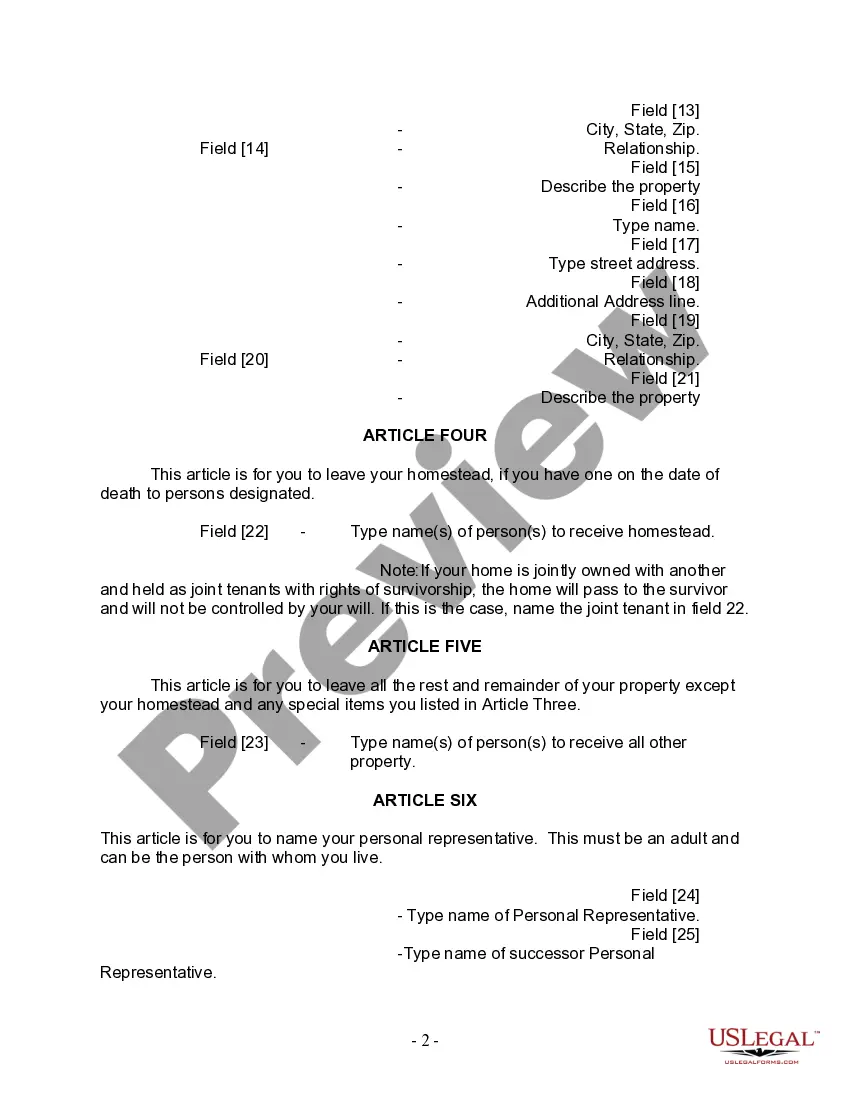
- Designate a personal representative to manage your estate.
- Complete the homestead designation, if applicable, as well as any additional clauses you wish to include.
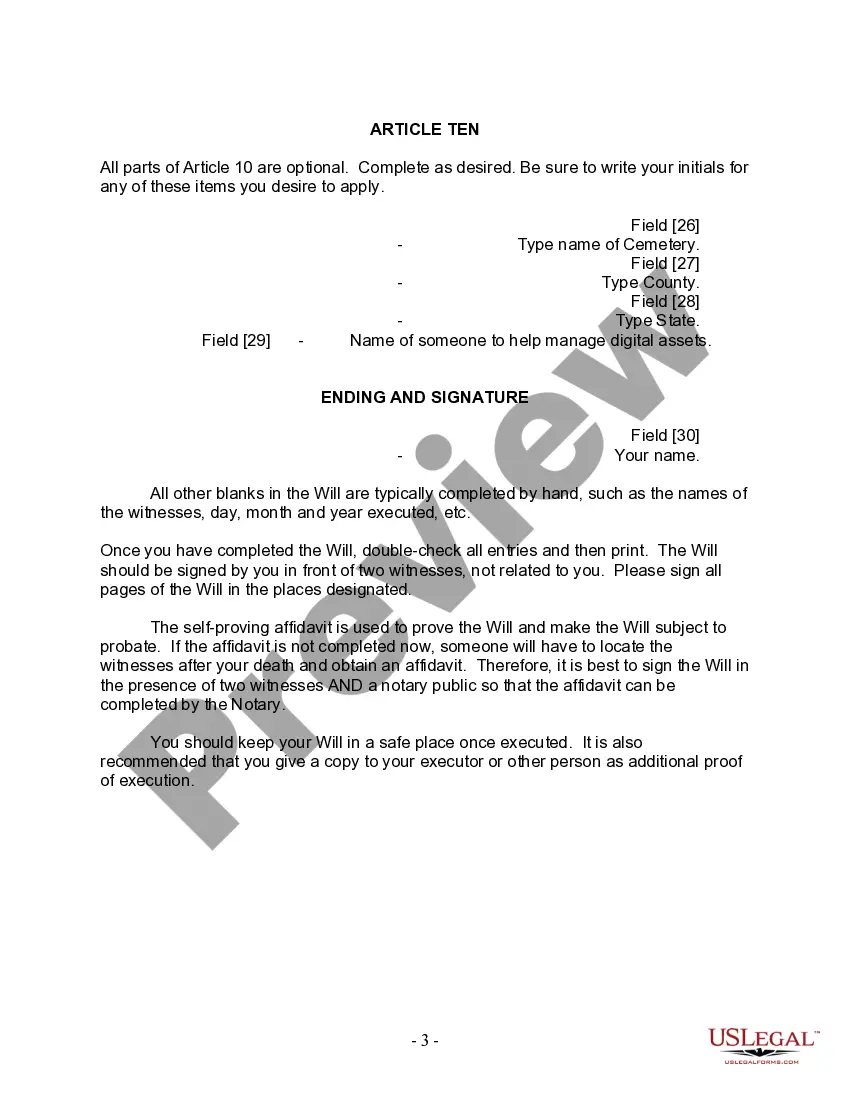
- Sign the will in front of two witnesses who are not related to you.
- If desired, have the will notarized to create a self-proving affidavit, which can simplify the probate process.
Does this document require notarization?
Notarization is required for this form to take effect. Our online notarization service, powered by Notarize, lets you verify and sign documents remotely through an encrypted video session, available 24/7.
Get your form ready online
Our built-in tools help you complete, sign, share, and store your documents in one place.
Make edits, fill in missing information, and update formatting in US Legal Forms—just like you would in MS Word.
Download a copy, print it, send it by email, or mail it via USPS—whatever works best for your next step.
Sign and collect signatures with our SignNow integration. Send to multiple recipients, set reminders, and more. Go Premium to unlock E-Sign.
If this form requires notarization, complete it online through a secure video call—no need to meet a notary in person or wait for an appointment.
We protect your documents and personal data by following strict security and privacy standards.

Make edits, fill in missing information, and update formatting in US Legal Forms—just like you would in MS Word.

Download a copy, print it, send it by email, or mail it via USPS—whatever works best for your next step.

Sign and collect signatures with our SignNow integration. Send to multiple recipients, set reminders, and more. Go Premium to unlock E-Sign.

If this form requires notarization, complete it online through a secure video call—no need to meet a notary in person or wait for an appointment.

We protect your documents and personal data by following strict security and privacy standards.
Common mistakes
- Failing to sign the will in front of witnesses, which can invalidate the document.
- Not including a personal representative, which can lead to complications during probate.
- Leaving out specific property designs or bequests, leading to unintended distributions.
- Not following state-specific requirements regarding signatures and witnesses.
Advantages of online completion
- Convenience of completing the form at your own pace and from the comfort of your home.
- Editability allows you to make changes easily before finalizing the document.
- Access to professionally drafted forms ensures compliance with legal standards.
- Immediate download capability saves time compared to traditional methods.
Main things to remember
- This Last Will and Testament form is tailored for divorced individuals without children.
- It ensures your property is distributed according to your wishes.
- Proper execution, including signatures and notarization, is essential for validity.
- Failing to complete the form accurately can lead to complications in probate.
Looking for another form?
Form popularity
FAQ
A notarized will does not need to be probated.When a person dies leaving behind a will that is not notarized, the law requires that its validity be ascertained by a notary or by a court. Similarly, any non-notarized modification made to a will must be probated, whether the will is notarized or not.
Yes. A will that you write yourself is called a holographic will. Holographic wills are not valid in every state, but they are valid in West Virginia, as long as they are written entirely in the author's handwriting.
No, in West Virginia, you do not need to notarize your will to make it legal.A self-proving will speeds up probate because the court can accept the will without contacting the witnesses who signed it.
The Will must be filed with the Probate Office of the County Clerk in the county where the decedent lived. A Petition for Probate must be filed as well. This requests the appointment of an executor. If there is no Will, the clerk will appoint someone to serve as the Personal Representative of the estate.
The individual's mental capacity in question at the time the will was executed. The document was not properly executed according to WV legal requirements. There is evidence of fraud, forgery, coercion, or deception. Need help bringing or defending a will contest in WV?
In order for a will to be valid, it must be: made by a person who is 18 years old or over and. made voluntarily and without pressure from any other person and.signed by the two witnesses, in the presence of the person making the will, after it has been signed.
Written will must be written: statements to others about you last wishes are unenforceable; Signed by testator you must sign your will; Two Witnesses you must have two witnesses, who won't get anything in the will; and. Signature of Two Witnesses your two witnesses must sign the will.