West Virginia Quitclaim Deed from Individual to Two Individuals in Joint Tenancy

Understanding this form
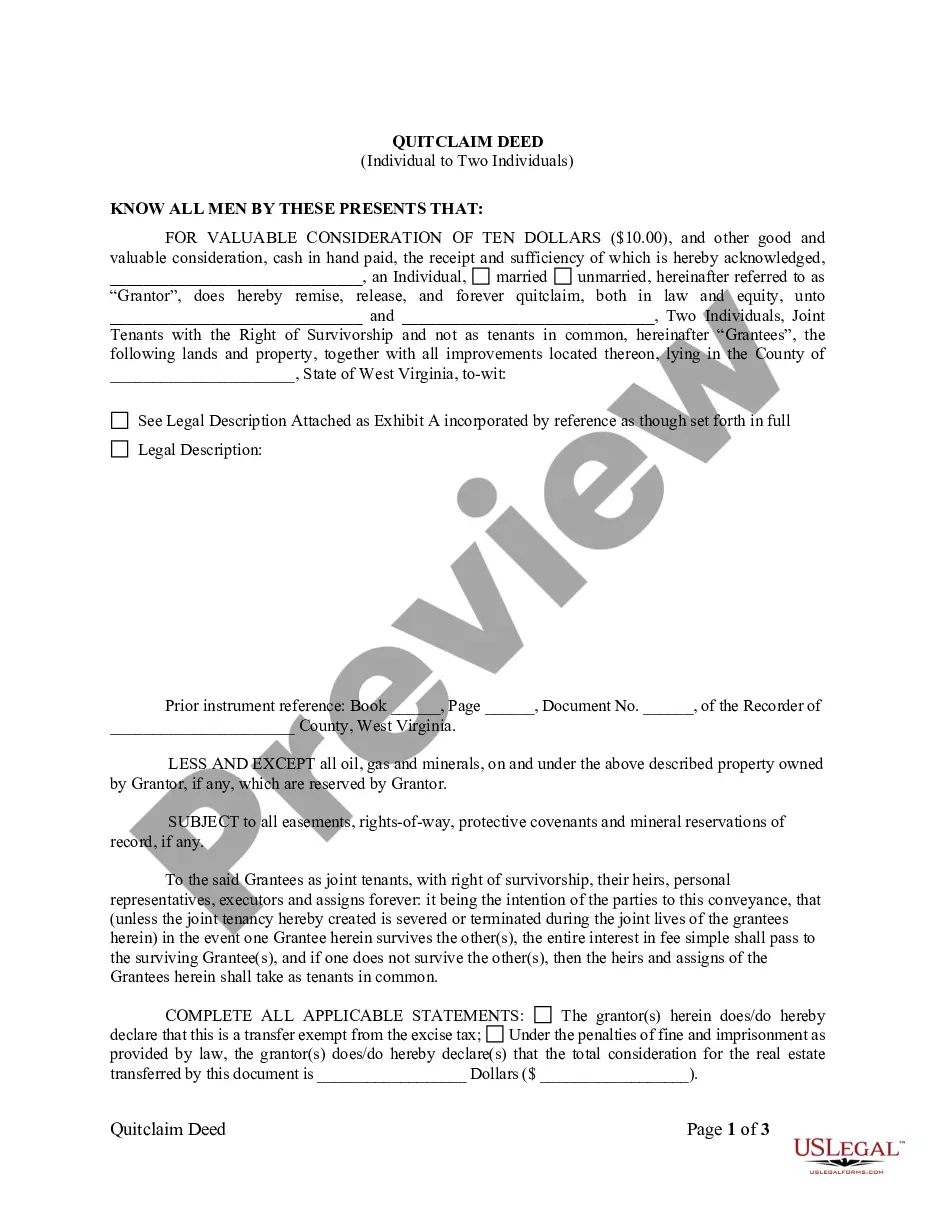
The Quitclaim Deed from Individual to Two Individuals in Joint Tenancy is a legal document used to transfer property ownership from one individual (the Grantor) to two individuals (the Grantees) who own the property in joint tenancy. This means that both Grantees have equal rights to the property, and if one owner passes away, the other automatically inherits the deceased owner's share. Unlike other types of deeds, a quitclaim deed does not guarantee that the Grantor has clear title to the property, making it essential in certain situations, such as when family members, friends, or business partners wish to transfer property without the complexities of a warranty deed.
Key components of this form
- Identification of the Grantor and Grantees
- Legal description of the property being transferred
- Statement of consideration (value exchanged)
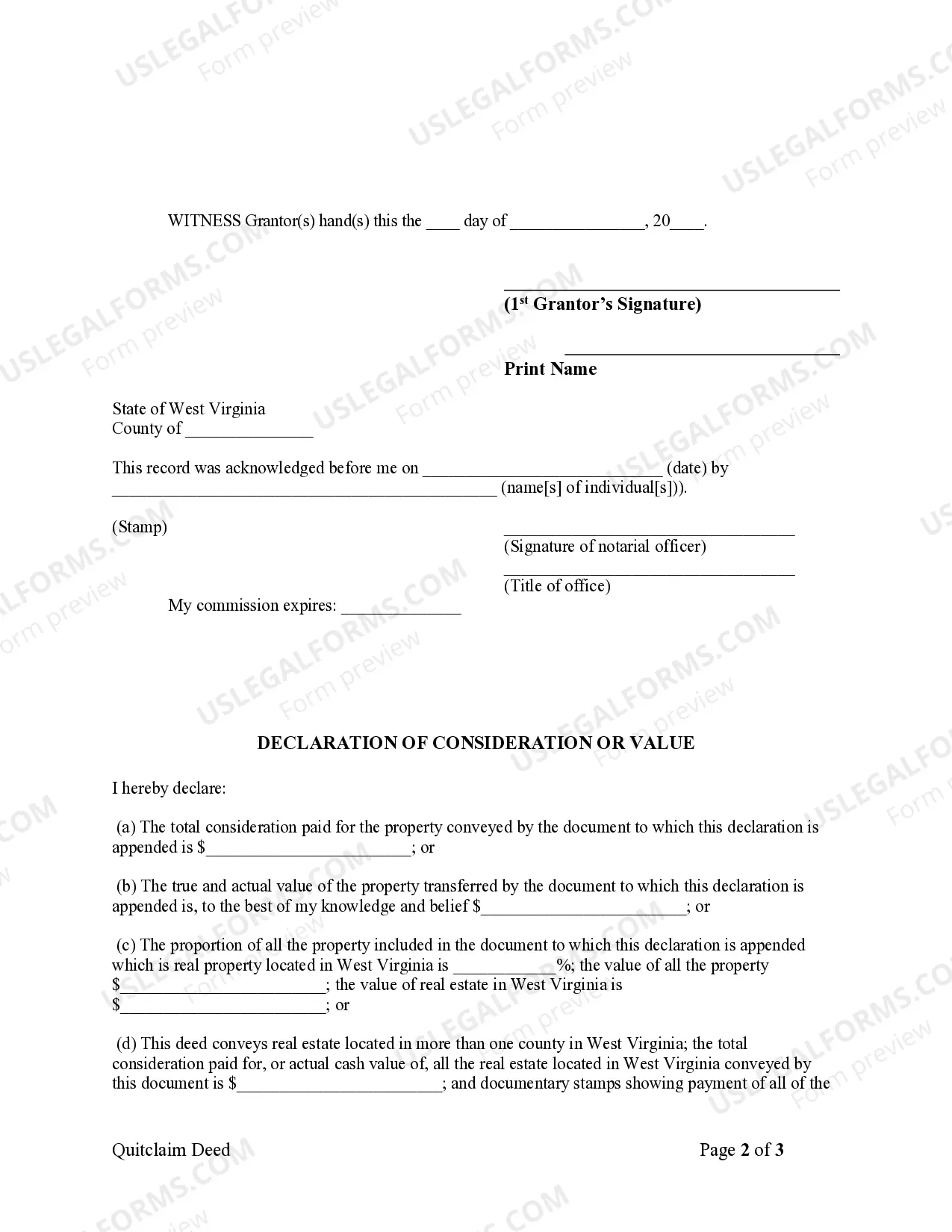
- Declaration about the transferâs tax exemption status
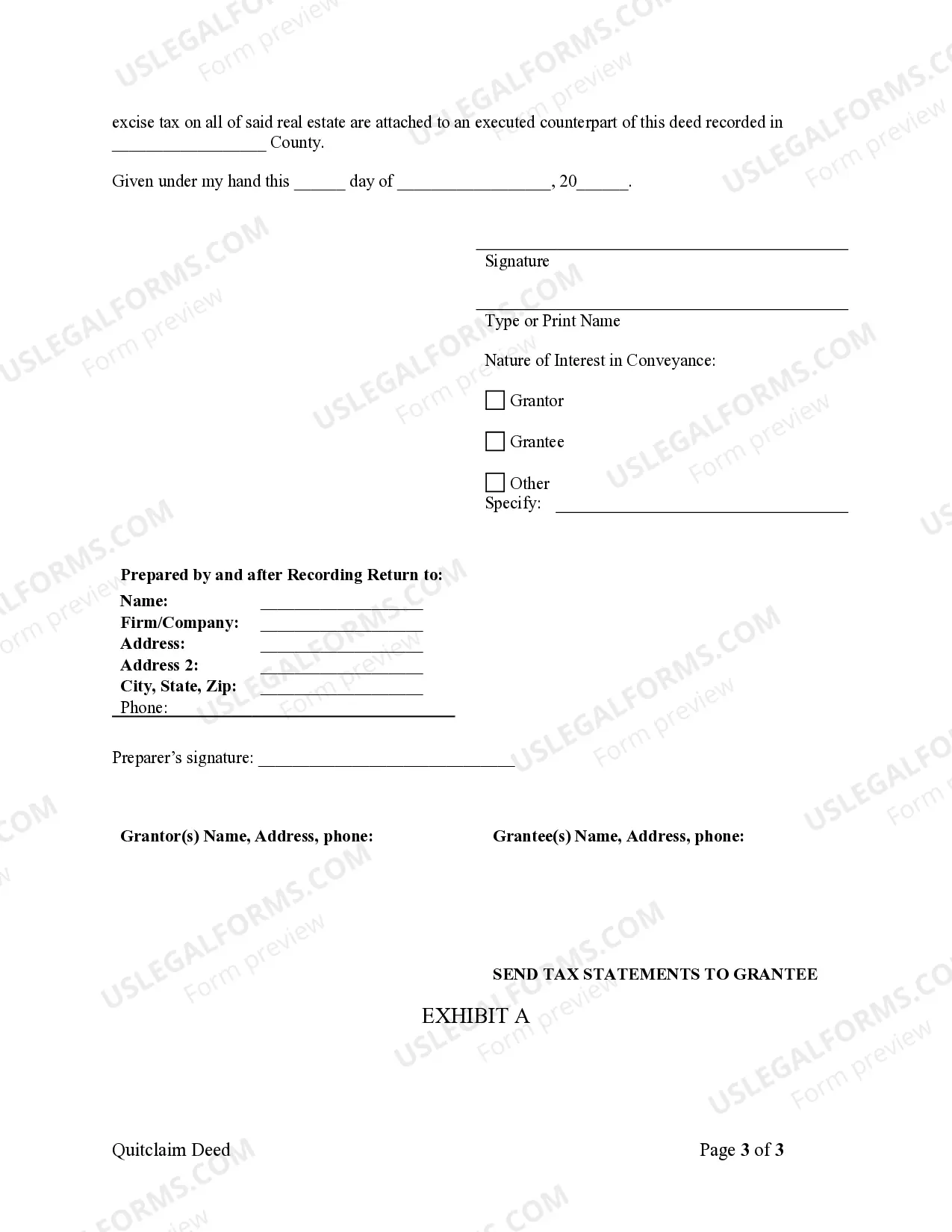
- Signatures of the Grantor and notarization details

Common use cases
This form is commonly used when an individual wants to transfer ownership of a property to two persons as joint tenants. Situations may include transferring family property to children, facilitating property transfers between friends, or restructuring ownership stakes in a business property. It is also useful in scenarios where the Grantor wishes to avoid probate complications for the surviving Grantee after their passing.
Who needs this form
- Individuals looking to transfer property to two individuals.
- Family members wanting to ensure property rights for joint ownership.
- Business partners needing to register joint ownership of an asset.
- Anyone wanting to simplify estate transfer through joint tenancy.
Instructions for completing this form
- Identify the parties involved: the Grantor and the two Grantees.
- Specify the property by including a legal description.
- Enter the consideration amount, typically a nominal sum.
- Complete any declarations regarding tax exemptions.
- Have the Grantor sign the document in the presence of a notary public.
Notarization requirements for this form
Yes, this form must be notarized to be legally valid. This ensures that the identities of the parties are verified and that the signing is executed correctly. US Legal Forms offers integrated online notarization services, allowing you to complete the process securely via video call, without the need for travel.
Get your form ready online
Our built-in tools help you complete, sign, share, and store your documents in one place.
Make edits, fill in missing information, and update formatting in US Legal Forms—just like you would in MS Word.
Download a copy, print it, send it by email, or mail it via USPS—whatever works best for your next step.
Sign and collect signatures with our SignNow integration. Send to multiple recipients, set reminders, and more. Go Premium to unlock E-Sign.
If this form requires notarization, complete it online through a secure video call—no need to meet a notary in person or wait for an appointment.
We protect your documents and personal data by following strict security and privacy standards.

Make edits, fill in missing information, and update formatting in US Legal Forms—just like you would in MS Word.

Download a copy, print it, send it by email, or mail it via USPS—whatever works best for your next step.

Sign and collect signatures with our SignNow integration. Send to multiple recipients, set reminders, and more. Go Premium to unlock E-Sign.

If this form requires notarization, complete it online through a secure video call—no need to meet a notary in person or wait for an appointment.

We protect your documents and personal data by following strict security and privacy standards.
Mistakes to watch out for
- Failing to include a complete legal description of the property.
- Not specifying the names of both Grantees accurately.
- Omitting notarization, which may invalidate the deed.
- Incorrectly stating the consideration amount or failing to include it.
- Leaving sections of the form incomplete, which can create confusion or legal issues.
Advantages of online completion
- Convenience of immediate access and download for your legal needs.
- Editable templates that allow for customization to fit your specific situation.
- Forms drafted by licensed attorneys to ensure compliance with state laws.
- Time-saving compared to traditional methods of obtaining legal documents.
Main things to remember
- A quitclaim deed is a simple way to transfer property without title guarantees.
- Joint tenancy with right of survivorship benefits the surviving grantee upon the death of one owner.
- Proper completion and notarization are essential for legal validity.
Looking for another form?

Form popularity
FAQ
To record a quitclaim deed with a county clerk in West Virginia, the instrument must meet state and county requirements of form and content for documents pertaining to an interest in real property. All recorded deeds must be accompanied by a Sales Listing Form.
The drawback, quite simply, is that quitclaim deeds offer the grantee/recipient no protection or guarantees whatsoever about the property or their ownership of it. Maybe the grantor did not own the property at all, or maybe they only had partial ownership.
Fill out the quit claim deed form, which can be obtained online, or write your own using the form as a guide. The person giving up the interest in the property is the grantor, and the person receiving the interest is the grantee.
Quitclaim deeds are most often used to transfer property between family members.Examples include when an owner gets married and wants to add a spouse's name to the title or deed, or when the owners divorce and one spouse's name is removed from the title or deed.
Discuss property ownership interests. Access a copy of your title deed. Complete, review and sign the quitclaim or warranty form. Submit the quitclaim or warranty form. Request a certified copy of your quitclaim or warranty deed.
But you might be wondering if an owner can transfer a deed to another person without a real estate lawyer. The answer is yes. Parties to a transaction are always free to prepare their own deeds.A quitclaim deed, for example, is far simpler than a warranty deed.
Quitclaim deeds are most often used to transfer property between family members. Examples include when an owner gets married and wants to add a spouse's name to the title or deed, or when the owners get divorced and one spouse's name is removed from the title or deed.
You can apply to court to change your ex-partner's tenancy to your name, or remove their name from a joint tenancy. You can apply for a 'transfer of tenancy' if: your landlord refuses to change your tenancy. your tenancy doesn't allow a transfer.
A Quitclaim Deed must be notarized by a notary public or attorney in order to be valid.Consideration in a Quitclaim Deed is what the Grantee will pay to the Grantor for the interest in the property.