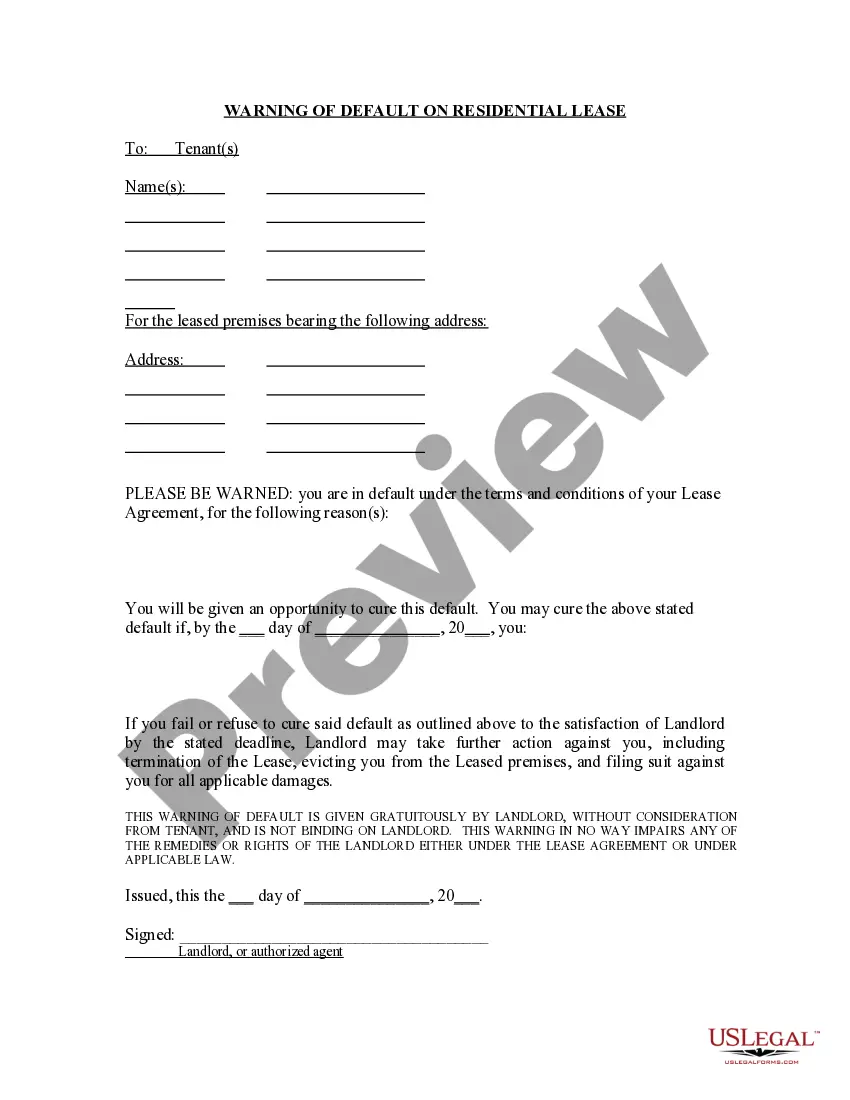
Wisconsin Warning of Default on Residential Lease
About this form
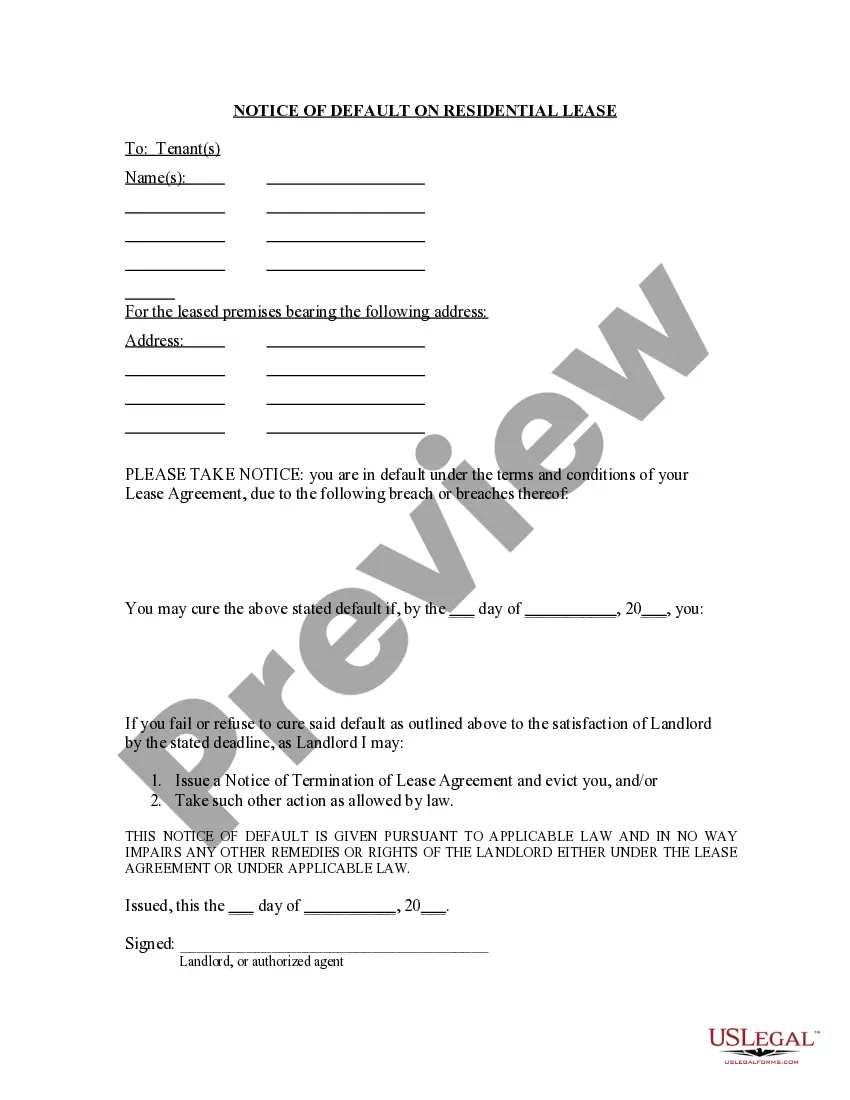
The Warning of Default on Residential Lease is a formal notification from a landlord to a tenant. This warning conveys that the tenant is at risk of being declared in default of their lease agreement if specific issues are not resolved promptly. Unlike other notices that may require immediate action or serve different purposes, this form primarily serves as a warning, allowing the tenant an opportunity to remedy the situation before further legal actions are taken.
What’s included in this form
- Date of issuance: The specific date when the warning is issued.
- Landlord's signature: Signature of the landlord or authorized agent confirming the notice.
- Statement of non-binding nature: Clarifies that this warning is not a legally binding action against the landlord.
- Conditions of default: Specific conditions under which the tenant may be deemed in default.

When to use this document
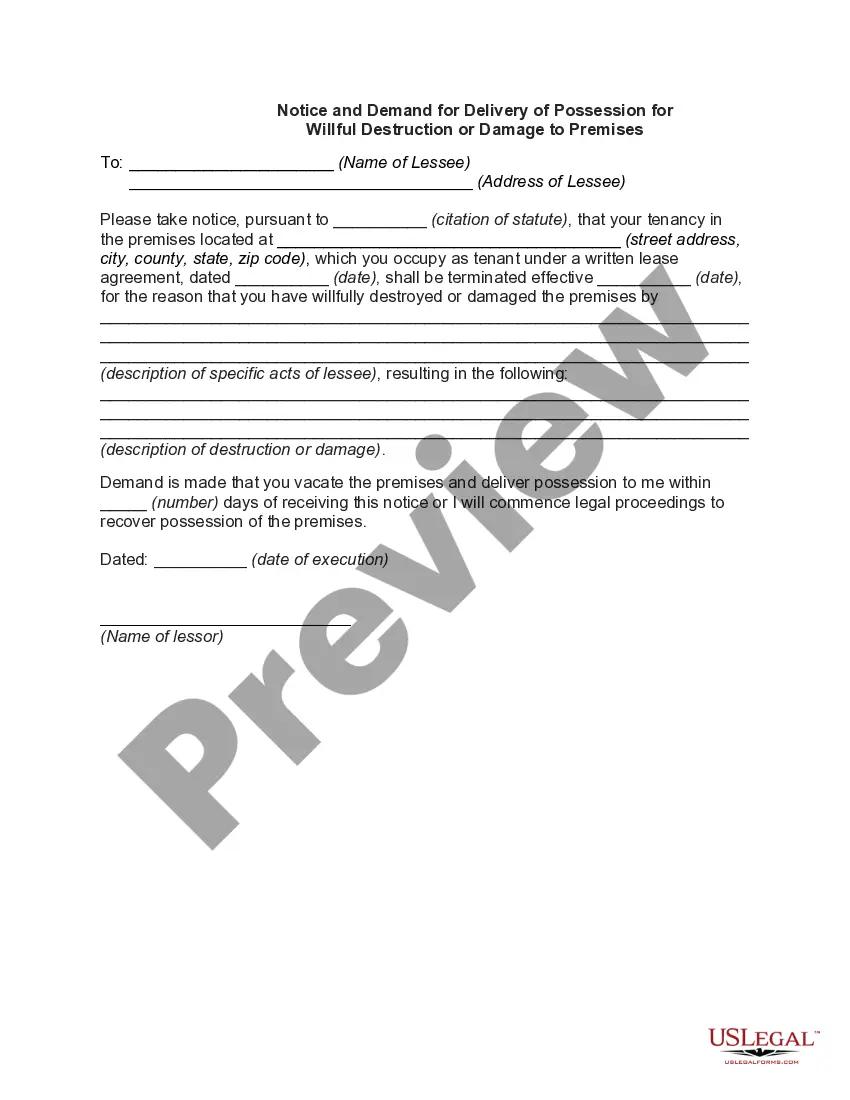
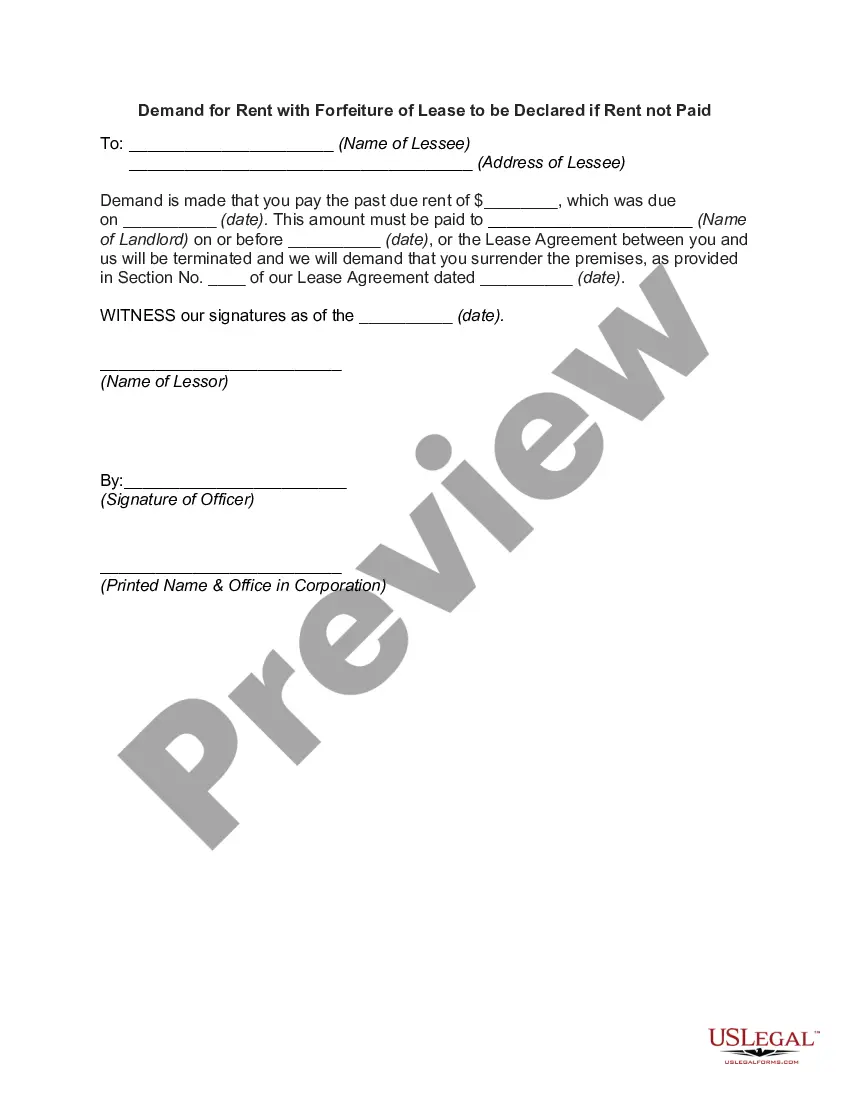
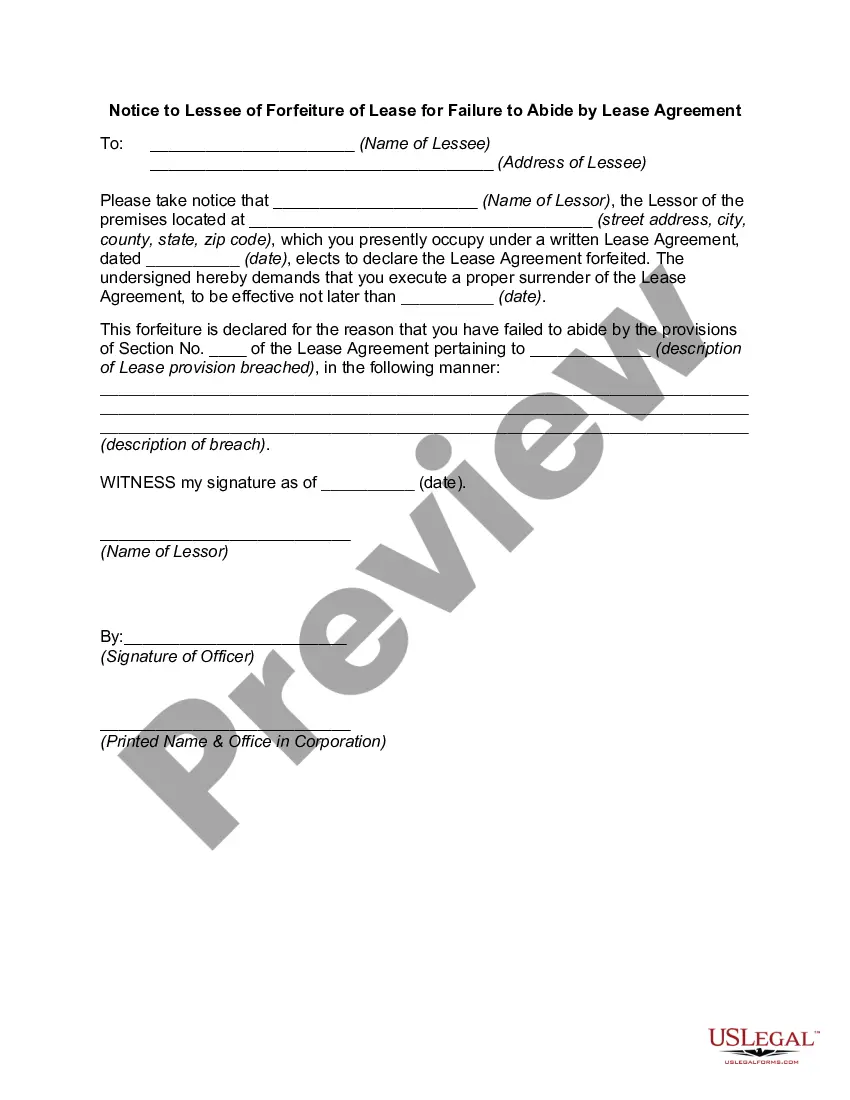
This form is used when a landlord believes that a tenant is not meeting their obligations under a residential lease. Common scenarios include late rent payments, failure to maintain the property, or any breach of terms specified in the lease. Issuing a Warning of Default can serve as a proactive measure to address these issues before they escalate to eviction proceedings.
Who should use this form
- Residential landlords seeking to communicate lease violations to their tenants.
- Property managers responsible for managing tenant relationships and lease compliance.
- Tenants who receive such notices and need clarity on the issues raised.
Steps to complete this form
- Fill in the date of issuance at the top of the form.
- Specify the conditions under which the tenant is at risk of defaulting on the lease.
- Provide the landlord's signature or the signature of an authorized agent at the bottom.
- Keep a copy for your records and provide a copy to the tenant.
Notarization guidance
This form does not typically require notarization unless specified by local law. Always check the relevant regulations in your state to ensure compliance with all legal requirements.
Get your form ready online
Our built-in tools help you complete, sign, share, and store your documents in one place.
Make edits, fill in missing information, and update formatting in US Legal Forms—just like you would in MS Word.
Download a copy, print it, send it by email, or mail it via USPS—whatever works best for your next step.
Sign and collect signatures with our SignNow integration. Send to multiple recipients, set reminders, and more. Go Premium to unlock E-Sign.
If this form requires notarization, complete it online through a secure video call—no need to meet a notary in person or wait for an appointment.
We protect your documents and personal data by following strict security and privacy standards.

Make edits, fill in missing information, and update formatting in US Legal Forms—just like you would in MS Word.

Download a copy, print it, send it by email, or mail it via USPS—whatever works best for your next step.

Sign and collect signatures with our SignNow integration. Send to multiple recipients, set reminders, and more. Go Premium to unlock E-Sign.

If this form requires notarization, complete it online through a secure video call—no need to meet a notary in person or wait for an appointment.

We protect your documents and personal data by following strict security and privacy standards.
Avoid these common issues
- Failing to include the specific conditions that led to the warning of default.
- Not signing the form or having the authorized agent sign it.
- Sending the warning to the wrong address or to the wrong tenant.
- Neglecting to keep a copy of the notice for personal records.
Benefits of using this form online
- Convenient and quick access to professionally drafted legal forms.
- Easy to customize and fill out according to your specific situation.
- Reliable and up-to-date legal content tailored for landlord-tenant relationships.
Legal use & context
- The form serves as a documented attempt to notify the tenant of a default situation, which can be useful in any subsequent legal proceedings.
- Providing this warning may help demonstrate the landlord's effort to resolve issues amicably prior to initiating eviction actions.
Summary of main points
- The Warning of Default is a crucial step in landlord-tenant communications.
- It offers tenants a chance to correct issues before facing legal consequences.
- Proper completion and delivery of this form can help landlords document tenant defaults effectively.
Looking for another form?






Form popularity
FAQ
Landlords are prohibited from harassing or retaliating against tenants who exercise their legal rights. In Wisconsin, the landlord must not terminate, refuse to renew a lease, or fine a tenant for complaining to the landlord regarding the deposit, complaining to a government agency, or exercising a legal right.
Tenant default occurs when a Tenant breaches one of the tenant's covenants in its lease. Tenant default can arise in a number of different ways but will typically be for one of the following: Non-payment of rent or other sums reserved under the lease.
In landlord-tenant law, default refers to the failure of a tenant to timely pay rent due.In general, the landlord is required to give the tenant notice of the default before bringing eviction proceedings or applying security deposit proceeds to the payment in default.
In Wisconsin, a landlord can evict a tenant for a variety of reasons, such as tenant nonpayment of rent or violation of rental or lease agreement term. Depending on the circumstances, a tenant facing an eviction may have the legal grounds, or a defense, to challenge the eviction.
Eviction Process for No Lease / End of Lease In the state of Wisconsin, if tenants hold over, or stay in the rental unit after the rental term has expired, then the landlord must give tenants notice before evicting them. This can include tenants without a written lease and week-to-week and month-to-month tenants.
Wisconsin landlords must provide at least 12 hours' notice before entering a property. This notice requirement does not apply in the case of emergencies.
A rental agreement will be void and unenforceable if it allows the landlord to terminate the tenancy of a tenant for a crime committed in relation to the rental property if it does not also include the new domestic abuse protection language set forth in sec.
Once the eviction is filed in small claims court, it takes 20 years between 2-10 years to get this removed from CCAP, a public website where all court records in Wisconsin can be easily accessed by anyone.
Harassment and illegal evictions. It's a crime for your landlord to harass you or try to force you out of a property without using proper procedures. If this happens, you may have a right to claim damages through the court.