Vermont Warranty Deed from Husband and Wife to a Trust

What is this form?
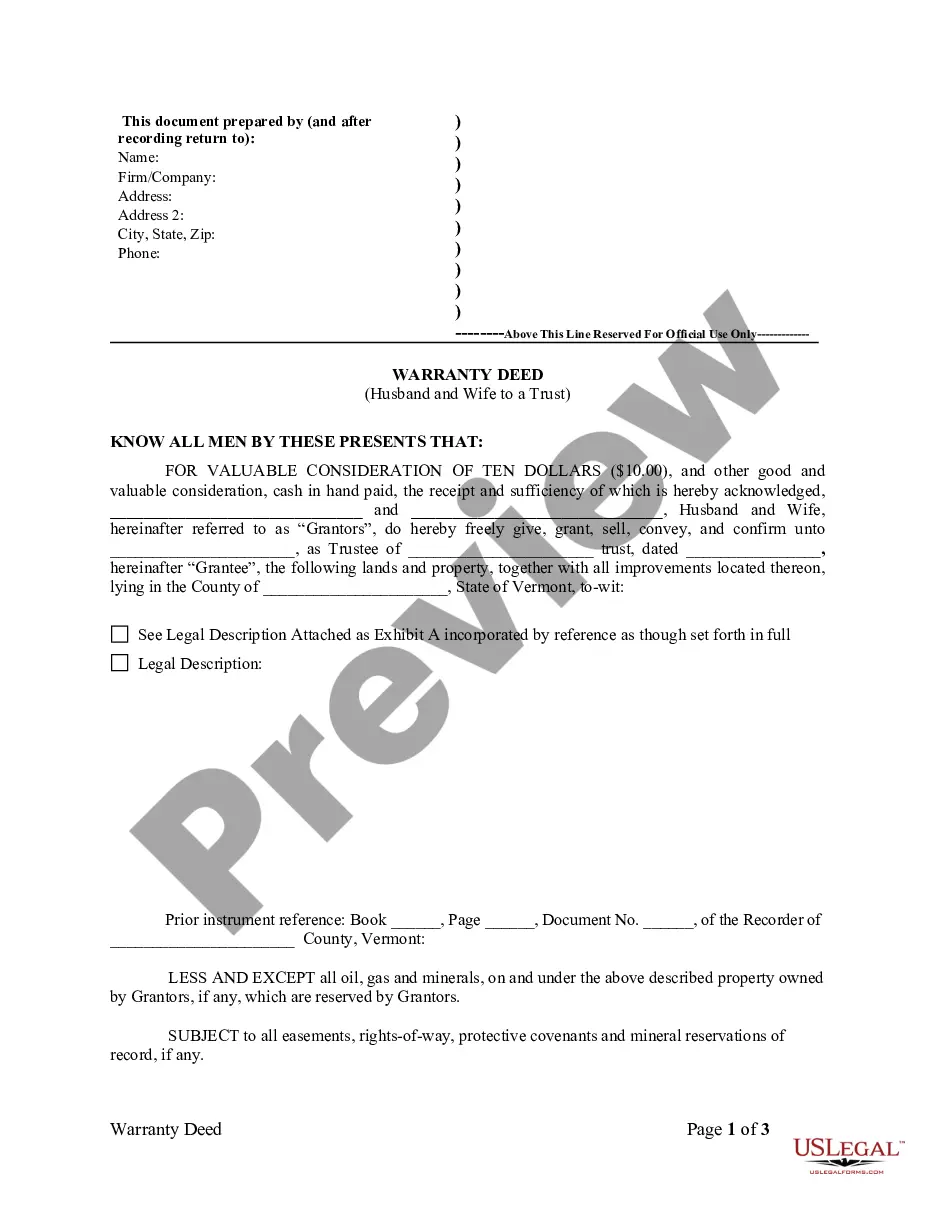
A Warranty Deed from Husband and Wife to a Trust is a legal document that allows a married couple (the grantors) to transfer ownership of real property to a trust (the grantee). This deed ensures that the couple warrants the title of the property, providing assurances that it is free from encumbrances unless otherwise noted. Unlike other deeds, this warranty deed specifically involves a married couple and a trust, serving to protect the interests of the trust's beneficiaries while preserving specific mineral rights for the grantors.
Key components of this form
- Identification of grantors (husband and wife) and grantee (trust).
- Description of the property being transferred, including legal description references.
- Warranties made by the grantors about the property title being free of encumbrances.
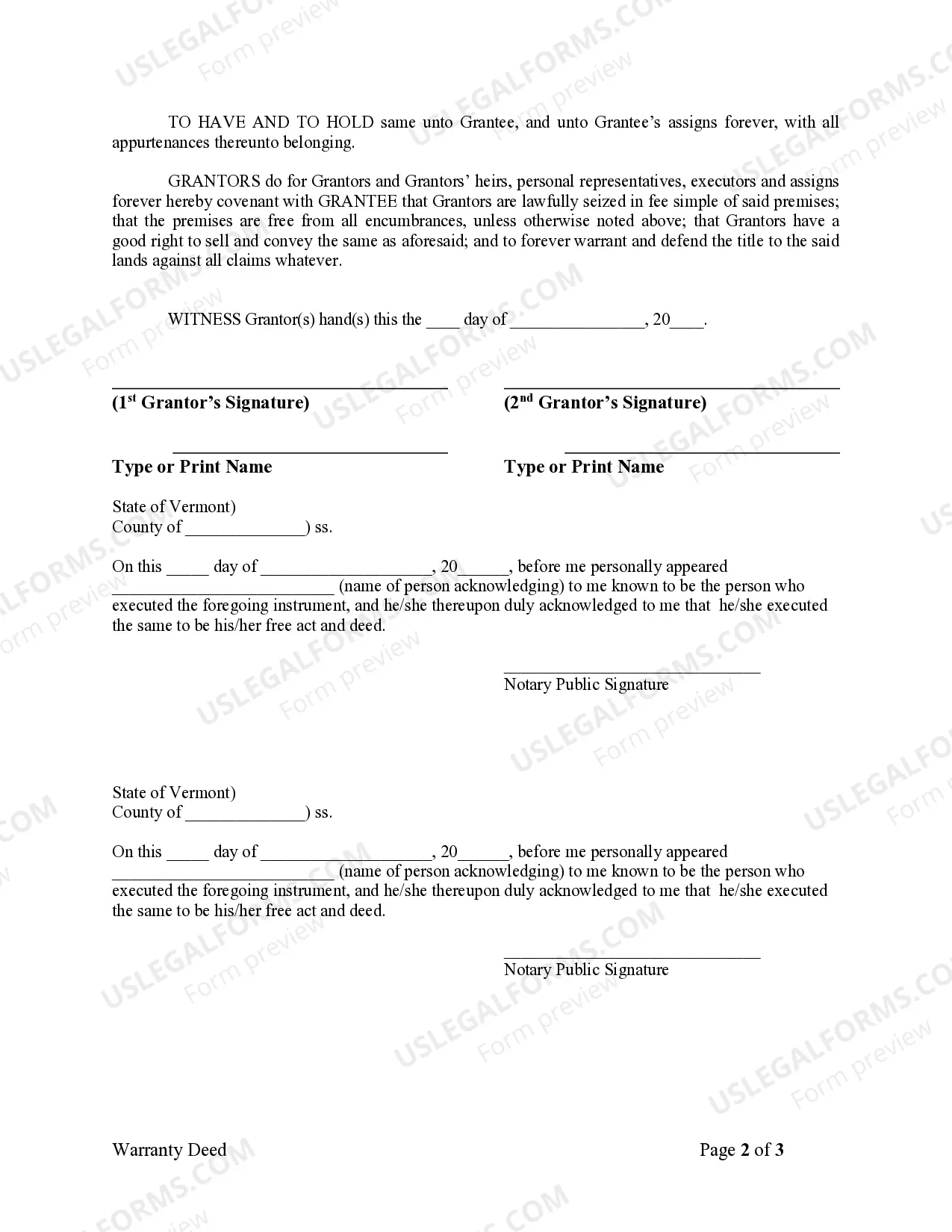
- Signature lines for both grantors along with a notary public section.
- Reservation of mineral rights, if any, retained by the grantors.





Common use cases
This form is particularly useful when a married couple wants to transfer their property into a trust for estate planning purposes. It can also be used to simplify property management and ensure that the property will be distributed according to the couple's wishes after their passing. Additionally, this deed is utilized when protecting specific interests, such as mineral rights, while ensuring the legal protection of the property within the trust.
Intended users of this form
- Married couples transferring property to a trust.
- Trustees who need documentation of property ownership under a trust.
- Individuals involved in estate planning, particularly for property management after death.
- Couples wanting to reserve mineral rights while transferring property ownership.
Completing this form step by step
- Identify the parties involved as the husband and wife grantors and the trust as the grantee.
- Specify the property being transferred, including entering the legal description as referenced in the form.
- Indicate any easements or mineral rights that may affect the property.
- Both grantors should sign the deed in front of a notary public.
- Ensure the notary public completes their section, confirming the identities and signatures.
Does this document require notarization?
This form needs to be notarized to ensure legal validity. US Legal Forms provides secure online notarization powered by Notarize, allowing you to complete the process through a verified video call, available anytime.
Get your form ready online
Our built-in tools help you complete, sign, share, and store your documents in one place.
Make edits, fill in missing information, and update formatting in US Legal Forms—just like you would in MS Word.
Download a copy, print it, send it by email, or mail it via USPS—whatever works best for your next step.
Sign and collect signatures with our SignNow integration. Send to multiple recipients, set reminders, and more. Go Premium to unlock E-Sign.
If this form requires notarization, complete it online through a secure video call—no need to meet a notary in person or wait for an appointment.
We protect your documents and personal data by following strict security and privacy standards.

Make edits, fill in missing information, and update formatting in US Legal Forms—just like you would in MS Word.

Download a copy, print it, send it by email, or mail it via USPS—whatever works best for your next step.

Sign and collect signatures with our SignNow integration. Send to multiple recipients, set reminders, and more. Go Premium to unlock E-Sign.

If this form requires notarization, complete it online through a secure video call—no need to meet a notary in person or wait for an appointment.

We protect your documents and personal data by following strict security and privacy standards.
Mistakes to watch out for
- Not providing a complete legal description of the property.
- Failing to reserve specific mineral rights, if applicable.
- Not having both grantors sign the document.
- Skipping the notarization step, which could render the deed invalid.
Benefits of using this form online
- Convenient access to a legally compliant warranty deed tailored for a married couple transferring property to a trust.
- Editability allows users to customize the document as required.
- Reliability, with forms drafted by licensed attorneys to ensure legal compliance.
Looking for another form?
Form popularity
FAQ
It's important to note that a warranty deed does not actually prove the grantor has ownership (a title search is the best way to prove that), but it is a promise by the grantor that they are transferring ownership and if it turns out they don't actually own the property, the grantor will be responsible for compensating
A warranty deed guarantees that: The grantor is the rightful owner of the property and has the legal right to transfer the title.The title would withstand third-party claims to ownership of the property. The grantor will do anything to ensure the grantee's title to the property.
Both a warranty deed and deed of trust are used to transfer the title of a property from one person to another. However, the difference between these two contracts is who is protected. As you now know, a deed of trust protects the beneficiary (lender). A warranty deed, on the other hand, protects the property owner.
Make sure the name of your trust is exactly the same named used in your trust and in your new deed. When using your trust to hold title to any real property in California, you should use the full legal name of your trust.
Open a bank account in the name of the trust. Close out any bank accounts the grantor established for the trust and put the proceeds into the new trust bank account. Cash in any life insurance policies that name the trust as beneficiary and put the proceeds into the trust bank account.
When it comes to reasons why you shouldn't add your new spouse to the Deed, the answer is simple divorce and equitable distribution. If you choose not to put your spouse on the Deed and the two of you divorce, the entire value of the home is not subject to equitable distribution.
A deed conveys ownership; a deed of trust secures a loan.
Obtain a California grant deed from a local office supply store or your county recorder's office. Complete the top line of the deed. Indicate the grantee on the second line. Enter the trustees' names and addresses.
A trustee deed offers no such warranties about the title.