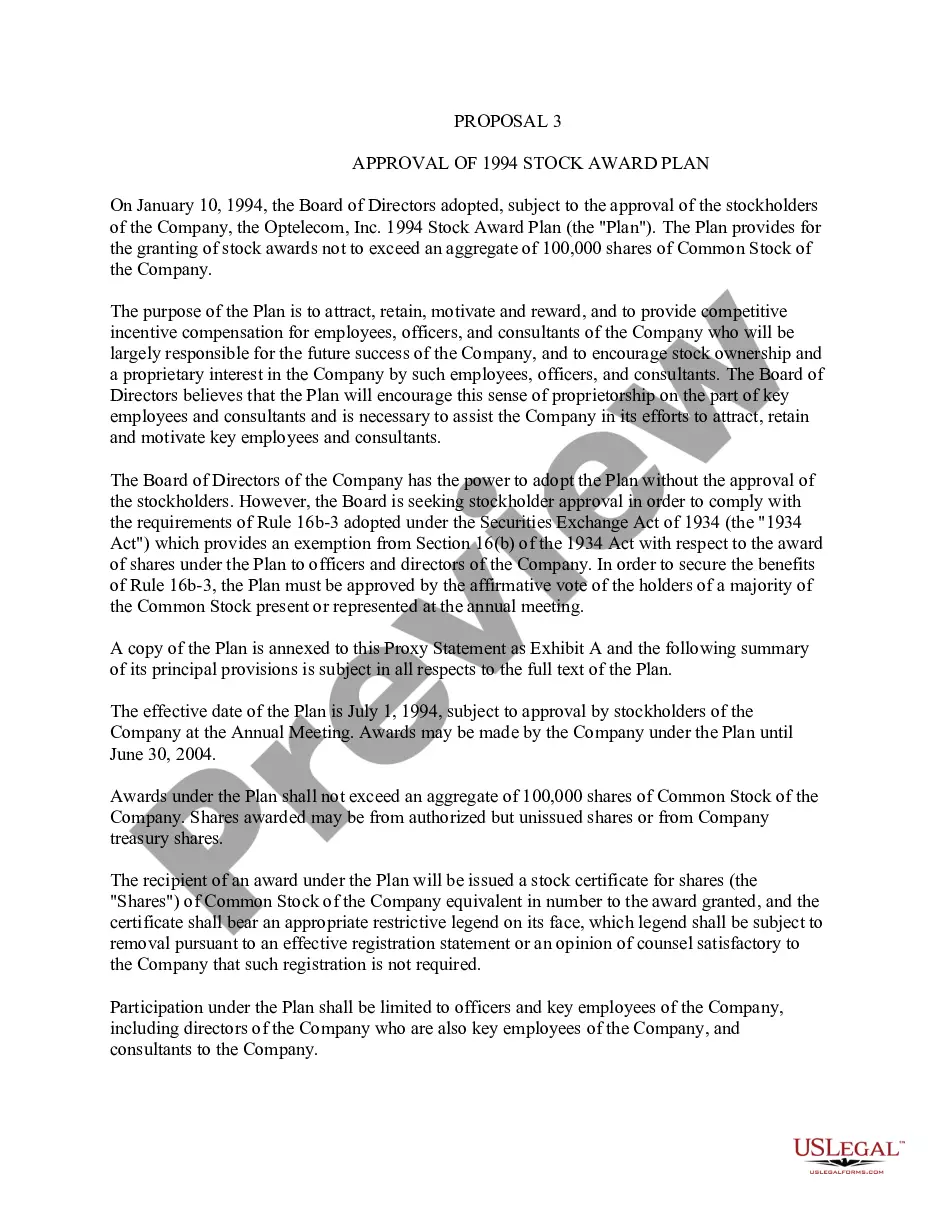
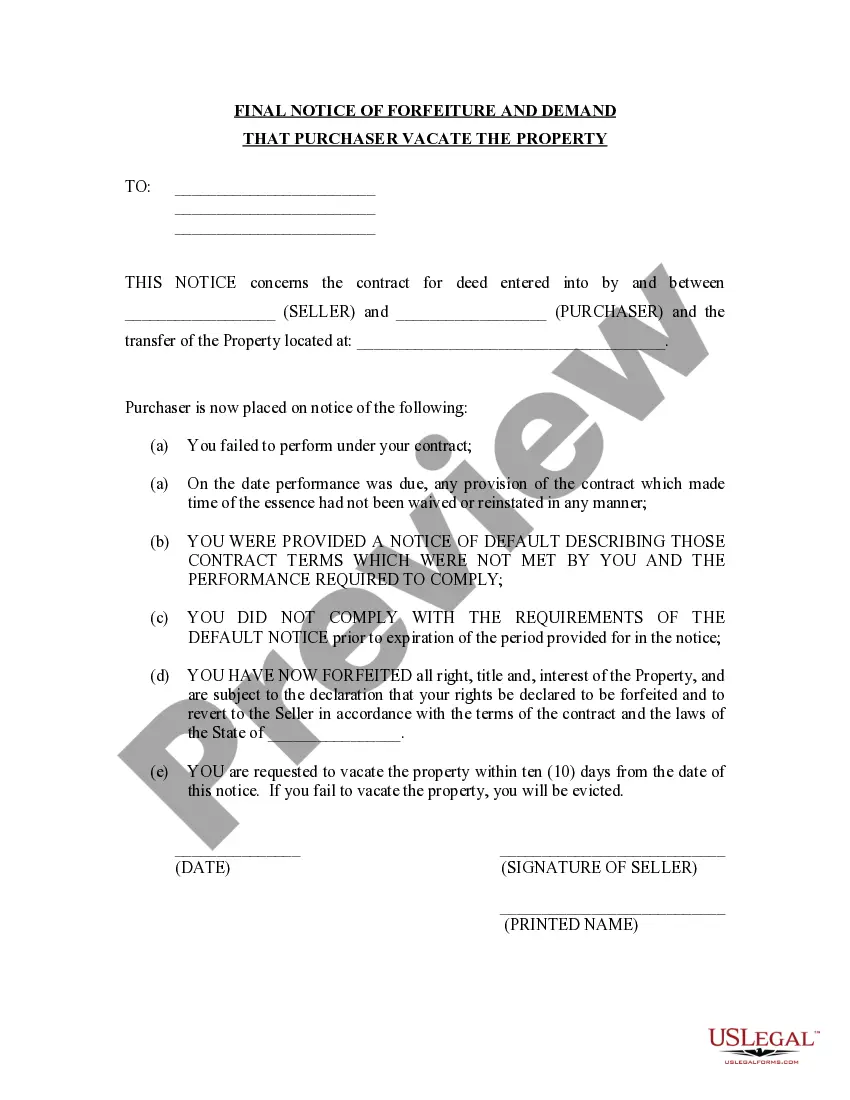
Vermont Final Notice of Forfeiture and Request to Vacate Property under Contract for Deed
About this form
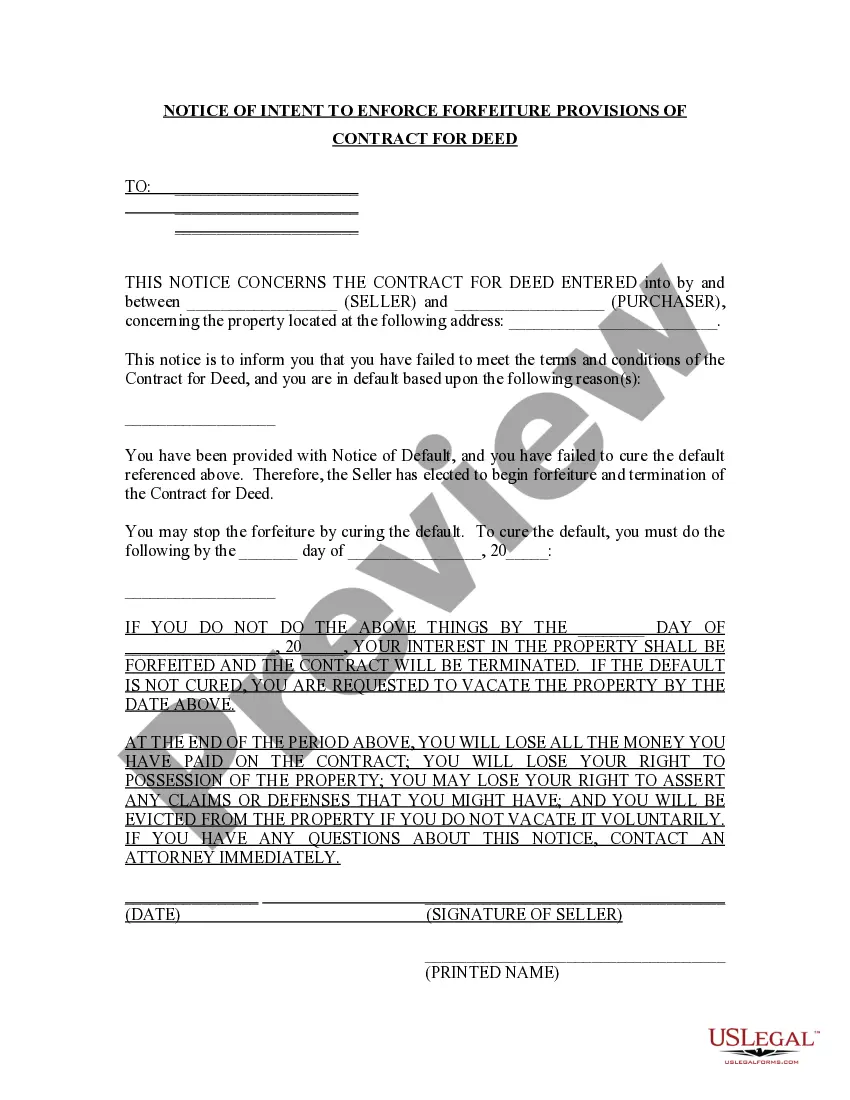
The Final Notice of Forfeiture and Request to Vacate Property under Contract for Deed is a legal document that informs the buyer of a property, following previous breach notices, that the seller has decided to cancel the contract for deed. This form signifies that any payments made are forfeited and that failing to vacate the property may lead to court action. It serves a distinct purpose compared to similar notices by clearly indicating the finality of the seller's decision and the urgency for the buyer to vacate the premises.
Key parts of this document
- Details identifying the seller and purchaser involved in the contract.
- Specific contract terms that were breached by the purchaser.
- Notice that all previous breach notifications have elapsed.
- Statement of forfeiture of payments made by the purchaser.
- Instructions for the purchaser to vacate the property promptly.

Common use cases
This form should be used when a seller has issued multiple notices of default to a buyer who has failed to comply with the terms of their contract for deed. It serves as the final notice that the seller intends to terminate the agreement and reclaim possession of the property. Using this form is essential to legally document the seller's decision and initiate any necessary legal actions if the buyer does not vacate the property.
Intended users of this form
- Sellers who wish to terminate a contract for deed due to buyer default.
- Purchasers who have received prior notices of default and have not remedied the breaches.
- Legal representatives acting on behalf of either the seller or the purchaser in property disputes.
Completing this form step by step
- Identify the parties involved: provide full names and contact information for both the seller and purchaser.
- Specify the property: include a clear description of the property involved in the contract for deed.
- Enter the breach details: outline the specific terms of the contract that were not fulfilled by the buyer.
- State the forfeiture: include a clear statement that all payments made are forfeited.
- Include the date of issuance: sign and date the notice to finalize the form.
Does this document require notarization?
This form does not typically require notarization unless specified by local law. It is advisable to check local regulations to ensure compliance, as certain jurisdictions may have specific requirements for this type of notice.
Get your form ready online
Our built-in tools help you complete, sign, share, and store your documents in one place.
Make edits, fill in missing information, and update formatting in US Legal Forms—just like you would in MS Word.
Download a copy, print it, send it by email, or mail it via USPS—whatever works best for your next step.
Sign and collect signatures with our SignNow integration. Send to multiple recipients, set reminders, and more. Go Premium to unlock E-Sign.
If this form requires notarization, complete it online through a secure video call—no need to meet a notary in person or wait for an appointment.
We protect your documents and personal data by following strict security and privacy standards.

Make edits, fill in missing information, and update formatting in US Legal Forms—just like you would in MS Word.

Download a copy, print it, send it by email, or mail it via USPS—whatever works best for your next step.

Sign and collect signatures with our SignNow integration. Send to multiple recipients, set reminders, and more. Go Premium to unlock E-Sign.

If this form requires notarization, complete it online through a secure video call—no need to meet a notary in person or wait for an appointment.

We protect your documents and personal data by following strict security and privacy standards.
Common mistakes
- Failing to correctly identify the parties involved in the contract.
- Omitting specific contract terms that were breached.
- Not clearly indicating the forfeiture of payments.
- Neglecting to sign and date the form.
- Not providing proper notice to the other party before using this form.
Advantages of online completion
- Convenient access: download the form anytime and anywhere.
- Editability: easily fill in and customize fields to suit your situation.
- Professional quality: forms are drafted by licensed attorneys to ensure legal compliance.
Legal use & context
- This form serves as an official document to enforce contract terms.
- It helps protect sellers by legally outlining the consequences of the buyer's default.
- Non-compliance can lead to legal proceedings to reclaim the property.
Key takeaways
- The form is crucial for notifying buyers of contract cancellations due to default.
- It should be used after all prior notices have been addressed.
- Proper completion ensures legal protection for the seller in reclaiming property.
Looking for another form?
Form popularity
FAQ
To start a case, you must file a complaint with the court. In that complaint, you can ask for an eviction order. You must file your complaint no more than 60 days after the end date listed in your notice to the tenant. You will be the plaintiff and the tenant will be the defendant.
Your landlord can end the let at any time by serving a written 'notice to quit'. The notice period will depend on the tenancy or agreement, but is often at least 4 weeks.
Under Vermont state law if a landlord is terminating a tenancy for none of the reasons explained above or for no given reason (called a termination for no cause in legal language), and the tenant is renting by the month, the tenant is entitled to at least 60 days written notice, or 21 days written notice if renting
When the tenancy is month-to-month, the tenant must give the landlord 15 days' notice before the end of any monthly period. (In Miami, the tenant must give the landlord 30 days' notice before the end of the monthly period).
In Colorado, evictions are sometimes referred to as forcible entry & detainer (FED). Before you can file for eviction, you must generally provide 10 days' notice (increased from 3 days prior) for tenants to correct a deficiency or leave the property, except in certain circumstances.