Parking User's Waiver and Release From Liability of Premises Owner
About this form
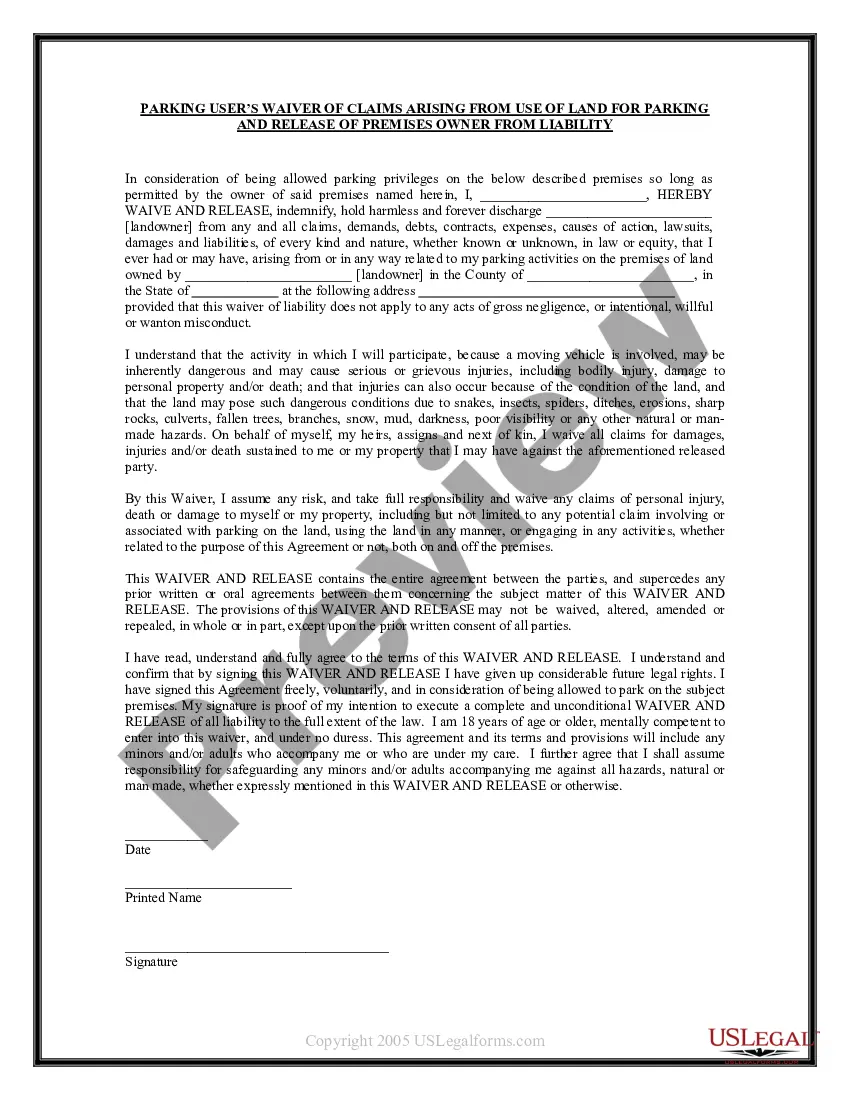
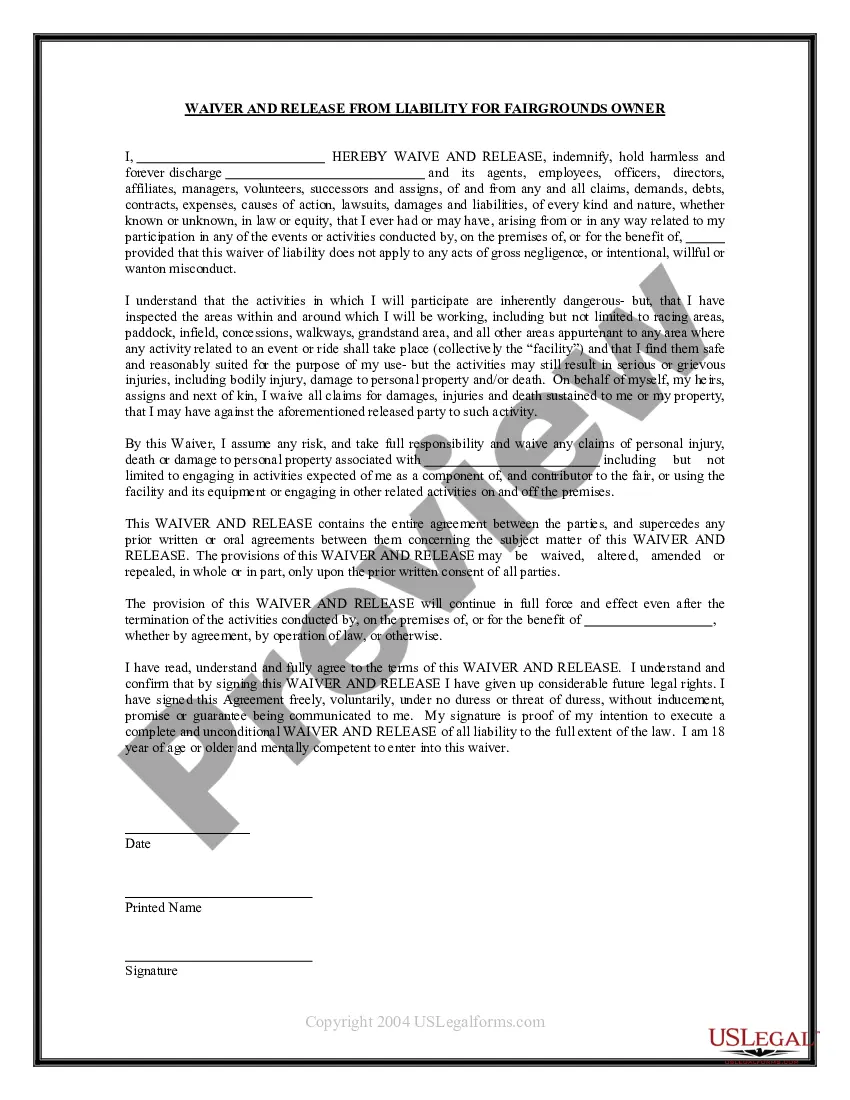
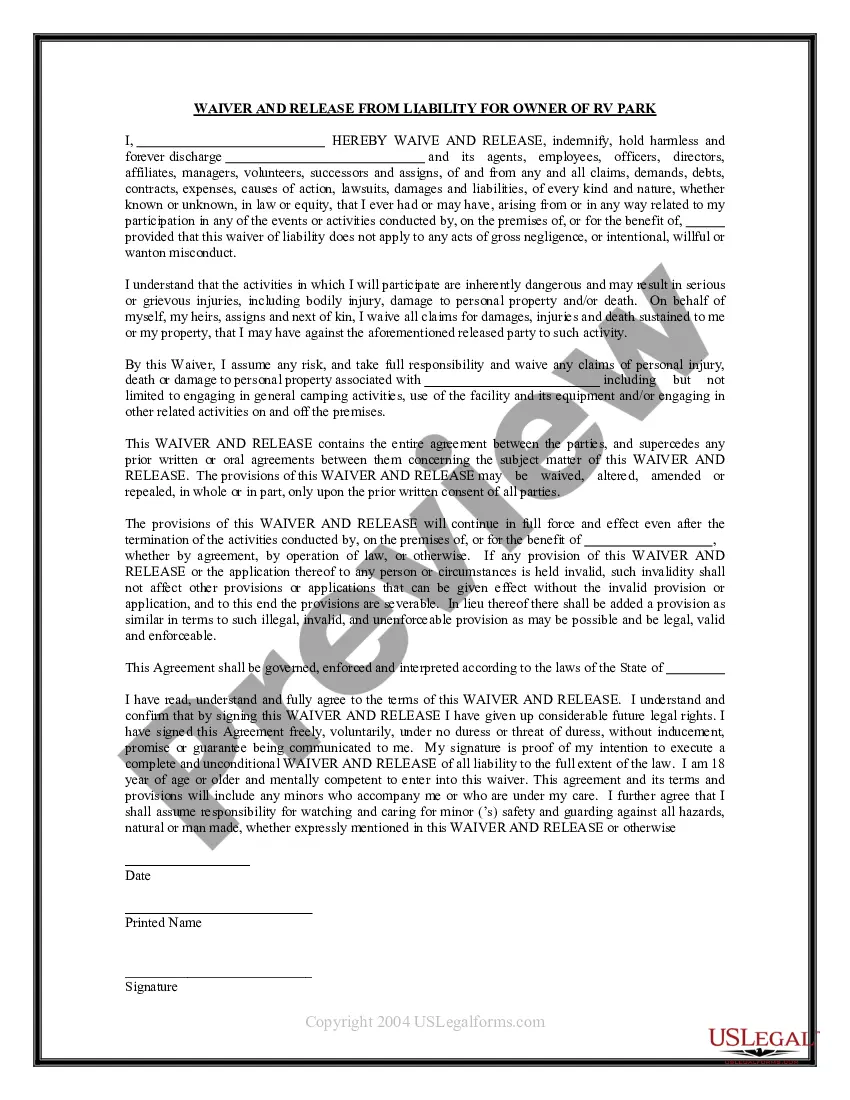
The Parking User's Waiver and Release From Liability of Premises Owner is a legal document that releases a property owner from liability when allowing an individual to park on their land. This waiver emphasizes that the individual assumes all risks associated with parking on the premises, providing protection for property owners against claims of personal injury or property damage. It differs from standard parking agreements as it specifically includes a waiver of liability for injuries or damages that may occur on the property.
What’s included in this form
- Assumption of risk: The individual acknowledges and accepts the risks associated with parking on the property.
- Release from liability: The property owner is released from any claims regarding personal injury, death, or property damage.
- Entire agreement clause: This section affirms that the waiver represents the complete agreement between the parties.
- Competency assurance: The individual confirms they are of legal age and mentally competent to enter into the waiver.
- Inclusion of minors: Responsibilities for any minors or adults under the individual's care are also covered.

When to use this form
This form is useful in situations where a property owner allows individuals to park their vehicles on their land, particularly when such permission could expose the owner to liability for injuries or damages. Common scenarios include private property parking for events, residential parking agreements, or temporary parking solutions at construction sites or business locations.
Who this form is for
- Property owners who wish to minimize their liability when allowing parking on their premises.
- Individuals who want to park on private property and need to understand the associated risks.
- Event organizers who require parking for attendees on private land.
Completing this form step by step
- Identify the parties involved: Enter the names of the property owner and the individual parking.
- Specify the property: Clearly describe the location where parking will occur.
- Read the terms: Review the waiver's clauses to understand the rights you are giving up.
- Sign and date the form: The individual must sign and date the waiver to make it legally binding.
- Include responsibility for minors: If applicable, confirm responsibility for any minors accompanying the individual.
Does this document require notarization?
Notarization is not commonly needed for this form. However, certain documents or local rules may make it necessary. Our notarization service, powered by Notarize, allows you to finalize it securely online anytime, day or night.
Get your form ready online
Our built-in tools help you complete, sign, share, and store your documents in one place.
Make edits, fill in missing information, and update formatting in US Legal Forms—just like you would in MS Word.
Download a copy, print it, send it by email, or mail it via USPS—whatever works best for your next step.
Sign and collect signatures with our SignNow integration. Send to multiple recipients, set reminders, and more. Go Premium to unlock E-Sign.
If this form requires notarization, complete it online through a secure video call—no need to meet a notary in person or wait for an appointment.
We protect your documents and personal data by following strict security and privacy standards.

Make edits, fill in missing information, and update formatting in US Legal Forms—just like you would in MS Word.

Download a copy, print it, send it by email, or mail it via USPS—whatever works best for your next step.

Sign and collect signatures with our SignNow integration. Send to multiple recipients, set reminders, and more. Go Premium to unlock E-Sign.

If this form requires notarization, complete it online through a secure video call—no need to meet a notary in person or wait for an appointment.

We protect your documents and personal data by following strict security and privacy standards.
Mistakes to watch out for
- Failing to read the waiver fully before signing.
- Not including necessary details about the property where parking is allowed.
- Overlooking the requirement to include guardianship for minors.
Benefits of completing this form online
- Convenience: Download and fill out the form at your own pace.
- Editability: Easily customize the form to suit your specific circumstances.
- Reliability: Ensured accuracy by using templates drafted by licensed attorneys.
Legal use & context
- This waiver is designed to limit liability for property owners effectively.
- It is enforceable as long as it is properly executed and complies with state laws.
- Users should be aware that without proper completion, the waiver may not hold up in court.
Summary of main points
- The Parking User's Waiver releases property owners from liability for parking-related injuries or damages.
- This form is essential for property owners to protect themselves if allowing parking on their land.
- Understanding the terms of the waiver is critical before signing.
Looking for another form?

Form popularity
FAQ
Get help. Writing a waiver should not be complicated. Use the correct structure. Proper formatting. Include a subject line. Include a caution! Talk about the activity risks. Do not forget an assumption of risk. Hold harmless.
In many cases, the waiver is not enforceable.If you've been injured due to negligent actions, you can sue even if you signed a waiver. Winning a lawsuit concerning negligence is not uncommon. Many celebrities have sued for negligence even though they signed documents stating they understood the risks.
A liability waiver, or release of liability, is a legal document that a company or organization has you sign in order to protect them from being sued in the event that you are injured.
A liability waiver, or release waiver, is a legal document that a company or organization requires members of the public to sign in order to protect their organization from being sued if you sustain an injury.Depending on the facts of your case, you may still be able to file a lawsuit and recover damages.
Release Versus Waiver The main difference between releases and waivers is the transferring of ownership. When rights are released, they are transferred to another party. When rights are waived, they are gone altogether.In the case of the skydiver, they might be asked to sign a release form rather than a waiver.
In California, a liability waiver must be clear, unambiguous, and explicit. In other words, waivers cannot be printed in faded ink, in small font, on the back of a paper, or in an otherwise ambiguous form. If the waiver that you sign is not represented clearly, it may not hold up in the event of a lawsuit.
If you've been injured due to negligent actions, you can sue even if you signed a waiver. Winning a lawsuit concerning negligence is not uncommon. Many celebrities have sued for negligence even though they signed documents stating they understood the risks.
In many cases, the waiver is not enforceable.If you've been injured due to negligent actions, you can sue even if you signed a waiver. Winning a lawsuit concerning negligence is not uncommon. Many celebrities have sued for negligence even though they signed documents stating they understood the risks.
A release and waiver agreement is an enforceable promise not to pursue legal action in exchange for compensation. The releasee gives money or some other form of compensation to the releasor, who then agrees not to press charges, sue, or take any other legal action against the releasee.