Residuals Clause for Basic Nondisclosure Agreement
What is this form?
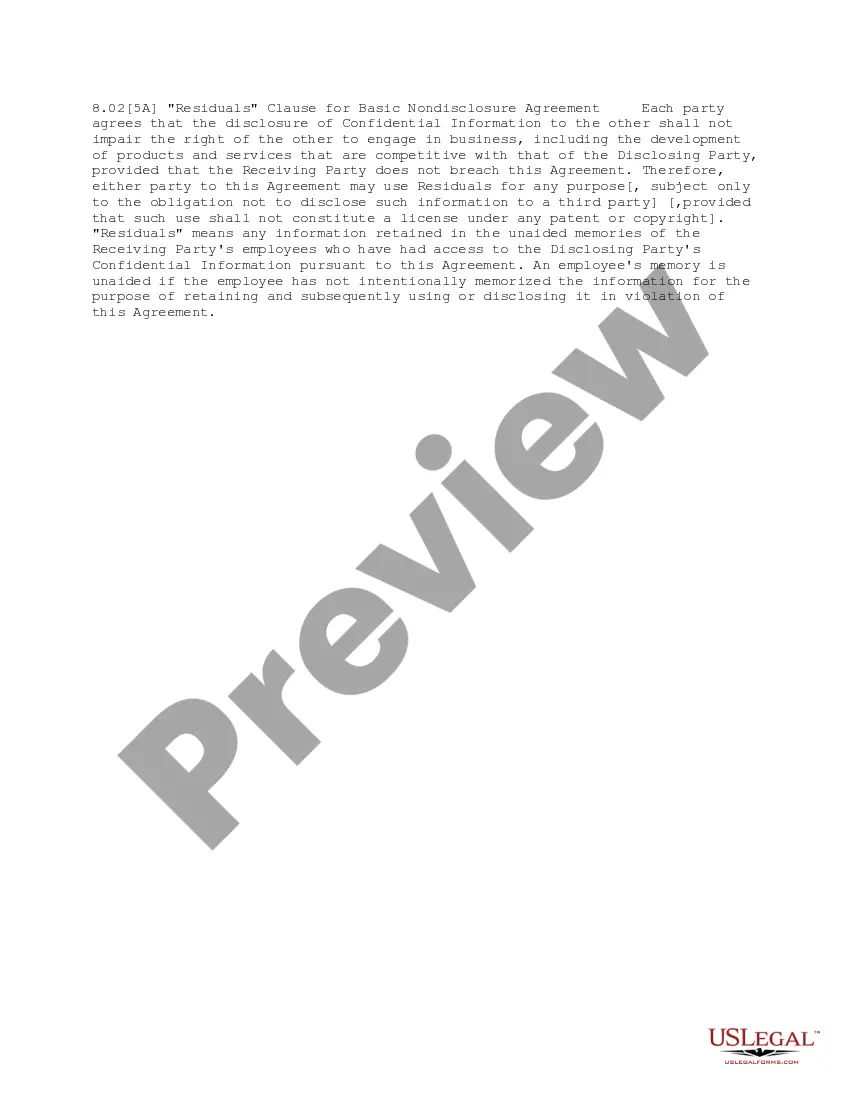
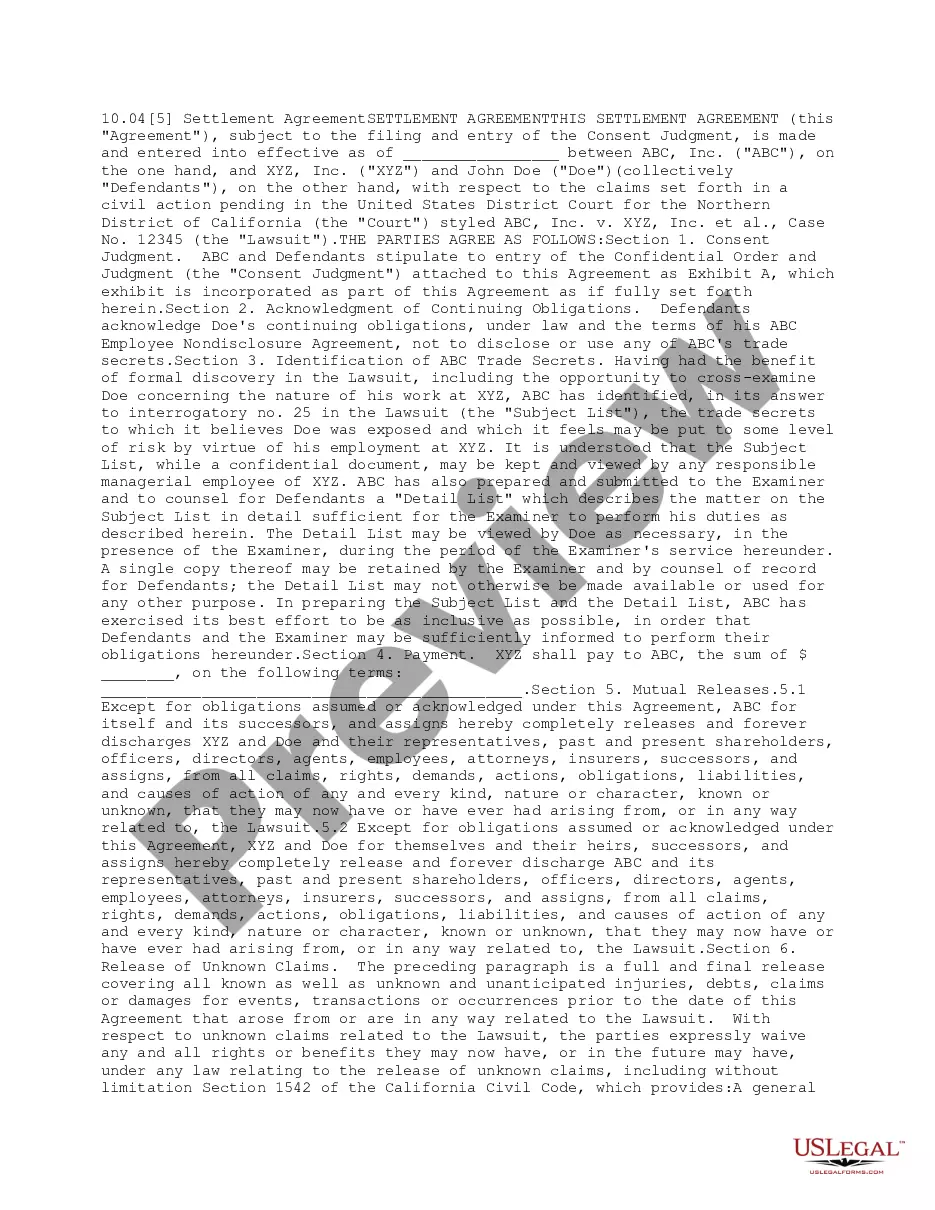
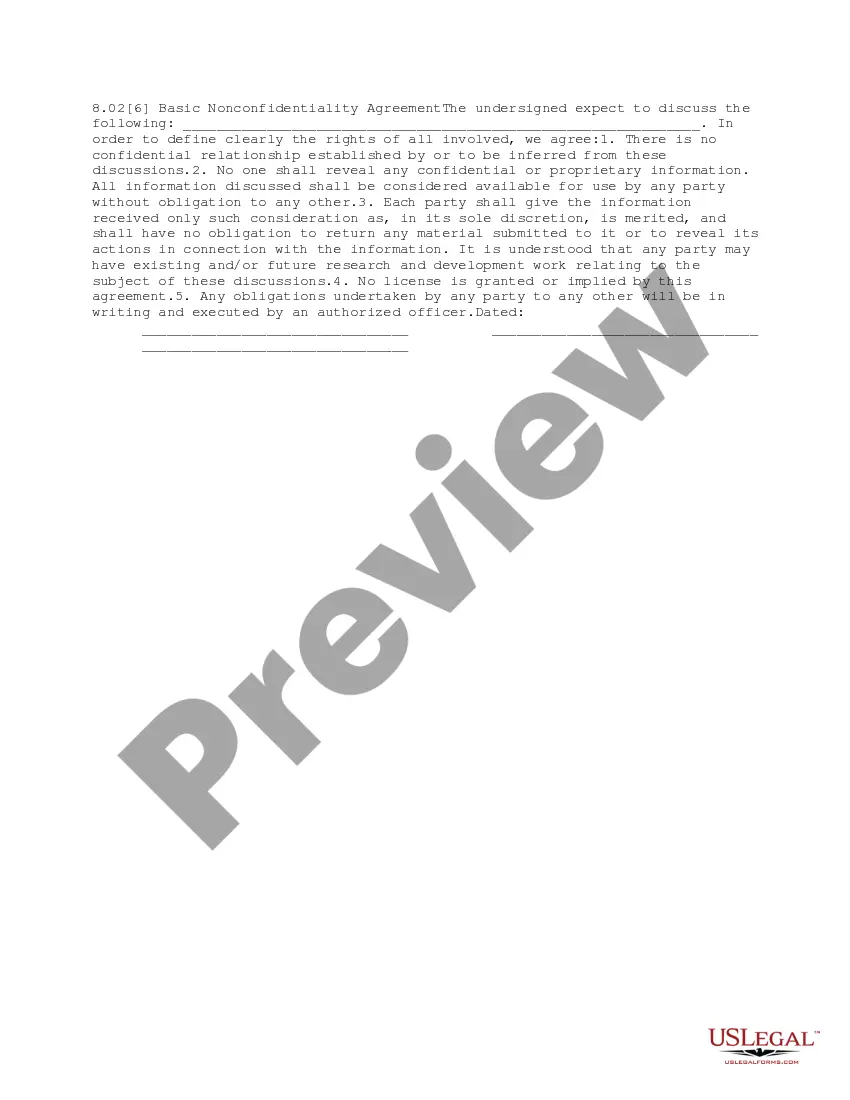
This form is a residuals clause for a basic nondisclosure agreement. It is used in agreements involving the nondisclosure of confidential information such as licensing, patents, and commercial trade secrets. The residuals clause allows for specific disclosures of confidential information under narrowly defined circumstances, distinguishing it from standard nondisclosure agreements by permitting certain uses of residual information without breaching the contract.
What’s included in this form
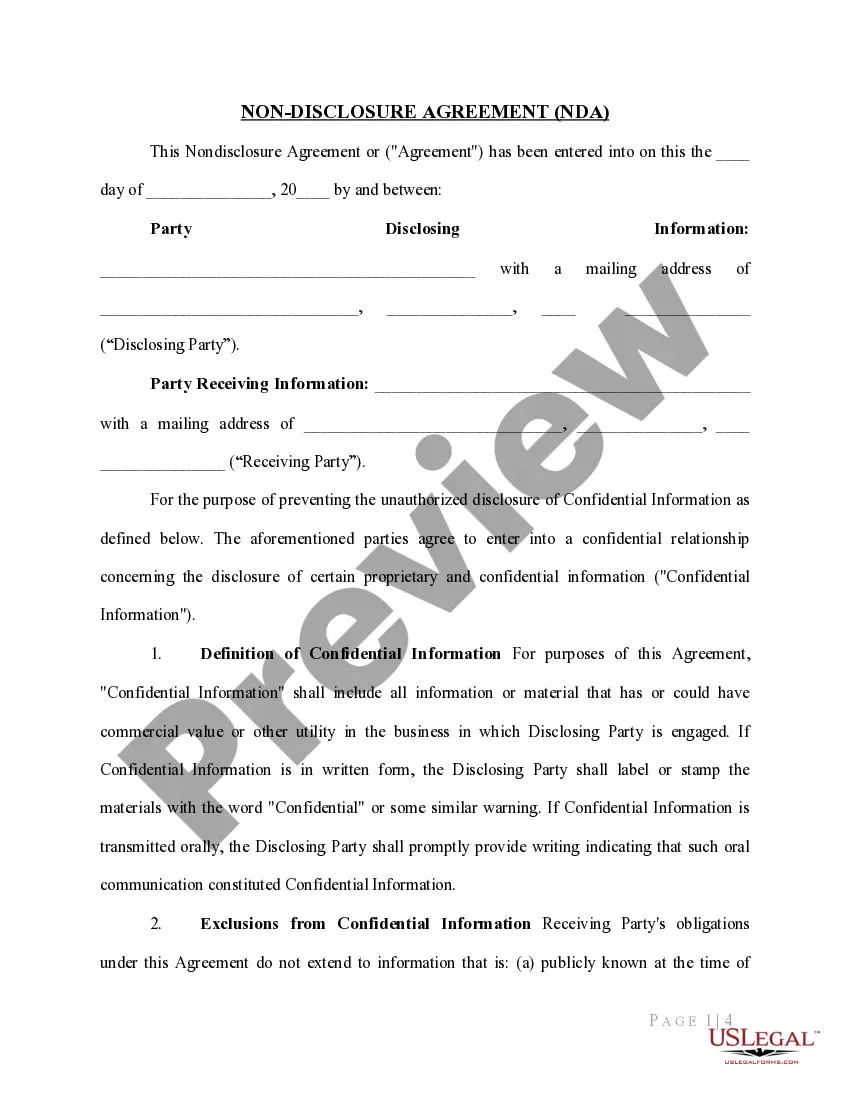
- Definition of Confidential Information: Outlines what constitutes confidential information under the agreement.
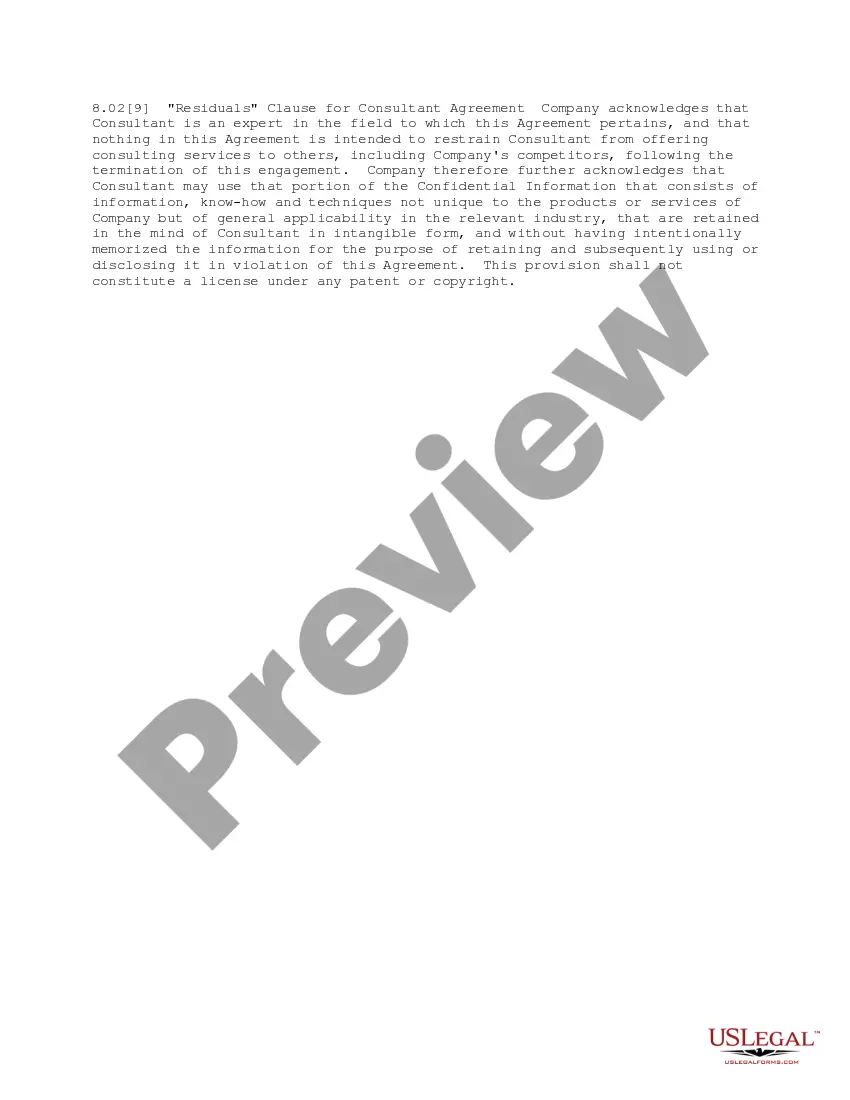
- Residuals Clause: Specifies that both parties may retain and use information in their unaided memories.
- Limitations on Disclosure: States the obligation not to disclose retained information to third parties.
- Conditions for Use: Clarifies that the use of residuals does not imply a license under any patent or copyright.
Situations where this form applies
You should use this form when entering into a nondisclosure agreement where you anticipate sharing confidential information. It is especially useful when both parties wish to protect their proprietary information while allowing them to use residual knowledge that may arise from their business interactions.
Who should use this form
- Businesses looking to protect their intellectual property during negotiations.
- Inventors or product developers who need to disclose information while safeguarding their ideas.
- Lawyers preparing nondisclosure agreements for clients involving sensitive information.
- Startups engaging in partnerships that require sharing of proprietary trade secrets.
How to prepare this document
- Identify the parties involved by entering their names and addresses.
- Specify the definition of Confidential Information relevant to your agreement.
- Include the residuals clause, ensuring it reflects your intentions regarding the use of information.
- Outline any limitations on the disclosure of this information to third parties.
- Make sure both parties sign and date the agreement to validate it.
Does this form need to be notarized?
This form does not typically require notarization unless specified by local law. It is advisable to check the requirements in your jurisdiction to ensure compliance.
Get your form ready online
Our built-in tools help you complete, sign, share, and store your documents in one place.
Make edits, fill in missing information, and update formatting in US Legal Forms—just like you would in MS Word.
Download a copy, print it, send it by email, or mail it via USPS—whatever works best for your next step.
Sign and collect signatures with our SignNow integration. Send to multiple recipients, set reminders, and more. Go Premium to unlock E-Sign.
If this form requires notarization, complete it online through a secure video call—no need to meet a notary in person or wait for an appointment.
We protect your documents and personal data by following strict security and privacy standards.

Make edits, fill in missing information, and update formatting in US Legal Forms—just like you would in MS Word.

Download a copy, print it, send it by email, or mail it via USPS—whatever works best for your next step.

Sign and collect signatures with our SignNow integration. Send to multiple recipients, set reminders, and more. Go Premium to unlock E-Sign.

If this form requires notarization, complete it online through a secure video call—no need to meet a notary in person or wait for an appointment.

We protect your documents and personal data by following strict security and privacy standards.
Mistakes to watch out for
- Failing to clearly define confidential information, which may lead to disputes.
- Omitting specific conditions under which residuals can be used.
- Not including a clause addressing the duration of confidentiality obligations.
Why complete this form online
- Convenience of downloading and customizing the form according to your needs.
- Access to legally vetted templates, minimizing the risk of errors.
- Easy to store and manage in digital format.
Legal use & context
- This form can enhance enforceability by clearly outlining the terms around confidential information usage.
- Residuals clauses are recognized in many jurisdictions but must be used thoughtfully to avoid conflicts with non-compete agreements.
- It is crucial to ensure the language accurately reflects the intentions of both parties to reduce potential legal disputes.
Summary of main points
- The Residuals Clause allows certain uses of retained information from confidentiality agreements.
- Clear definitions and obligations are critical to protect all parties involved.
- This form is adaptable for use across various businesses and legal scenarios concerning confidential information.
Looking for another form?



Form popularity
FAQ
And while every non-disclosure agreement is as unique as the parties and the agreement involved, terms of 1 10 years are standard, with the duration of confidentiality lasting indefinitely on trade secrets and as long as possible (or as is necessary) for other forms of IP.
A residuals clause or residual information clause in an NDA is designed to allow the receiving party (usually the buyer) to use and/or disclose Confidential Information received from the disclosing party (usually the seller) without violating the NDA.
Identification of the parties. Definition of what is deemed to be confidential. The scope of the confidentiality obligation by the receiving party. The exclusions from confidential treatment. The term of the agreement.
Don't Release Information Before the Agreement Is Signed. Work With a Professional. Use a Unilateral NDA, if Possible. Choose an End Date. Define the Confidential Information. Provide Extra Protection for Trade Secrets. Define How the Information Will Be Used. Require Return of the Information.
The cold hard truth is that most NDAs do not hold up in court. Non-Disclosure Agreements are most effective in establishing a paper trail of confidential information as it relates to partnerships, and discouraging partners from misappropriating proprietary information.
Today's contract tip is about indemnification in non-disclosure agreements (NDAs). Smart lawyers have different views on it. But this smart lawyer's view is that commercial NDAs should never include indemnity provisions.
Read the Duration clauses. Good NDAs will have two different terms of duration. Read the termination clause. Like any other relationship, business partnerships can come to an early end unexpectedly. Read the Return of Information clause.
A non-disclosure agreement may be unilateral, that is, one person is bound by the obligation to keep a secret, or it may be mutual, in which both parties have an obligation to keep the secrets of the other disclosing party. As in all contracts, both parties must receive a benefit; this benefit is called consideration.