Jury Instructions
What this document covers
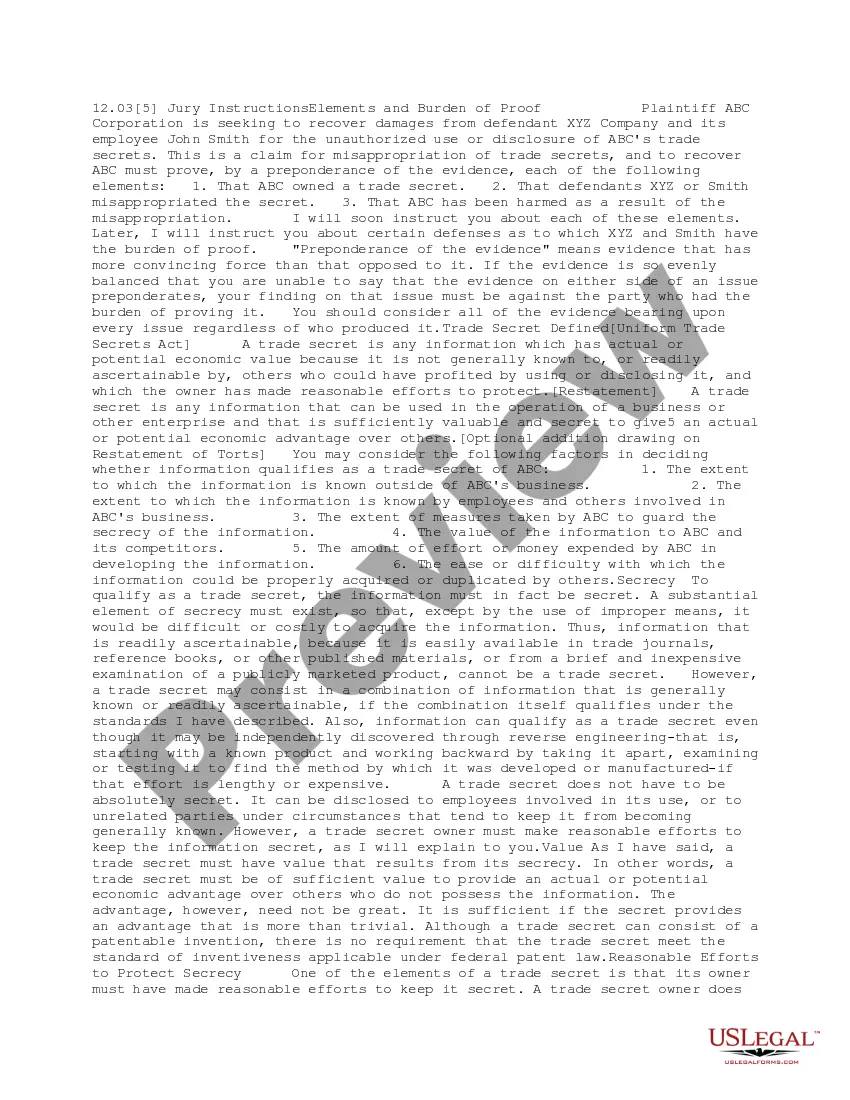
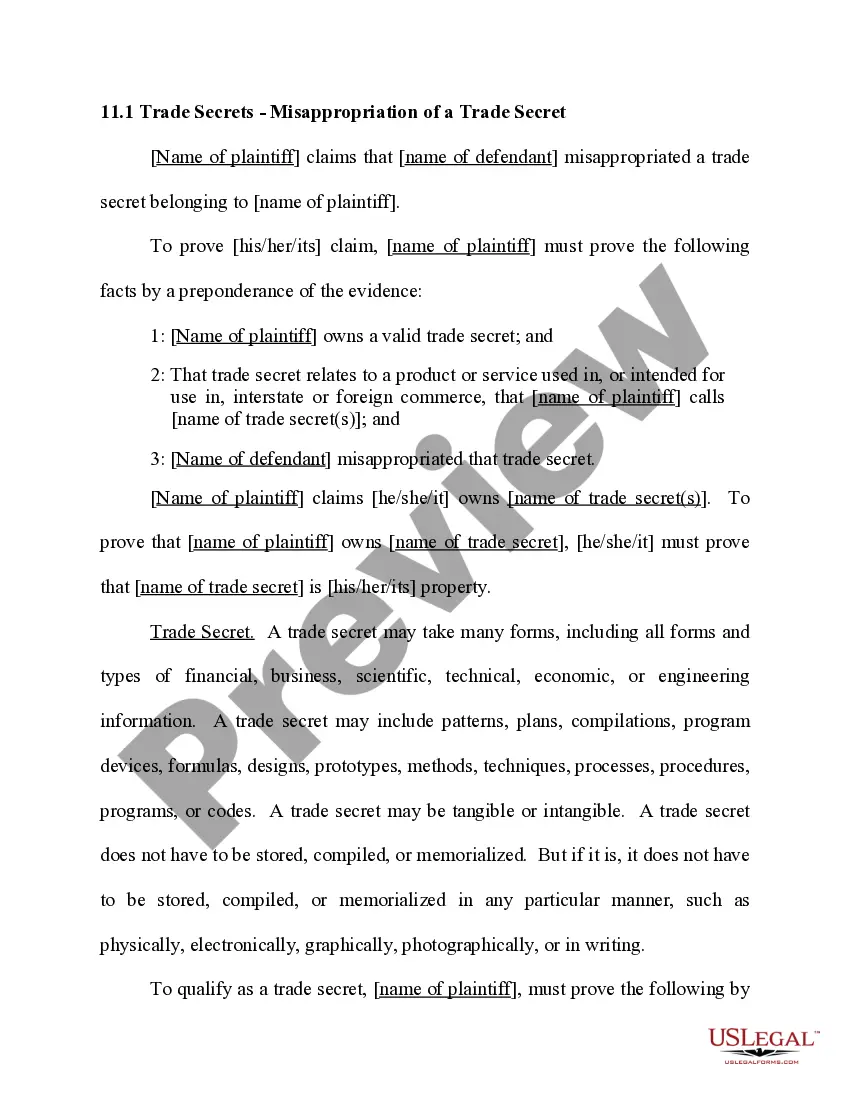
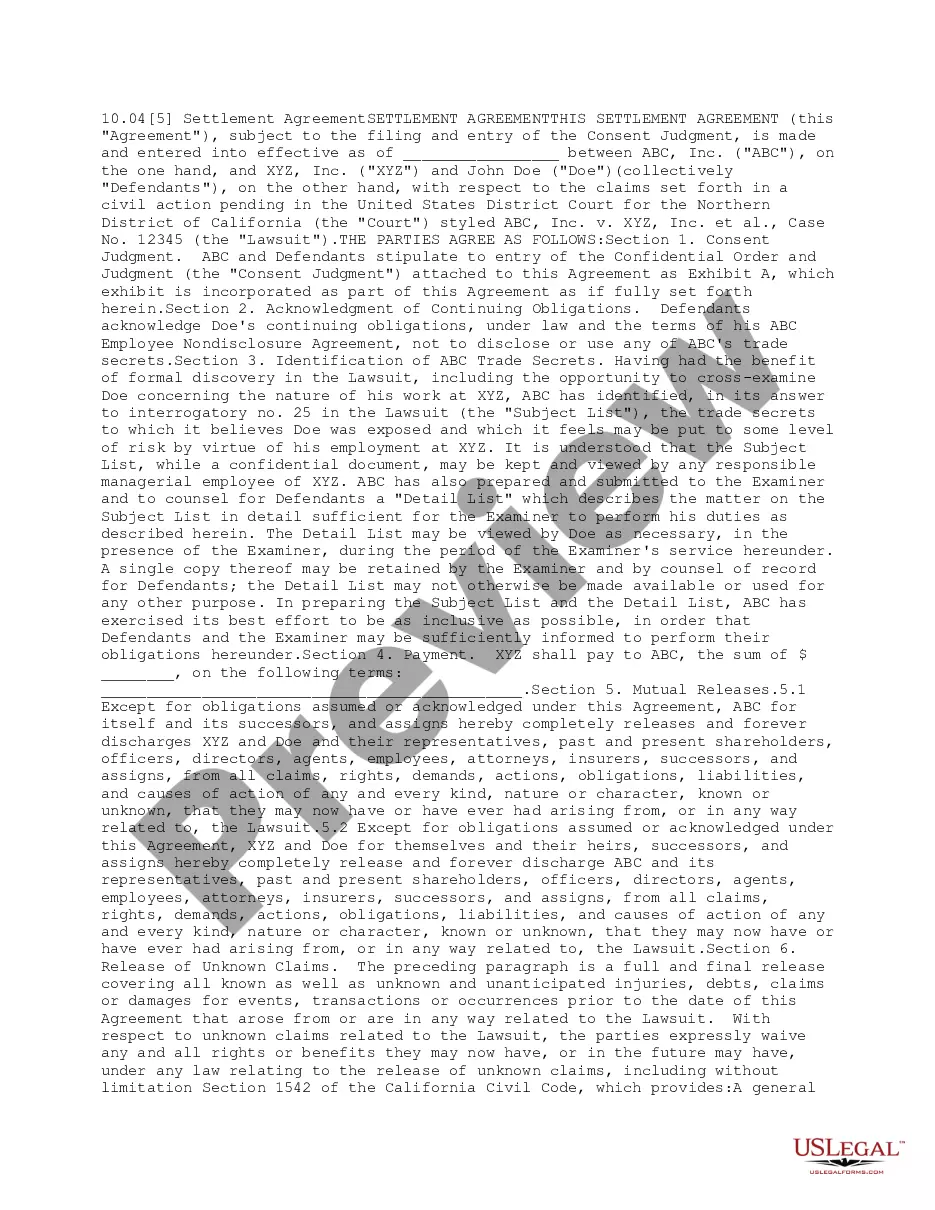
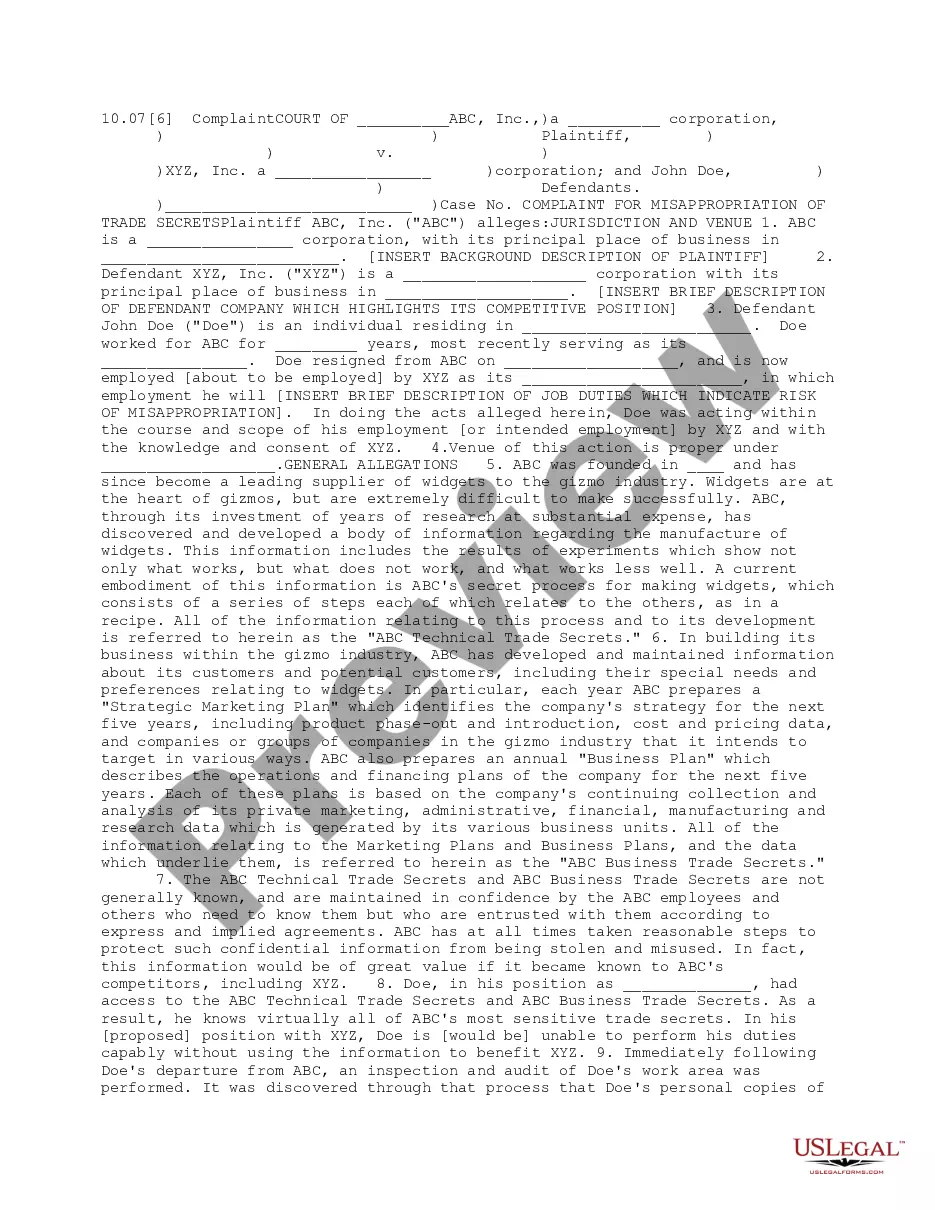
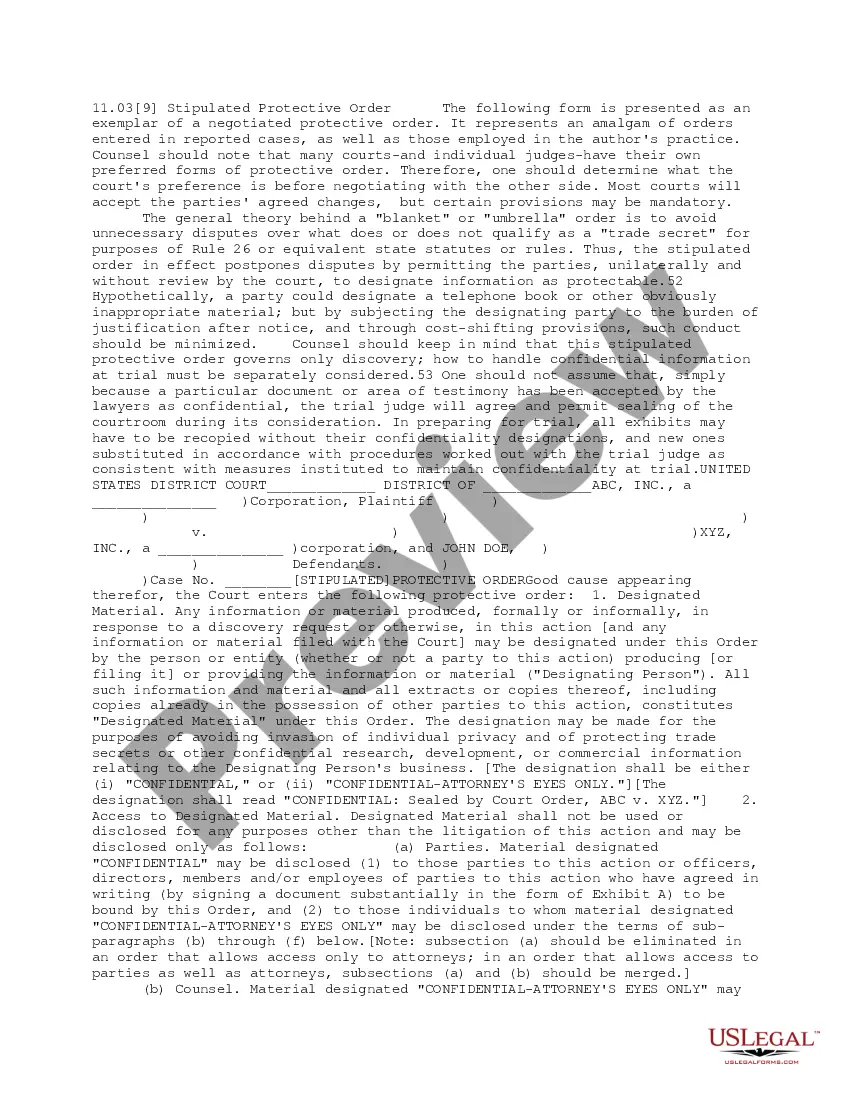
This Jury Instructions form provides guidance for jurors in cases involving misappropriation of trade secrets. It outlines the essential elements that must be proven by the plaintiff in order to establish claims of misappropriation, distinguishing it from other legal forms related to intellectual property. This form is specifically tailored for legal cases where evidence of trade secrets and their unauthorized use are at the forefront of the dispute.
Key components of this form
- Elements and burden of proof required to establish a claim for misappropriation of trade secrets.
- Definition of a trade secret according to the Uniform Trade Secrets Act.
- Criteria for determining if information qualifies as a trade secret.
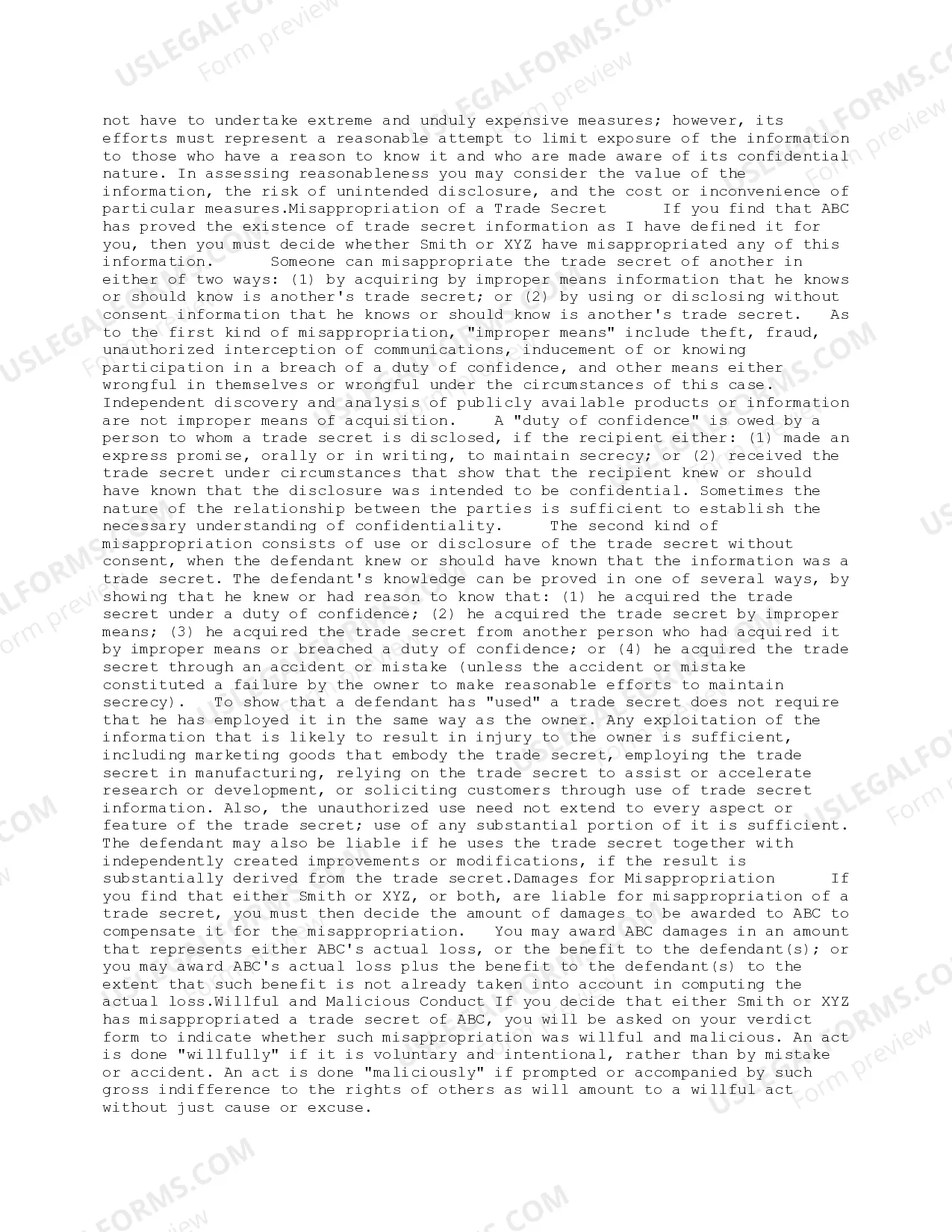
- Details on misappropriation methods and defendant's duties of confidence.
- Guidance on assessing damages for misappropriation.
- Clarification of what constitutes willful and malicious conduct regarding misappropriation.
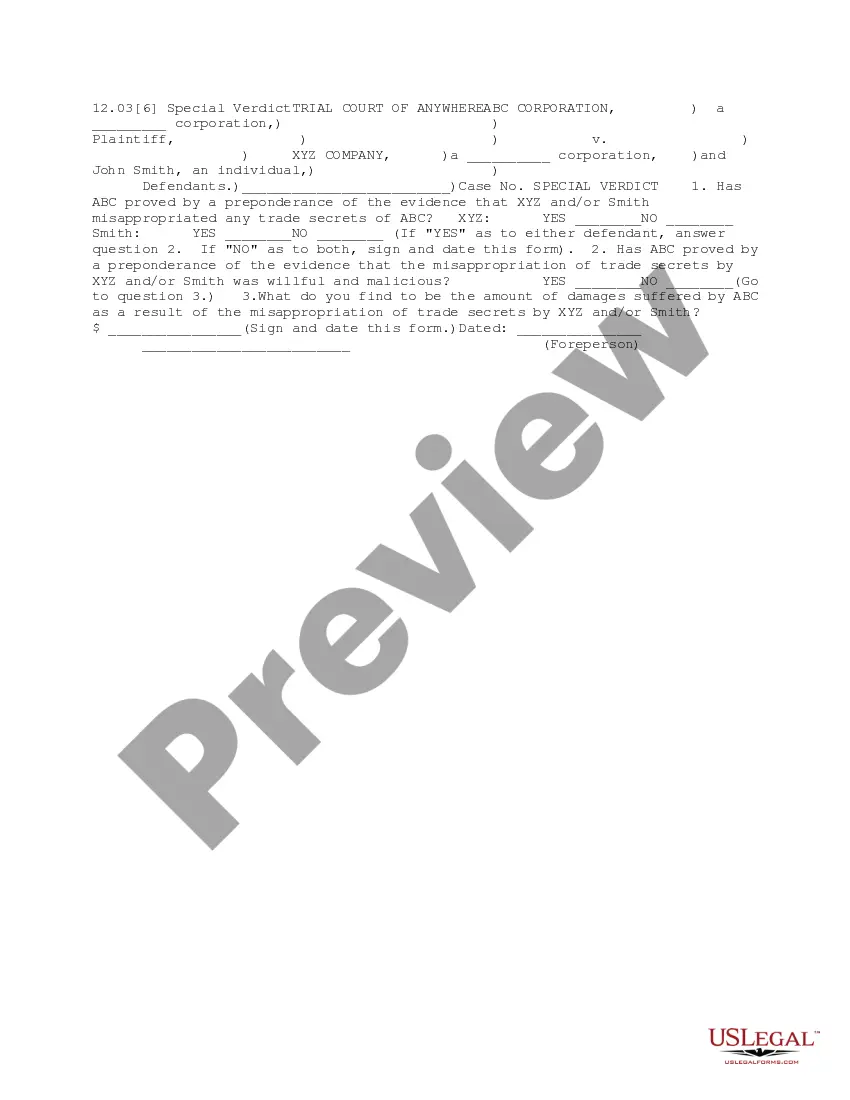
Situations where this form applies
This form is necessary when a company believes its trade secrets have been unlawfully used or disclosed by another party. It is applicable in civil litigation cases where a plaintiff must prove that their trade secrets were misappropriated, thus justifying the need for legal recourse to recover damages.
Who can use this document
- Business owners who suspect their trade secrets have been misappropriated.
- Legal professionals representing clients in intellectual property disputes.
- Companies seeking to strengthen their case with clear juror instructions on trade secrets.
Steps to complete this form
- Identify the plaintiff and defendants involved in the trade secret dispute.
- Specify the trade secret information that is claimed to have been misappropriated.
- List the efforts made by the plaintiff to maintain the confidentiality of the trade secrets.
- Document any evidence supporting the claim of misappropriation.
- Include information on the damages suffered due to the alleged misappropriation.
Does this document require notarization?
Notarization is not commonly needed for this form. However, certain documents or local rules may make it necessary. Our notarization service, powered by Notarize, allows you to finalize it securely online anytime, day or night.
Get your form ready online
Our built-in tools help you complete, sign, share, and store your documents in one place.
Make edits, fill in missing information, and update formatting in US Legal Forms—just like you would in MS Word.
Download a copy, print it, send it by email, or mail it via USPS—whatever works best for your next step.
Sign and collect signatures with our SignNow integration. Send to multiple recipients, set reminders, and more. Go Premium to unlock E-Sign.
If this form requires notarization, complete it online through a secure video call—no need to meet a notary in person or wait for an appointment.
We protect your documents and personal data by following strict security and privacy standards.

Make edits, fill in missing information, and update formatting in US Legal Forms—just like you would in MS Word.

Download a copy, print it, send it by email, or mail it via USPS—whatever works best for your next step.

Sign and collect signatures with our SignNow integration. Send to multiple recipients, set reminders, and more. Go Premium to unlock E-Sign.

If this form requires notarization, complete it online through a secure video call—no need to meet a notary in person or wait for an appointment.

We protect your documents and personal data by following strict security and privacy standards.
Typical mistakes to avoid
- Failing to clearly define what constitutes the trade secret.
- Not demonstrating reasonable efforts to protect the trade secret.
- Overlooking the necessity to establish all elements of proof required for misappropriation.
- Not providing adequate evidence linking the defendant to the misappropriation.
Benefits of using this form online
- Immediate access to professionally drafted jury instructions tailored for legal cases involving trade secrets.
- Conveniently downloadable and easy to edit based on specific case needs.
- Reliable legal guidance that follows current laws and standards governing trade secret misappropriation.
Legal use & context
- The form aids in instructing jurors on critical legal standards relevant to trade secret cases.
- It outlines crucial elements necessary for a successful claim of misappropriation in court.
- Enforceability of claims and the importance of correctly presenting evidence are emphasized.
Key takeaways
- The form outlines the legal requirements for proving trade secret misappropriation.
- Clarity in defining trade secrets is essential for effective legal arguments.
- Jury instructions are vital for guiding jurors' understanding of complex legal concepts.
Key terms explained
- Trade secret: Information that has economic value because it is not generally known or readily available.
- Misappropriation: The unauthorized acquisition or disclosure of trade secrets.
- Burden of proof: The obligation to prove allegations in a legal proceeding.
Looking for another form?

Form popularity
FAQ
Jury instructions, directions to the jury, or judge's charge are legal rules that jurors should follow when deciding a case.
A curative instruction is given to a jury by the judge in a case to negate the prejudicial effect of an erroneous instruction or tainted evidence.
Westlaw: Jury instructions can be found by going to Secondary Sources link, then selecting jury selections from the options listed on the left side of the page.
They will review the evidence and arguments made by both sides, and frame the legal principles on which the jury has to make its decision. These remarks from the judge are known as jury directions. Jury directions have become more and more frequent as the criminal process has developed over the generations.
They ask everyone to stand up to show respect for the Judge, the court and the law by saying: All rise. This court is now in session. Judge comes in, sits down and tells everyone else to be seated. Judge tells everyone what the trial is about.
Jury Instructions. instructions that are given by the trial judge that specifically state what the defendant can be found guilty of and what the prosecution or plaintiff has to prove in order for a guilty verdict.
These are civil or criminal jury instructions approved by a state court, bench committee, or bar association. They are commonly used by courts in the relevant jurisdiction, as they ease the process of drafting fair jury instructions and theoretically do not have errors.
A jury instruction is given by the judge to the jury to explain what is happening in the court, to explain the points of law relevant to the case, to explain certain aspects of the evidence presented and to assist the jurors in understanding their duties in reaching a verdict.
Instructions to the Jury The judge instructs the jury about the relevant laws that should guide its deliberations. (In some jurisdictions, the court may instruct the jury at any time after the close of evidence. This sometimes occurs before closing arguments.) The judge reads the instructions to the jury.