USLegal Pamphlet on Gag Orders
What this document covers
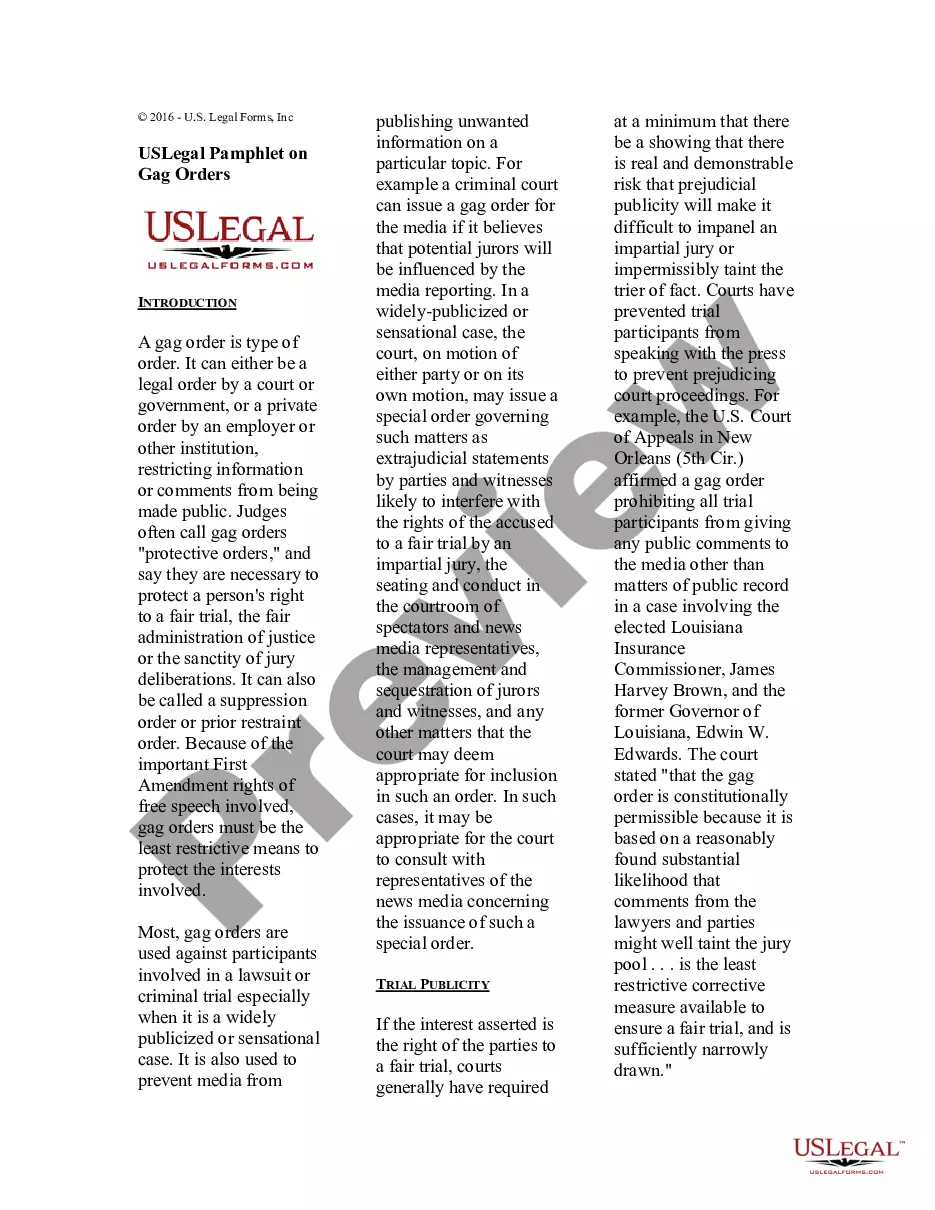
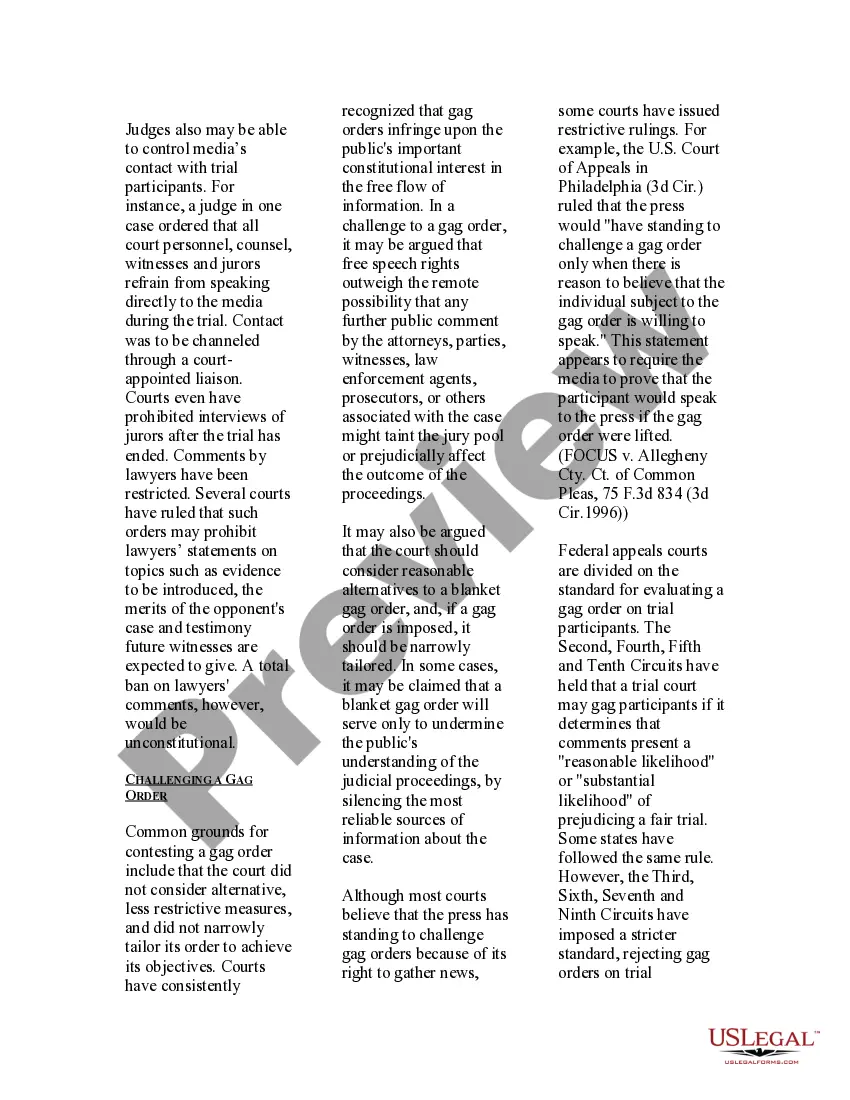
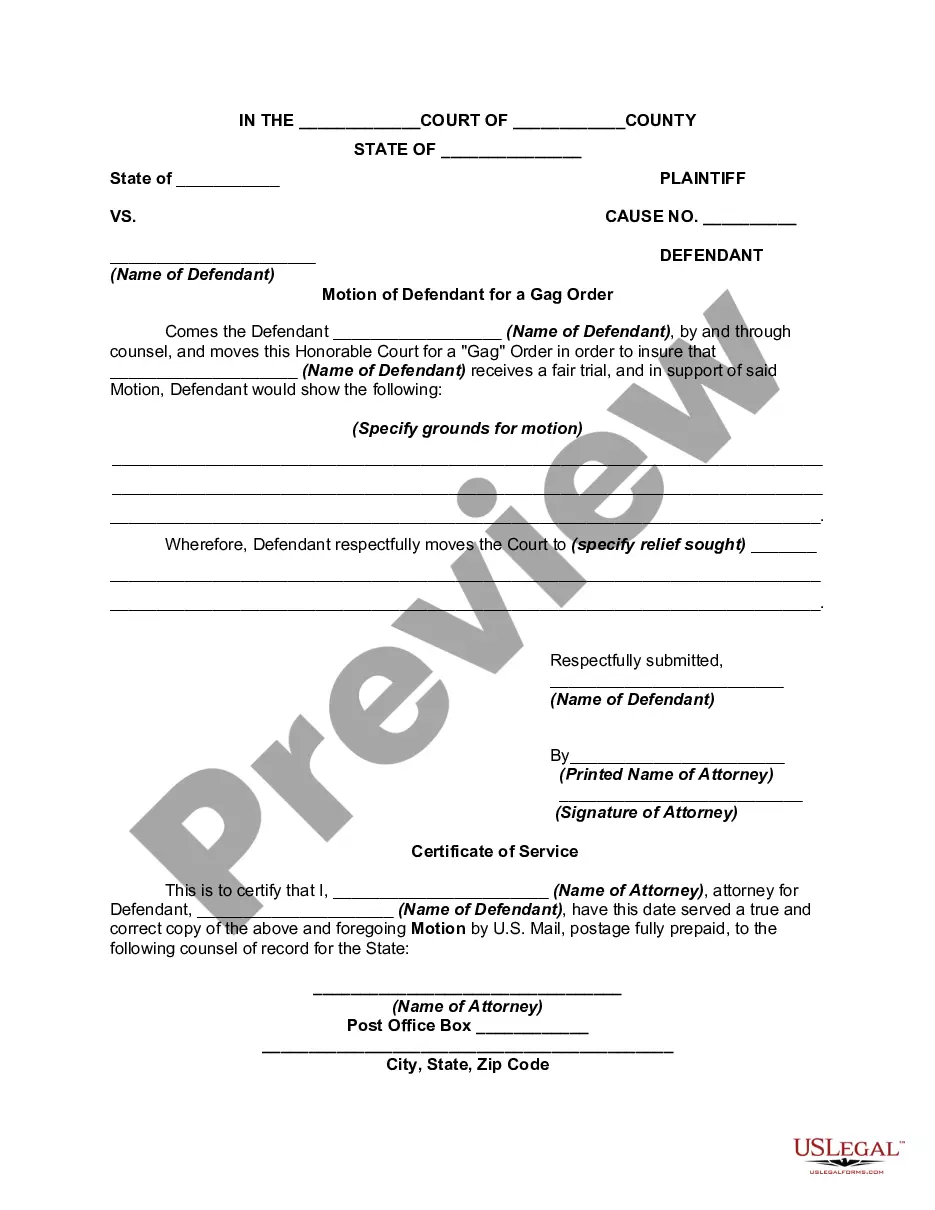
The USLegal Pamphlet on Gag Orders provides a comprehensive overview of gag orders, which are legal restrictions imposed to prevent the public disclosure of specific information. These orders are crucial for maintaining a fair trial and protecting the integrity of the judicial process. Unlike other legal forms, this pamphlet focuses on understanding the implications, uses, and challenges associated with gag orders, making it a unique resource for individuals seeking clarity on this complex issue.
Key parts of this document
- Definition and explanation of gag orders.
- Discussion on the constitutional considerations involved.
- Overview of the circumstances under which gag orders are applied.
- Guidelines for challenging a gag order effectively.
When to use this form
This pamphlet is valuable when you are involved in legal proceedings that may garner media attention, or if you are a participant in a lawsuit facing a gag order. It is also useful if you seek to understand how to challenge such orders or to find information on your rights regarding free speech in the context of ongoing legal matters.
Intended users of this form
- Individuals involved in lawsuits or criminal cases.
- Legal professionals needing a reference on gag orders.
- Members of the media seeking to understand their rights and limitations.
- Anyone interested in First Amendment rights and courtroom proceedings.
How to prepare this document
- Read through the pamphlet thoroughly to understand the content about gag orders.
- Identify the specific situation where a gag order may apply to your case.
- Make note of any constitutional rights you wish to defend or challenge.
- Consider consulting a legal professional if you need assistance challenging a gag order.
- Utilize the information provided to prepare any necessary documentation or arguments related to your case.
Does this form need to be notarized?
This form does not typically require notarization to be legally valid. However, some jurisdictions or document types may still require it. US Legal Forms provides secure online notarization powered by Notarize, available 24/7 for added convenience.
Get your form ready online
Our built-in tools help you complete, sign, share, and store your documents in one place.
Make edits, fill in missing information, and update formatting in US Legal Forms—just like you would in MS Word.
Download a copy, print it, send it by email, or mail it via USPS—whatever works best for your next step.
Sign and collect signatures with our SignNow integration. Send to multiple recipients, set reminders, and more. Go Premium to unlock E-Sign.
If this form requires notarization, complete it online through a secure video call—no need to meet a notary in person or wait for an appointment.
We protect your documents and personal data by following strict security and privacy standards.

Make edits, fill in missing information, and update formatting in US Legal Forms—just like you would in MS Word.

Download a copy, print it, send it by email, or mail it via USPS—whatever works best for your next step.

Sign and collect signatures with our SignNow integration. Send to multiple recipients, set reminders, and more. Go Premium to unlock E-Sign.

If this form requires notarization, complete it online through a secure video call—no need to meet a notary in person or wait for an appointment.

We protect your documents and personal data by following strict security and privacy standards.
Common mistakes to avoid
- Failing to understand the difference between gag orders and other types of protective orders.
- Not consulting a legal professional before trying to challenge a gag order.
- Assuming that all gag orders are unconstitutional.
- Neglecting to research local laws that may affect the challenge of a gag order.
Benefits of using this form online
- Access to legal information at your convenience and from anywhere.
- Ability to download and print materials for easy reference.
- Comprehensive coverage of important legal topics without the need for in-person consultations.
- Regular updates to ensure that you receive accurate and relevant information.
Legal use & context
Gag orders are typically used in criminal and civil cases to ensure a fair trial by limiting prejudicial publicity. Understanding the nuances of these orders is essential for both legal professionals and the public, as misuse can infringe upon First Amendment rights. It is important to recognize that while gag orders are legally enforceable, their application can vary significantly based on the case and jurisdiction.
Looking for another form?
Form popularity
FAQ
California courts have not expressly addressed media standing to challenge gag orders. However, one court recognized the right of a third party to challenge a gag order because of its interest in the case.
Gag orders issued by a court, government, or private entity require an individual to refrain from making public comments. Typically, judges issue injunctions barring trial participants including attorneys, litigants, and witnesses from discussing trial related material outside the courtroom.
Judges issue gag orders to ensure a fair trial, to facilitate efficient administration of justice, and to prevent prejudicial information from reaching the jury pool.
According to the Court, it is constitutionally permissible to subordinate the First Amendment rights of attorneys participating in a pending case to a party's interest in obtaining a fair trial.By statute or court rule, gag orders are often placed on grand jury participants.
A court order to gag or bind an unruly defendant or remove her or him from the courtroom in order to prevent further interruptions in a trial.However, the U.S. Supreme Court has upheld the constitutionality of the practice in cases where a defendant is particularly disruptive.
To prevent the companies from doing so, federal law enforcement typically obtains a non-disclosure order pursuant to 18 U.S.C. § 2705(b) from a federal magistrate court. These gag orders have generally not had a definite expiration date.
A gag order occurs when a judge makes a ruling that a specific case cannot be discussed outside of the courtroom. This includes speaking of, writing about, or sharing any of the case's information.
What Happens if You Break a Gag Order? If you break a gag order, a court may find you in contempt and issue a fine or sentence you to jail time. If you break a non-disclosure agreement, a company may have a right to sue. You may lose your job or face other punishments.
U.S. Court of Appeals rules gag orders are unconstitutional, unenforceable.The ruling holds that gag orders equate to hush money to keep victims quiet, making them unconstitutional.