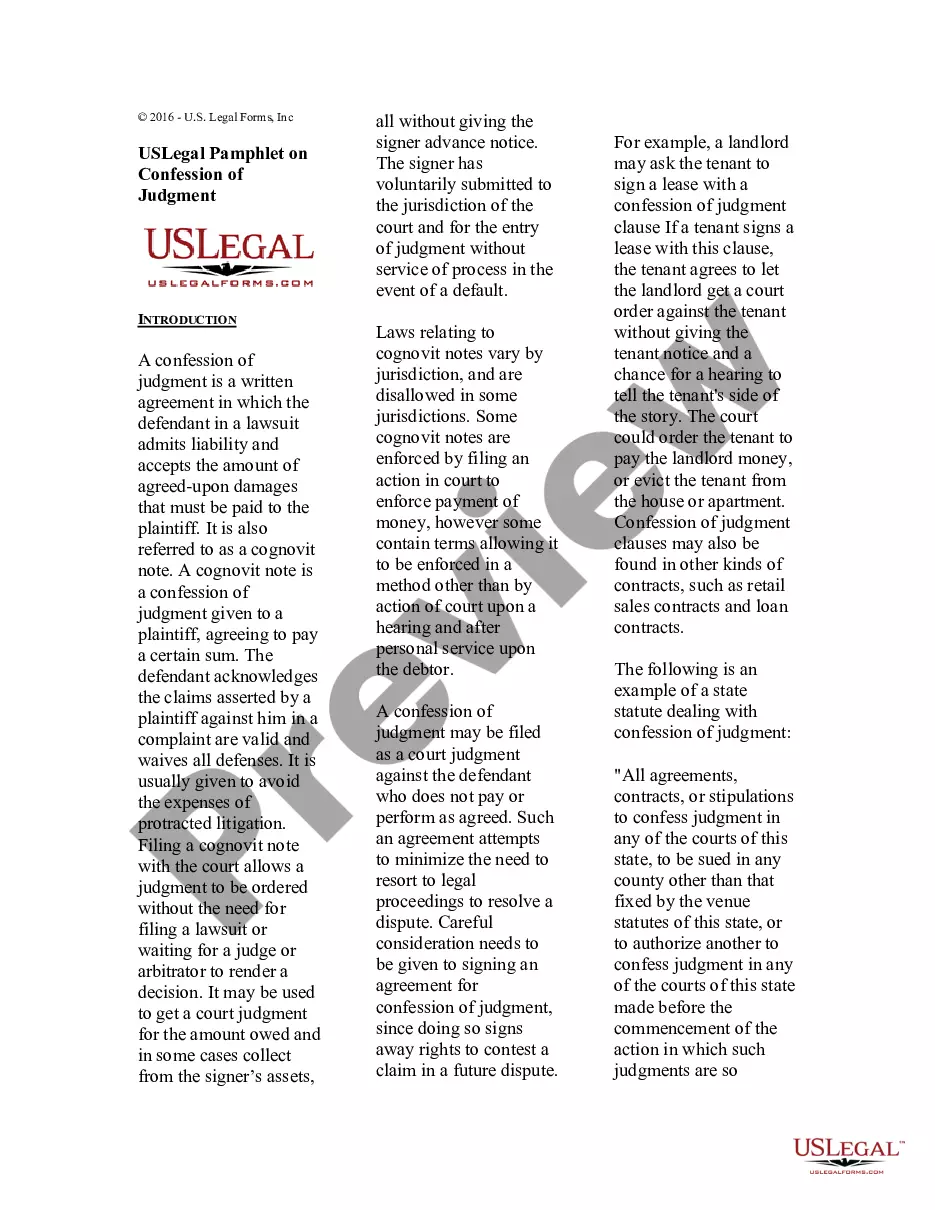
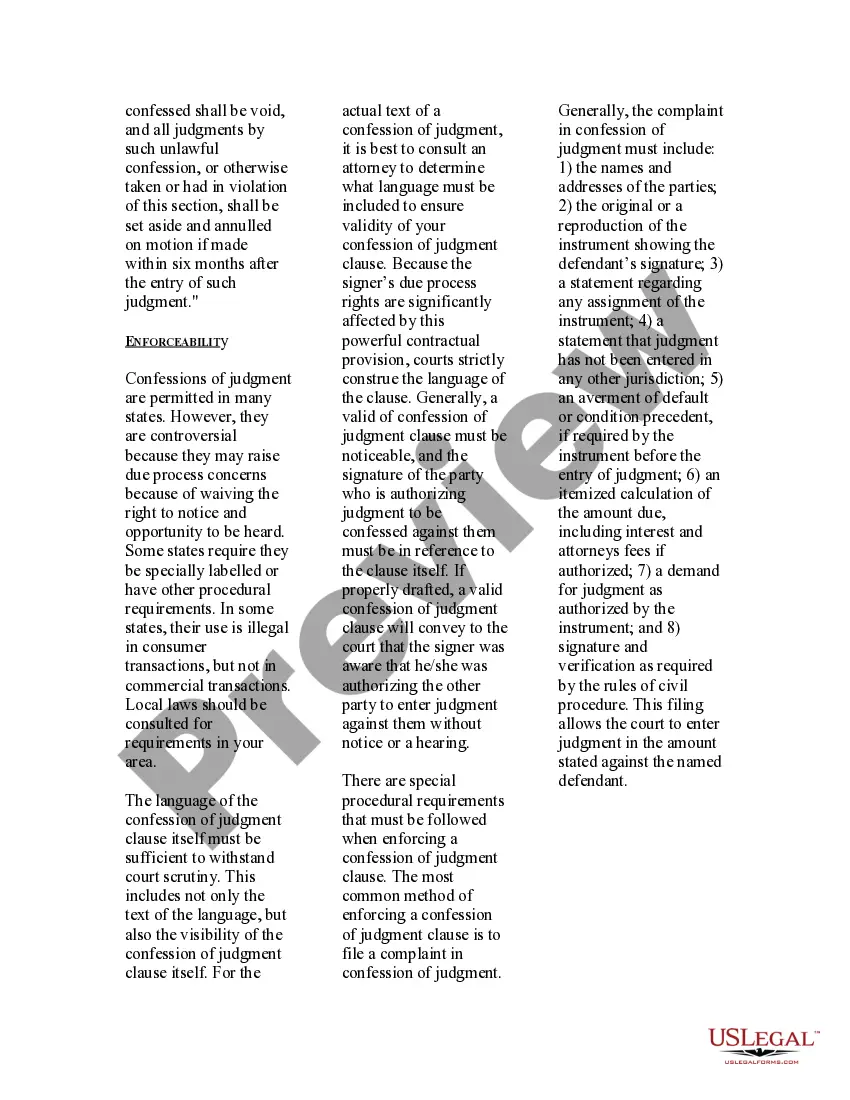
This pamphlet provides an overview on the use of a confessed judgment clause in contracts. Topics covered include how to draft a confession of judgment clause, as well as how to enforce it.
USLegal Pamphlet on Confession of Judgment
Category:
State:
Multi-State
Control #:
US-PMPH-11
Format:
Word;
Rich Text
Instant download
Description
Free preview
How to fill out USLegal Pamphlet On Confession Of Judgment?
When it comes to drafting a legal document, it’s better to leave it to the experts. Nevertheless, that doesn't mean you yourself can not get a template to use. That doesn't mean you yourself can’t find a template to utilize, however. Download USLegal Pamphlet on Confession of Judgment from the US Legal Forms site. It offers numerous professionally drafted and lawyer-approved documents and samples.
For full access to 85,000 legal and tax forms, customers just have to sign up and select a subscription. When you are registered with an account, log in, find a particular document template, and save it to My Forms or download it to your device.
To make things much easier, we have included an 8-step how-to guide for finding and downloading USLegal Pamphlet on Confession of Judgment fast:
- Be sure the document meets all the necessary state requirements.
- If available preview it and read the description before buying it.
- Click Buy Now.
- Choose the appropriate subscription to meet your needs.
- Create your account.
- Pay via PayPal or by debit/bank card.
- Choose a needed format if a few options are available (e.g., PDF or Word).
- Download the document.
Once the USLegal Pamphlet on Confession of Judgment is downloaded it is possible to fill out, print out and sign it in almost any editor or by hand. Get professionally drafted state-relevant papers within a matter of minutes in a preferable format with US Legal Forms!
Form popularity
FAQ
The three-year shelf-life of affidavits of confession of judgment is sometimes overlooked by practitioners and is important to bear in mind.
The confession of judgment is allowed in New Jersey only after notice to the defendant is served in lieu of a summons either by registered or certified mail.The court may, if satisfied, enter a judgment satisfied with the proofs, enter a judgment for what the court finds due.
A Florida court decision from 1997 recognized that even though confessions of judgment are per se illegal in Florida, the state of Florida is, nonetheless, required to recognize such judgments entered in other states, based upon the full faith and credit clause of the U.S. Constitution.
Renew the judgment Money judgments automatically expire (run out) after 10 years.If the judgment is not renewed, it will not be enforceable any longer and you will not have to pay any remaining amount of the debt. Once a judgment has been renewed, it cannot be renewed again until 5 years later.
The statute of limitations for a debt collector to collect a past-due debt in New Jersey is six years, said Karra Kingston, a bankruptcy attorney in Union City.
In order to vacate a judgment in California, You must file a motion with the court asking the judge to vacate or set aside the judgment. Among other things, you must tell the judge why you did not respond to the lawsuit (this can be done by written declaration).
United StatesConfessions of judgment are permitted in many states. New Jersey and Pennsylvania permit them, among others. Some states, including Michigan, require they be specially labelled or have other procedural requirements.
In New Jersey, there is a six-year statute of limitations on collecting a debt. This means that a creditor can no longer make attempts to collect on a debt once six years have passed since the original date that payment was owed.
Judgments in New Jersey remain in effect for 20 years and may be renewed for an additional 20 years by filing a motion in the Superior Court, Law Division, Civil Part and/or in the Special Civil Part if the Special Civil Part case was assigned a DJ or J docket number.