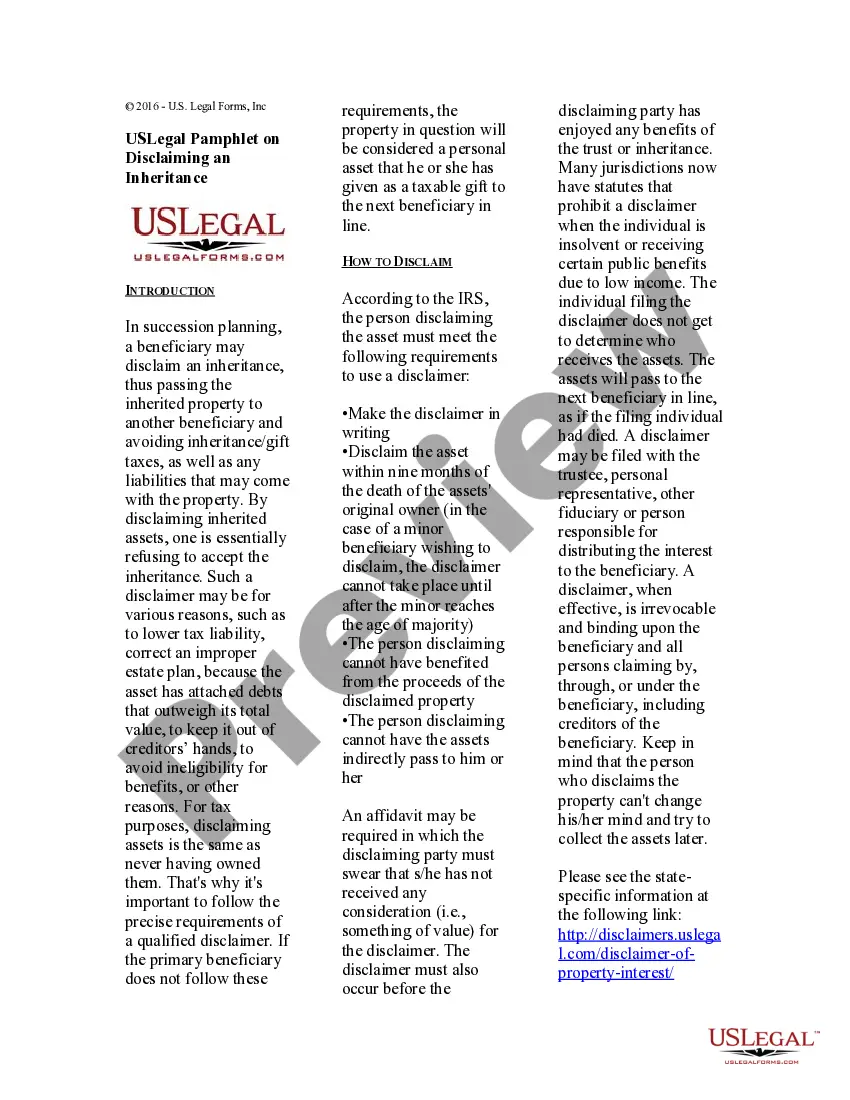
USLegal Pamphlet on Disclaiming an Inheritance
What this document covers
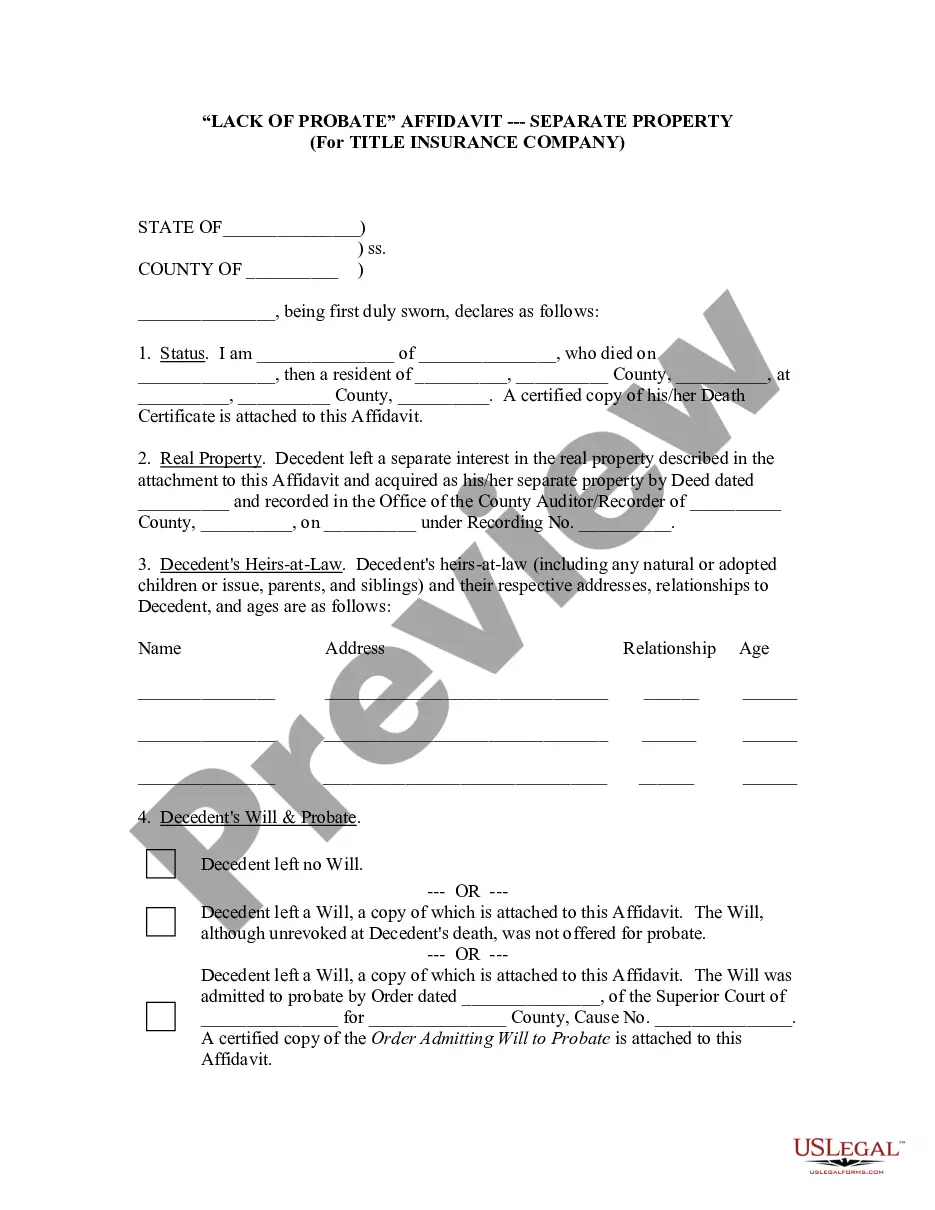
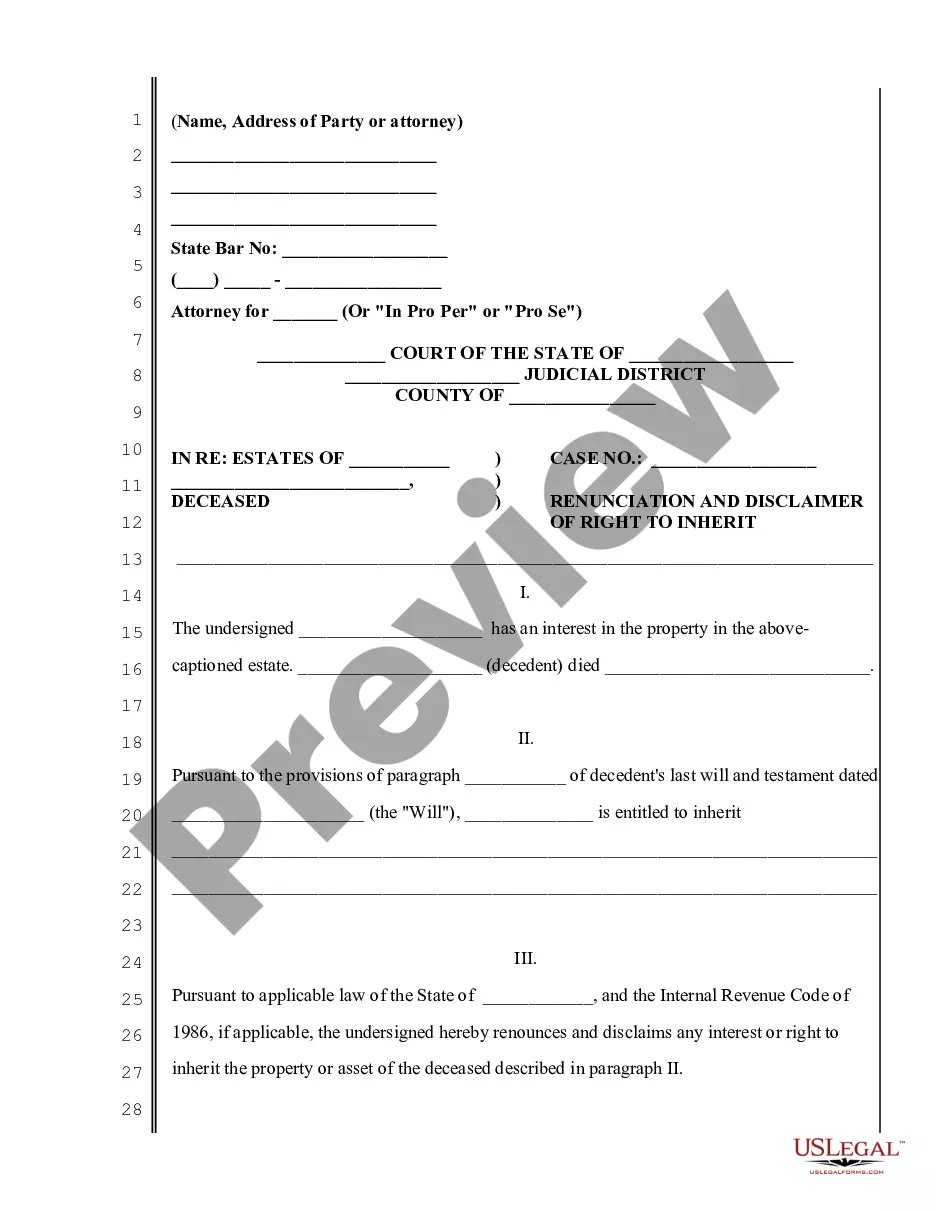
The USLegal Pamphlet on Disclaiming an Inheritance provides detailed guidance on how a beneficiary can choose to refuse an inheritance. By using a disclaimer, the beneficiary can pass the inherited assets to another party, often to minimize tax liabilities or avoid inheriting debts. This pamphlet clarifies the conditions under which disclaimers can be made and outlines the steps necessary for a valid disclaimer, making it an essential resource for individuals involved in estate planning.
Main sections of this form
- Definition of a disclaimer and its legal implications.
- Requirements set by the IRS for making a valid disclaimer.
- Explanation of the process for filing a disclaimer.
- Discussion of the consequences of disclaiming an inheritance.
- State-specific information regarding disclaimers.
When to use this document
This pamphlet is useful in situations where a beneficiary decides to disclaim an inheritance for reasons such as wanting to avoid tax liabilities, managing debts associated with the property, or ensuring the assets do not affect eligibility for public benefits. It provides the necessary guidelines to ensure that the disclaimer process is correctly followed to achieve the desired legal effect.
Who this form is for
- Beneficiaries of an estate who wish to refuse their inheritance.
- Individuals concerned about tax implications of accepting an inheritance.
- Persons managing estate plans and seeking to clarify legal processes.
- Legal professionals advising clients on disclaiming inheritances.
How to prepare this document
- Prepare a written disclaimer stating your intention to refuse the inheritance.
- File the disclaimer within nine months of the death of the original property owner.
- Ensure that you have not benefited from the disclaimed property.
- Submit the disclaimer to the appropriate trustee or person responsible for distributing the inheritance.
- Keep a copy of the disclaimer for your records after submission.
Does this form need to be notarized?
This form does not typically require notarization unless specified by local law. It is important to check your jurisdiction's requirements to ensure compliance.
Get your form ready online
Our built-in tools help you complete, sign, share, and store your documents in one place.
Make edits, fill in missing information, and update formatting in US Legal Forms—just like you would in MS Word.
Download a copy, print it, send it by email, or mail it via USPS—whatever works best for your next step.
Sign and collect signatures with our SignNow integration. Send to multiple recipients, set reminders, and more. Go Premium to unlock E-Sign.
If this form requires notarization, complete it online through a secure video call—no need to meet a notary in person or wait for an appointment.
We protect your documents and personal data by following strict security and privacy standards.

Make edits, fill in missing information, and update formatting in US Legal Forms—just like you would in MS Word.

Download a copy, print it, send it by email, or mail it via USPS—whatever works best for your next step.

Sign and collect signatures with our SignNow integration. Send to multiple recipients, set reminders, and more. Go Premium to unlock E-Sign.

If this form requires notarization, complete it online through a secure video call—no need to meet a notary in person or wait for an appointment.

We protect your documents and personal data by following strict security and privacy standards.
Common mistakes
- Failing to file the disclaimer within the nine-month period.
- Accepting any benefits from the property before disclaiming it.
- Not properly documenting the disclaimer in writing.
- Assuming that disclaiming will automatically pass the inheritance to your heirs instead of the next beneficiary in line.
Why use this form online
- Convenient access to legal information anytime, anywhere.
- Downloadable templates that can be filled out easily.
- Reliable guidance drafted by licensed attorneys.
- Editability allows for custom adjustments to fit specific needs.
Legal use & context
- Disclaimers must meet IRS requirements to be effective and valid.
- A disclaimer is irrevocable and legally binding once filed.
- Consulting with an attorney is advisable to navigate any complex situations related to inheritance law.
Looking for another form?









Form popularity
FAQ
These documents can include the will, death certificate, transfer of ownership forms and letters from the estate executor or probate court.If you received the inheritance in the form of cash, request a copy of the bank statement that reflects the deposit.
Disclaiming is pretty simple. Send a written statement to the IRA administrator stating that you irrevocably, unconditionally disclaim your right to the IRA, or to some portion of the account. You have to do this within nine months of the death, unless you're underage.
In your disclaimer, cover any and all liabilities for the product or service that you provide. You should warn consumers of any dangers or hazards posed by your product. You should list specific risks while at the same time acknowledging that the list is not exhaustive. For example, you could write, NOTICE OF RISK.
The disclaimer must be in writing: A signed letter by the person doing the disclaiming, identifying the decedent, describing the asset to be disclaimed, and the extent and amount, percentage or dollar amount, to be disclaimed, must be delivered to the person in control of the estate or asset, such as an executor,
In the law of inheritance, wills and trusts, a disclaimer of interest (also called a renunciation) is an attempt by a person to renounce their legal right to benefit from an inheritance (either under a will or through intestacy) or through a trust.A disclaimer of interest is irrevocable.
Note that inheritances from a trust typically cannot be assigned to someone else.That means it could go to the next person in the line of succession, such as the children of the person who disclaims the inheritance. There are legal restrictions on disclaiming an inheritance. There are time constraints, for example.
When you relinquish property, you don't get any say in who inherits in your place. If you want to control who gets the inheritance, you must accept it and give it to that person. If you relinquish the property and the deceased didn't name a back-up heir, the court will apply state law to decide who inherits.
Put the disclaimer in writing. Deliver the disclaimer to the person in control of the estate usually the executor or trustee. Complete the disclaimer within nine months of the death of the person leaving the property. Do not accept any benefit from the property you're disclaiming.
Disclaim Inheritance, Definition In a nutshell, it means you're refusing any assets that you stand to inherit under the terms of someone's will, a trust or, in the case of a person who dies intestate, the inheritance laws of your state.