Authority to Pay Medical Bills
About this form
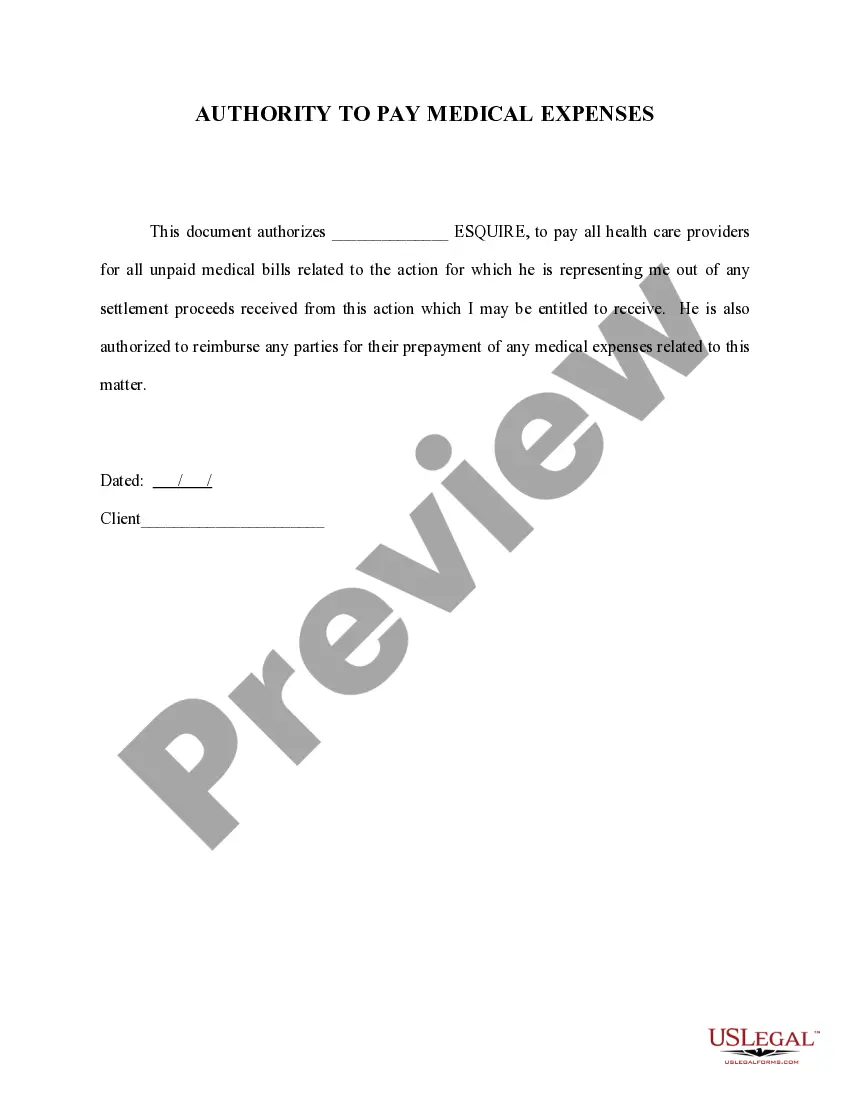
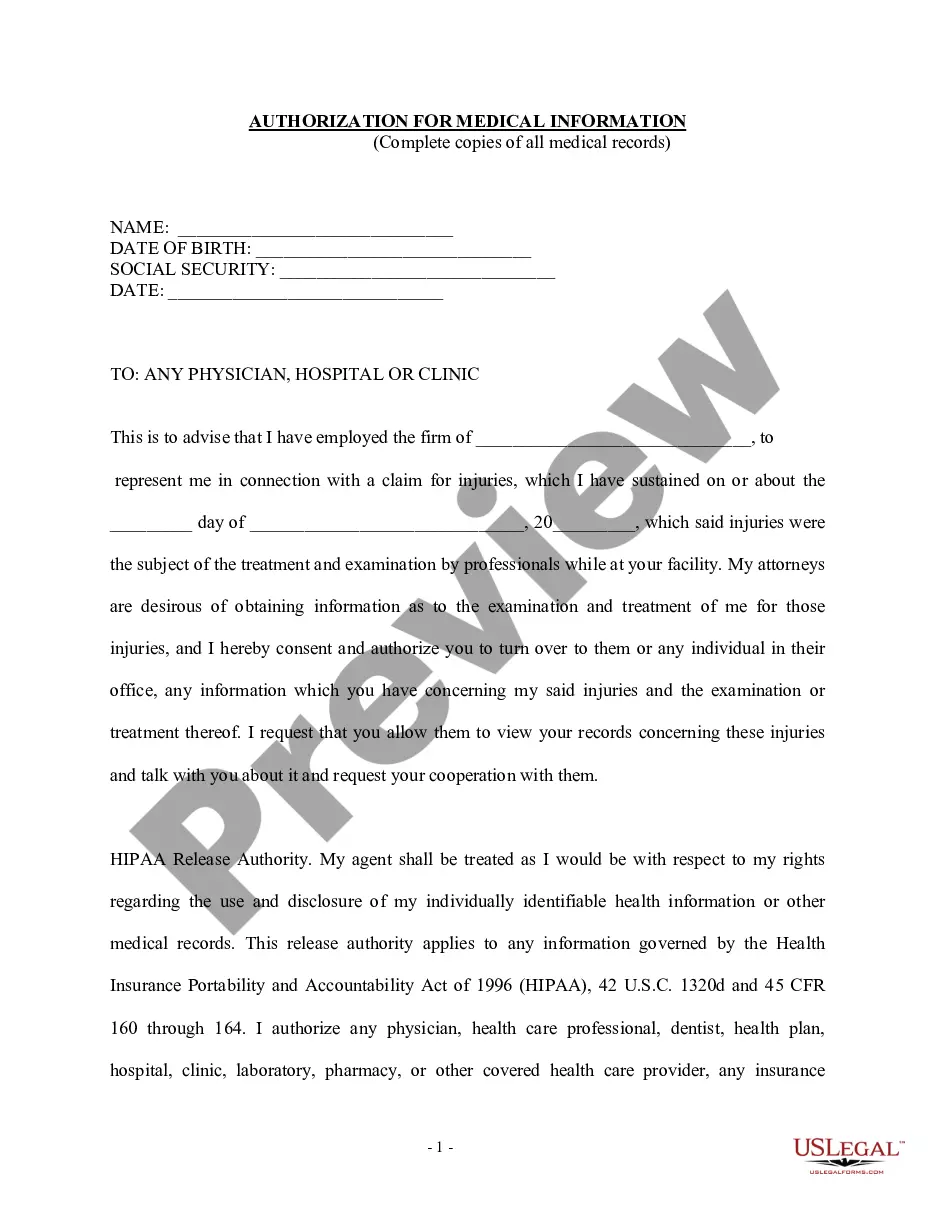
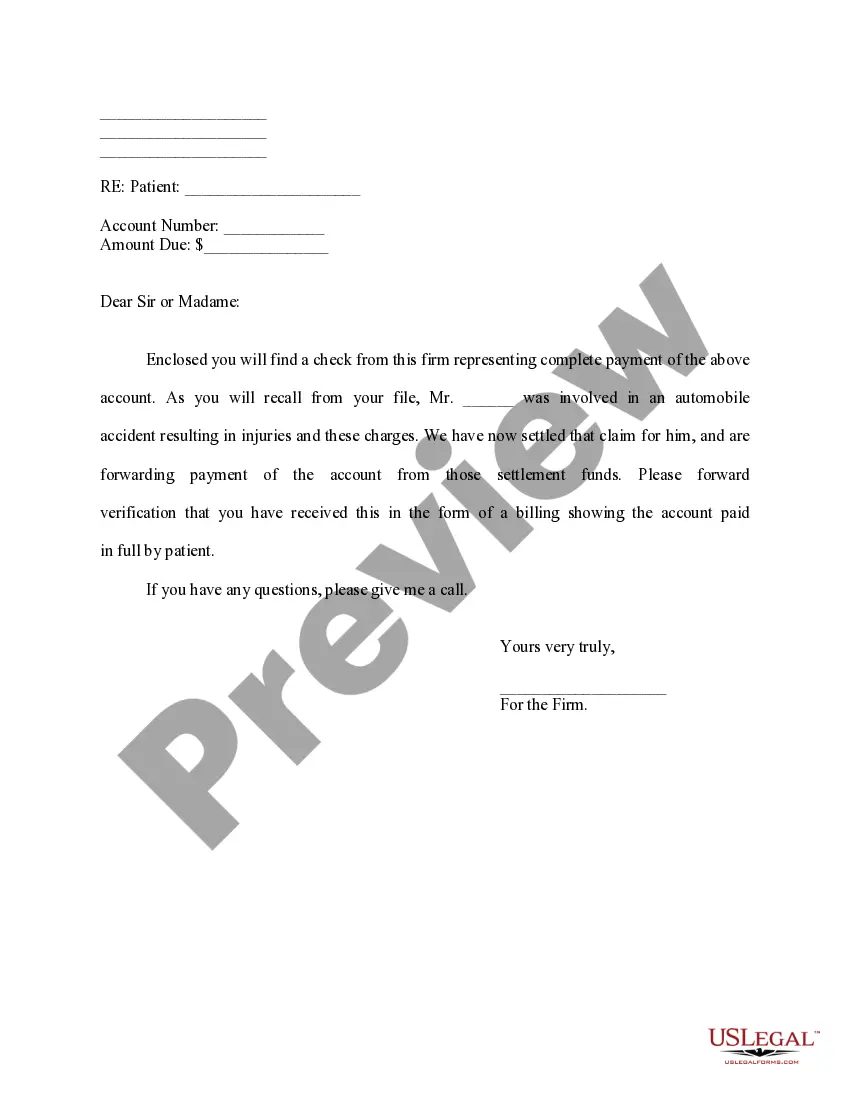
The Authority to Pay Medical Bills form is a legal document that grants an attorney the authority to pay the client's unpaid medical bills from settlement proceeds. This form is essential for clients who are pursuing a legal action and want to ensure that their medical expenses are handled efficiently after a settlement is reached. It differs from other medical payment forms by specifically addressing medical bills tied to legal claims and settlements.
Key components of this form
- Client's name and attorney's name are specified at the beginning.
- A declaration that the attorney is granted authority to pay all unpaid medical bills.
- Authorization to reimburse any parties who prepaid medical expenses.
- Space for the date of the agreement.
- Signature line for the client to validate the form.
When to use this form
This form should be used when a client has reached a settlement in a personal injury or other legal case and has outstanding medical bills. It is vital in situations where the attorney needs to pay those medical bills directly from the settlement proceeds before distributing the remaining funds to the client. This helps manage financial obligations linked to the legal matter efficiently.
Who should use this form
- Clients who have hired an attorney for a personal injury case or similar legal action.
- Individuals who have unpaid medical bills related to their legal claims.
- Attorneys representing clients who require a clear authorization to settle medical debts from settlement funds.
Steps to complete this form
- Enter the attorney's name in the designated area.
- Fill in your name as the client.
- Specify any unpaid medical bills to ensure clarity on financial obligations.
- Sign and date the document to finalize the authority granted to the attorney.
Does this document require notarization?
This form usually doesn’t need to be notarized. However, local laws or specific transactions may require it. Our online notarization service, powered by Notarize, lets you complete it remotely through a secure video session, available 24/7.
Get your form ready online
Our built-in tools help you complete, sign, share, and store your documents in one place.
Make edits, fill in missing information, and update formatting in US Legal Forms—just like you would in MS Word.
Download a copy, print it, send it by email, or mail it via USPS—whatever works best for your next step.
Sign and collect signatures with our SignNow integration. Send to multiple recipients, set reminders, and more. Go Premium to unlock E-Sign.
If this form requires notarization, complete it online through a secure video call—no need to meet a notary in person or wait for an appointment.
We protect your documents and personal data by following strict security and privacy standards.

Make edits, fill in missing information, and update formatting in US Legal Forms—just like you would in MS Word.

Download a copy, print it, send it by email, or mail it via USPS—whatever works best for your next step.

Sign and collect signatures with our SignNow integration. Send to multiple recipients, set reminders, and more. Go Premium to unlock E-Sign.

If this form requires notarization, complete it online through a secure video call—no need to meet a notary in person or wait for an appointment.

We protect your documents and personal data by following strict security and privacy standards.
Common mistakes to avoid
- Failing to include the attorney's name correctly may invalidate the form.
- Not signing the form in the designated signature area.
- Leaving out the date can create confusion about the timeline of authority granted.
Benefits of completing this form online
- Convenience of downloading the form immediately without the need for in-person visits.
- Editability allows for customization to suit specific needs and situations.
- Reliability of having a form drafted by licensed legal professionals ensures compliance with legal standards.
What to keep in mind
- The Authority to Pay Medical Bills form is essential for managing medical bill payments after a legal settlement.
- Properly completing the form ensures that potential financial obligations are addressed efficiently.
- This form can be utilized across multiple states, simplifying the process for clients nationwide.
Looking for another form?


Form popularity
FAQ
It's much better to deal with creditors than debt collectors. Whatever the past-due debt is for doctor bills, credit card payments, car loan the creditor may still see you as a potential return customer. A debt collector's only interest is squeezing money out of you.
If you choose not to pay the bills or refuse to work with the hospital on a payment plan, the bills will likely be sent to debt collection. After a period of time, the collection agency can report the debt to credit bureaus.
If the collection agency bought the debt from the creditor (rather than the creditor just assigning the debt to the agency for collection), the agency owns the debt. If you negotiate with and make payments to the creditor, the collector may refuse to credit you for those payments.
Federal, state, and local governments support uncompensated care to uninsured Americans and others who cannot pay for the costs of their care, primarily as hospital ($23.6 billion) and clinic services ($7 billion).
Making payments on a medical bill doesn't necessarily keep it out of collections.Protections under the Affordable Care Act give patients at nonprofit hospitals time to apply for financial assistance before any extraordinary collection measures are taken. But for the most part, any unpaid balance is fair game.
It's possible in some cases to negotiate with a lender to repay a debt after it's already been sent to collections. Working with the original creditor, rather than dealing with debt collectors, can be beneficial.
And here's what happens if you don't pay medical bills: phone calls and letters.Later, if you are still unable to make payments, the collectors might try to sue you in an effort to garnish wages or put a lien on your property.
That means you have a legal obligation to pay the collection agency, not the hospital. If you pay the hospital $1,000 for the debt, you will still have a legal obligation to pay the collection agency.The original creditor could keep the money you owe and not inform the collection agency of anything.
After a period of nonpayment, the hospital or health care facility will likely sell unpaid health care bills to a collections agency, which works to recoup its investment in your debt.You can't make medical debt and hospital bills disappear by ignoring them, experts say.