Final Judgment in favor of Defendants
What this document covers
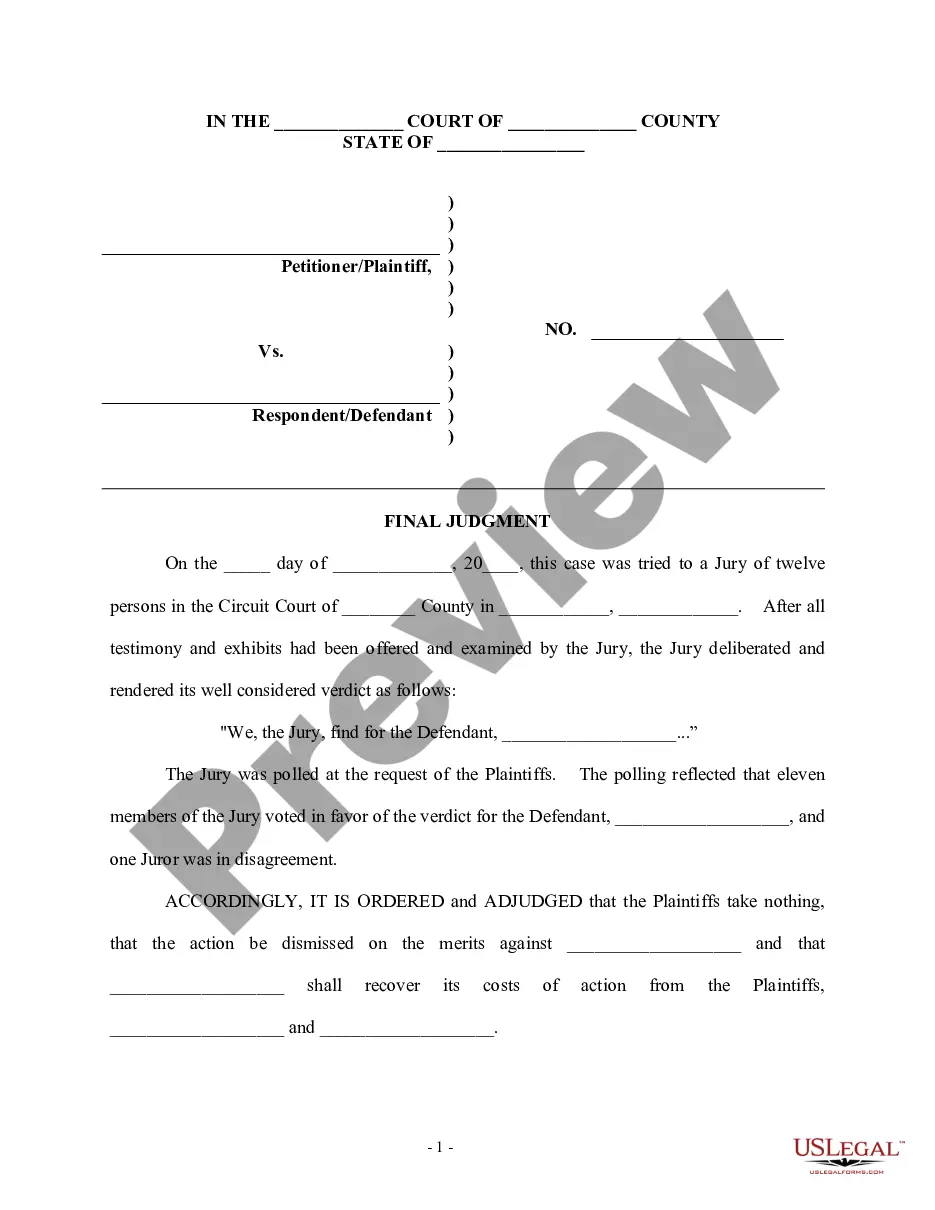
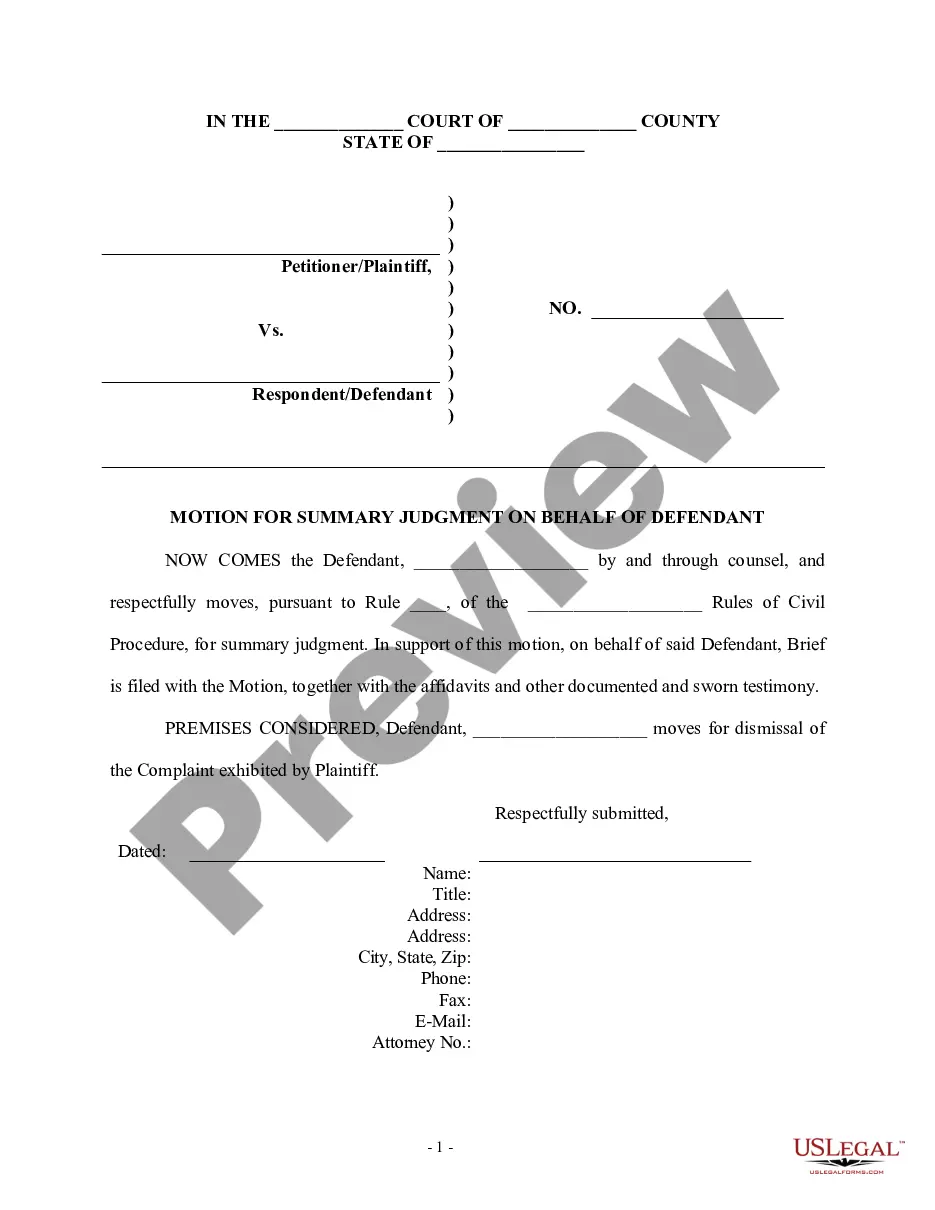
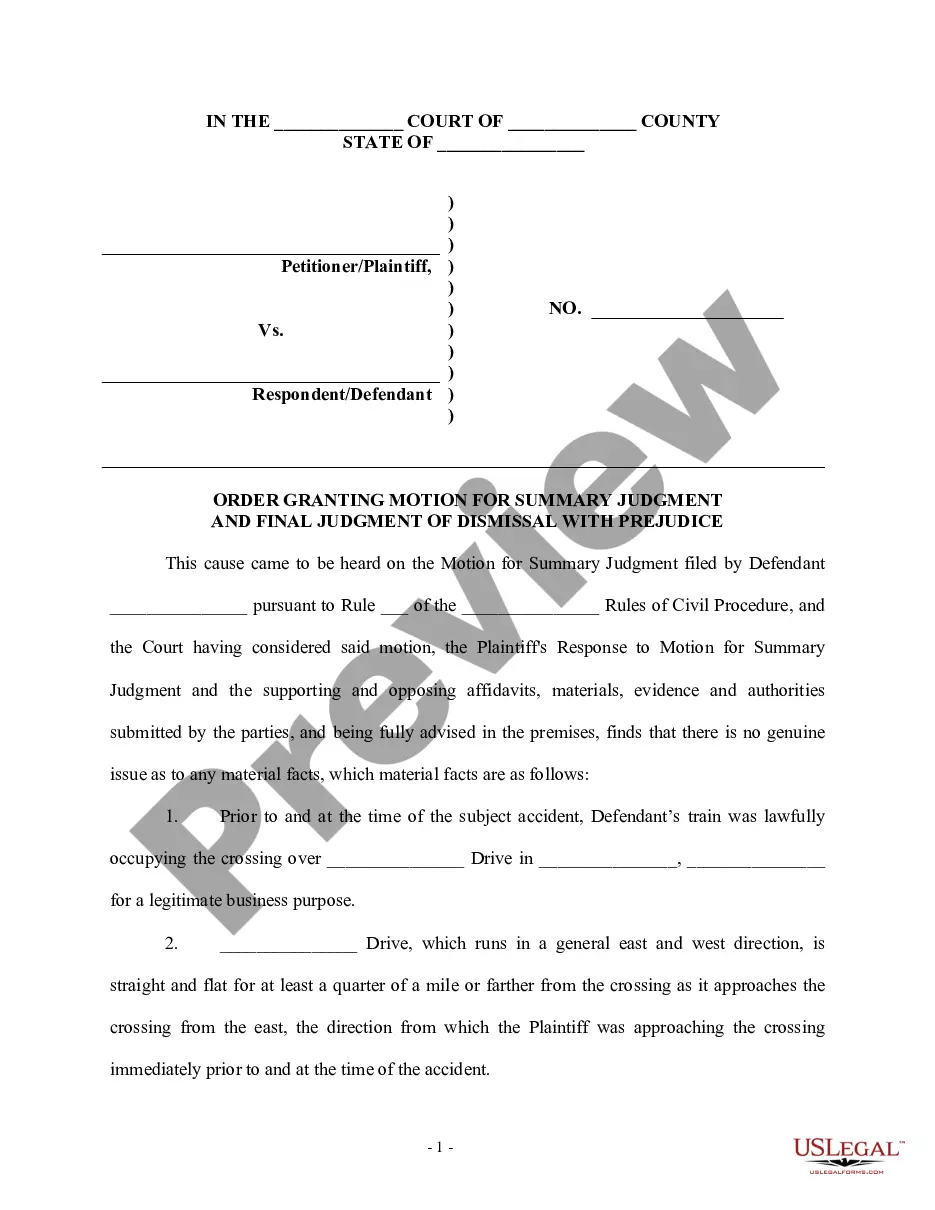
The Final Judgment in favor of Defendants is a legal document issued following a jury trial in a personal injury case. This judgment indicates that the jury has found in favor of the defendant, meaning that the plaintiffs are not entitled to any damages. This form differs from other legal judgments because it specifically outlines the jury's verdict and the dismissal of the action against the defendant.
Form components explained
- Header indicating the type of judgment and case classification.
- Statement of the jury's verdict in favor of the defendant.
- Polling results of jury members reflecting the majority vote.
- Order stating that the plaintiffs take nothing from the defendant.
- Recovery of costs awarded to the defendant.
- Signature line for the presiding circuit judge.

When this form is needed
This form is used when a jury has reached a verdict in a personal injury case, finding in favor of the defendant. It is necessary for formally documenting the outcome of the trial, specifically when the plaintiffs' claims have been dismissed and the defendant is entitled to recover costs. This judgment may be required for filing in court or for the defendant's legal records.
Who needs this form
This form is intended for:
- Defendants in personal injury lawsuits who have been found not liable by a jury.
- Attorneys representing defendants in such cases.
- Legal professionals involved in the filing and documentation of court judgments.
Steps to complete this form
- Identify the defendant's name and fill in the appropriate fields.
- Ensure the jury's verdict reflects the majority's agreement.
- Enter the date when the judgment is being issued.
- Complete the order section that states the plaintiffs take nothing.
- Have the presiding circuit judge sign and date the judgment.
Notarization requirements for this form
This form does not typically require notarization unless specified by local law. Be sure to check any specific requirements that may apply to your jurisdiction before submission.
Get your form ready online
Our built-in tools help you complete, sign, share, and store your documents in one place.
Make edits, fill in missing information, and update formatting in US Legal Forms—just like you would in MS Word.
Download a copy, print it, send it by email, or mail it via USPS—whatever works best for your next step.
Sign and collect signatures with our SignNow integration. Send to multiple recipients, set reminders, and more. Go Premium to unlock E-Sign.
If this form requires notarization, complete it online through a secure video call—no need to meet a notary in person or wait for an appointment.
We protect your documents and personal data by following strict security and privacy standards.

Make edits, fill in missing information, and update formatting in US Legal Forms—just like you would in MS Word.

Download a copy, print it, send it by email, or mail it via USPS—whatever works best for your next step.

Sign and collect signatures with our SignNow integration. Send to multiple recipients, set reminders, and more. Go Premium to unlock E-Sign.

If this form requires notarization, complete it online through a secure video call—no need to meet a notary in person or wait for an appointment.

We protect your documents and personal data by following strict security and privacy standards.
Common mistakes to avoid
- Failing to include all parties' names accurately.
- Not polling the jury, which could affect the validity of the judgment.
- Leaving out the date, which is crucial for court records.
- Using incorrect signatures that may not be validated by the court.
Benefits of using this form online
- Convenience of accessing and downloading the form from anywhere.
- Editable fields that allow customization to fit specific case details.
- Instant availability, eliminating delays associated with mailing or in-person visits.
- Reliable templates drafted by licensed attorneys help ensure legal compliance.
Legal use & context
- This form serves as a formal conclusion of a personal injury case.
- It establishes the jury's decision, which is crucial for enforcing the judgment.
- The document may be needed in case of appeals or for recovering costs.
Summary of main points
- The form is essential for documenting a jury's favorable verdict for the defendant.
- Accurate completion is vital to prevent errors that could affect enforcement.
- Using the form correctly helps finalize personal injury cases efficiently.
Looking for another form?

Form popularity
FAQ
A judgment is a court order that is the decision in a lawsuit. If a judgment is entered against you, a debt collector will have stronger tools, like garnishment, to collect the debt. A judgment is an official result of a lawsuit in court.Ignore the lawsuit, or. Don't respond to the lawsuit in a timely manner.
Most often, it is a judgment in favor of a plaintiff when the defendant has not responded to a summons or has failed to appear before a court of law.A party can have a default judgment vacated, or set aside, by filing a motion, after the judgment is entered, by showing of a proper excuse.
In order to vacate a judgment in California, You must file a motion with the court asking the judge to vacate or set aside the judgment. Among other things, you must tell the judge why you did not respond to the lawsuit (this can be done by written declaration).You may even be able to win the case.
It means defendant won the law suit.
Comparison Between Judgment and DecreeJudgment is defined in section 2(9) of the C.P.C. which says judgment is the statement given by the Judge on the grounds of a decree or order. Judgment refers to what the judge writes regarding all the issues in the matter and the decision on each of the issues.
1. A judgment is the statement given by the Judge, on the grounds of a decree or order. It is the end product of the proceedings in the Court. The writing of a judgment is one of the most important and time consuming task performed by a Judge.
Assuming all of the necessary paperwork was completed correctly and filed, then usually around 4-6 weeks.
The last decision from a court that resolves all issues in dispute and settles the parties' rights with respect to those issues. A final judgment leaves nothing except decisions on how to enforce the judgment, whether to award costs, and whether to file an appeal.