Response to Plaintiff's Motion for Additur or New Trial
About this form
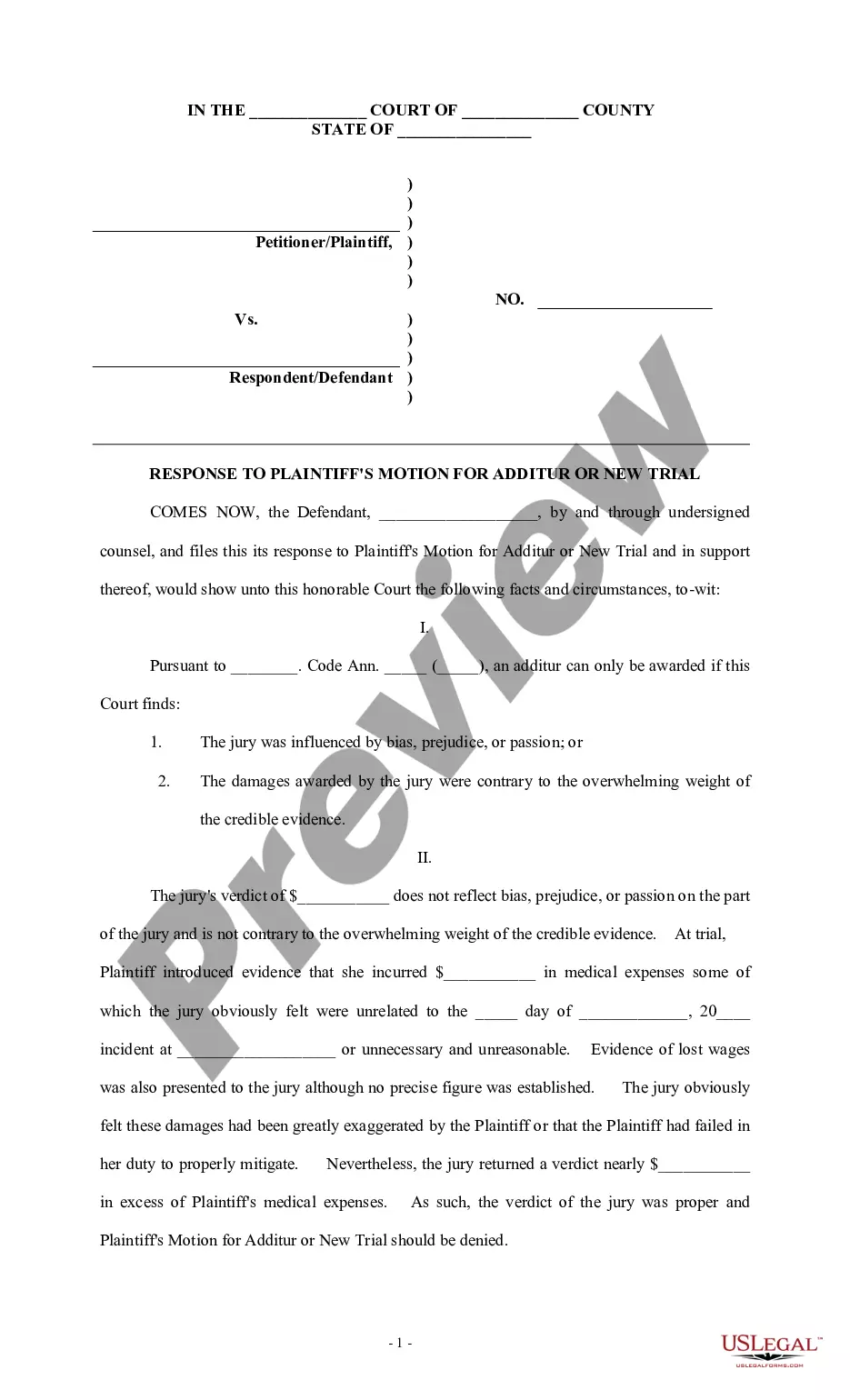
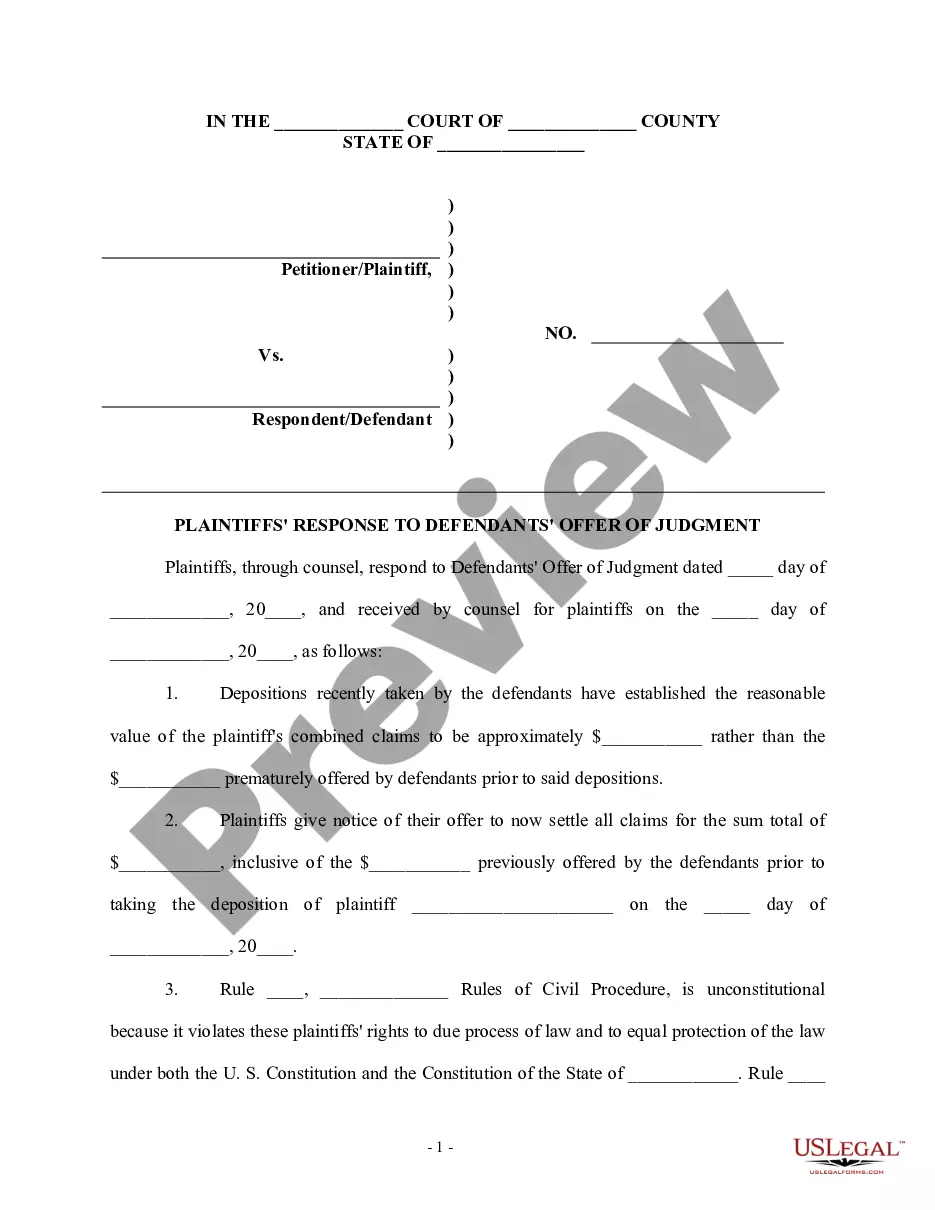
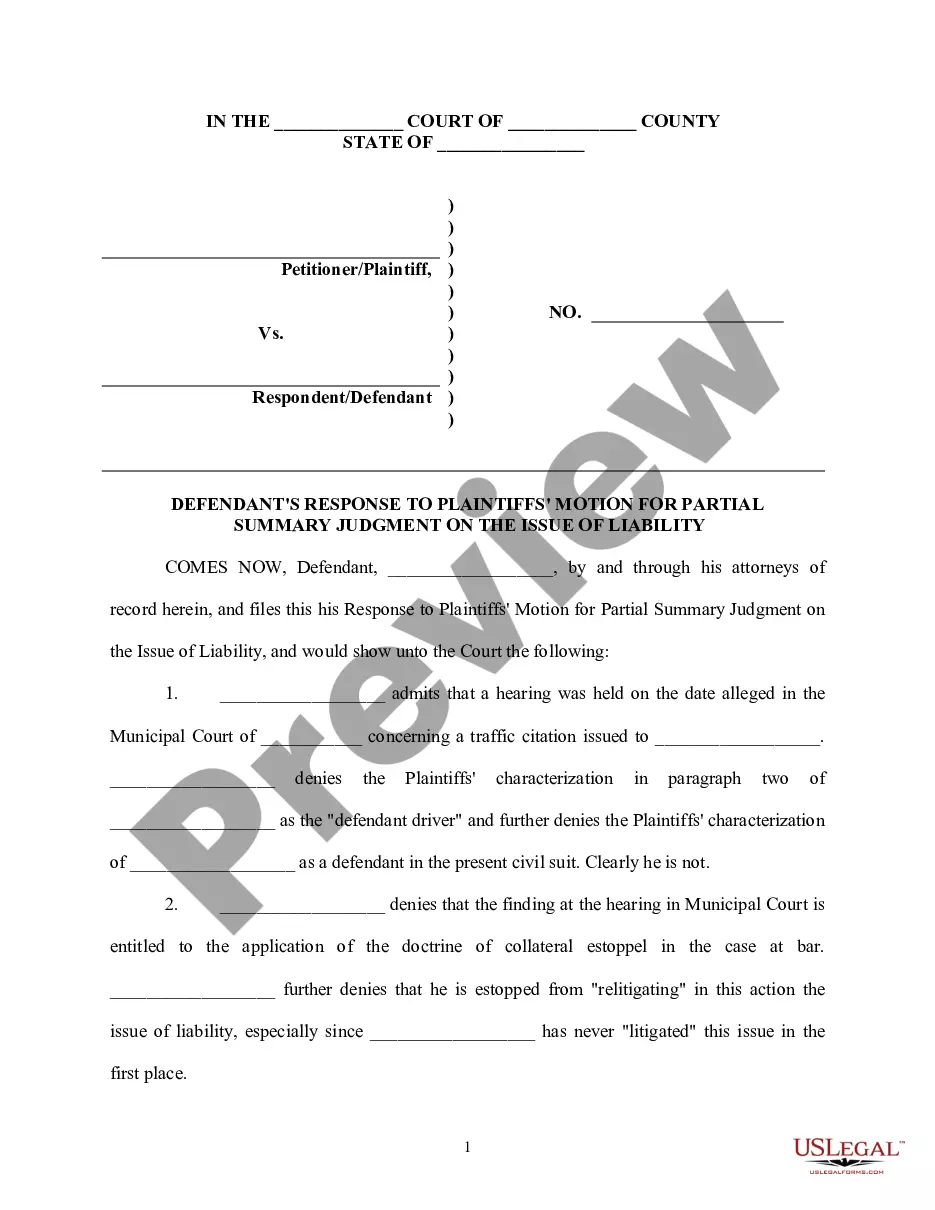
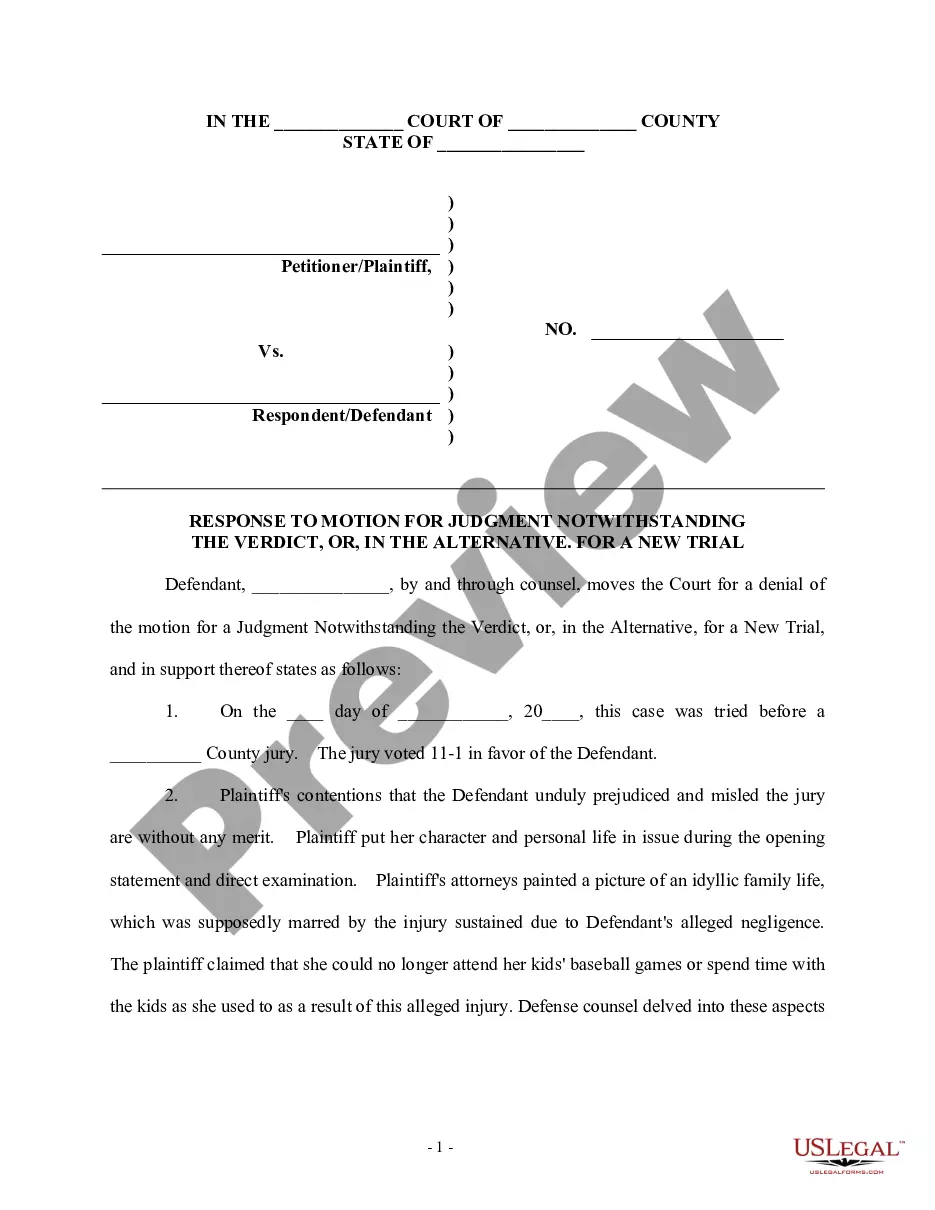
The Response to Plaintiff's Motion for Additur or New Trial is a legal document used by a defendant to formally contest a plaintiff's request for altering a jury verdict or seeking a new trial. This response asserts that the jury's decision was justified and should remain unchanged, distinguishing itself from other types of legal motions that may relate to verdict adjustments.
What’s included in this form
- Reference to the applicable code section regarding additur.
- Assertion that the jury verdict was not influenced by bias or prejudice.
- Details regarding the evidence presented at trial, including medical expenses and lost wages.
- Arguments supporting the jury's verdict and reasons why the motion should be denied.
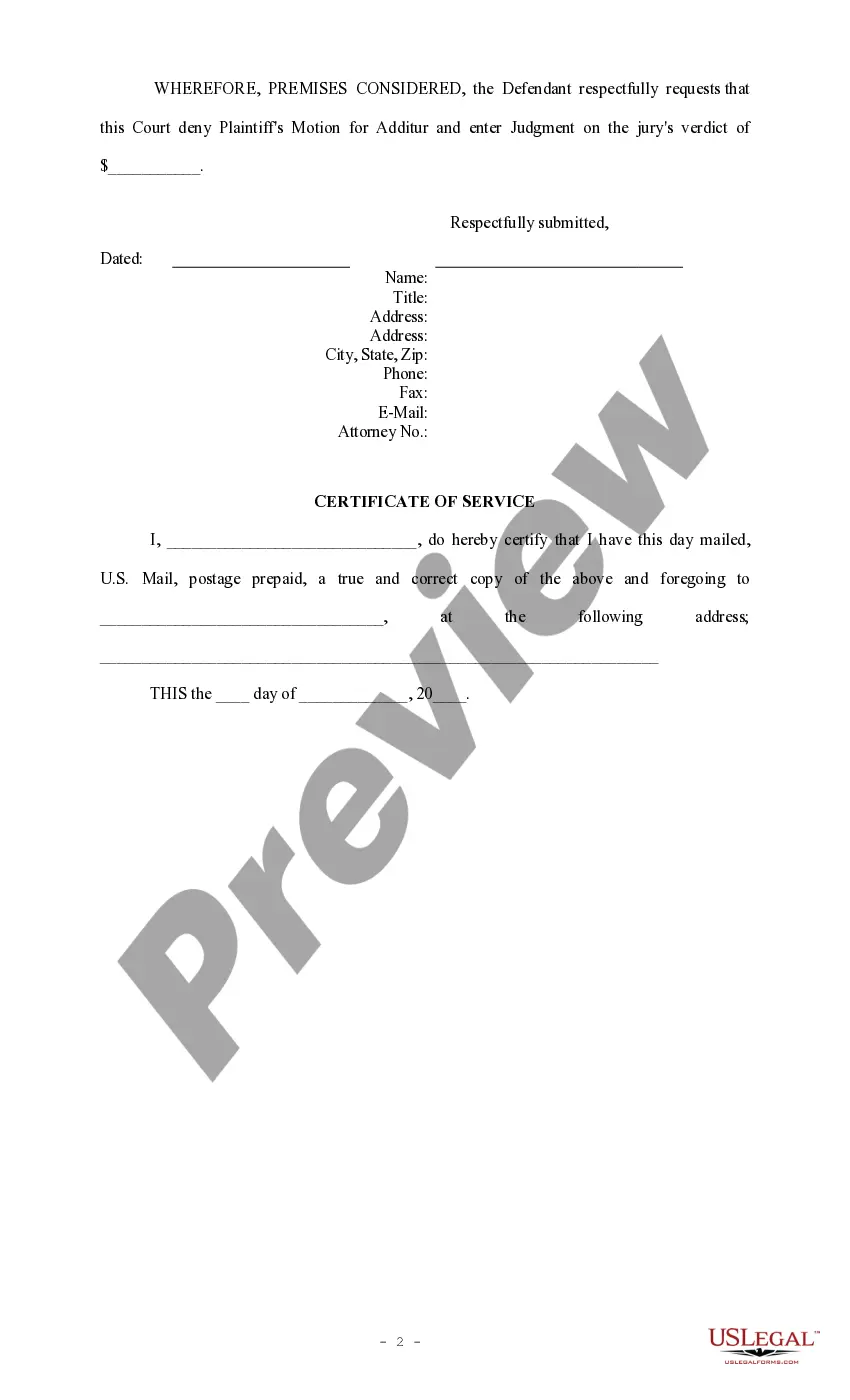
- Request for the court to deny the plaintiff's motion and affirm the jury's decision.
Situations where this form applies
This form is used when a defendant receives a motion from the plaintiff seeking additur (increasing the damages awarded) or a new trial due to perceived errors in the trial process. It is appropriate to respond with this form to ensure the jury's original verdict is upheld and to articulate the reasons for opposing the plaintiff's request.
Who should use this form
- Defendants in civil litigation involved in a case where the plaintiff has filed a motion for additur or a new trial.
- Attorneys representing defendants who need to counter a plaintiff's motion effectively.
- Individuals seeking to ensure their legal rights are protected by responding formally to a motion in court.
How to prepare this document
- Identify the applicable code section regarding additur in your jurisdiction.
- State the jury's verdict clearly, emphasizing that it was not based on improper influences.
- Include relevant details about the evidence presented, highlighting any discrepancies noted by the jury.
- Formulate arguments supporting why the plaintiff's motion should be denied based on the evidence and jury decision.
- Complete the certificate of service to notify the opposing party of your response, including the date and method of mailing.
Does this document require notarization?
In most cases, this form does not require notarization. However, some jurisdictions or signing circumstances might. US Legal Forms offers online notarization powered by Notarize, accessible 24/7 for a quick, remote process.
Get your form ready online
Our built-in tools help you complete, sign, share, and store your documents in one place.
Make edits, fill in missing information, and update formatting in US Legal Forms—just like you would in MS Word.
Download a copy, print it, send it by email, or mail it via USPS—whatever works best for your next step.
Sign and collect signatures with our SignNow integration. Send to multiple recipients, set reminders, and more. Go Premium to unlock E-Sign.
If this form requires notarization, complete it online through a secure video call—no need to meet a notary in person or wait for an appointment.
We protect your documents and personal data by following strict security and privacy standards.

Make edits, fill in missing information, and update formatting in US Legal Forms—just like you would in MS Word.

Download a copy, print it, send it by email, or mail it via USPS—whatever works best for your next step.

Sign and collect signatures with our SignNow integration. Send to multiple recipients, set reminders, and more. Go Premium to unlock E-Sign.

If this form requires notarization, complete it online through a secure video call—no need to meet a notary in person or wait for an appointment.

We protect your documents and personal data by following strict security and privacy standards.
Typical mistakes to avoid
- Failing to reference the specific code section, which can weaken your argument.
- Neglecting to provide sufficient evidence to support your claims about the jury's verdict.
- Omitting the certificate of service, which is required to inform the plaintiff's attorney.
- Using overly technical language that may confuse the court.
Benefits of completing this form online
- Convenience of instant access to legal forms tailored for your needs.
- Editability allows customization to fit specific case details and requirements.
- Ensures reliability as forms are drafted and reviewed by licensed attorneys.
Looking for another form?








Form popularity
FAQ
A "motion" is simply a formal request to a court that it do something or decide an issue in favor of the party that asks for it. "Granted" means the court agreed with the request, and did or decided in favor of the requester.
An additur (Latin: "it is added to") is a legal term referring to the practice of a trial judge adding damages additional to the original amount awarded by the jury. It is not allowed in U.S. federal courts, as held by Dimick vs. Schiedt, 293 U.S. 474 (1935).
Motion to Dismiss an attempt to get the judge to dismiss a charge or the case. Motion to Suppress an attempt to keep certain statements or evidence from being introduced as evidence. Motion for Change of Venue may be made for various reasons including pre-trial publicity.
At a motion hearing, each party can argue its position and the judge can ask specific questions about the fact or law. After hearing the judge decides the motion and this is called an order. However, during a trial or a hearing, an oral motion may also be permitted.
After you complete your motion, you must file it with the court.You must then serve (mail) a copy of your filed motion (including all exhibits and the date, time, and place of hearing) to all other parties in the case. If a party is represented by an attorney, mail the motion directly to the attorney's office.
In effect, in both kinds of cases, the lawyer asks the judge to direct a verdict for the defendant. The judge will either grant or deny the motion. If it is granted, the case is over and the defendant wins. If the motion is denied, as it usually is, the defense is given the opportunity to present its evidence.
When a trial has concluded and a verdict has been rendered by a judge or jury, the judgment must be formalized in writing by the court. Once the judgment has been rendered, either party may file what is called a post trial motion, or motion which is filed after the trial is over.
A motion is an application to the court made by the prosecutor or defense attorney, requesting that the court make a decision on a certain issue before the trial begins. The motion can affect the trial, courtroom, defendants, evidence, or testimony.
What Happens at a Trial Setting Conference? The judge will ask questions about the case to ascertain whether it is ready for trial and how long the trial is likely to take. If the case is indeed ready to proceed to trial, the court will set a Mandatory Settlement Conference (or MSC) as well as a trial date.