Order Allowing Attorney to Withdraw
What this document covers
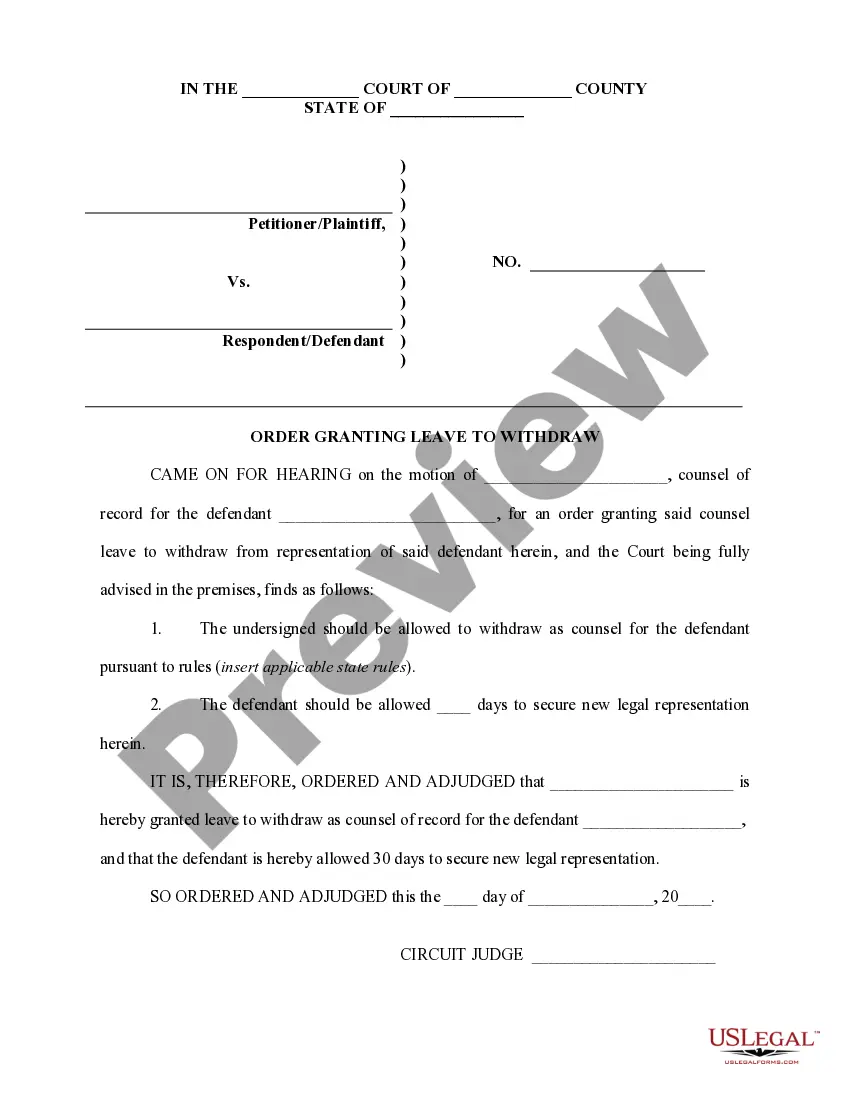
The Order Allowing Attorney to Withdraw is a legal document that grants permission for an attorney to withdraw from representing a client in a legal matter. This form ensures that the withdrawal is formally recognized by the court and provides the client with a specified period to find new legal representation. This form is essential for maintaining procedural integrity and is typically used in civil and criminal cases where the lawyer-client relationship needs to be terminated securely and legally.
Main sections of this form
- Statement requesting withdrawal of counsel based on applicable state rules.
- Specified period for the defendant to secure new legal representation.
- Order granting leave for the attorney to withdraw as counsel of record.
- Signature of the Circuit Judge and date of the order.
- Name of the defendant and attorney involved in the case.
When to use this form
This form is needed when an attorney wishes to withdraw from representing a client and must formalize this action with the court. Common situations include the attorney's inability to continue representing due to conflicts of interest, non-payment of fees by the client, or the client's decision to terminate the attorney's services. It is crucial to use this form to ensure the withdrawal is processed correctly and that the client has adequate time to find a new attorney.
Who should use this form
- Attorneys who want to withdraw from a case.
- Clients who are changing legal representation.
- Defendants in legal matters who need to formalize the withdrawal of counsel.
How to prepare this document
- Insert the relevant state rules applicable to attorney withdrawal.
- Specify the number of days the defendant has to find new legal representation.
- Fill in the names of both the withdrawing attorney and the defendant.
- Sign the order in front of the Circuit Judge and date it accurately.
- Submit the completed form to the court as required.
Does this form need to be notarized?
This form does not typically require notarization to be legally valid. However, some jurisdictions or document types may still require it. US Legal Forms provides secure online notarization powered by Notarize, available 24/7 for added convenience.
Get your form ready online
Our built-in tools help you complete, sign, share, and store your documents in one place.
Make edits, fill in missing information, and update formatting in US Legal Forms—just like you would in MS Word.
Download a copy, print it, send it by email, or mail it via USPS—whatever works best for your next step.
Sign and collect signatures with our SignNow integration. Send to multiple recipients, set reminders, and more. Go Premium to unlock E-Sign.
If this form requires notarization, complete it online through a secure video call—no need to meet a notary in person or wait for an appointment.
We protect your documents and personal data by following strict security and privacy standards.

Make edits, fill in missing information, and update formatting in US Legal Forms—just like you would in MS Word.

Download a copy, print it, send it by email, or mail it via USPS—whatever works best for your next step.

Sign and collect signatures with our SignNow integration. Send to multiple recipients, set reminders, and more. Go Premium to unlock E-Sign.

If this form requires notarization, complete it online through a secure video call—no need to meet a notary in person or wait for an appointment.

We protect your documents and personal data by following strict security and privacy standards.
Common mistakes
- Failing to specify the number of days for the client to secure new counsel.
- Omitting the applicable state rules, which may result in rejection.
- Not obtaining the Circuit Judge's signature before submission.
Advantages of online completion
- Convenient access to legal templates anytime and anywhere.
- Editable fields allowing for customization according to specific needs.
- Reliable templates drafted by licensed attorneys for accuracy.
Key takeaways
- The Order Allowing Attorney to Withdraw is essential for formalizing an attorney's withdrawal from a case.
- It provides a timeline for clients to find new legal representation.
- Completing this form correctly is important to avoid delays in legal proceedings.
Looking for another form?








Form popularity
FAQ
The Order Allowing Attorney to Withdraw formalizes a lawyer's withdrawal by filing a statement requesting withdrawal under applicable state rules and results in an order granting leave for the attorney to withdraw as counsel of record. It also provides a period for the defendant to obtain new representation and is signed by the Circuit Judge. It is used when withdrawal is needed for conflicts, non-payment, or termination by the client.
When an attorney withdraws using this form, the court grants leave for the attorney to withdraw as counsel of record after a filed statement requesting withdrawal under state rules. The order sets a specified period for the defendant to secure new representation and is signed by the Circuit Judge with the defendant and attorney named. This ensures the withdrawal is processed properly.
When a lawyer files a motion to withdraw using this form, the court considers the request under applicable state rules and issues an order granting leave for the attorney to withdraw as counsel of record. The order sets a period for the defendant to secure new representation and is signed by the Circuit Judge, with the defendant and attorney named.
An order granting motion to withdraw appearance is the court-issued document that approves the attorney's withdrawal and finalizes the change in representation. It sets a period for the defendant to obtain new representation and is signed by the Circuit Judge, with the defendant and attorney named.
It means the attorney ceases representing the client in the case; the court must issue an order granting leave to withdraw; there will be a specified period to find new counsel. The withdrawal must be formalized to preserve procedural integrity; the order includes the name of the defendant and attorney, and is signed by the Circuit Judge.
It delivers a court-approved order granting leave for withdrawal as counsel of record, includes a set period for the defendant to find new representation, and bears the Circuit Judge's signature, whereas a simple motion to withdraw may request the change without producing an enforceable order or deadline.