Form of Anti-Money Laundering Policy
Overview of this form
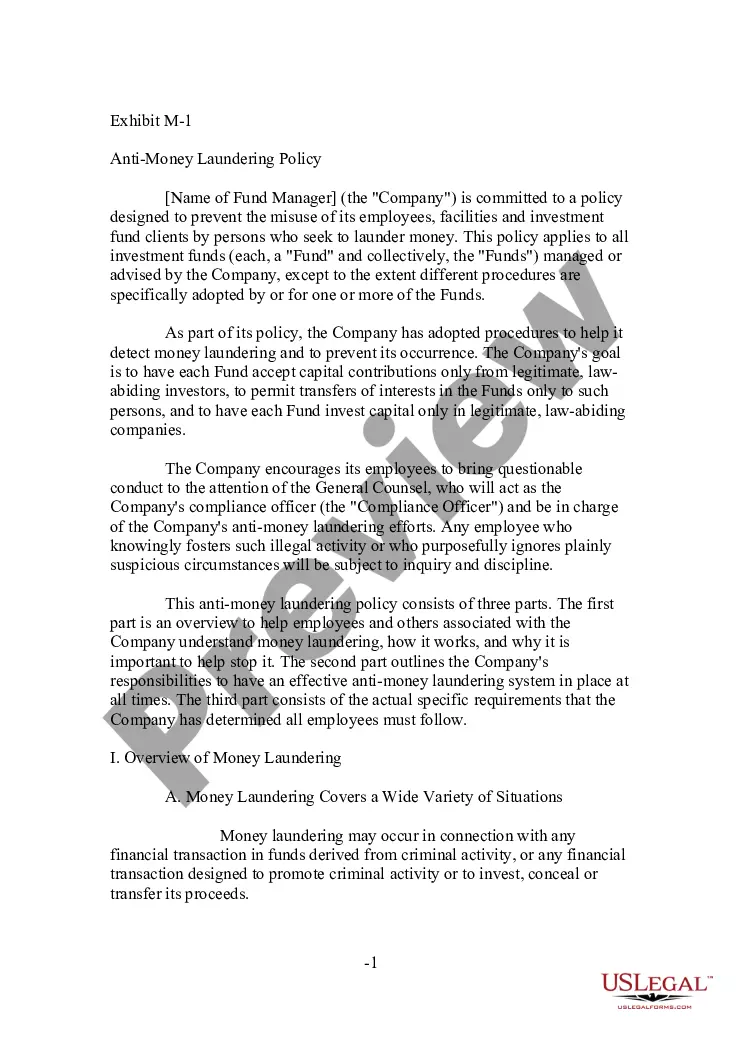
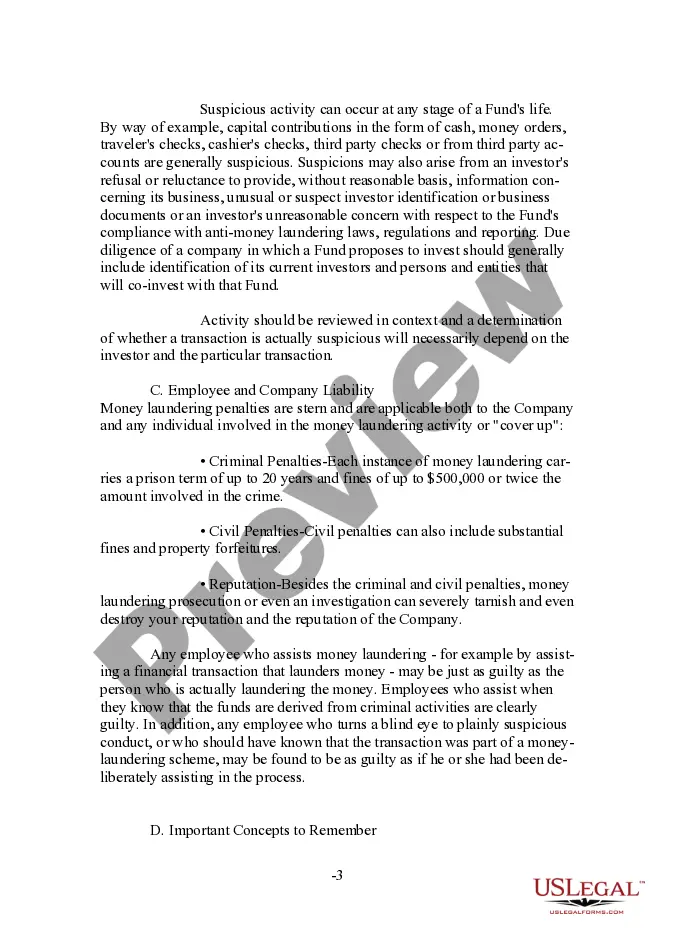
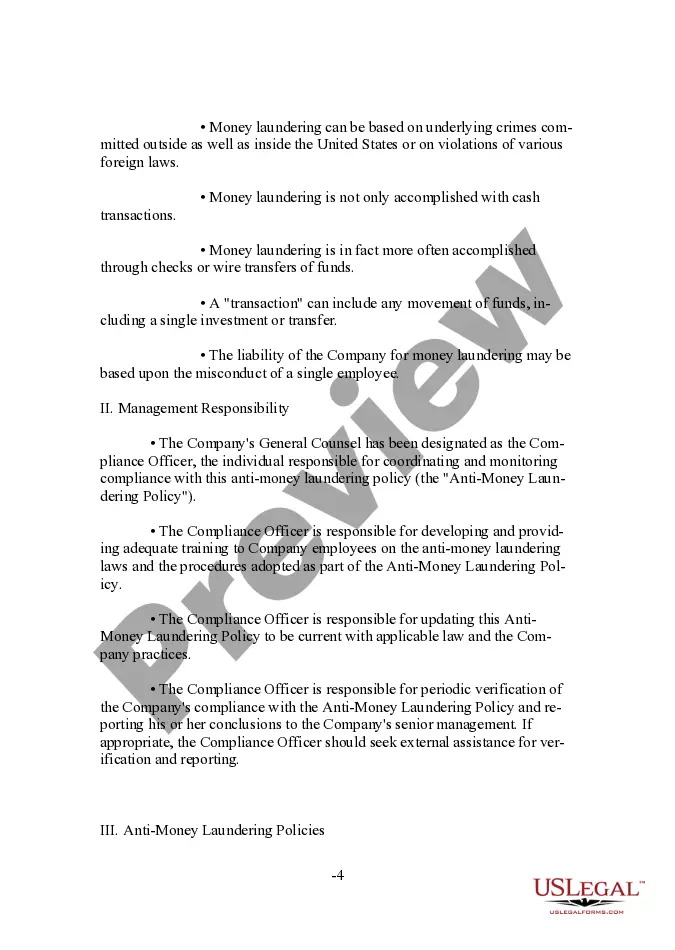
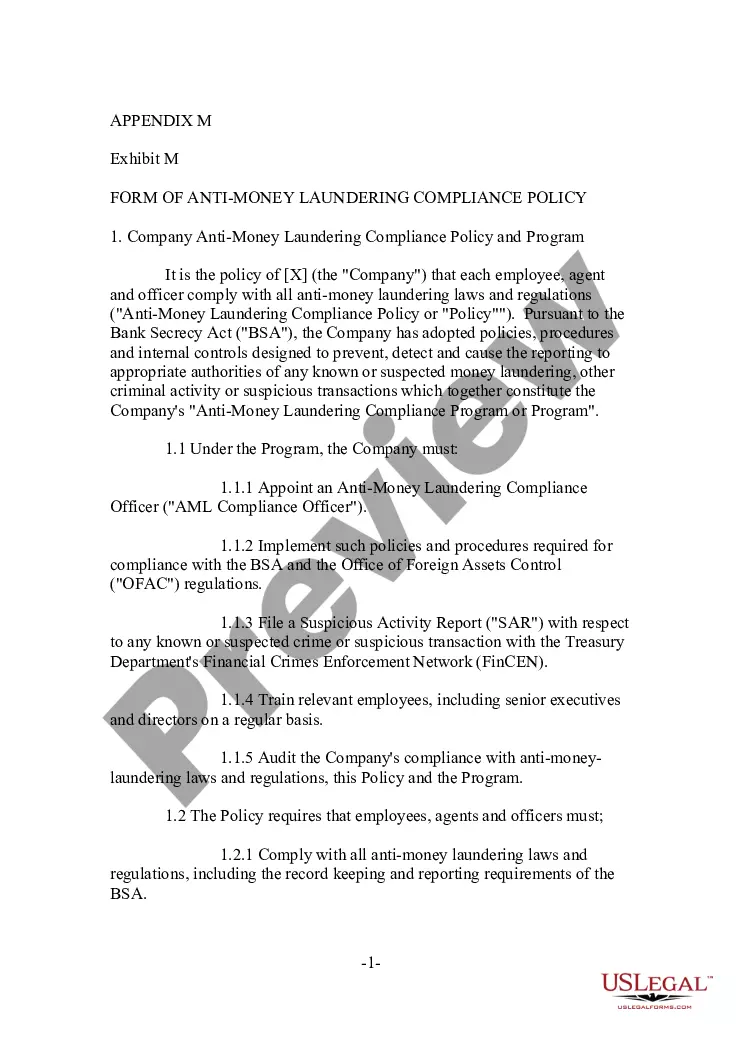
The Anti-Money Laundering Policy is a crucial document specifically designed for investment fund managers to establish guidelines that prevent the misuse of funds and resources for money laundering activities. This policy outlines the responsibilities of employees in identifying and reporting suspicious activities. It differs from other legal forms by addressing not just compliance but also the culture of vigilance within investment companies, ensuring all stakeholders understand the responsibilities in relation to money laundering.
Key components of this form
- Overview of money laundering and its implications for financial transactions.
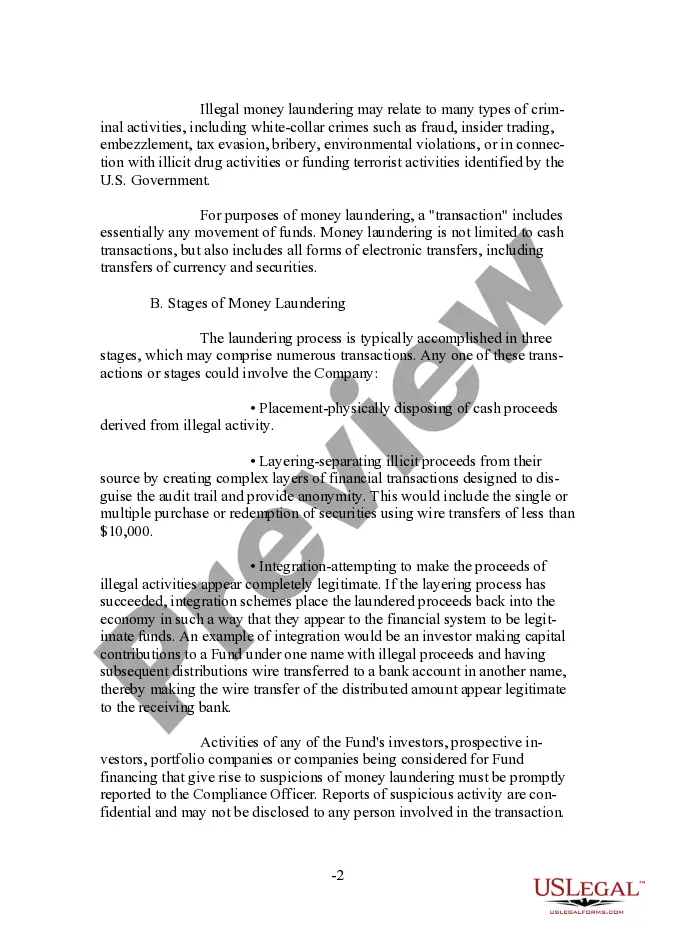
- Stages of money laundering including placement, layering, and integration.
- Employee responsibilities to report suspicious activities and ensure compliance.
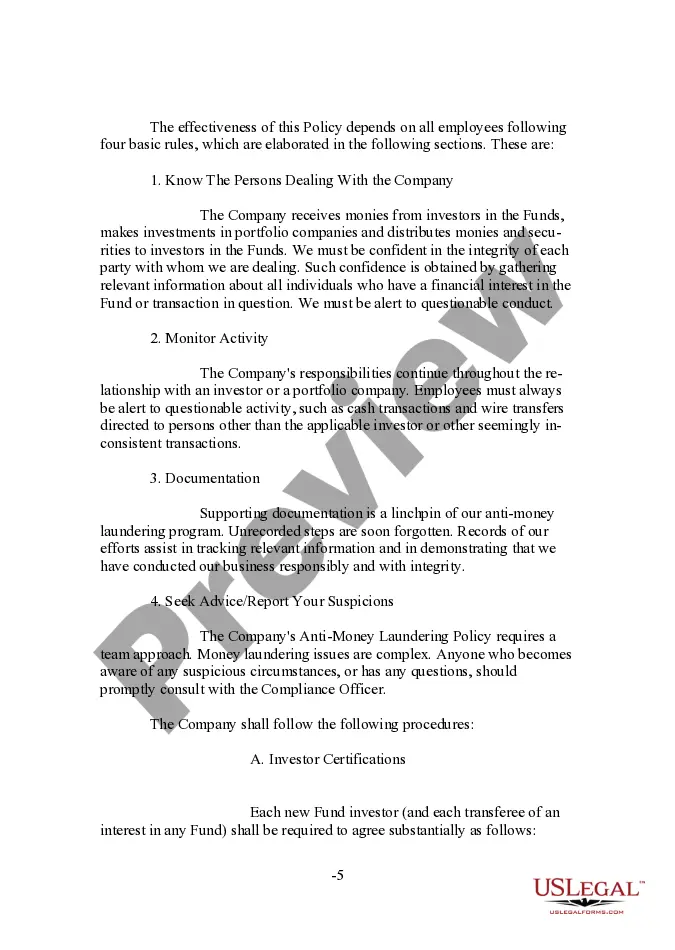
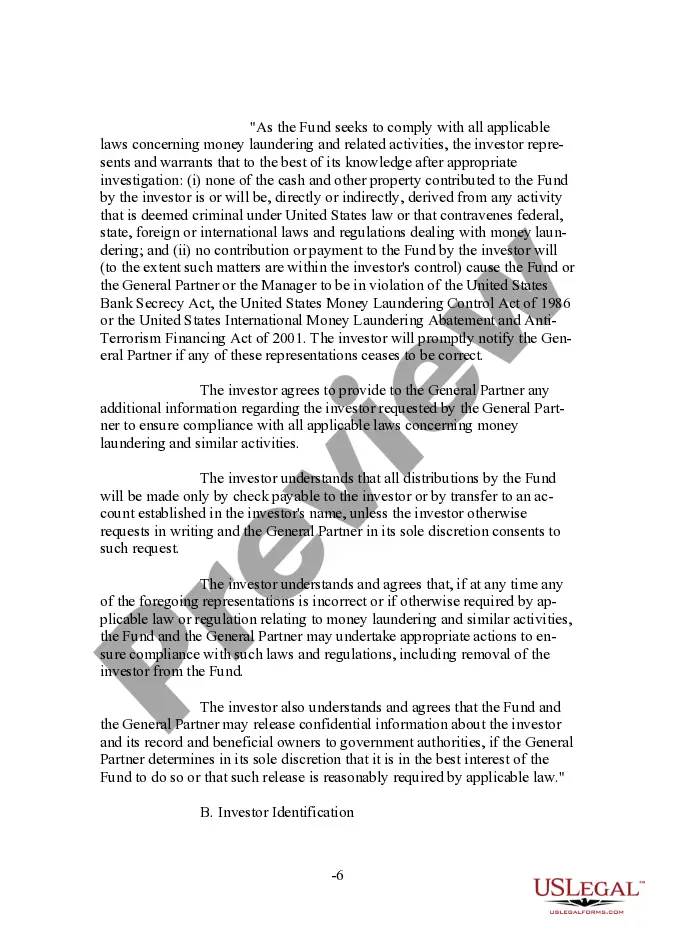
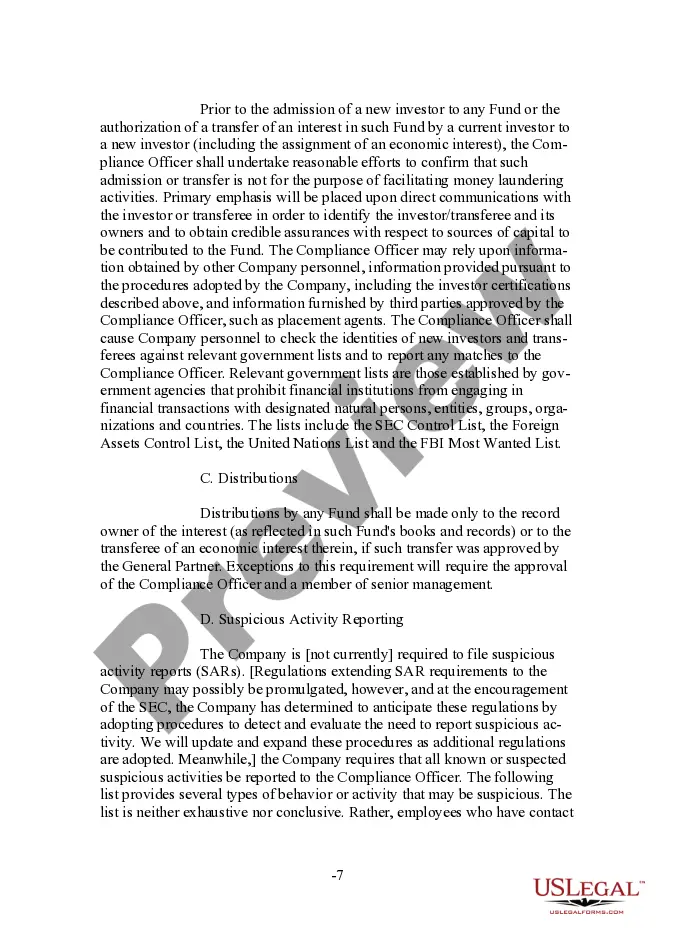
- Detailed procedures for investor certification and identification.
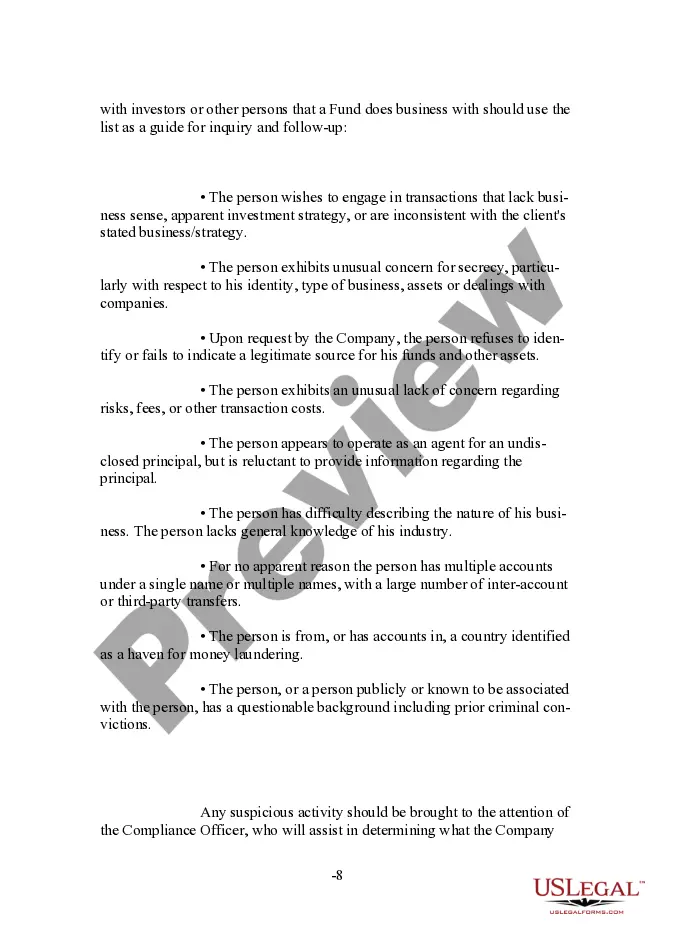
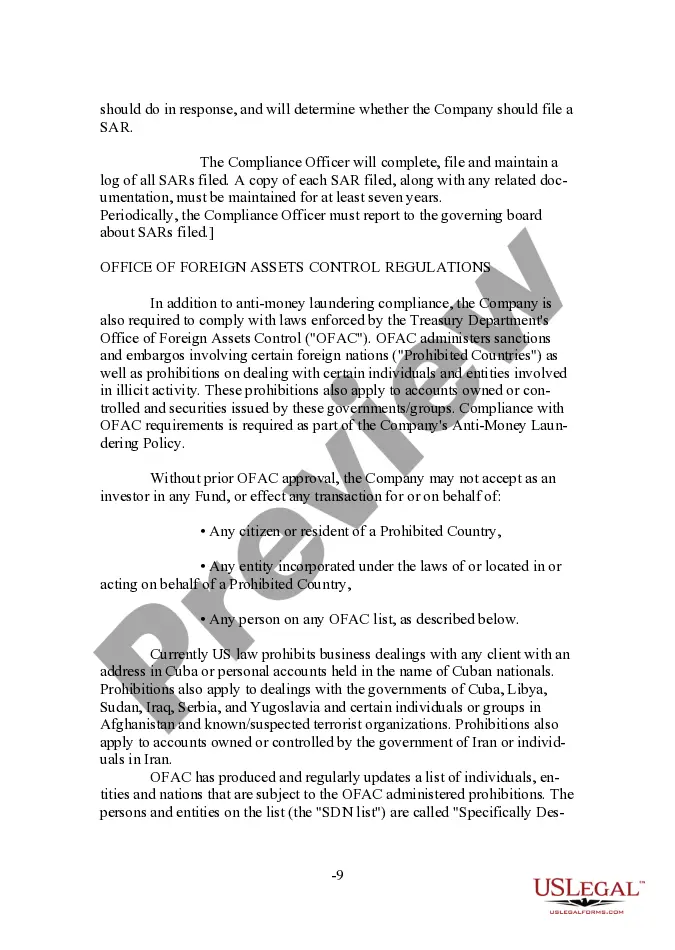
- Guidelines for monitoring transactions and documenting activities.
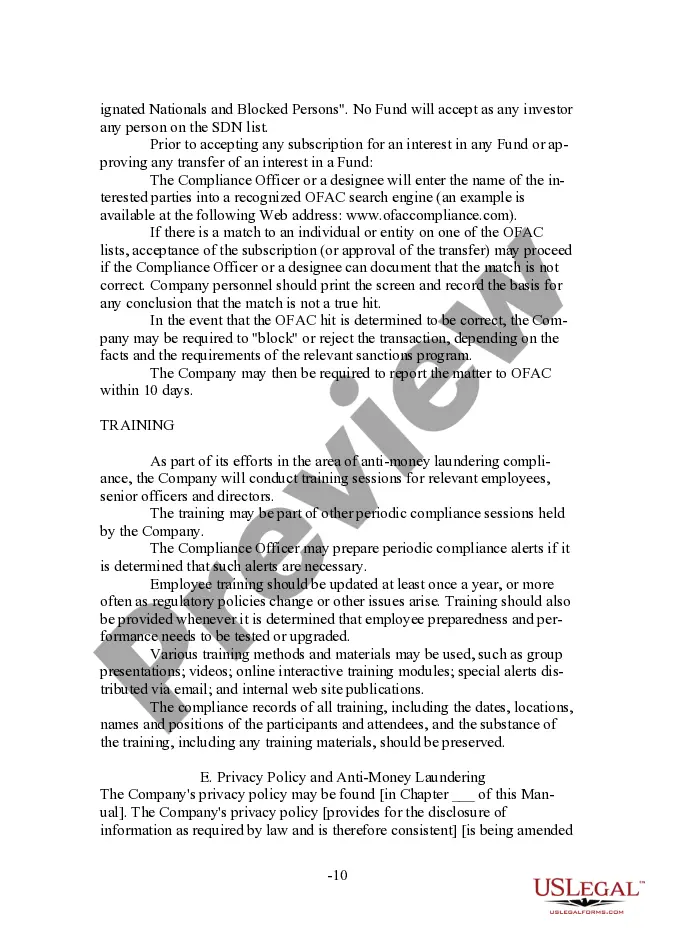
- Training requirements for employees regarding anti-money laundering laws.

When to use this form
This form should be used by private equity firms and investment companies when establishing or updating their anti-money laundering policies. It is essential whenever there is a need to comply with legal standards for preventing money laundering, particularly when onboarding new investors or conducting financial transactions. Additionally, it is relevant for internal training sessions to educate employees about recognizing and handling suspicious activities effectively.
Intended users of this form
- Investment fund managers responsible for overseeing fund operations.
- Compliance officers tasked with regulatory adherence and monitoring activities.
- Employees and staff involved in financial transactions and investor relations.
- Legal advisors working with investment management firms.
How to prepare this document
- Identify the company and fund manager responsible for implementing the policy.
- Outline the definitions and descriptions of money laundering and its stages.
- Assign responsibilities to the Compliance Officer and define their role.
- Establish procedures for investor certifications and the identification process.
- Detail employee training policies and schedules for maintaining compliance.
- Specify documentation requirements for all monitoring activities and suspicious transactions.
Notarization requirements for this form
In most cases, this form does not require notarization. However, some jurisdictions or signing circumstances might. US Legal Forms offers online notarization powered by Notarize, accessible 24/7 for a quick, remote process.
Get your form ready online
Our built-in tools help you complete, sign, share, and store your documents in one place.
Make edits, fill in missing information, and update formatting in US Legal Forms—just like you would in MS Word.
Download a copy, print it, send it by email, or mail it via USPS—whatever works best for your next step.
Sign and collect signatures with our SignNow integration. Send to multiple recipients, set reminders, and more. Go Premium to unlock E-Sign.
If this form requires notarization, complete it online through a secure video call—no need to meet a notary in person or wait for an appointment.
We protect your documents and personal data by following strict security and privacy standards.

Make edits, fill in missing information, and update formatting in US Legal Forms—just like you would in MS Word.

Download a copy, print it, send it by email, or mail it via USPS—whatever works best for your next step.

Sign and collect signatures with our SignNow integration. Send to multiple recipients, set reminders, and more. Go Premium to unlock E-Sign.

If this form requires notarization, complete it online through a secure video call—no need to meet a notary in person or wait for an appointment.

We protect your documents and personal data by following strict security and privacy standards.
Common mistakes
- Failing to provide adequate training to employees on anti-money laundering laws.
- Not updating the policy in accordance with changes in regulations.
- Inadequate documentation of suspicious activities and lack of follow-up.
- Overlooking the importance of employee vigilance and reporting procedures.
Advantages of online completion
- Easy access to up-to-date legal templates that can be customized to specific needs.
- Convenience of downloading and filling out forms at your own pace.
- Secure digital storage options for records and documentation.
- Reliable compliance support through clear guidelines and structured policies.
Legal use & context
- This form is essential for compliance with anti-money laundering regulations set by federal authorities.
- Failure to adhere to the guidelines can result in severe penalties for both the company and its employees.
- The policy lays the groundwork for a culture of compliance and transparency within financial institutions.
Summary of main points
- The Anti-Money Laundering Policy is crucial for preventing illegal financial activities within investment funds.
- All employees must understand their responsibilities in reporting suspicious activity.
- Regular training and updates to the policy are necessary to maintain compliance with new regulations.
- Proper documentation and monitoring are essential components of an effective anti-money laundering strategy.
Looking for another form?










Form popularity
FAQ
Anti-money laundering (AML) refers to the laws, regulations and procedures intended to prevent criminals from disguising illegally obtained funds as legitimate income. Though anti-money laundering laws cover a limited range of transactions and criminal behavior, their implications are far-reaching.
Anti-Money Laundering (AML) is a set of policies, procedures, and technologies that prevents money laundering. It is implemented within government systems and large financial institutions to monitor potentially fraudulent activity.
AML stands for Anti-Money Laundering. It refers to a broad set of security measures banks take to reduce their exposure to bad actors using their banks to disguise illegitimate funds as legitimate income. Anti-money laundering laws started applying to banks once the Financial Action Task Force (FATF) was formed.
As per the revised guidelines AML documents (Proof of identity with photo, address proof) are mandatory for health insurance claims if the claim amount is Rs. 1 Lakh and above, with effect from April 01, 2013. Insurers shall verify and document identity, address and recent photograph (in case of individual.
NEW DELHI: Insurance regulator IRDA has issued Anti Money Laundering (AML) guidelines that include strict adherence of KYC norms by insurance companies.However, products like standalone health insurance, group insurance issued by a company and term life insurance contract are exempted from AML purview.
The Act requires insurance companies to establish anti-money laundering (AML) programs that comply with minimum standards developed by the Department of the Treasury.
Firms must comply with the Bank Secrecy Act and its implementing regulations ("AML rules"). The purpose of the AML rules is to help detect and report suspicious activity including the predicate offenses to money laundering and terrorist financing, such as securities fraud and market manipulation.
Know Your Customer (KYC) refers to the process of verifying the identity of your customers, either before or during the time that they start doing business with you.The KYC process is also a legal requirement intended as an anti-money laundering (AML) measure.
The process of laundering money typically involves three steps: placement, layering, and integration. Placement puts the "dirty money" into the legitimate financial system. Layering conceals the source of the money through a series of transactions and bookkeeping tricks.