Parent - Minor Child Internet Use Agreement
Understanding this form
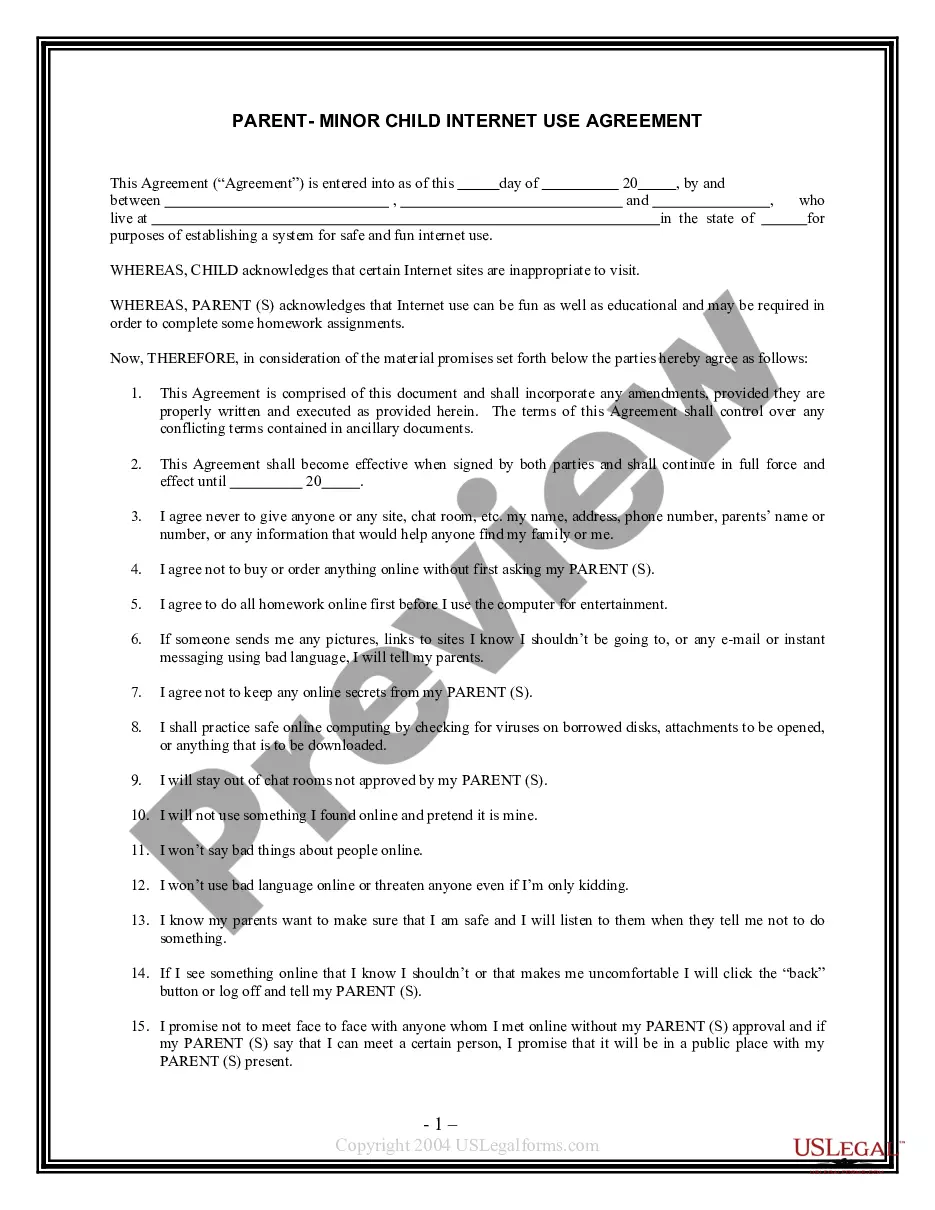
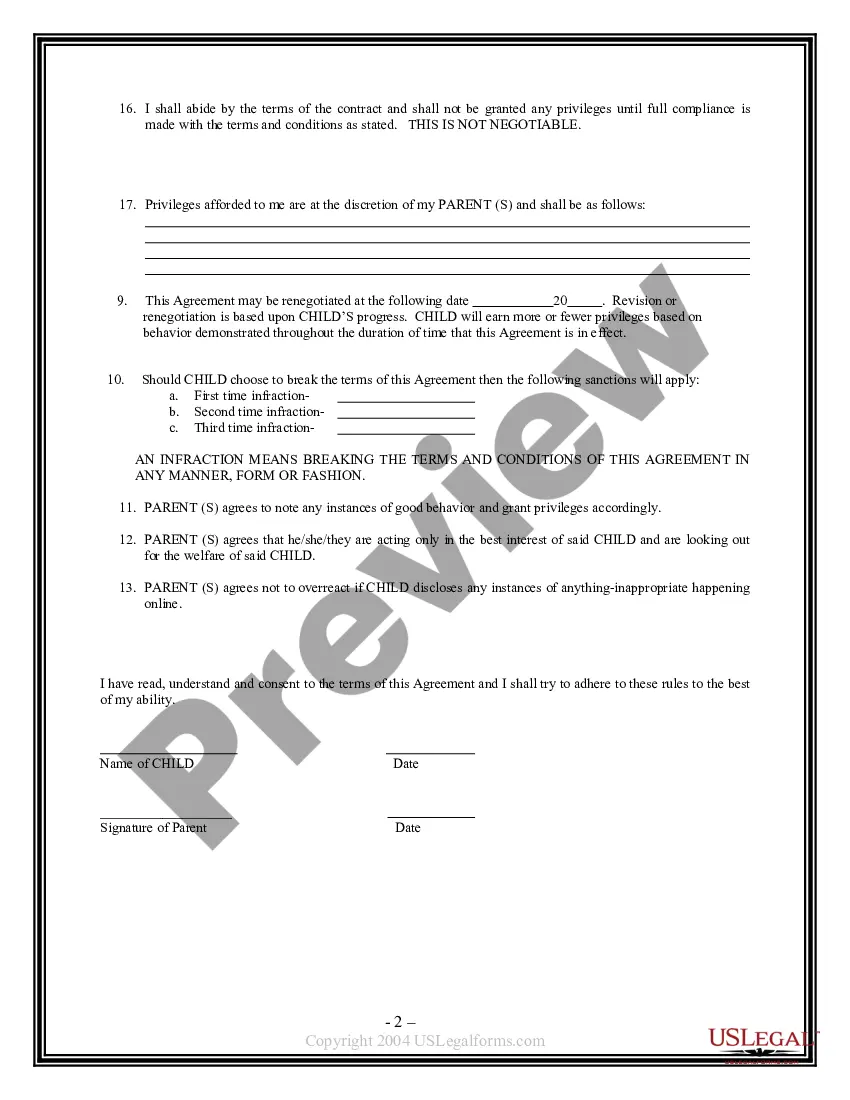
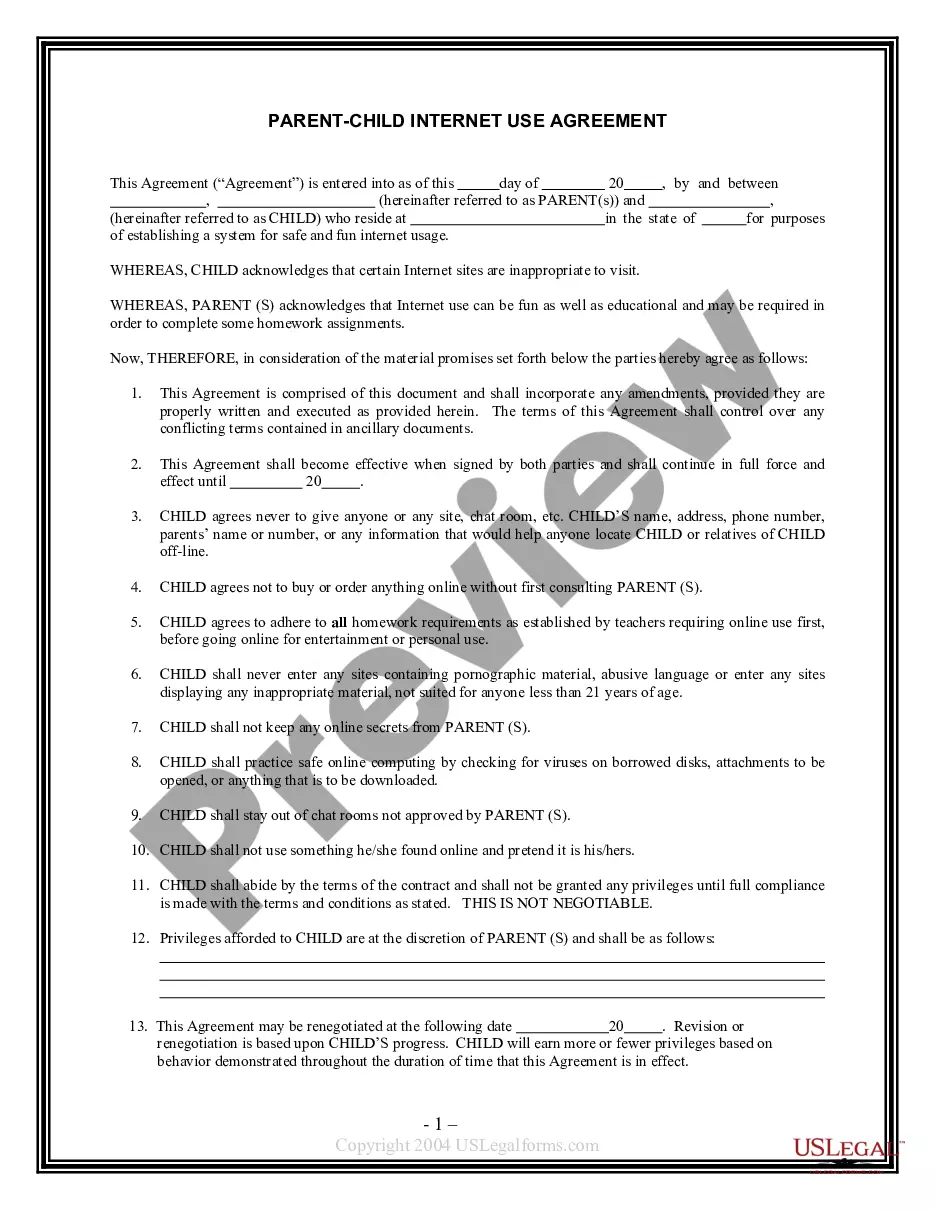
The Parent - Minor Child Internet Use Agreement is a legal contract designed to establish clear guidelines for safe internet usage by minors. This agreement helps parents communicate safety rules about online behavior, including inappropriate websites, online interactions, and general internet etiquette. Unlike other parenting contracts, this form focuses specifically on internet safety, ensuring children understand the importance of responsible online conduct.
Key components of this form
- Agreement on not making online purchases without parental consent.
- Instruction to complete homework online before recreational use of the computer.
- Obligation to report inappropriate online content or communications.
- Rules against sharing online secrets from parents.
- Commitment to safe computing practices, such as virus checking.
- Provisions regarding communication with online acquaintances and meeting them in person.
When this form is needed
Use the Parent - Minor Child Internet Use Agreement when introducing your child to the internet or when you wish to reinforce existing internet safety rules. It is beneficial for parents looking to set boundaries concerning acceptable online behavior and to foster open communication about internet use. This form can also be helpful if you notice changes in your child's online behavior or if they are starting to use the internet more independently.
Who can use this document
- Parents or guardians of minor children who use the internet.
- Families seeking to establish clear boundaries for internet use.
- Parents looking to communicate expectations and responsibilities regarding online behavior.
How to complete this form
- Read the agreement carefully to understand all terms and conditions.
- Identify the parties involved: the parent(s) and the minor child.
- Customize any sections as necessary to reflect your family's specific rules.
- Both parties should sign the document to indicate their agreement to the terms.
- Keep a copy of the signed agreement for future reference.
Does this document require notarization?
In most cases, this form does not require notarization. However, some jurisdictions or signing circumstances might. US Legal Forms offers online notarization powered by Notarize, accessible 24/7 for a quick, remote process.
Get your form ready online
Our built-in tools help you complete, sign, share, and store your documents in one place.
Make edits, fill in missing information, and update formatting in US Legal Forms—just like you would in MS Word.
Download a copy, print it, send it by email, or mail it via USPS—whatever works best for your next step.
Sign and collect signatures with our SignNow integration. Send to multiple recipients, set reminders, and more. Go Premium to unlock E-Sign.
If this form requires notarization, complete it online through a secure video call—no need to meet a notary in person or wait for an appointment.
We protect your documents and personal data by following strict security and privacy standards.

Make edits, fill in missing information, and update formatting in US Legal Forms—just like you would in MS Word.

Download a copy, print it, send it by email, or mail it via USPS—whatever works best for your next step.

Sign and collect signatures with our SignNow integration. Send to multiple recipients, set reminders, and more. Go Premium to unlock E-Sign.

If this form requires notarization, complete it online through a secure video call—no need to meet a notary in person or wait for an appointment.

We protect your documents and personal data by following strict security and privacy standards.
Common mistakes to avoid
- Failing to discuss the agreement openly with the child before signing.
- Not updating the agreement as the child's internet usage evolves.
- Assuming the child understands all terms without explanation.
Advantages of online completion
- Convenience of downloading and printing the form at home.
- Editable format allows for customization based on family needs.
- Reliability of having an agreement drafted to reflect legal standards.
Main things to remember
- The Parent - Minor Child Internet Use Agreement is essential for promoting safe online practices.
- Clear communication of rules helps prevent misunderstandings about internet use.
- This form provides a structured way for parents to set expectations and consequences for online behavior.
Looking for another form?



Form popularity
FAQ
No. COPPA covers operators of general audience websites or online services only where such operators have actual knowledge that a child under age 13 is the person providing personal information. The Rule does not require operators to ask the age of visitors.
The Children's Online Privacy Protection Act (COPPA) is a U.S. federal law designed to limit the collection and use of personal information about children by the operators of Internet services and Web sites. Passed by the U.S. Congress in 1998, the law took effect in April 2000.
Rule Summary: COPPA imposes certain requirements on operators of websites or online services directed to children under 13 years of age, and on operators of other websites or online services that have actual knowledge that they are collecting personal information online from a child under 13 years of age.
Experts Say Supervision is Vital Safekids.com says children can benefit from Internet exposure as early as age 3 as long as parents are present and in control.
While children under 13 can legally give out personal information with their parents' permission, many websitesparticularly social media sites, but also other sites that collect most personal infodisallow children under 13 from using their services altogether due to the cost and work involved in complying with the
Today, YouTube announced official changes to the way it treats kid's content on the platform, and how those changes affect every single creator. Whether they publish child-focused content or not.The Children's Online Privacy Protection Act (COPPA) is a 1998 U.S. law created to protect the privacy of children under 13.
The answer: eight years old is the average age at which parents allow independent Internet and device use. Ninety-four percent of parents said they allow their kids unsupervised access to at least one device or online service like email or social networks.
According a BBC survey more than three quarters of younger children between 10 and 12 years old are using at least one social media network.Ultimately, these social networks give children a safer environment where they can share their experiences and engage with friends they know.
Have introduced legislation to update the Children's Online Privacy Protection Act (COPPA). The bill bans internet companies from collecting personal or location information from children under 13 without parental consent and from teens ages 13-15 without the user's consent.