Memorandum of Option for Regeneration Station Easement
What this document covers
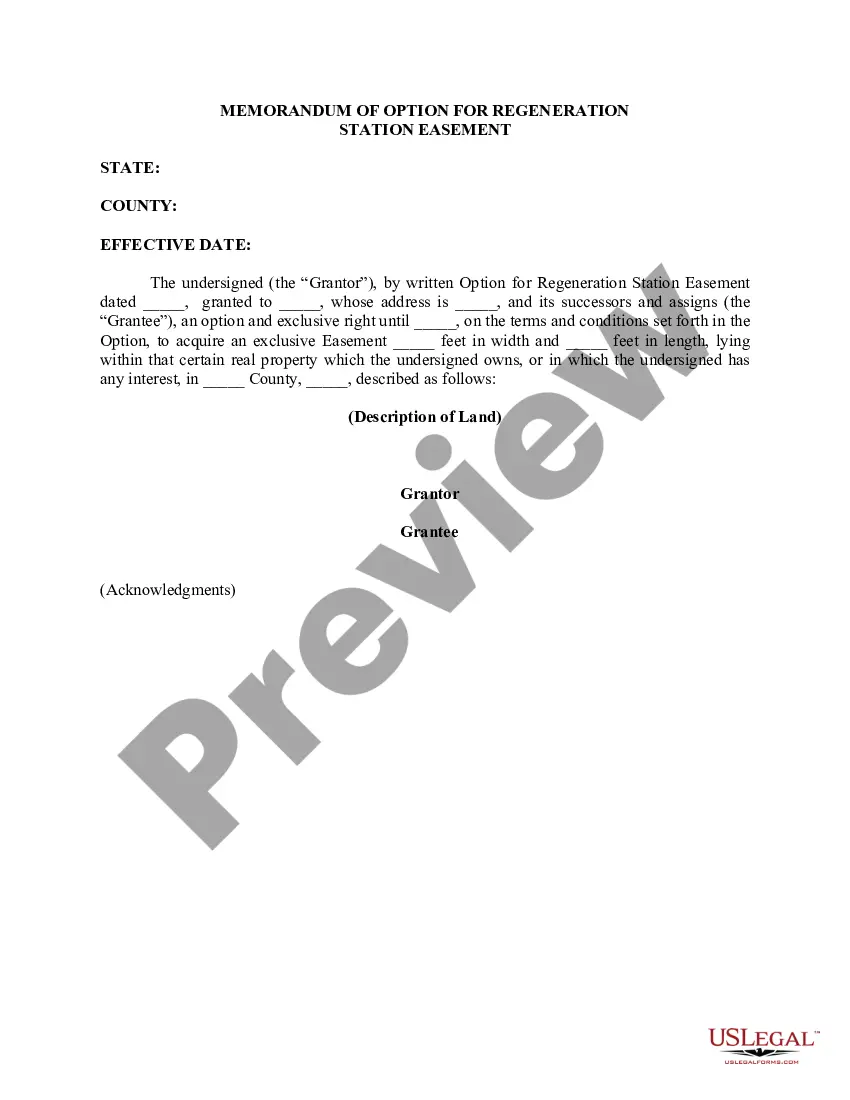
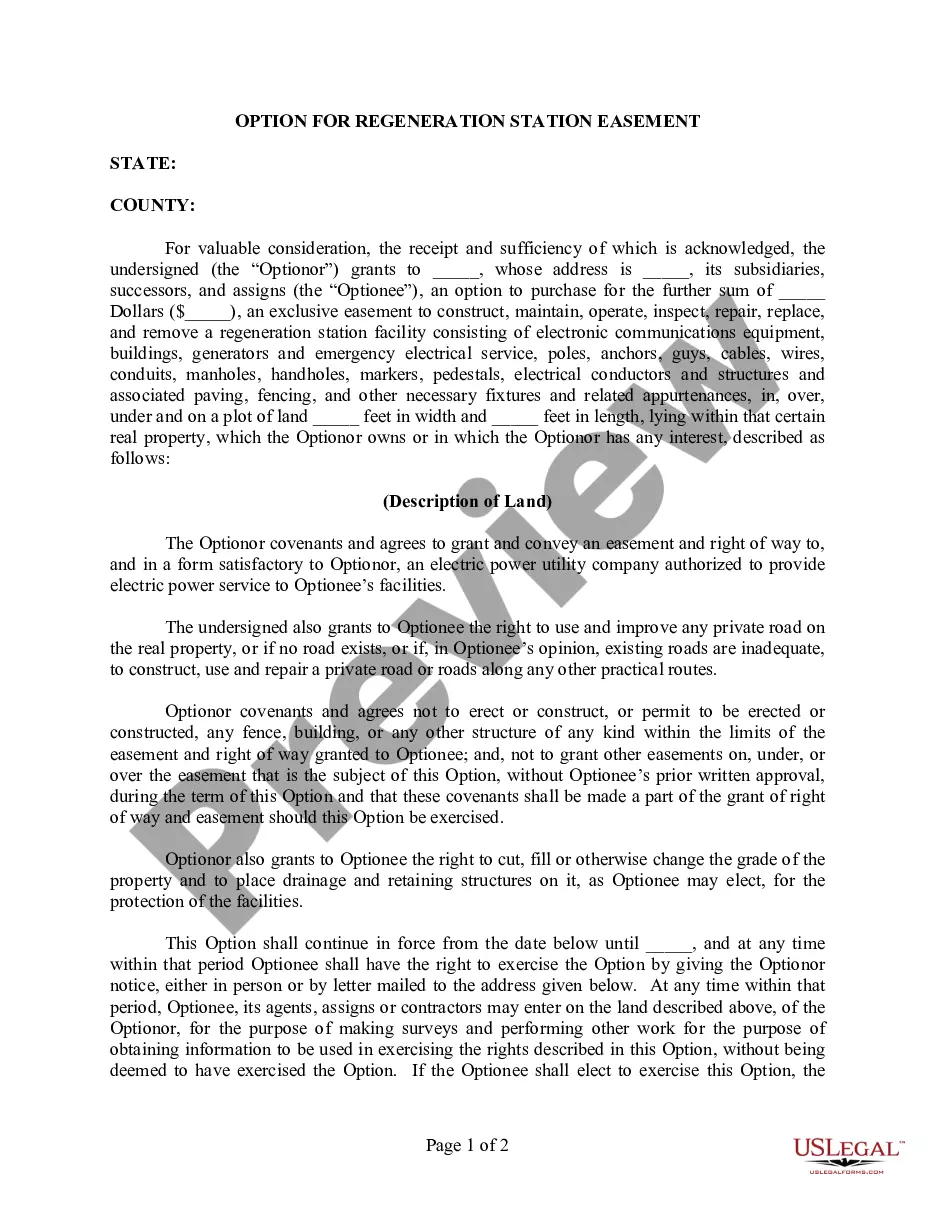
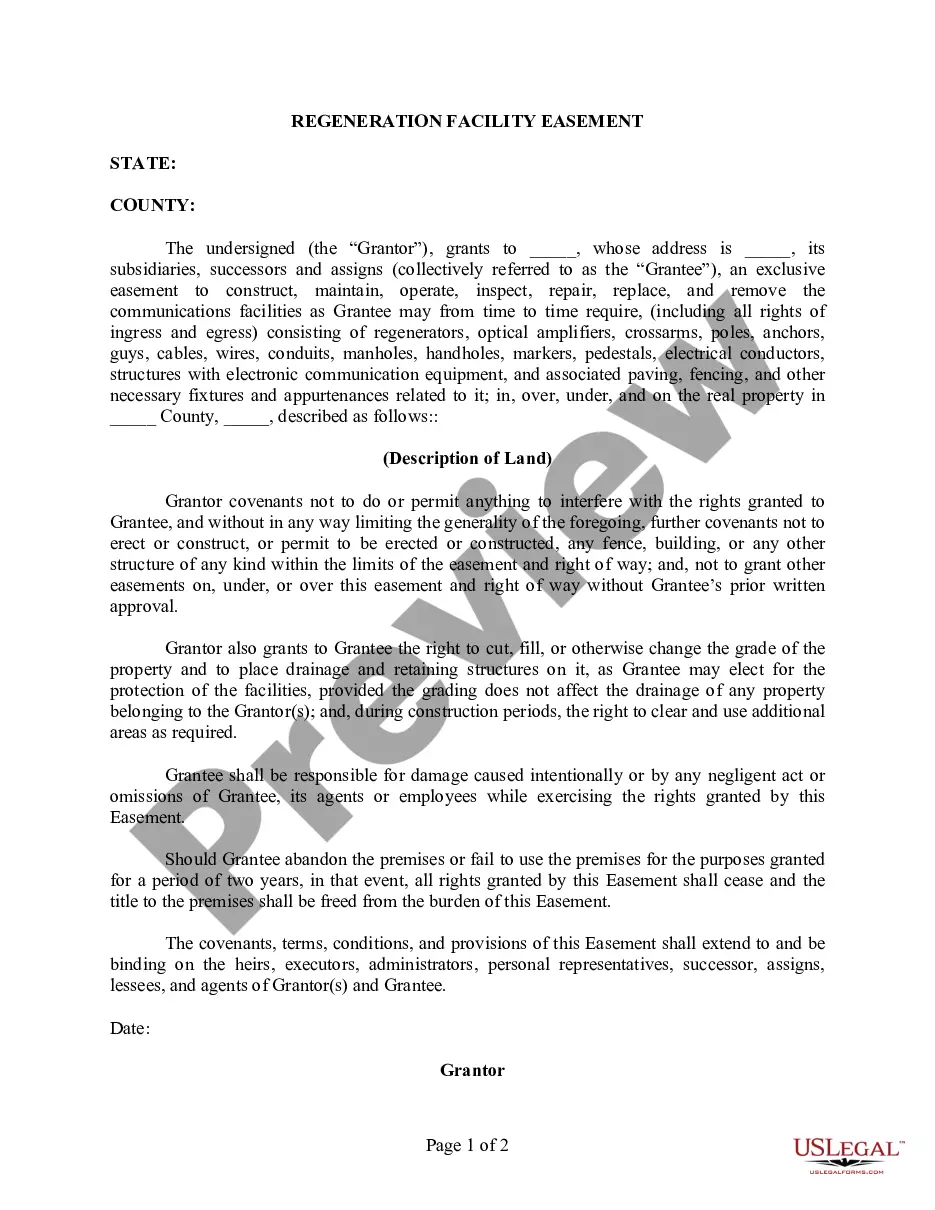
The Memorandum of Option for Regeneration Station Easement is a legal document that grants an exclusive right to a party, known as the Grantee, to acquire an easement on a specified property owned by another party, referred to as the Grantor. This form is essential for formally recording the option agreement related to the easement, distinguishing it from other easement agreements by its focus on the option provision rather than immediate transfer of land rights. It is particularly useful when the Grantee intends to secure rights for utility or infrastructure development while allowing the Grantor time before finalizing the easement terms.
Form components explained
- Date of the option agreement
- Names and addresses of the Grantor and Grantee
- Specific measurements of the easement (width and length)
- Description of the property involved
- Effective date of the memorandum
- Signatures of the Grantor and Grantee
When to use this form
This form is used when a property owner (Grantor) wishes to grant another party (Grantee) the option to acquire an easement for utility or infrastructure purposes. This is particularly relevant in scenarios where the Grantee may need to survey or plan land use, making it crucial to secure access rights before final agreement and construction begin. It is commonly used by utility companies, infrastructure developers, or land planners.
Who this form is for
- Property owners (Grantors) considering granting easements
- Utility companies looking for temporary rights to access land
- Developers needing to secure options on land for future projects
- Real estate professionals involved in land use agreements
Steps to complete this form
- Identify the parties: Enter the names and addresses of the Grantor and Grantee.
- Specify the property: Provide a detailed description of the property where the easement will be located.
- Enter measurements: Clearly state the width and length of the proposed easement.
- Fill in dates: Complete the date fields, including the effective date of the memorandum.
- Signature: Have the Grantor and Grantee sign and date the form properly.
Is notarization required?
To make this form legally binding, it must be notarized. Our online notarization service, powered by Notarize, lets you verify and sign documents remotely through an encrypted video session.
Get your form ready online
Our built-in tools help you complete, sign, share, and store your documents in one place.
Make edits, fill in missing information, and update formatting in US Legal Forms—just like you would in MS Word.
Download a copy, print it, send it by email, or mail it via USPS—whatever works best for your next step.
Sign and collect signatures with our SignNow integration. Send to multiple recipients, set reminders, and more. Go Premium to unlock E-Sign.
If this form requires notarization, complete it online through a secure video call—no need to meet a notary in person or wait for an appointment.
We protect your documents and personal data by following strict security and privacy standards.

Make edits, fill in missing information, and update formatting in US Legal Forms—just like you would in MS Word.

Download a copy, print it, send it by email, or mail it via USPS—whatever works best for your next step.

Sign and collect signatures with our SignNow integration. Send to multiple recipients, set reminders, and more. Go Premium to unlock E-Sign.

If this form requires notarization, complete it online through a secure video call—no need to meet a notary in person or wait for an appointment.

We protect your documents and personal data by following strict security and privacy standards.
Common mistakes
- Neglecting to provide complete property descriptions.
- Forgetting to include both parties' signatures.
- Misstating the measurements of the easement.
- Leaving date fields blank or incorrect.
Advantages of online completion
- Convenience of downloading and accessing the form anytime.
- Editability allows users to customize information to fit their specific needs.
- Reliability as the form is drafted by licensed attorneys to ensure legal validity.
Looking for another form?
Form popularity
FAQ
An easement is a property right that provides its holder with a non-possessory interest on another person's land.If there are only personal individual benefits from an easement the term used is in gross. The majority of easements are affirmative, this means that they authorise the use of another person's land.
The fact that the party wall is defined as an easement, the right to use the wall is granted. The easement exist due to the fact that an agreement also exists between the two parties.
Easements are commonly granted to public utility companies, for example, for various power or plumbing lines. While you certainly do not need a lawyer to create or grant an easement to your neighbor, it might be a good idea to retain one.
There are four types of easement Section. 5 of Easement Act deals with the types of easement. It provides that the easements are either continuous or discontinuous ,apparent or non apparent. A continuous easement is one whose enjoyment is, or may be, continual without the act of man.
An easement is a non-possessory interest in another person's property that gives someone the right to use another person's property for a specific purpose.The party granting the easement must sign the easement deed and have his or her signature acknowledged before submitting the document to the county recorder.
Give the document a simple title: Grant of Easement is sufficient. Identify the parties. You need to explain who the parties are to the agreement. The person granting the easement to his property is the Grantor and the person gaining access to the property is the Grantee.
Cross easements are reciprocal easements created by contract, the one being granted in favor of premises of one party in consideration of a grant by such party in favor of premises of the other party.
So, having an easement on a property may have a permanent outcome on the property with rights of the home owner. But not all easements are bad.If you live in a rural area, you run into bad easement issues more often, typically where the easement was created by a parcel owner next to your land.
Can You Fight an Easement? You might be able to successfully challenge an easement, but only if the circumstances are right. And be prepared to take the battle to court. It could be a simple matter if the holder of the easement such as your neighbor agrees to terminate the easement agreement.