Sanitation of Public Eating and Drinking Places Code or Ordinance
Overview of this form
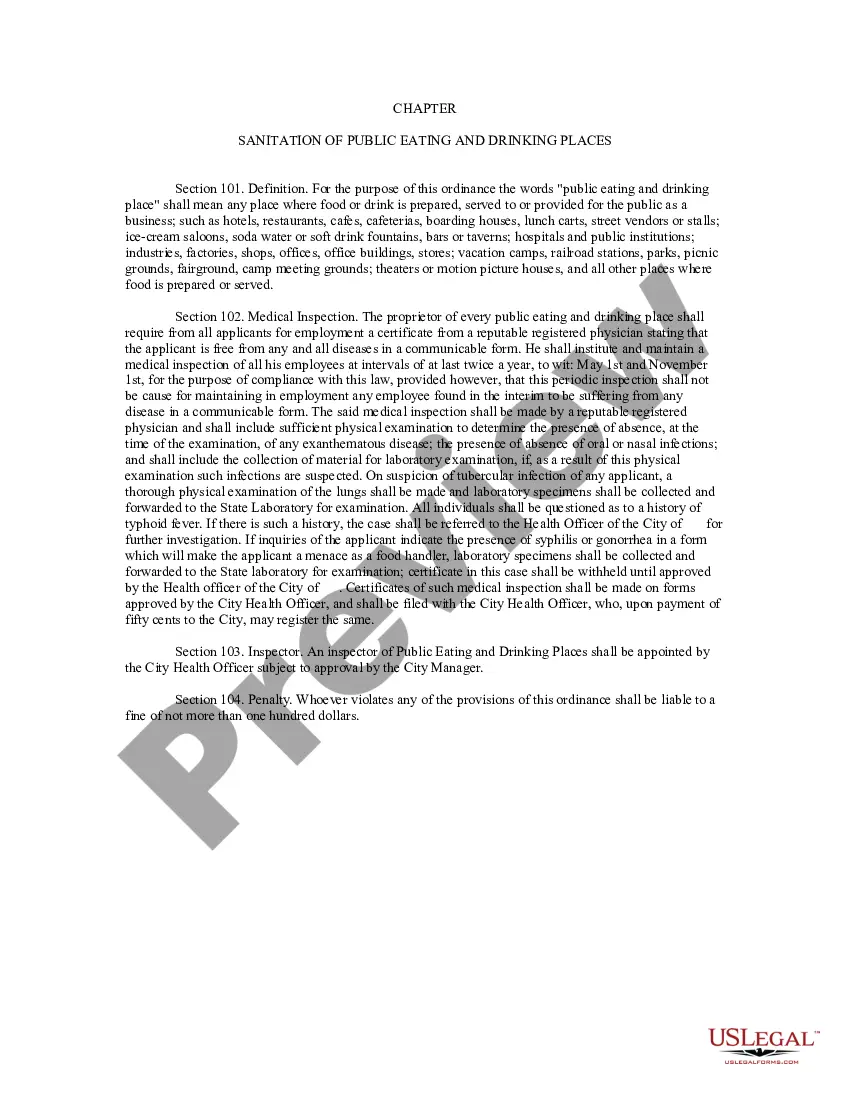
The Sanitation of Public Eating and Drinking Places Code or Ordinance is a legal document that establishes sanitation standards for establishments that prepare and serve food or drink to the public. This form outlines the requirements for medical inspections and the responsibilities of proprietors, helping ensure public health and safety. It differs from other ordinances in that it is specifically focused on regulations tied to health inspections in food service environments.
Form components explained
- Definition of public eating and drinking places: Clarifies what constitutes a public eating and drinking establishment.
- Medical inspection requirements: Mandates health certifications from registered physicians for employees to ensure they are free from communicable diseases.
- Inspections: Specifies that a health inspector must be appointed to oversee compliance with sanitation regulations.
- Penalties: Outlines fines for violations of the ordinance provisions.
Situations where this form applies
This form should be used when a city or municipality intends to implement or update sanitation regulations for public eating and drinking places. It is applicable after a local authority identifies a need for health and safety measures to control foodborne illnesses or enhances overall public health standards in dining establishments.
Who this form is for
- City health departments responsible for public health enforcement.
- Proprietors and managers of restaurants, cafes, and similar establishments.
- Local government officials aiming to ensure compliance with health regulations.
Steps to complete this form
- Define the public eating and drinking places within your jurisdiction.
- Specify medical inspection intervals for employees, detailing the requirements.
- Appoint a health inspector as mandated by the local authority.
- Establish penalties for violations to ensure compliance with the ordinance.
- File the completed ordinance with the appropriate local health officer for approval.
Notarization guidance
This form usually doesn’t need to be notarized. However, local laws or specific transactions may require it. Our online notarization service, powered by Notarize, lets you complete it remotely through a secure video session, available 24/7.
Get your form ready online
Our built-in tools help you complete, sign, share, and store your documents in one place.
Make edits, fill in missing information, and update formatting in US Legal Forms—just like you would in MS Word.
Download a copy, print it, send it by email, or mail it via USPS—whatever works best for your next step.
Sign and collect signatures with our SignNow integration. Send to multiple recipients, set reminders, and more. Go Premium to unlock E-Sign.
If this form requires notarization, complete it online through a secure video call—no need to meet a notary in person or wait for an appointment.
We protect your documents and personal data by following strict security and privacy standards.

Make edits, fill in missing information, and update formatting in US Legal Forms—just like you would in MS Word.

Download a copy, print it, send it by email, or mail it via USPS—whatever works best for your next step.

Sign and collect signatures with our SignNow integration. Send to multiple recipients, set reminders, and more. Go Premium to unlock E-Sign.

If this form requires notarization, complete it online through a secure video call—no need to meet a notary in person or wait for an appointment.

We protect your documents and personal data by following strict security and privacy standards.
Avoid these common issues
- Failing to update the ordinance with new health regulations or guidelines.
- Neglecting to outline the inspection process clearly.
- Overlooking the need for regular medical inspections of employees.
Advantages of online completion
- Convenience of downloading and printing the form as needed.
- Ability to edit the form to suit specific municipal requirements.
- Access to reliable templates drafted by licensed attorneys, ensuring compliance with legal standards.
Legal use & context
- This ordinance helps local governments enforce public health standards in food establishments.
- It provides a legal basis for penalizing establishments that fail to meet sanitation requirements.
Main things to remember
- The Sanitation of Public Eating and Drinking Places Code or Ordinance is essential for ensuring public health in food establishments.
- Employment medical inspections are mandatory for compliance.
- This ordinance can be tailored for specific states or municipalities.
- Using this form helps prevent health violations and potential fines.
Looking for another form?

Form popularity
FAQ
The Food and Drug Administration (FDA) and the Environmental Protection Agency (EPA) are both responsible for the safety of drinking water. EPA regulates public drinking water (tap water), while FDA regulates bottled drinking water.
The FDA Food Code is not federal law. It is the FDA's best advice for ways to ensure that food at retail and in foodservice is safe, properly protected and presented. It is up the agencies that have responsibility for food safety to either adopt or adapt the FDA code to their own jurisdiction.
Food code is neither a federal law or regulation, rather it is the FDA best advice for uniform inspection or regulation of food safety.
The U. S. Food and Drug Administration (FDA) publishes the Food Code, a model that assists food control jurisdictions at all levels of government by providing them with a scientifically sound technical and legal basis for regulating the retail and food service segment of the industry (restaurants and grocery stores and
The Food Code is guidance representing FDA's current thinking and is a model on safeguarding public health and ensuring food is unadulterated and honestly presented when offered to the consumer.This resource is recommended as a public health guide and for community interventions.
Standard of identity- the FDA specifies that bottled water is intended for consumption and that it must be sealed with no added ingredients. It also states that bottled water must label the source.
FDA's Food Code is a model that is offered for state and local legislatures to adopt or incorporate into state and local law requirements.The 2001 Food Code is adopted in six states: California, Florida (by one agency), Indiana, Louisiana, New York (by one agency), and Vermont.
What does the FDA food code require of a water system in a food establishment? Meets peak water demand. A food establishment must have enough water, including hot water, to meet peak demands.