Nonqualified Stock Option Agreement of N(2)H(2), Inc.
What is this form?
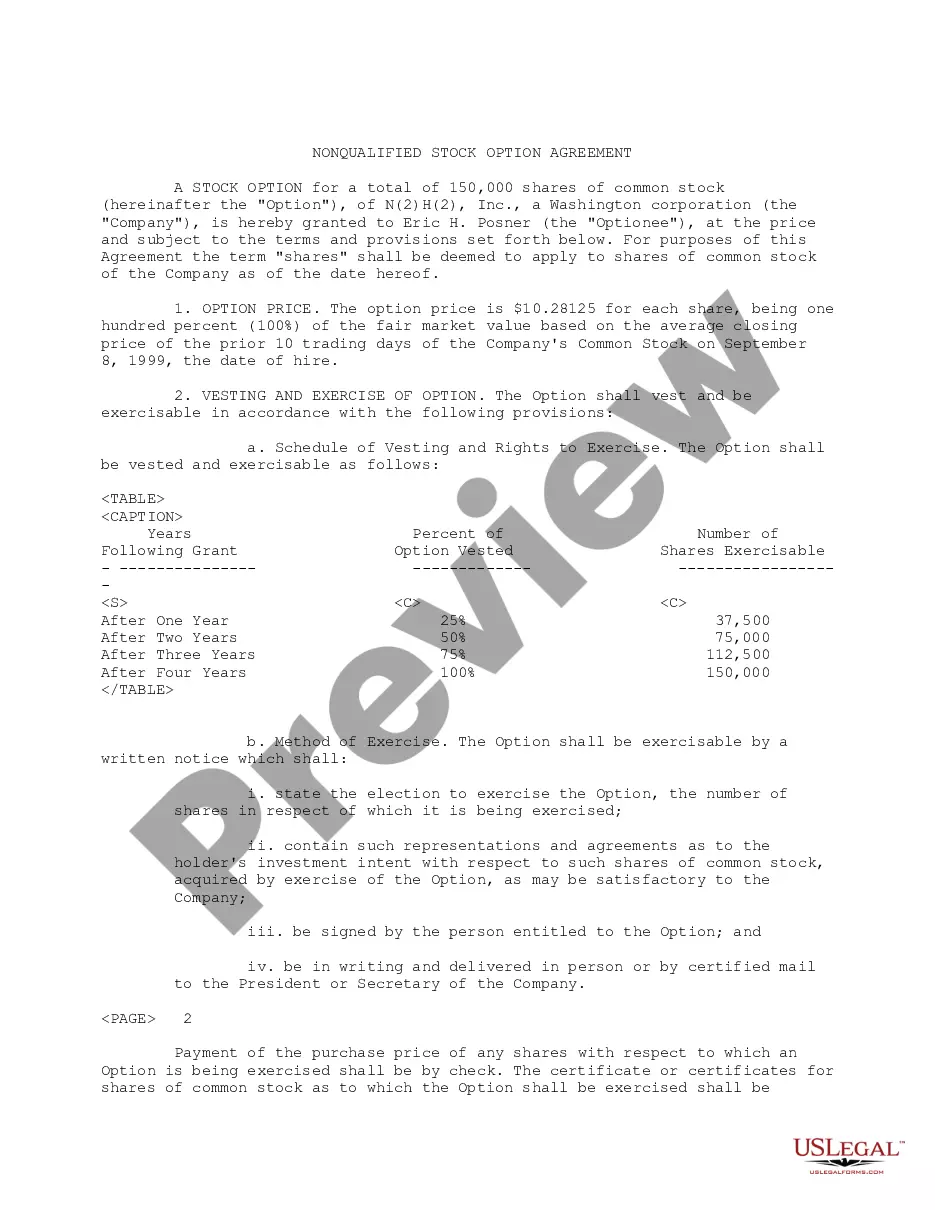
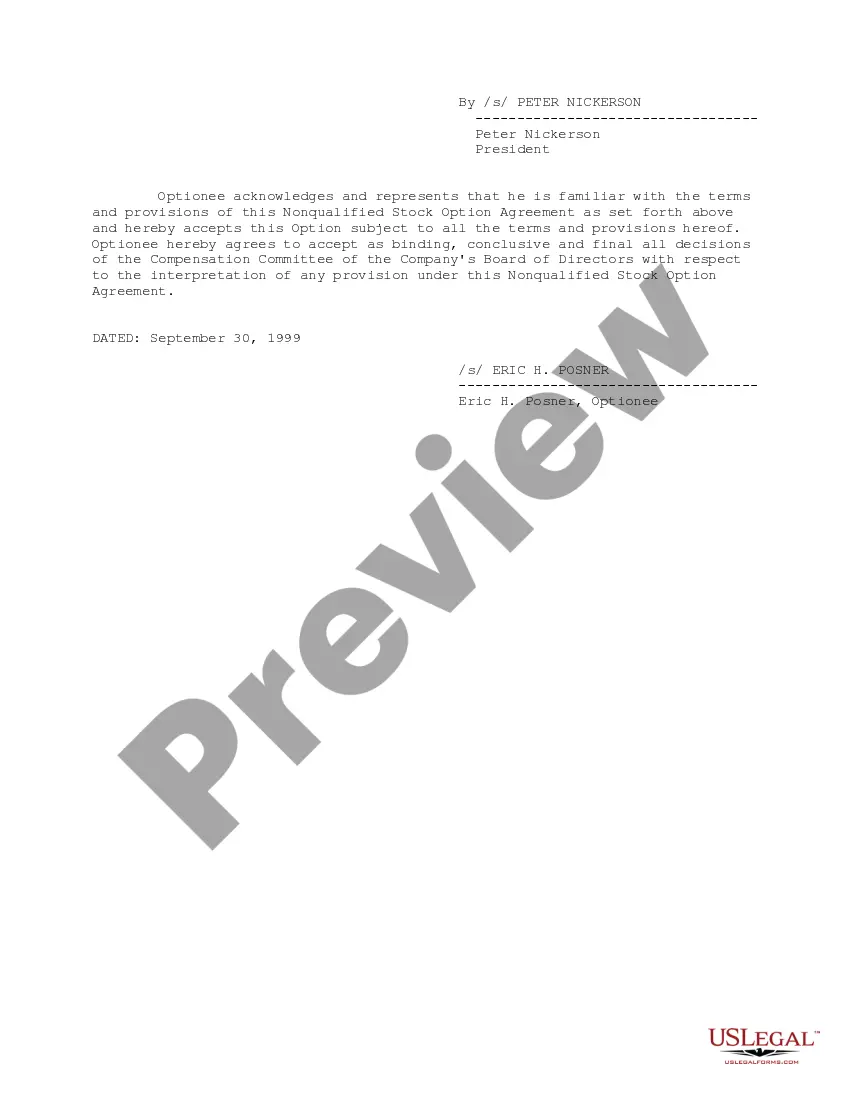
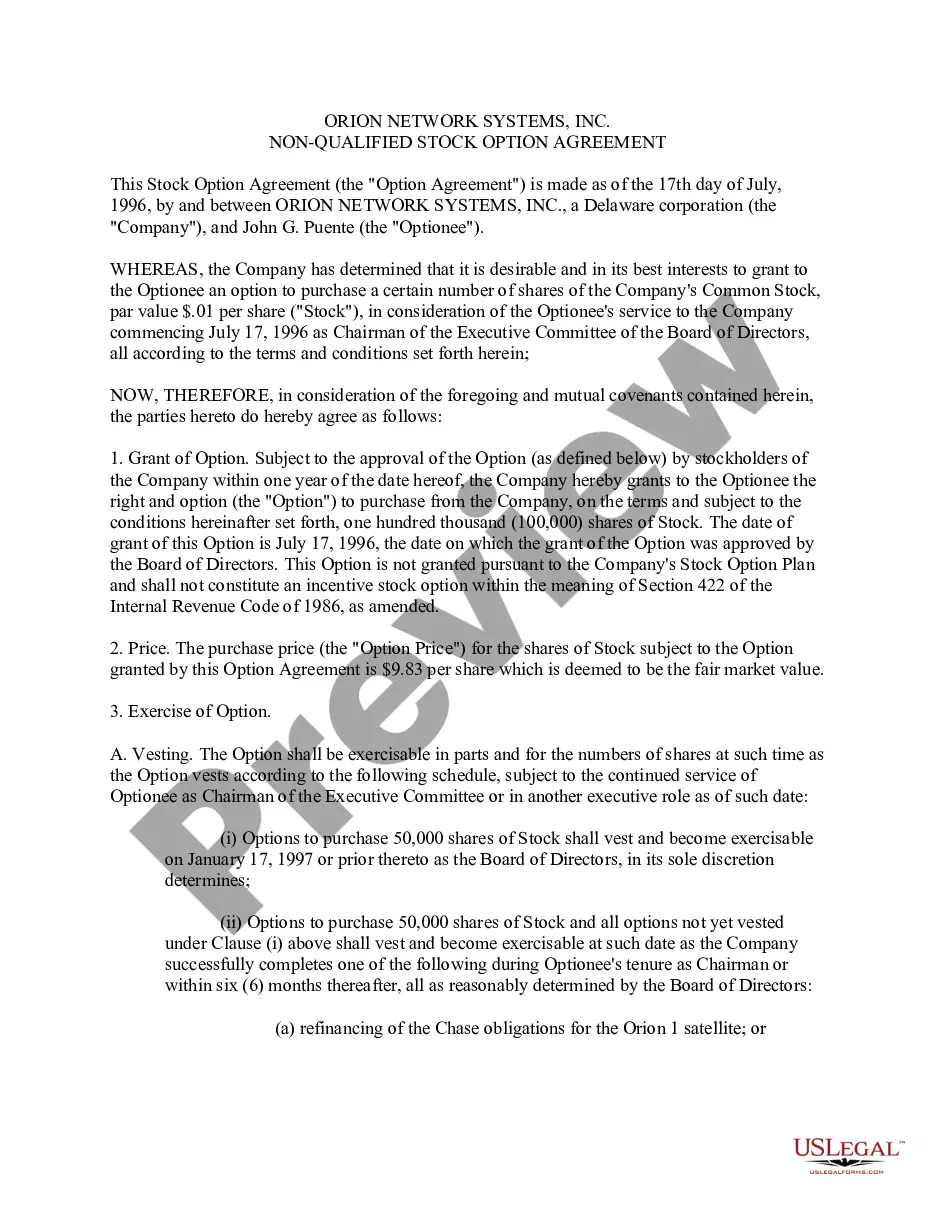
The Nonqualified Stock Option Agreement of N(2)H(2), Inc. is a legal document that grants an employee, in this case, Eric H. Posner, the right to purchase a specified number of shares of the company's stock at a predetermined price. Unlike qualified stock options, nonqualified options do not meet certain regulatory requirements that allow for specific tax benefits. This form details the rights and conditions under which the option can be exercised, including vesting schedules and transfer restrictions, making it essential for both the company and the option holder.
Key components of this form
- Option price: The cost per share is defined as $10.28125, which is 100 percent of the fair market value at the time of the employee's hire.
- Vesting schedule: Specifies how and when the options become exercisable, based on the length of service with the company.
- Method of exercise: Outlines the process for exercising the option, including necessary written notices and payment terms.
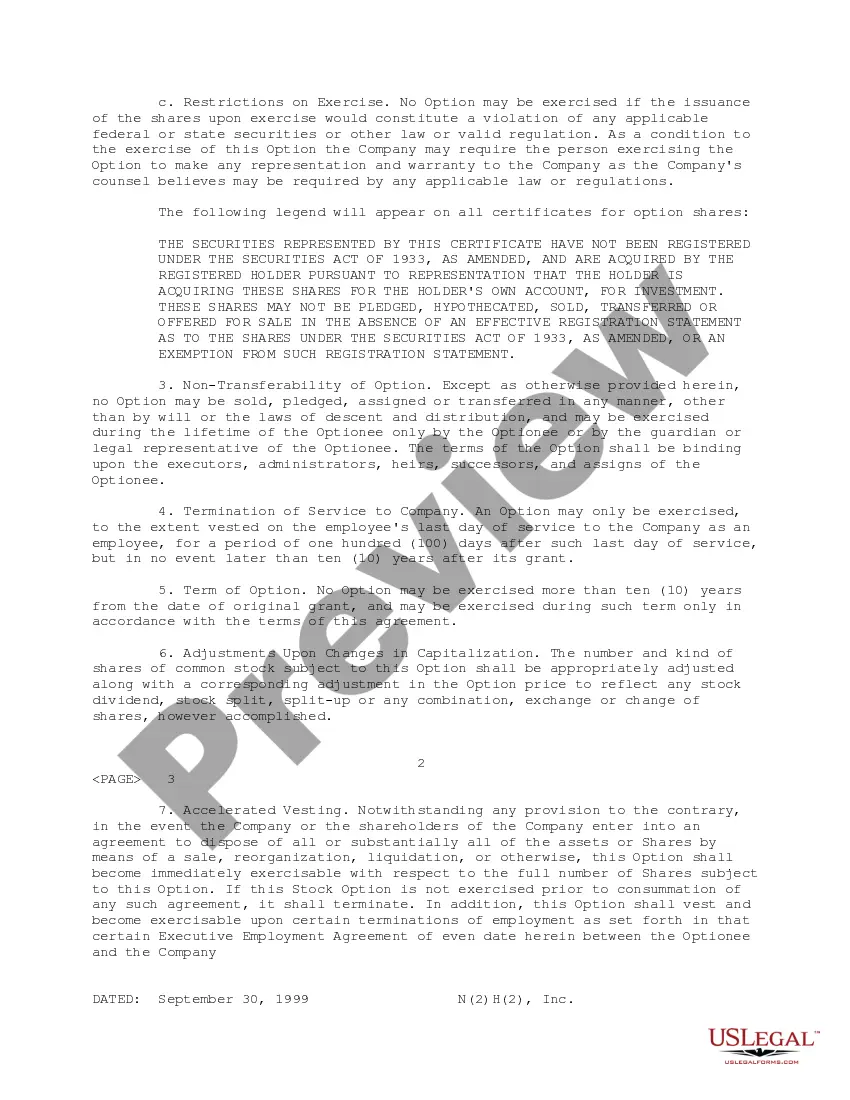
- Restrictions on exercise: Defines any legal limitations on exercising the options, including compliance with securities laws.
- Non-transferability of options: Details that options cannot be sold or transferred, except under specific circumstances such as death.
Situations where this form applies
This form should be used when an employer grants stock options as part of employee compensation. It is particularly relevant for companies looking to incentivize employees or retain talent through stock ownership. If an employee is interested in purchasing shares at the agreed upon strike price, they must refer to this agreement when exercising their options, particularly if they are leaving the company or in the event of a company merger or acquisition.
Intended users of this form
This form is intended for:
- Employers who are granting stock options to employees as part of their compensation package.
- Employees who are receiving nonqualified stock options and wish to understand their rights and obligations.
- Human resources departments involved in employee stock option plans.
Completing this form step by step
- Identify the parties: Clearly state the name of the company and the employee receiving the option.
- Specify the option price: Enter the fixed price per share that the employee will pay when exercising their options.
- Detail the vesting schedule: Include the timeline for when the employee can start exercising their options based on tenure.
- Signature section: Ensure all necessary parties sign and date the agreement to validate it.
- Documentation: Provide a copy of the agreement to the employee for their records.
Notarization requirements for this form
This form usually doesn’t need to be notarized. However, local laws or specific transactions may require it. Our online notarization service, powered by Notarize, lets you complete it remotely through a secure video session, available 24/7.
Get your form ready online
Our built-in tools help you complete, sign, share, and store your documents in one place.
Make edits, fill in missing information, and update formatting in US Legal Forms—just like you would in MS Word.
Download a copy, print it, send it by email, or mail it via USPS—whatever works best for your next step.
Sign and collect signatures with our SignNow integration. Send to multiple recipients, set reminders, and more. Go Premium to unlock E-Sign.
If this form requires notarization, complete it online through a secure video call—no need to meet a notary in person or wait for an appointment.
We protect your documents and personal data by following strict security and privacy standards.

Make edits, fill in missing information, and update formatting in US Legal Forms—just like you would in MS Word.

Download a copy, print it, send it by email, or mail it via USPS—whatever works best for your next step.

Sign and collect signatures with our SignNow integration. Send to multiple recipients, set reminders, and more. Go Premium to unlock E-Sign.

If this form requires notarization, complete it online through a secure video call—no need to meet a notary in person or wait for an appointment.

We protect your documents and personal data by following strict security and privacy standards.
Mistakes to watch out for
- Failing to specify the vesting schedule, leading to confusion about when options can be exercised.
- Not detailing the method of exercising options, which can result in improper submissions.
- Overlooking legal compliance with securities laws when issuing stock options.
Why complete this form online
- Convenience: Easily download the form at your convenience without the need for in-person meetings.
- Editability: Fill in the necessary information digitally, allowing for quick updates and corrections.
- Reliability: Ensure that you are using a legally compliant document drafted by licensed attorneys.
Legal use & context
- This form serves as a binding contract between the employer and the employee regarding stock options.
- It clarifies the conditions under which options can be exercised, thus protecting both parties' interests.
- Failure to comply with the terms outlined in this agreement may result in the loss of rights to exercise the options.
Key takeaways
- The Nonqualified Stock Option Agreement allows an employee to purchase shares at a predetermined price.
- It includes important details such as vesting schedules and exercise methods that must be followed.
- Both parties should understand their rights and obligations under this agreement to avoid legal complications.
Looking for another form?






Form popularity
FAQ
Once you exercise your non-qualified stock option, the difference between the stock price and the strike price is taxed as ordinary income. This income is usually reported on your paystub.If you hold the shares for less than one year, any gain is taxed at your ordinary income tax rates, which are usually higher.
Incentive stock options, or ISOs, are options that are entitled to potentially favorable federal tax treatment. Stock options that are not ISOs are usually referred to as nonqualified stock options or NQOs.These do not qualify for special tax treatment.
What Is a Non-Qualified Stock Option (NSO)? A non-qualified stock option (NSO) is a type of employee stock option wherein you pay ordinary income tax on the difference between the grant price and the price at which you exercise the option.
If you exercised nonqualified stock options (NQSOs) last year, the income you recognized at exercise is reported on your W-2. It appears on the W-2 with other income in: Box 1: Wages, tips, and other compensation. Box 3: Social Security wages (up to the income ceiling)
If the grant is an NSO, the employee pays federal income taxes on $0.90 of income per share at exercise, even though the employee has not sold any shares. If the grant is an ISO, there is no federal income tax due at exercise.
A qualified stock option is a type of company share option granted exclusively to employees. It confers an income tax benefit when exercised. Qualified stock options are also referred to as "incentive stock options" or "incentive share options."
Depending upon the tax treatment of stock options, they can be classified into qualified and non-qualified stock options. Qualified stock options are also called Incentive Stock Options (ISO). Nonqualified: Employees generally don't owe tax when these options are granted.