Company Records Checklist
Overview of this form
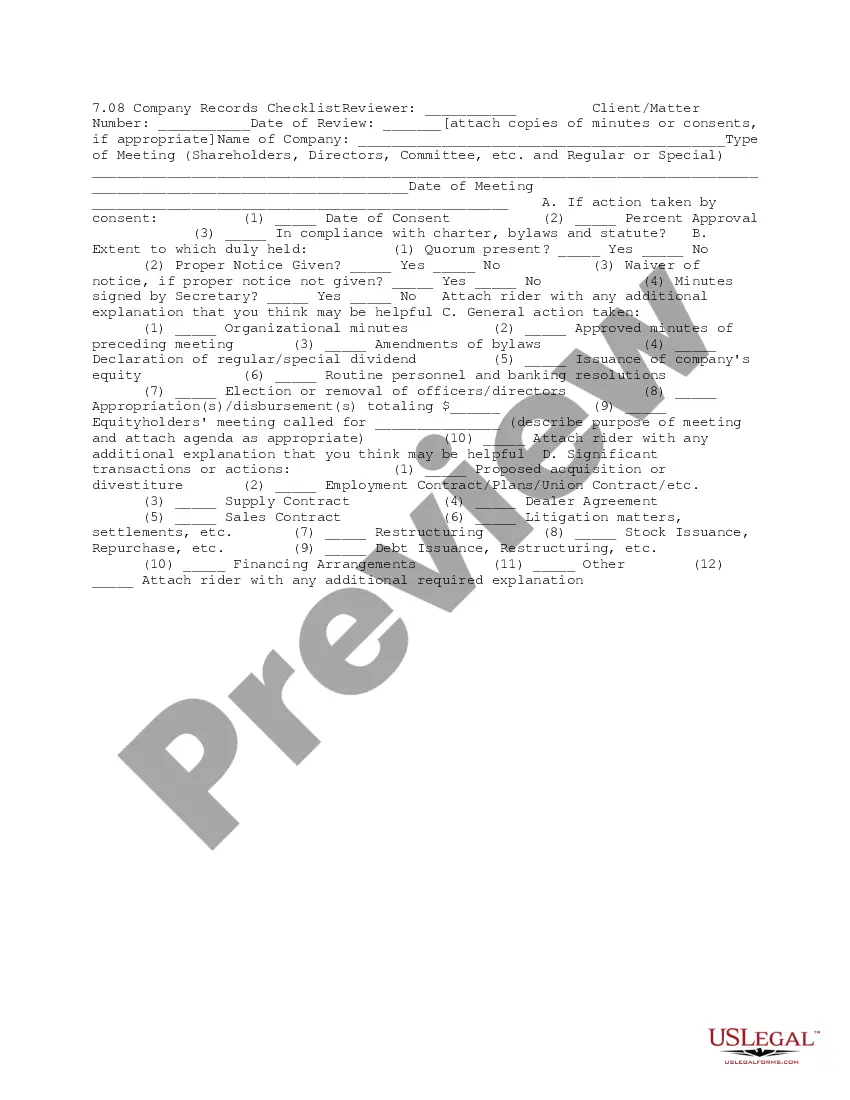
The Company Records Checklist is a due diligence tool utilized during business transactions. This form provides a structured checklist of key company records for review at meetings, ensuring compliance with legal and procedural requirements. Unlike general record-keeping forms, this checklist focuses specifically on aspects relevant to corporate governance and decision-making processes.
Key components of this form
- Reviewer identification section
- Company name and matter number
- Date of review and meeting details
- Actions taken by consent with approval metrics
- Quorum and notice requirements
- General actions and resolutions undertaken in the meeting
- Details on significant transactions or actions taken




When to use this form
This form should be used when preparing for meetings related to significant business transactions, such as shareholder meetings or board discussions. It helps ensure all necessary documentation is in order and assists in maintaining compliance with corporate bylaws and state regulations. Use it to review actions taken by the company, document minutes, and ensure proper procedures are followed.
Who this form is for
The following individuals or groups should consider using the Company Records Checklist:
- Corporate secretaries responsible for maintaining accurate company records
- Legal counsel overseeing corporate governance matters
- Business owners preparing for shareholder or director meetings
- Any professionals involved in corporate compliance and due diligence processes
How to complete this form
- Identify the reviewer and complete the client/matter number and date of review.
- Enter the name of the company and specify the type of meeting (e.g., shareholders, directors).
- Document the date of the meeting and any actions taken by consent with relevant approval metrics.
- Confirm that quorum requirements are met and that proper notice was given for the meeting.
- List the general actions taken during the meeting, including any significant transactions.
Notarization guidance
This form usually doesn’t need to be notarized. However, local laws or specific transactions may require it. Our online notarization service, powered by Notarize, lets you complete it remotely through a secure video session, available 24/7.
Get your form ready online
Our built-in tools help you complete, sign, share, and store your documents in one place.
Make edits, fill in missing information, and update formatting in US Legal Forms—just like you would in MS Word.
Download a copy, print it, send it by email, or mail it via USPS—whatever works best for your next step.
Sign and collect signatures with our SignNow integration. Send to multiple recipients, set reminders, and more. Go Premium to unlock E-Sign.
If this form requires notarization, complete it online through a secure video call—no need to meet a notary in person or wait for an appointment.
We protect your documents and personal data by following strict security and privacy standards.

Make edits, fill in missing information, and update formatting in US Legal Forms—just like you would in MS Word.

Download a copy, print it, send it by email, or mail it via USPS—whatever works best for your next step.

Sign and collect signatures with our SignNow integration. Send to multiple recipients, set reminders, and more. Go Premium to unlock E-Sign.

If this form requires notarization, complete it online through a secure video call—no need to meet a notary in person or wait for an appointment.

We protect your documents and personal data by following strict security and privacy standards.
Common mistakes
- Failing to document the date of consent and approval percentages.
- Not confirming that quorum requirements were met before proceeding with decisions.
- Overlooking the need to attach detailed explanations or additional documentation.
Advantages of online completion
- Convenient access to a structured checklist helps streamline preparation for meetings.
- Editable format allows users to customize the checklist based on specific company requirements.
- Reliability of attorney-drafted templates ensures compliance with legal standards.
Looking for another form?



Form popularity
FAQ
Correspondence records. Correspondence records may be created inside the office or may be received from outside the office. Accounting records. The records relating to financial transactions are known as financial records. Legal records. Personnel records. Progress records. Miscellaneous records.
Establish Business Bank Accounts. Avoid Using Cash. Schedule a Specific Time Each Week. Purchase the Right Accounting Software. Tax Obligations. Keep a Complete Record of Accounting Documents.
A company should also keep copies of its certificate of incorporation, the memorandum and articles of association, and all share certificates (if applicable). Accounting records should be kept for the following: Goods and services bought and sold by the company. All forms of income and expenditure.
Accounting records. Accounting records document your business's transactions. Bank statements. Bank statements are records of all your accounts with the bank. Legal documents. Depending on your type of business structure, you have different legal documents. Permits and Licenses. Insurance documents.
Company Books and Records means all books, records, ledgers, reports, plans and files related to the conduct of the businesses of the Company and its Subsidiaries in paper, electronic or other forms that are maintained by the Company or any of its Subsidiaries.
Set up a Good Accounting Software System. Burden of Proof For Business Taxes. Source Documents for Accounting Journals. EFT and Your Business Payments. Daily and Monthly Summary of Cash Receipts and Disbursements. Pay Attention to Your Petty Cash Fund. Employee Payroll Tax Deductions.
Business expenses. Sales records. Accounts receivable. Accounts payable. Customer list. Vendors. Employee information. Tax documents.
17.3 Definition and Identification of RecordsExamples include documents, books, paper, electronic records, photographs, videos, sound recordings, databases, and other data compilations that are used for multiple purposes, or other material, regardless of physical form or characteristics.
Company records are defined in the Companies Act 2006 as any register, index, accounting record, agreement, memorandum, minute or other document required by the Companies Acts to be kept by a company and any register kept by a company of its debenture holders.