Employee Plan ESOP Due Diligence Supplemental Checklist
Understanding this form
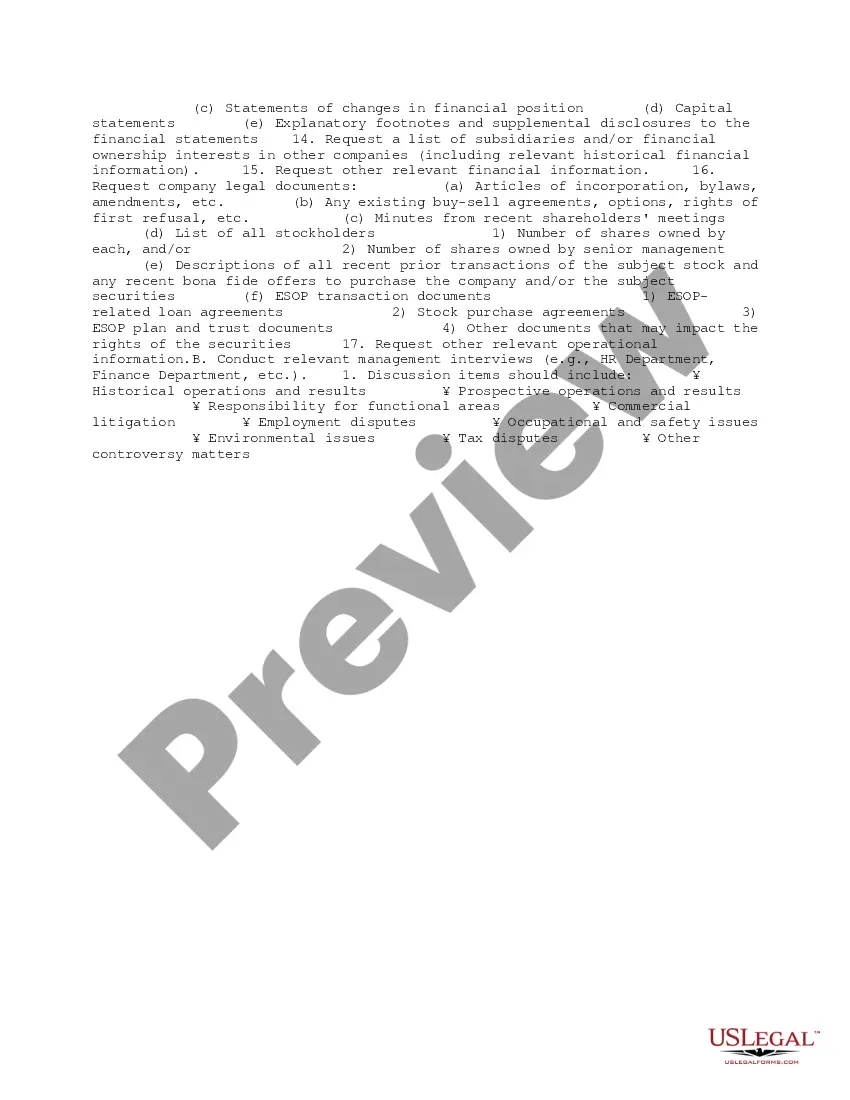
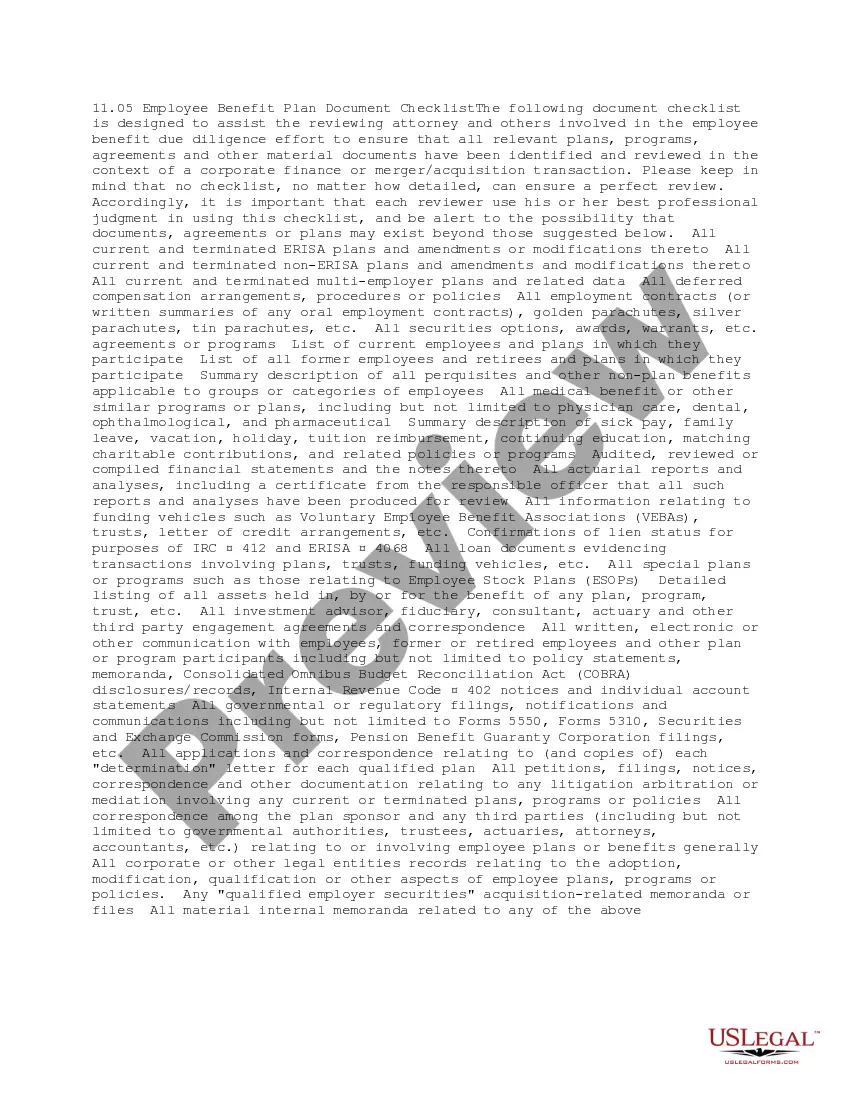
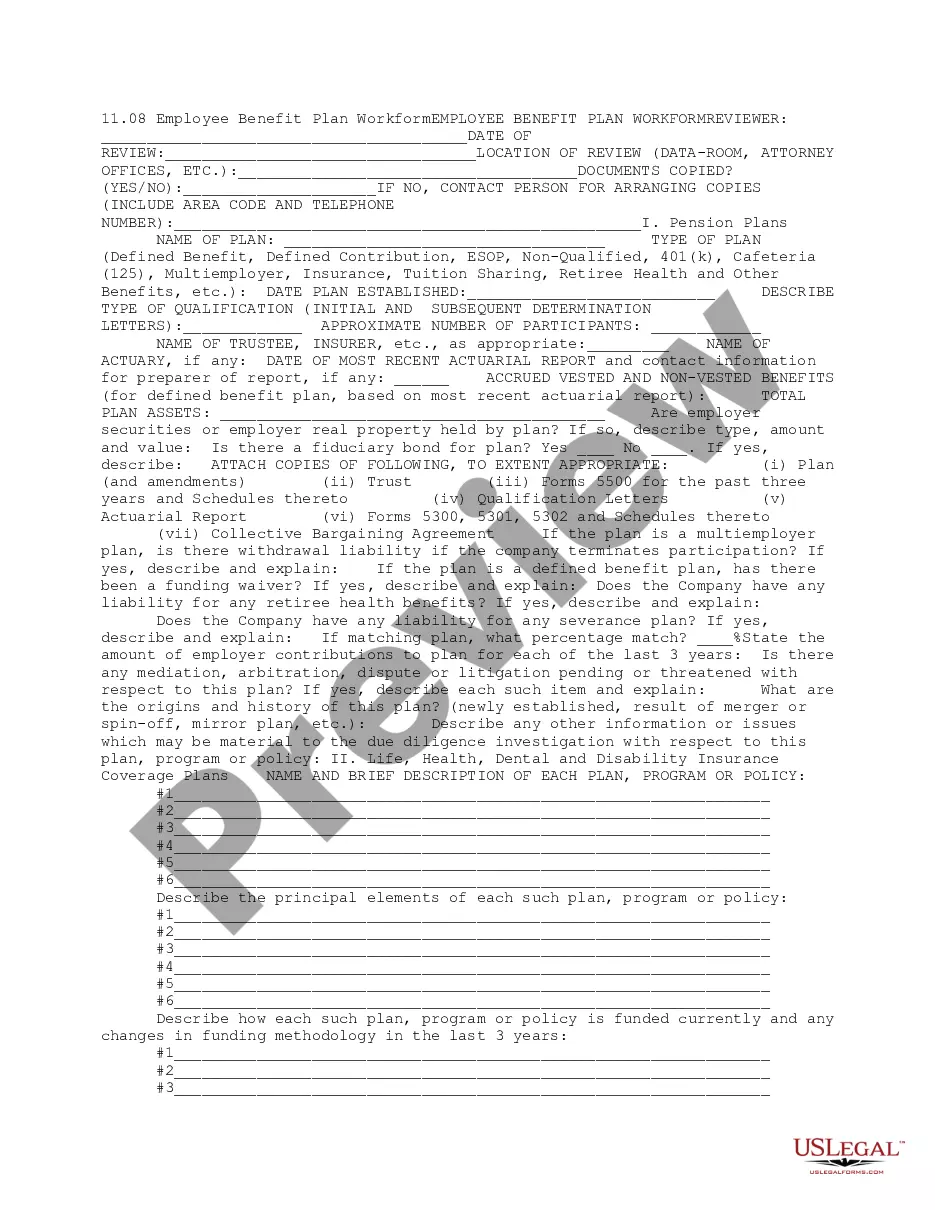
The Employee Plan ESOP Due Diligence Supplemental Checklist is a structured document used to gather and evaluate relevant information for Employee Stock Ownership Plans (ESOPs). This checklist aids companies in examining their ESOP-related documents and business transactions, ensuring compliance with legal standards. It is a comprehensive tool that distinguishes itself from other checklists by focusing specifically on ESOP-related due diligence, which is crucial for assessing the viability and legal standing of the plan.
Key components of this form
- Schedule of Plan Participants including personal and employment details
- Employment agreements, collective bargaining agreements, and contracts
- Documentation of employee benefit plans, including pension and retirement plans
- Fidelity bonds covering fiduciaries and employees
- Company financial documents including tax returns and financial statements
- History of ESOP formation and relevant transactions



Situations where this form applies
This checklist should be used during the due diligence process when a company is preparing to establish, review, or audit its Employee Stock Ownership Plan (ESOP). It is required for verifying compliance and ensuring that all necessary information is available for legal and financial assessments. Companies undergoing mergers or acquisitions that involve an ESOP also benefit from this checklist to ensure all pertinent details are accounted for.
Who can use this document
- ESOP administrators managing the plan
- Corporate legal teams involved in transactions related to employee ownership
- Financial advisors conducting due diligence for clients with ESOPs
- Human resources professionals responsible for employee compensation and benefits
- Business owners planning to implement or revise an ESOP
Steps to complete this form
- Gather all necessary ESOP-related documents and participant information.
- Review and organize employee benefit agreements and contracts.
- Compile financial statements and tax documents for the last five years.
- Document the history of ESOP formations and significant transactions.
- Identify key stakeholders for management interviews to discuss relevant matters.
Does this document require notarization?
Notarization is not commonly needed for this form. However, certain documents or local rules may make it necessary. Our notarization service, powered by Notarize, allows you to finalize it securely online anytime, day or night.
Get your form ready online
Our built-in tools help you complete, sign, share, and store your documents in one place.
Make edits, fill in missing information, and update formatting in US Legal Forms—just like you would in MS Word.
Download a copy, print it, send it by email, or mail it via USPS—whatever works best for your next step.
Sign and collect signatures with our SignNow integration. Send to multiple recipients, set reminders, and more. Go Premium to unlock E-Sign.
If this form requires notarization, complete it online through a secure video call—no need to meet a notary in person or wait for an appointment.
We protect your documents and personal data by following strict security and privacy standards.

Make edits, fill in missing information, and update formatting in US Legal Forms—just like you would in MS Word.

Download a copy, print it, send it by email, or mail it via USPS—whatever works best for your next step.

Sign and collect signatures with our SignNow integration. Send to multiple recipients, set reminders, and more. Go Premium to unlock E-Sign.

If this form requires notarization, complete it online through a secure video call—no need to meet a notary in person or wait for an appointment.

We protect your documents and personal data by following strict security and privacy standards.
Mistakes to watch out for
- Failing to include all plan participant information in the schedule.
- Overlooking prior employment agreements or variations that may affect the ESOP.
- Neglecting to update financial documents to reflect the most recent information.
- Inadequately preparing for interviews with key management personnel.
Advantages of online completion
- Convenient access to all necessary templates and checklists from any location.
- Editable forms that allow for customization to meet specific business needs.
- Reliable resources prepared by licensed attorneys ensuring legal compliance.
Legal use & context
- This checklist aids in ensuring compliance with ESOP regulations set by the IRS and Department of Labor.
- Utilizing this form helps mitigate legal risks associated with improper ESOP management.
- It is a crucial tool in documenting due diligence for audits or legal reviews of the ESOP.
Quick recap
- The Employee Plan ESOP Due Diligence Supplemental Checklist is essential for evaluating ESOP compliance.
- Using this checklist can help avoid common pitfalls during the ESOP review process.
- Complete and accurate documentation is vital for legal and financial assessments regarding ESOPs.
Looking for another form?

Form popularity
FAQ
A due diligence checklist is an organized way to analyze a company that you are acquiring through sale, merger, or another method. By following this checklist, you can learn about a company's assets, liabilities, contracts, benefits, and potential problems.
Step 1: Company Capitalization. Step 2: Revenue, Margin Trends. Step 3: Competitors & Industries. Step 4: Valuation Multiples. Step 5: Management and Ownership. Step 6: Balance Sheet Exam. Step 7: Stock Price History. Step 8: Stock Options & Dilution.
Well very simply a due diligence information packet is a set of documents that is required by a licensed financial institution to be able to do due diligence on you. What's the name of your company.Can you show the incorporation documents of your company.
Due diligence is an investigation, audit, or review performed to confirm facts or details of a matter under consideration. In the financial world, due diligence requires an examination of financial records before entering into a proposed transaction with another party.
Due diligence is the investigation of every aspect of a property that could affect its value and suitability as a home or investment. Unfortunately for many buyers, due diligence involves little more than a building and pest inspection and contract review. These steps are essential, but only form part of the process.
Write for the target audience. Focus on the report objectives. Limit the report to information that has material impact to your company. Structure the information to be used as valuable reference material later.
The report will include a list of key findings and valid recommendations, as well as a reasoned conclusion with a financial analysis explaining the feasibility of our recommendations, and its impact on the company.
Company information. Who owns the company? Finances. Where are the company's quarterly and annual financial statements from the past several years? Products and services. What are the company's current and future products and services? Customers. Technology assets. IP assets. Physical assets. Legal issues.
Due Diligence Examples Conducting thorough inspections on a property before buying it in order to make sure that it is a good investment. An underwriter auditing an issuer's business and operations prior to selling it.