Proposal to amend articles of incorporation to effect a reverse stock split of common stock and authorize a share dividend on common stock
Overview of this form
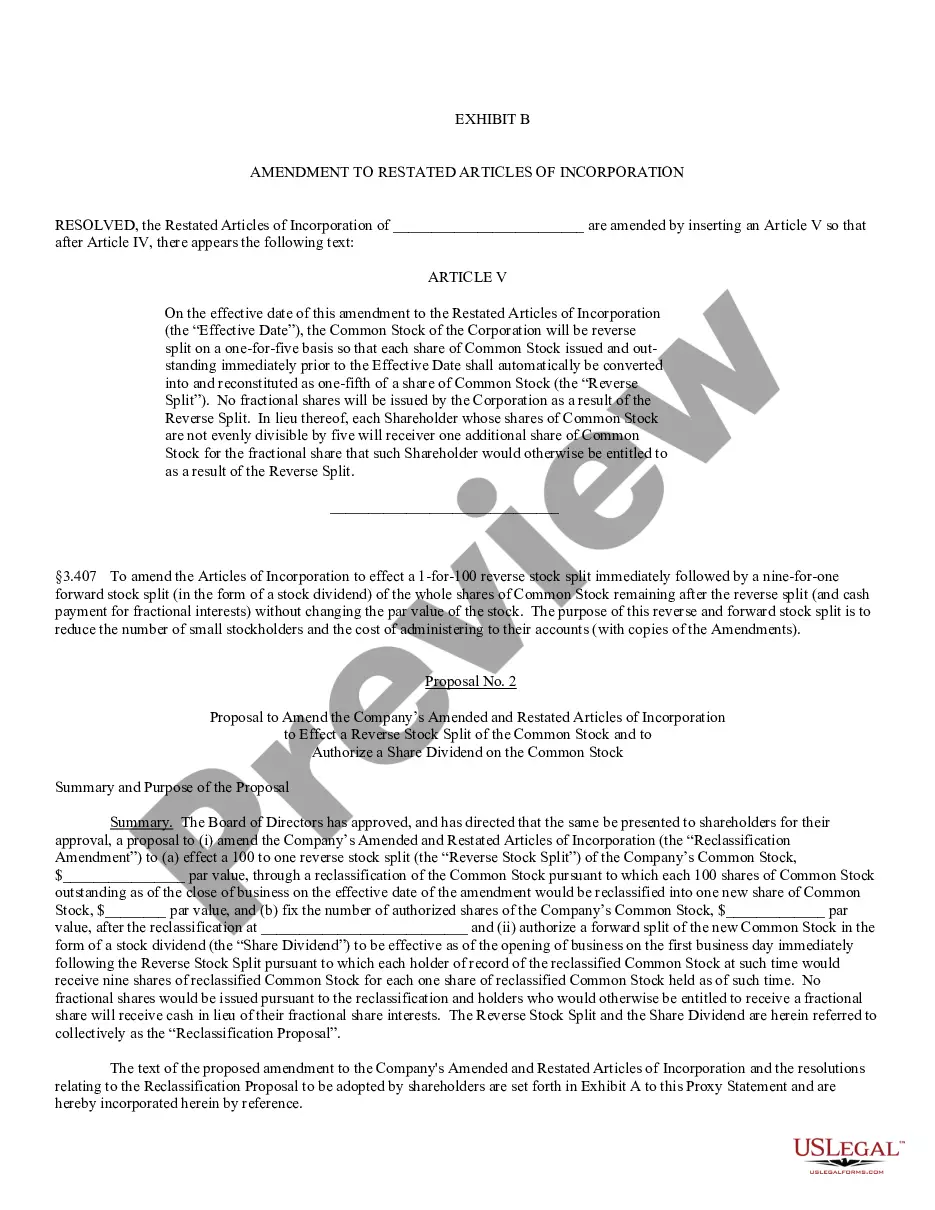
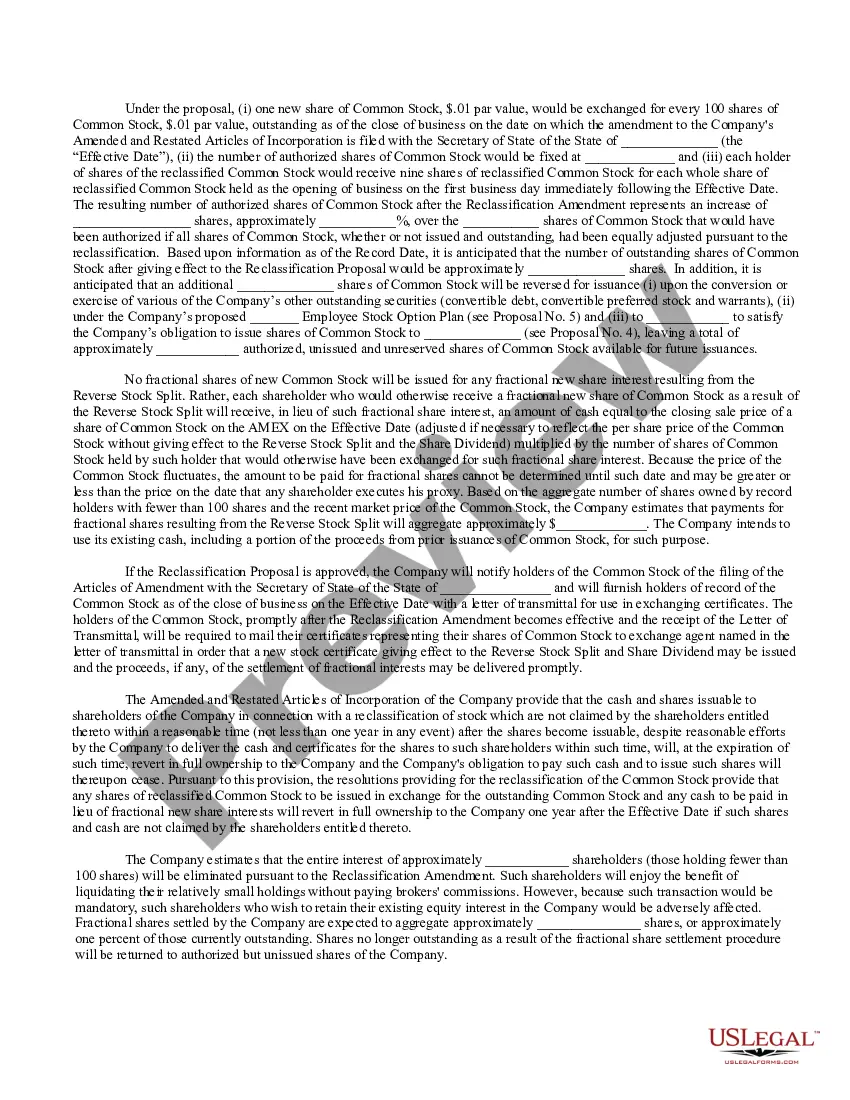
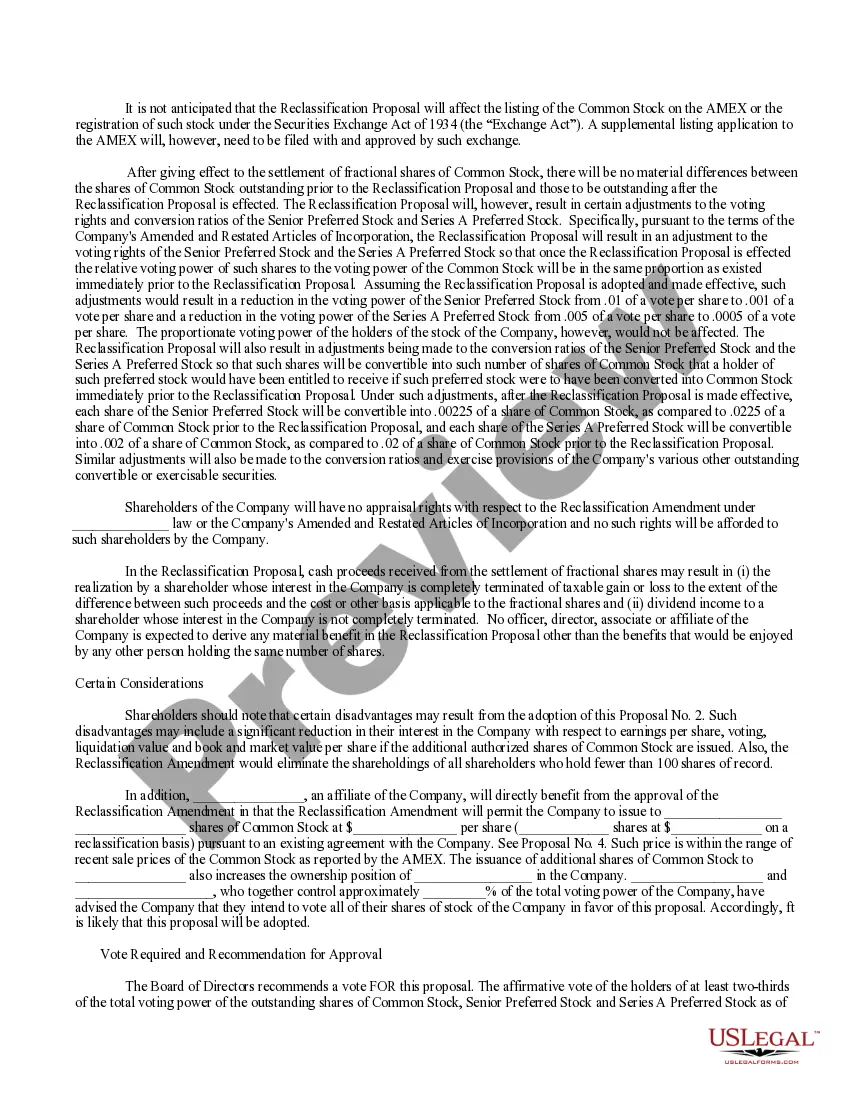
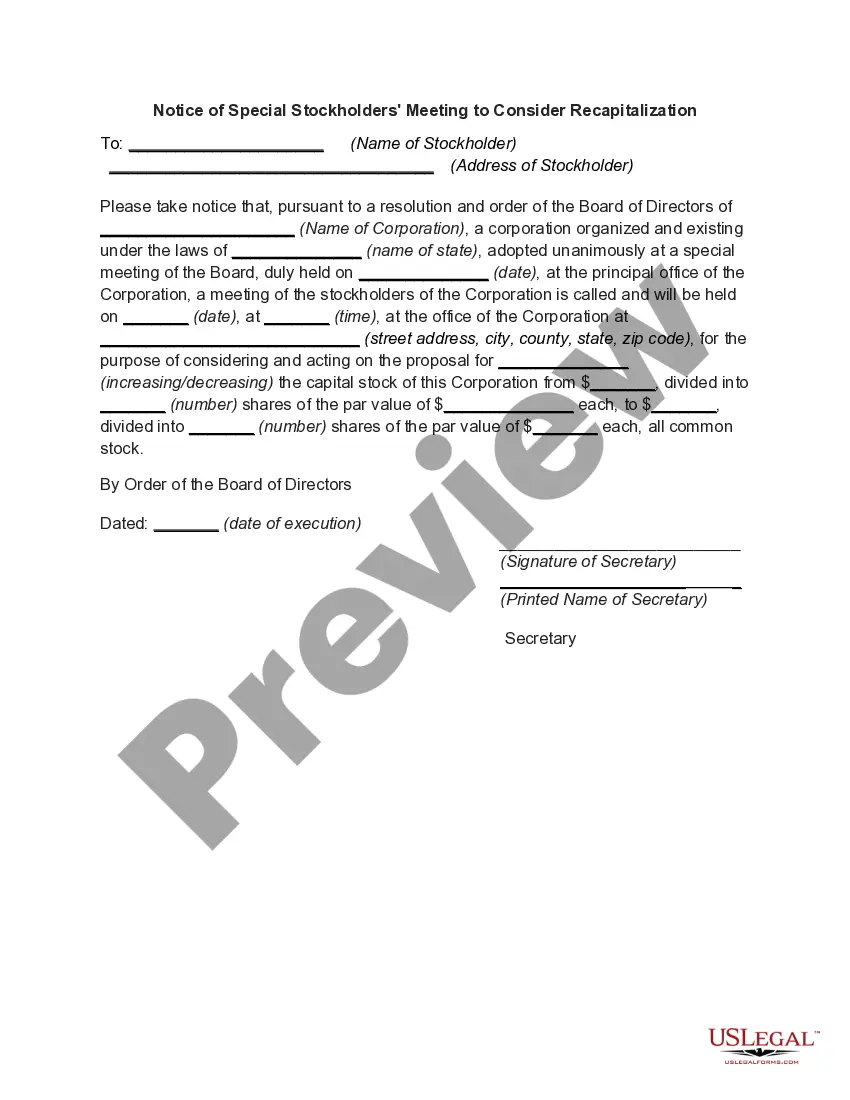
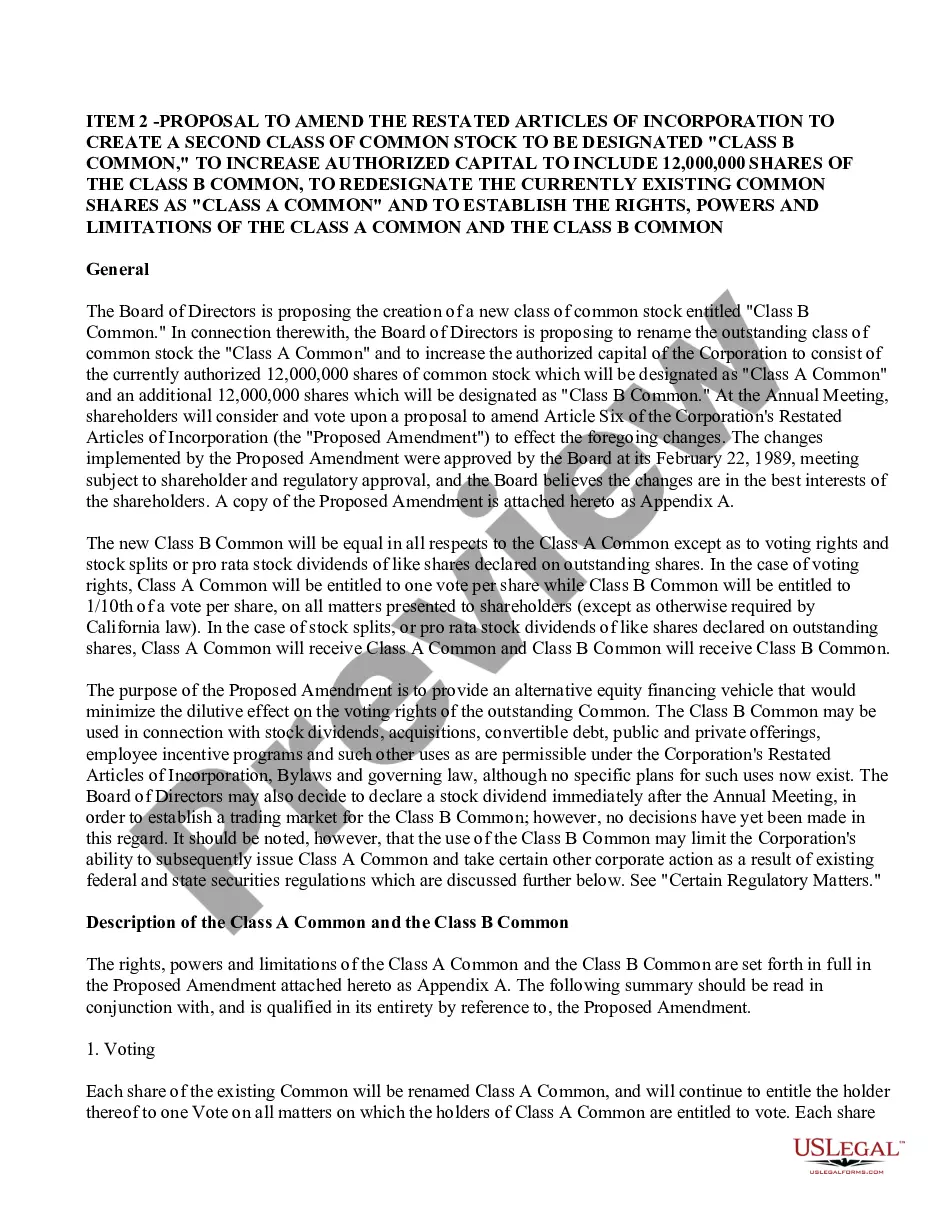
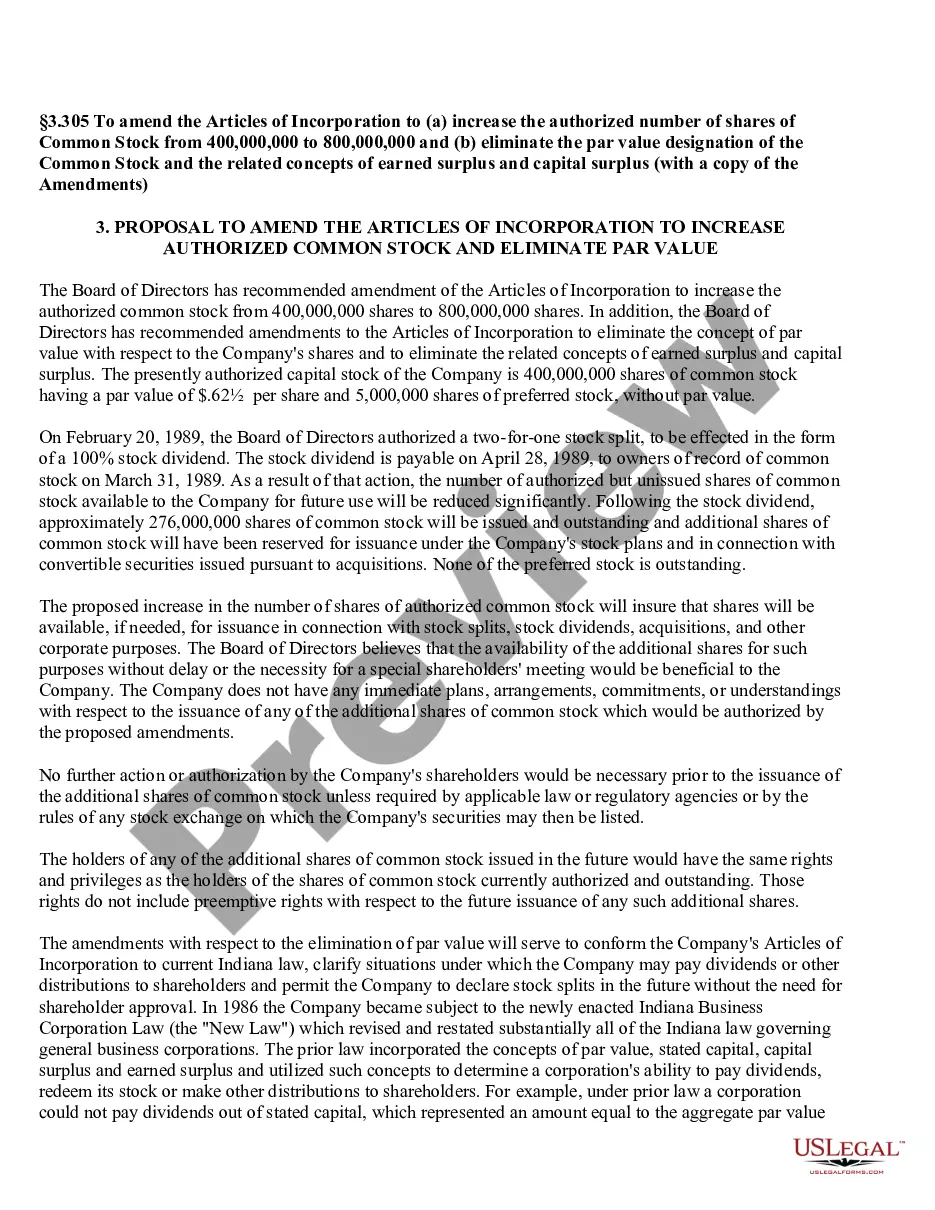
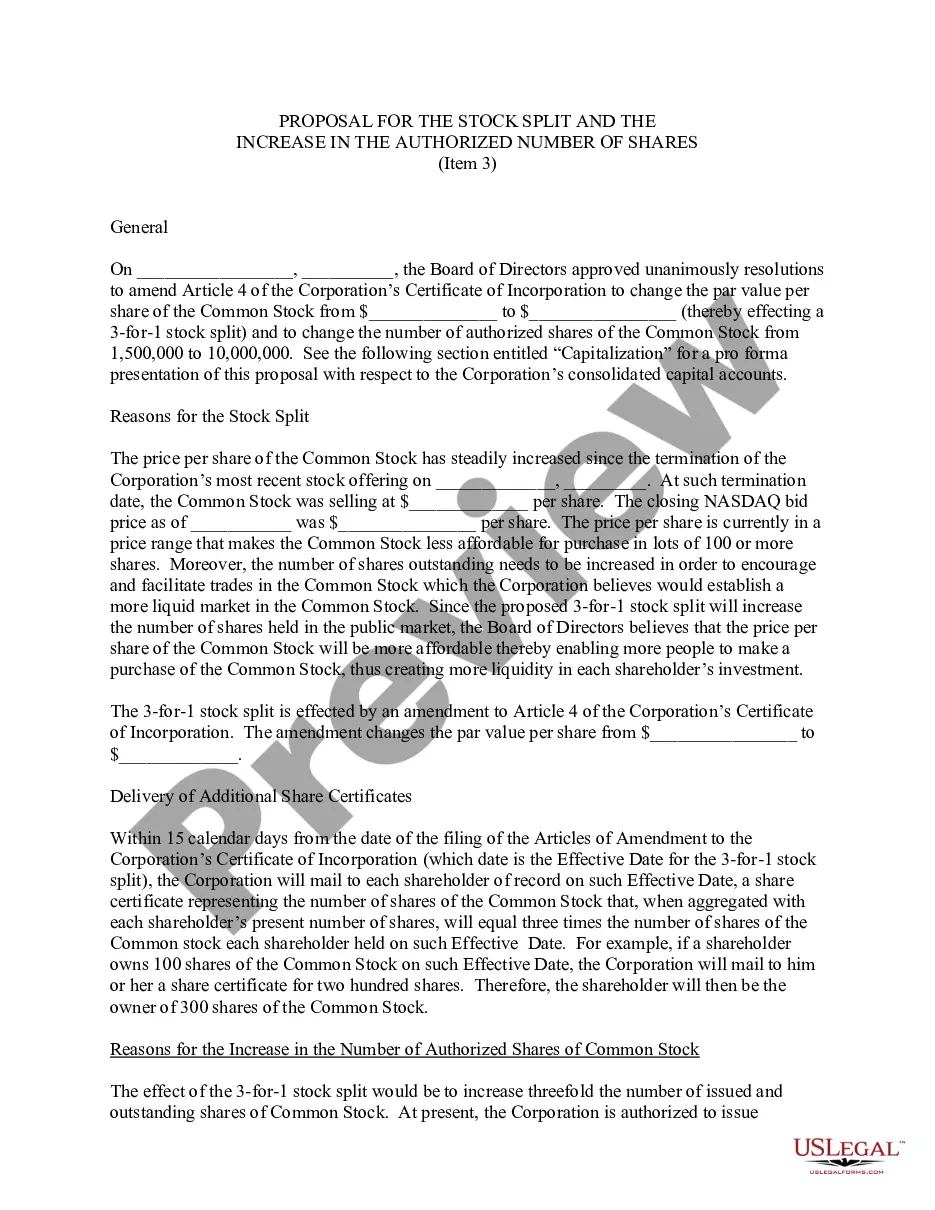
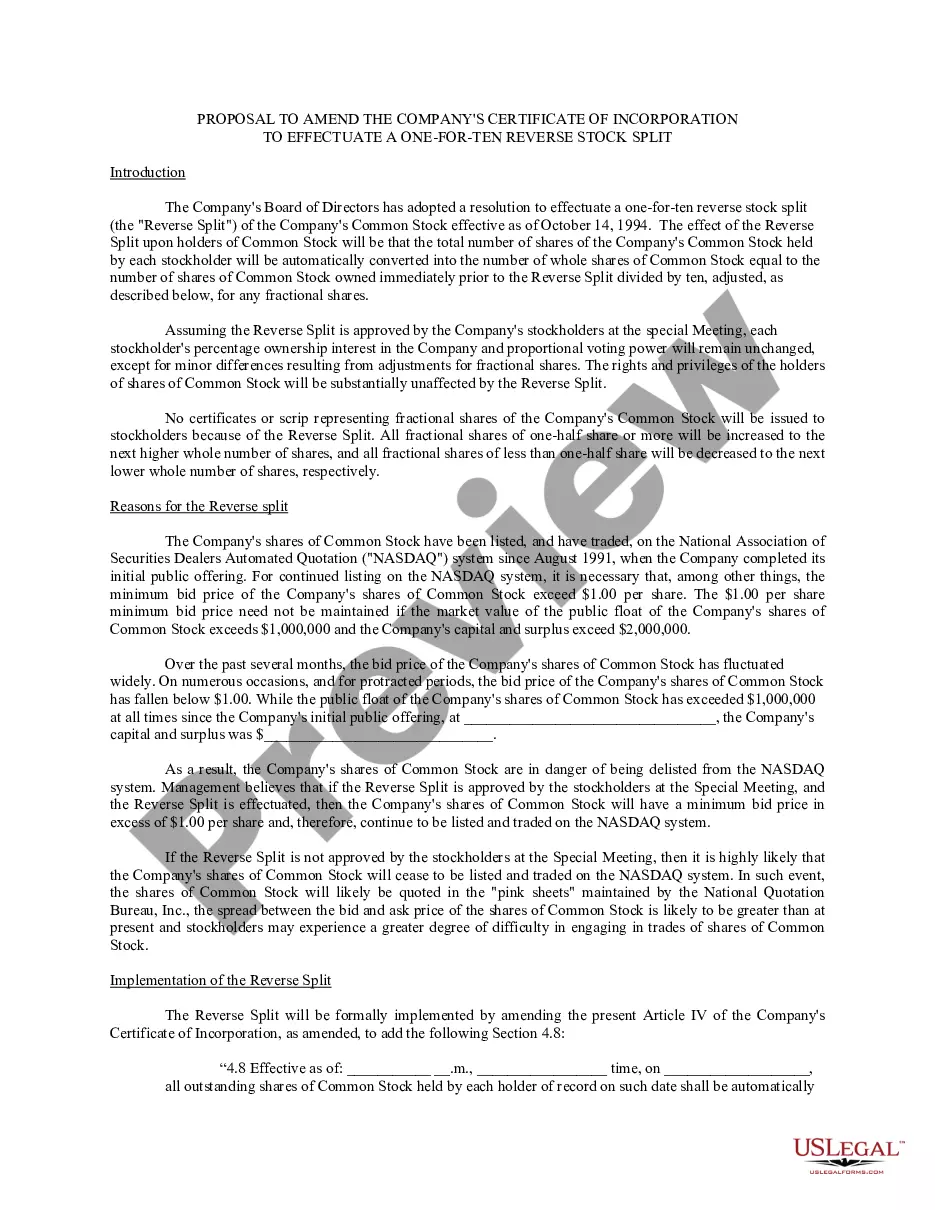
This Proposal to amend articles of incorporation is designed to document a company's intent to implement a reverse stock split of common stock and authorize a share dividend. This form is essential for corporations planning to adjust their capital structure for various reasons, including reducing the number of shareholders or increasing market appeal. It details the specific amendments to the company's articles of incorporation, which are necessary to officially enact these changes.
Key components of this form
- Article V: Details of the reverse stock split, including the exchange ratio.
- Shareholder entitlements: Clarifications on how fractional shares are handled.
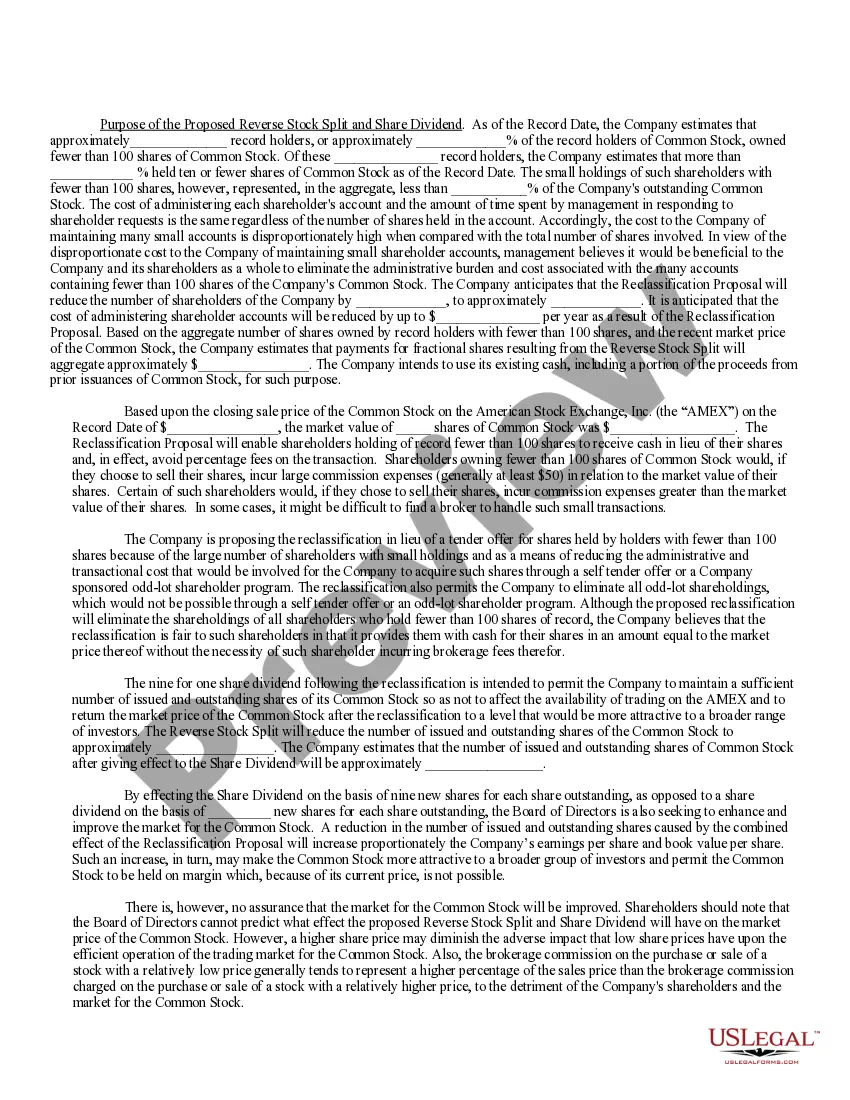
- Proposal overview: Summary of the board's recommendations for shareholders.
- Justification: Explanation of reasons for the reverse stock split and share dividend.
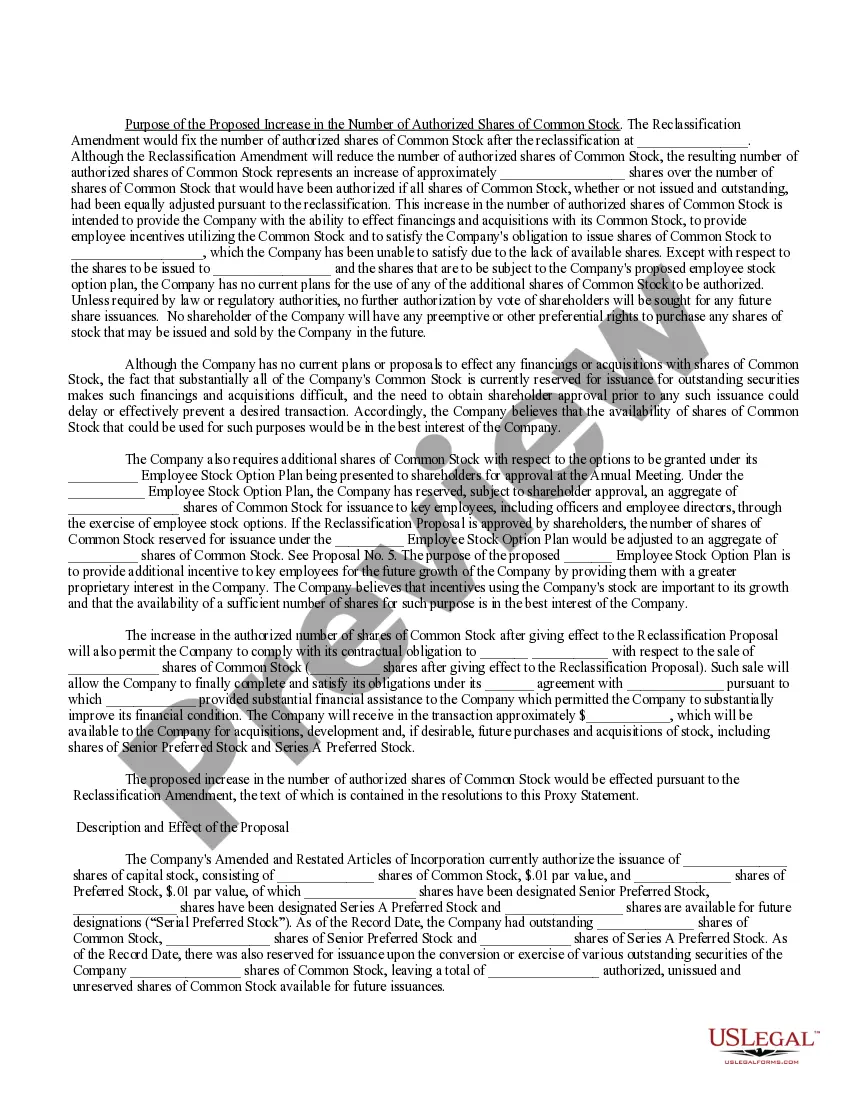
- Authorized shares: Details on adjusting the number of authorized shares.

Common use cases
This form should be used when a corporation seeks to reduce the number of shares held by small shareholders, streamline administrative processes, or improve the market perception of its common stock. Corporations typically utilize this form during a strategic restructuring, particularly when the number of small individual shareholders is high, affecting operational efficiency and costs.
Who this form is for
- Corporationâs Board of Directors seeking to propose structural changes.
- Shareholders reviewing significant amendments to their company's articles.
- Legal professionals advising corporate clients on governance matters.
- Businesses preparing for regulatory filings pertaining to stock changes.
Instructions for completing this form
- Identify the corporation: Insert the full name of the corporation in the designated section.
- Specify the effective date: Indicate the date on which the reverse stock split will take place.
- Detail the reverse stock split ratio: Clearly state the ratio, such as one-for-five.
- Outline the share dividend terms: Include details of the share dividend following the reverse split.
- Gather shareholder approvals: Ensure necessary shareholder voting is completed as required.
Notarization guidance
This form does not typically require notarization unless specified by local law. Review your stateâs regulations to ensure compliance with any additional requirements when amending articles of incorporation.
Get your form ready online
Our built-in tools help you complete, sign, share, and store your documents in one place.
Make edits, fill in missing information, and update formatting in US Legal Forms—just like you would in MS Word.
Download a copy, print it, send it by email, or mail it via USPS—whatever works best for your next step.
Sign and collect signatures with our SignNow integration. Send to multiple recipients, set reminders, and more. Go Premium to unlock E-Sign.
If this form requires notarization, complete it online through a secure video call—no need to meet a notary in person or wait for an appointment.
We protect your documents and personal data by following strict security and privacy standards.

Make edits, fill in missing information, and update formatting in US Legal Forms—just like you would in MS Word.

Download a copy, print it, send it by email, or mail it via USPS—whatever works best for your next step.

Sign and collect signatures with our SignNow integration. Send to multiple recipients, set reminders, and more. Go Premium to unlock E-Sign.

If this form requires notarization, complete it online through a secure video call—no need to meet a notary in person or wait for an appointment.

We protect your documents and personal data by following strict security and privacy standards.
Typical mistakes to avoid
- Failing to clearly outline the reverse stock split ratio, leading to confusion among shareholders.
- Neglecting to specify how fractional shares will be handled.
- Not obtaining proper approvals from shareholders before proceeding.
- Forgetting to notify regulatory authorities of the amendment once approved.
Why complete this form online
- Convenience: Easily accessible for download at any time.
- Editability: Customize the form to meet specific corporate needs.
- Reliability: Forms are drafted by licensed attorneys ensuring legal compliance.
Legal use & context
- This form must comply with corporate governance laws in your state.
- Ensure adherence to SEC regulations if the company is publicly traded.
- Consider implications of the amendment on shareholder rights and voting processes.
Summary of main points
- This form is essential for executing reverse stock splits and share dividends within corporations.
- Understanding the rationale behind these amendments can aid in shareholder communications.
- Adapting the form to comply with state laws is critical for validity.
Looking for another form?


Form popularity
FAQ
Reasons for a reverse stock split That's because reverse splits usually follow some kind of negative event in the company's life that has seen the stock decline for months or years. The reverse split is often associated with bad news, although it's not necessarily bad in and of itself.
Will the reverse stock split change the par value of the share? Yes, the par value of each share will be increased proportionally to the exchange ratio, i.e. it will be multiplied by 20.
Reverse stock splits work the same way as regular stock splits but in reverse. A reverse split takes multiple shares from investors and replaces them with a smaller number. The new share price is proportionally higher, leaving the total market value of the company unchanged.
When a company's stock splits, the change in the par value is offset by a corresponding change in the number of shares so the total par value remains the same. The total stockholders' equity is unaffected by the stock split and no entries are recorded.
A company performs a reverse stock split to boost its stock price by decreasing the number of shares outstanding. A reverse stock split has no inherent effect on the company's value, with market capitalization remaining the same after it's executed.
To calculate the new cost basis for the 3-for-4 reverse stock split, again divide the cost basis per share by the number of new shares you receive per each original share. In this case, divide $9.00 by 0.75 to get the new cost basis per share of $12.00 ($9.00 / 0.75 = $12.00).
1Take the original investment amount ($10,000) and divide it by the new number of shares you hold (2,000 shares) to arrive at the new per-share cost basis ($10,000/2,000 = $5).2Take your previous cost basis per share ($10) and divide it by the split factor of 2:1 ($10.00/2 = $5).
A Shareholder will not lose money on the reverse split in and of the split itself.The reverse split increases the price to a level that increases pro trading activity, often boosting the stock price higher. The stock price is below the exchange price requirement to remain listed on the exchange.
Current shareholders will hold twice the shares at half the value for each, but the total value doesn't change.Investors who own a stock that splits may not make a lot of money immediately, but they shouldn't sell the stock since the split is likely a positive sign.