Sale of stock
About this form
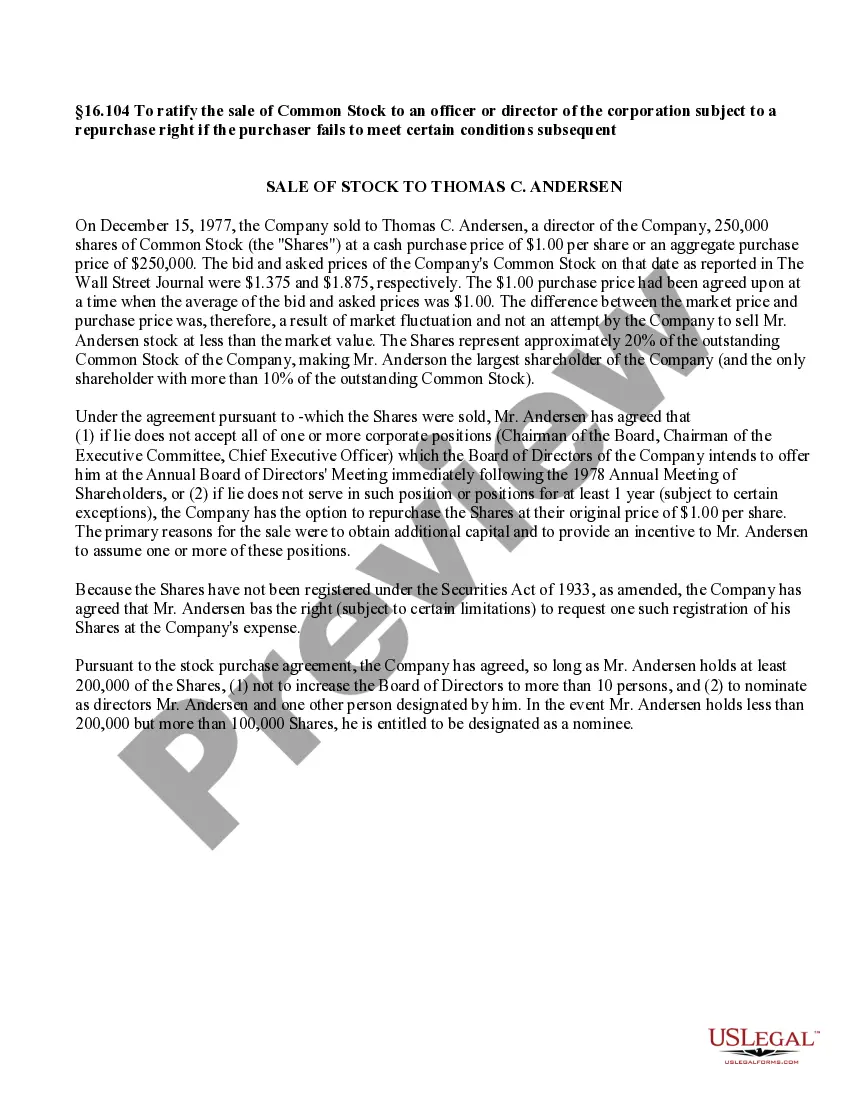
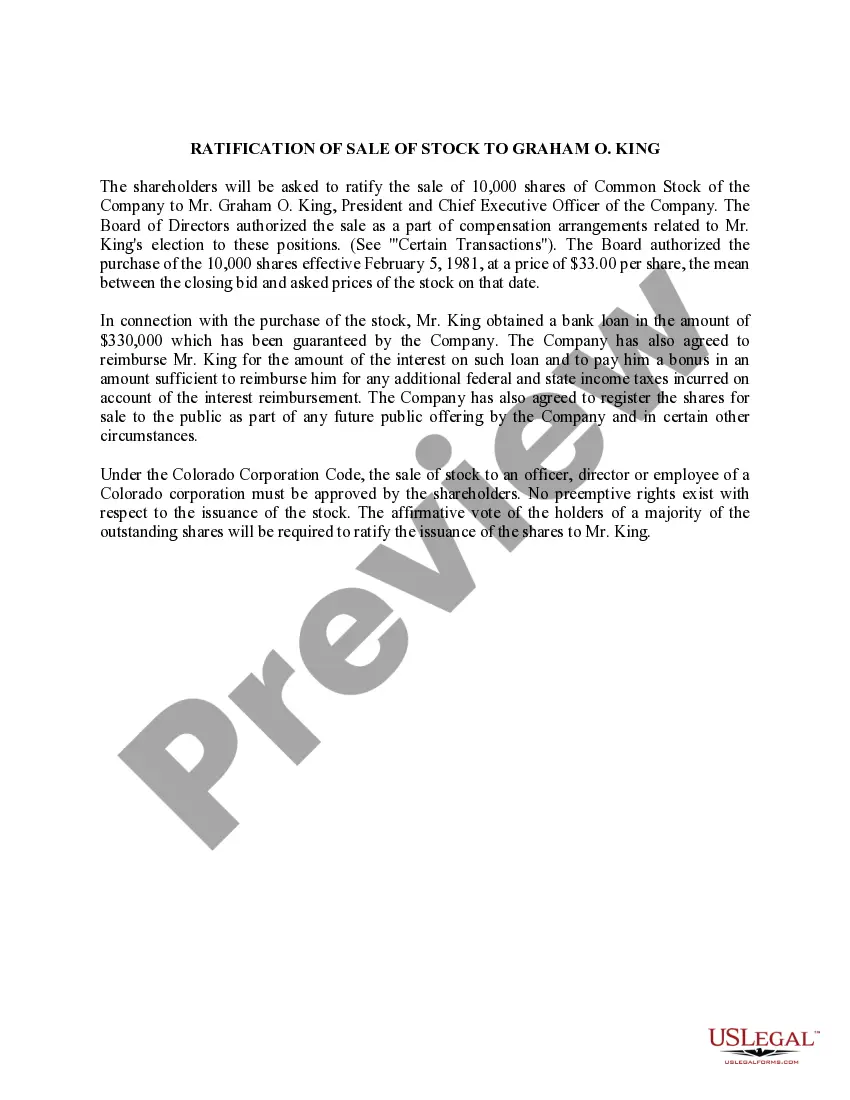
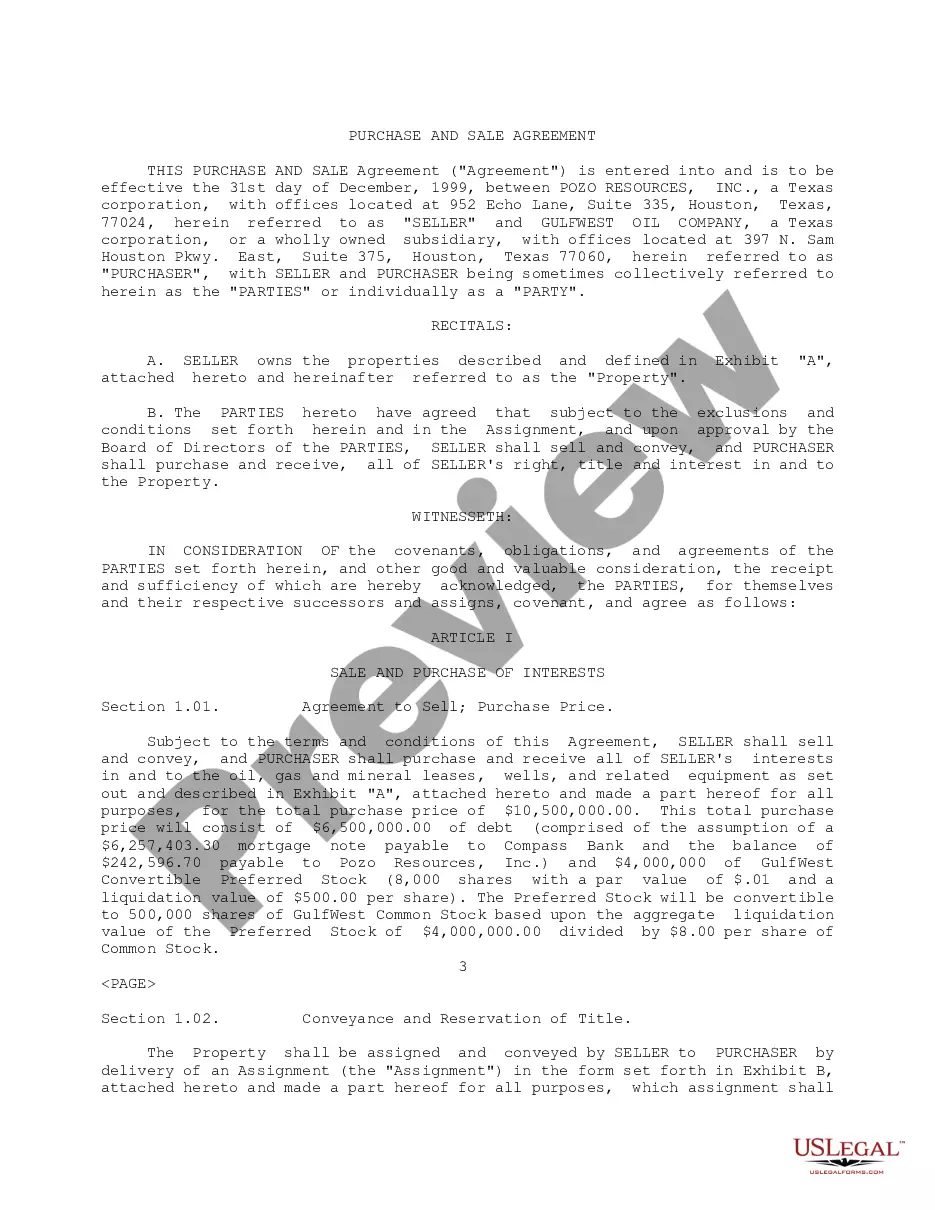
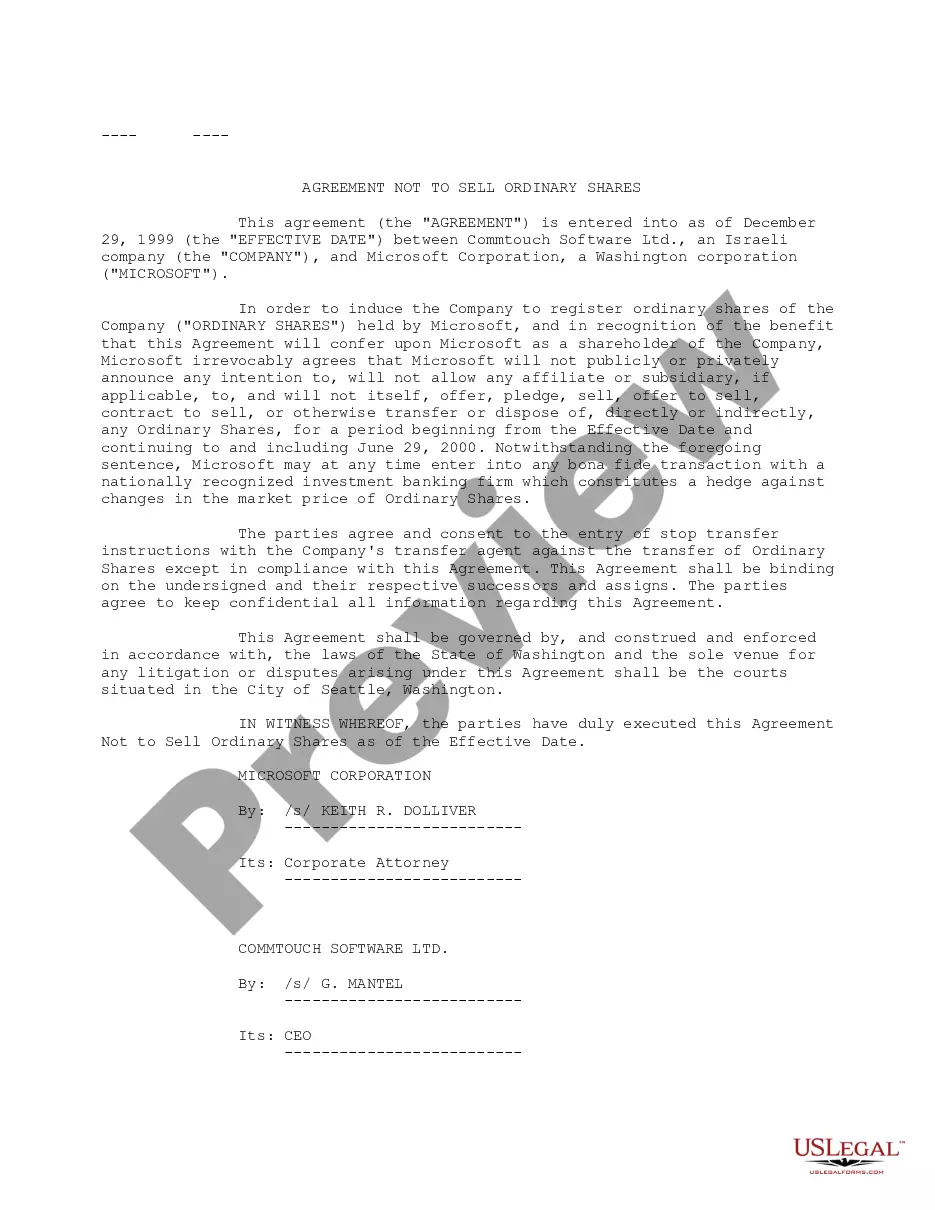
The Sale of Stock form is a legal document used to confirm the sale of stock shares from a company to a buyer. This form is crucial for maintaining clear records of ownership and ensuring compliance with corporate governance. It serves as an official record, outlining the terms of the sale, including the number of shares sold, the purchase price, and any conditions attached to the sale, distinguishing it from other stock transfer or sale agreements.
Key components of this form
- Details of the seller and buyer, including names and addresses.
- The number of shares being sold and the purchase price per share.
- Conditions related to the sale, including any corporate positions offered to the buyer.
- Provisions regarding the right to request registration of shares with the Securities and Exchange Commission.
- Agreements pertaining to board nominations and company governance.
Situations where this form applies
This form should be used when a company is selling stock to a buyer, particularly when the buyer is an insider, such as an executive or director. It is needed to document the sale, ensuring compliance with applicable securities laws, and to outline any conditions or restrictions associated with the ownership or sale of the shares. It is also useful when the sale impacts the company's management structure or governance.
Who can use this document
This form is intended for:
- Company executives and directors participating in stock sales.
- Shareholders looking to sell their shares to other parties.
- Legal professionals facilitating stock transactions.
- Companies seeking to raise capital through stock sales.
Instructions for completing this form
- Identify the seller (the company) and the buyer (individual or entity).
- Enter the number of shares being sold and the agreed purchase price per share.
- Specify any conditions attached to the stock sale, such as obligations related to corporate positions.
- Include the date of the transaction and any notable market price references.
- Both parties should sign to validate the agreement.
Does this document require notarization?
This form does not typically require notarization to be legally valid. However, some jurisdictions or document types may still require it. US Legal Forms provides secure online notarization powered by Notarize, available 24/7 for added convenience.
Get your form ready online
Our built-in tools help you complete, sign, share, and store your documents in one place.
Make edits, fill in missing information, and update formatting in US Legal Forms—just like you would in MS Word.
Download a copy, print it, send it by email, or mail it via USPS—whatever works best for your next step.
Sign and collect signatures with our SignNow integration. Send to multiple recipients, set reminders, and more. Go Premium to unlock E-Sign.
If this form requires notarization, complete it online through a secure video call—no need to meet a notary in person or wait for an appointment.
We protect your documents and personal data by following strict security and privacy standards.

Make edits, fill in missing information, and update formatting in US Legal Forms—just like you would in MS Word.

Download a copy, print it, send it by email, or mail it via USPS—whatever works best for your next step.

Sign and collect signatures with our SignNow integration. Send to multiple recipients, set reminders, and more. Go Premium to unlock E-Sign.

If this form requires notarization, complete it online through a secure video call—no need to meet a notary in person or wait for an appointment.

We protect your documents and personal data by following strict security and privacy standards.
Typical mistakes to avoid
- Failing to state the number of shares clearly.
- Not including conditions of the sale that may affect ownership.
- Omitting signatures from both parties, making the document invalid.
- Neglecting to keep a copy for personal records.
Why use this form online
- Convenience of downloading and preparing the form at your own pace.
- Editable fields allow for customized details in the agreement.
- Reliability and accuracy, ensuring alignment with legal standards.
Legal use & context
- This form serves to document a stock sale, providing legal protection for both parties involved in the transaction.
- It is crucial for maintaining accurate records for corporate governance and compliance with securities laws.
- Using this form can help avoid disputes over share ownership and validate the share transfer process.
What to keep in mind
- The Sale of Stock form is essential for any legal stock transaction.
- This form helps document ownership changes and terms of sale clearly.
- Adhering to correct procedures can prevent future legal issues and ensure compliance.
Looking for another form?

Form popularity
FAQ
Invest for the long term. Take advantage of tax-deferred retirement plans. Use capital losses to offset gains. Watch your holding periods. Pick your cost basis.
When you sell your stocks, the two sides to the trade -- you the seller and the buyer -- must each fulfil his side of the deal. You must deliver the stock shares and the buyer must give the money to pay for the shares to his broker.
When you report a sale of shares on your tax return, you must complete IRS Form 8949 if the cost basis needs an adjustment, along with Schedule D. You submit both with your Form 1040 tax return. Form 8949 is where you list the details of each stock sale, using the information on Form 1099-B.
An asset sale is the purchase of individual assets and liabilities, whereas a stock sale is the purchase of the owner's shares of an entity. The deal structure of any transaction can have a major impact on the future for both the buyer and seller.
Capital gains are the profits from the sale of an asset shares of stock, a piece of land, a business and generally are considered taxable income. How much these gains are taxed depends a lot on how long you held the asset before selling.
1- If a company decides it wants to issue new shares, such as in an IPO or capital raise, then if you buy these shares, the money goes to the company. If you sell them on, however, the money comes from other shareholders. Similarly if a company does a share buyback, obviously they are paying for the shares.
Generally, any profit you make on the sale of a stock is taxable at either 0%, 15% or 20% if you held the shares for more than a year or at your ordinary tax rate if you held the shares for less than a year. Also, any dividends you receive from a stock are usually taxable.
It's generally a bad idea to sell a stock simply because the price went up or down. On the other hand, there are some other situations that can be perfectly valid reasons to hit the sell button: The reasons you bought the stock no longer apply. The company is being acquired.
Asset sales: an alternative to stock sales Theoretically, whether you acquire 100% of a target's stock (stock sale) or all assets and liabilities (asset sale) and leave the now-worthless stock untouched gets you to the same place: You own the entire thing.