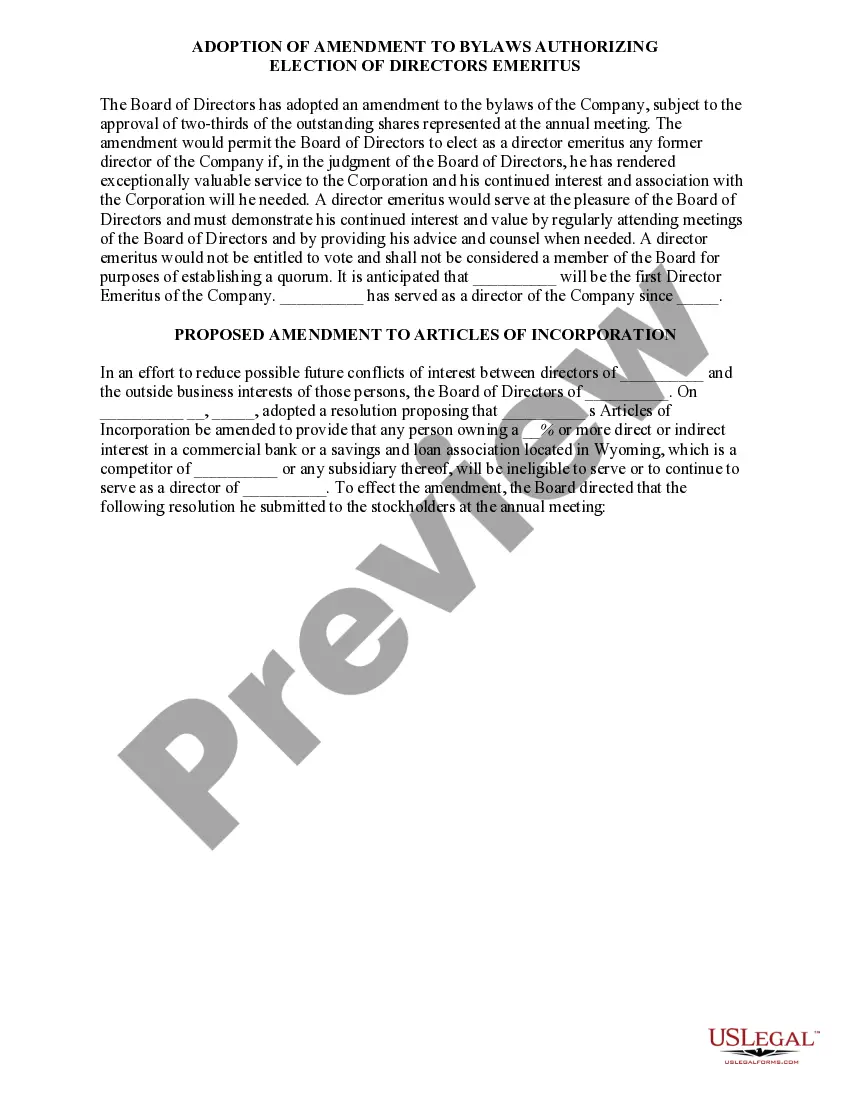
Adoption of Amendment to Bylaws Authorizing Election of Directors Emeritus
About this form
The Adoption of Amendment to Bylaws Authorizing Election of Directors Emeritus is a legal document that allows a corporation's Board of Directors to designate a former director as a Director Emeritus. This honorary title recognizes individuals who have provided significant service to the company. Unlike regular board members, Directors Emeritus do not have voting rights but are valued for their continued involvement and guidance.
What’s included in this form
- Election of Directors Emeritus: Details the criteria for electing former directors as Directors Emeritus.
- Approval Requirement: States that the amendment needs the approval of two-thirds of outstanding shares at the annual meeting.
- Role of Director Emeritus: Describes the non-voting status and expected participation of the Director Emeritus in board meetings.
- Proposed Amendment to Articles of Incorporation: Outlines a potential conflict of interest clause related to banking affiliations.
Situations where this form applies
This form is necessary when a corporation wishes to formally recognize a former director for their exceptional contributions by appointing them as a Director Emeritus. Such recognition can strengthen the board's connection to its past leadership and foster ongoing mentorship for current directors.
Who this form is for
- Corporations seeking to honor past directors with the title of Director Emeritus.
- Current Board members responsible for proposing amendments to corporate bylaws.
- Shareholders participating in the approval process at annual meetings.
How to prepare this document
- Identify and confirm the former director to be elected as Director Emeritus.
- Ensure the proposed amendment is drafted and includes necessary legal language.
- Gather approval from the Board of Directors and arrange for a vote at the annual meeting.
- Document that at least two-thirds of outstanding shares approve the amendment.
- Record the decision in the corporate minutes and update the bylaws accordingly.
Notarization requirements for this form
This form usually doesn’t need to be notarized. However, local laws or specific transactions may require it. Our online notarization service, powered by Notarize, lets you complete it remotely through a secure video session, available 24/7.
Get your form ready online
Our built-in tools help you complete, sign, share, and store your documents in one place.
Make edits, fill in missing information, and update formatting in US Legal Forms—just like you would in MS Word.
Download a copy, print it, send it by email, or mail it via USPS—whatever works best for your next step.
Sign and collect signatures with our SignNow integration. Send to multiple recipients, set reminders, and more. Go Premium to unlock E-Sign.
If this form requires notarization, complete it online through a secure video call—no need to meet a notary in person or wait for an appointment.
We protect your documents and personal data by following strict security and privacy standards.

Make edits, fill in missing information, and update formatting in US Legal Forms—just like you would in MS Word.

Download a copy, print it, send it by email, or mail it via USPS—whatever works best for your next step.

Sign and collect signatures with our SignNow integration. Send to multiple recipients, set reminders, and more. Go Premium to unlock E-Sign.

If this form requires notarization, complete it online through a secure video call—no need to meet a notary in person or wait for an appointment.

We protect your documents and personal data by following strict security and privacy standards.
Common mistakes
- Failing to secure the required two-thirds approval from shareholders.
- Neglecting to accurately outline the qualifications for Director Emeritus.
- Not properly documenting the process in board minutes.
Why complete this form online
- Convenience: Download and complete the form from any location.
- Editability: Easily customize the form to meet specific corporate needs.
- Reliability: Forms are drafted by licensed attorneys, ensuring legal compliance.
Looking for another form?


Form popularity
FAQ
The term ex-officio is a Latin term that loosely translates to by virtue of holding another office. An ex-officio member is a member of a board, committee, council or other body that receives a position on that body solely because of holding another office.
Board chair or president. The board chair oversees the work of the board and the organization's senior management team. Vice chair or vice president. Secretary. Treasurer. Using ad hoc committees. Selecting committee members.
General liability: This involves issues like gross negligence. Board members can be held liable for bad things they didn't take steps to prevent or eliminate.
Emeritus - Wikipedia, the free encyclopedia. Emeritus Board Members.
Emeritus status is an honor conferred by the university to show respect for a distinguished career. It says even though you are no longer an official part of this organization, you have shown such merit that we claim you as a continuing part of our professional group; we gather glory from your reflected glory.
Emeritus status may be given to an individual who has retired from an institution that was a member in good standing at the time of their retirement. Emeritus status is recognition for long term (at least ten years) service and leadership in ACBSP.
4. Non-Voting and Honorary Board Members Many nonprofit organizations have non-voting or honorary board members. This practice is not recommended because those individuals may be held liable for board decisions in which they participated in deliberations but were unable to vote.
Make the organization a part of your estate planning. Provide in-kind gifts and resources to help reduce costs. Attend the majority of events hosted by the organization or by fellow board members. Take time to visit the organization and observe its work in action.
To put it simply, homeowners can sue condo or HOA board members and even name them personally in the lawsuit. But, there's no guarantee that they will win. Board members are afforded a certain level of protection from personal liability, both through state laws and the association's governing documents.