Section 262 of the Delaware General Corporation Law
Overview of this form
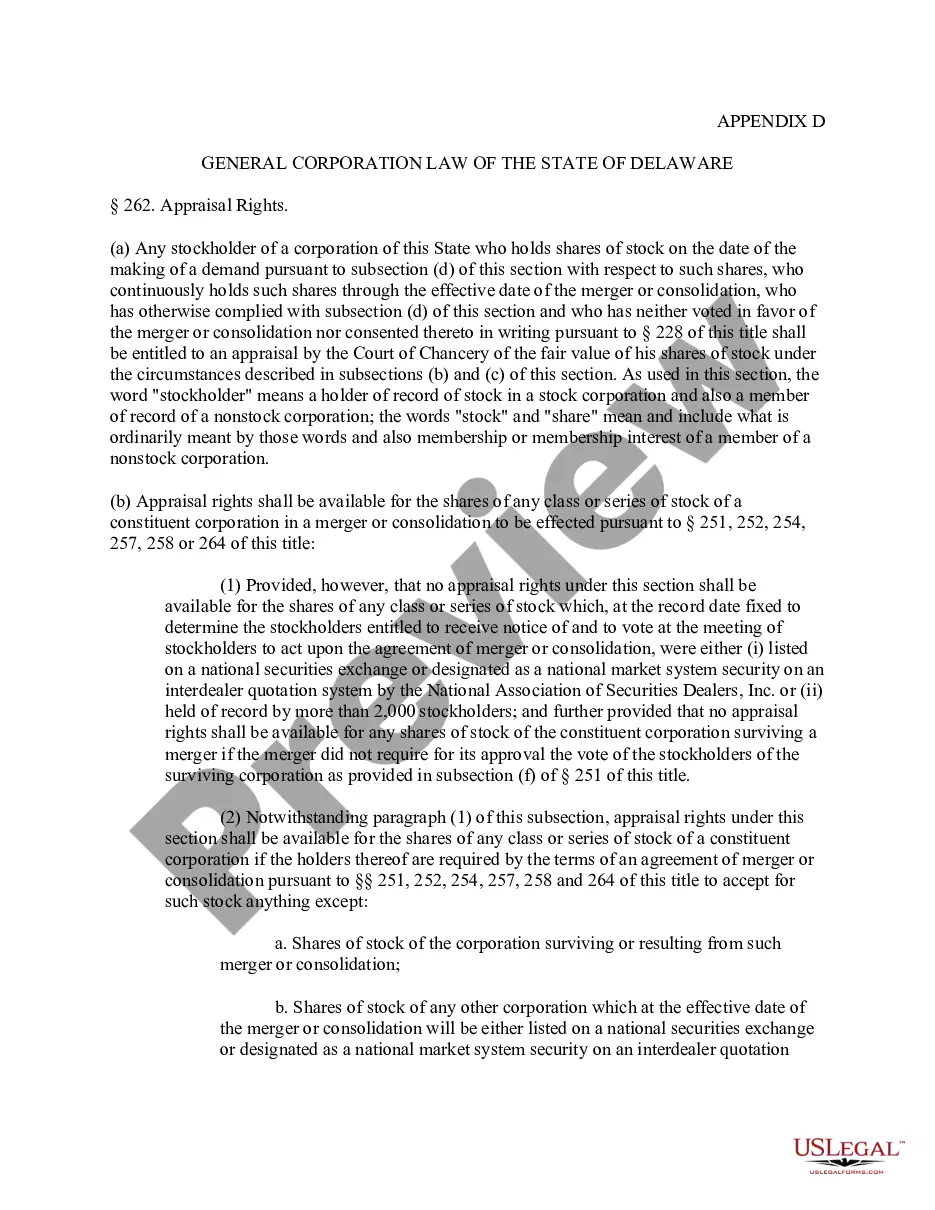
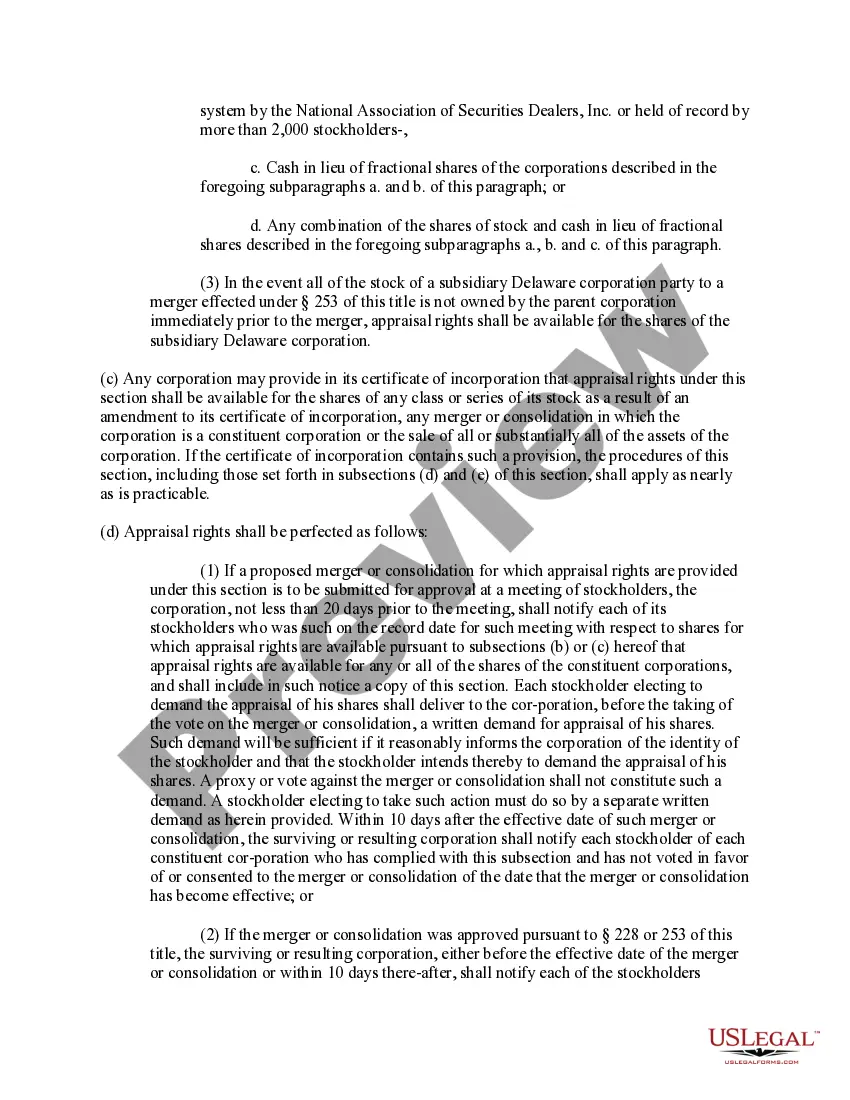
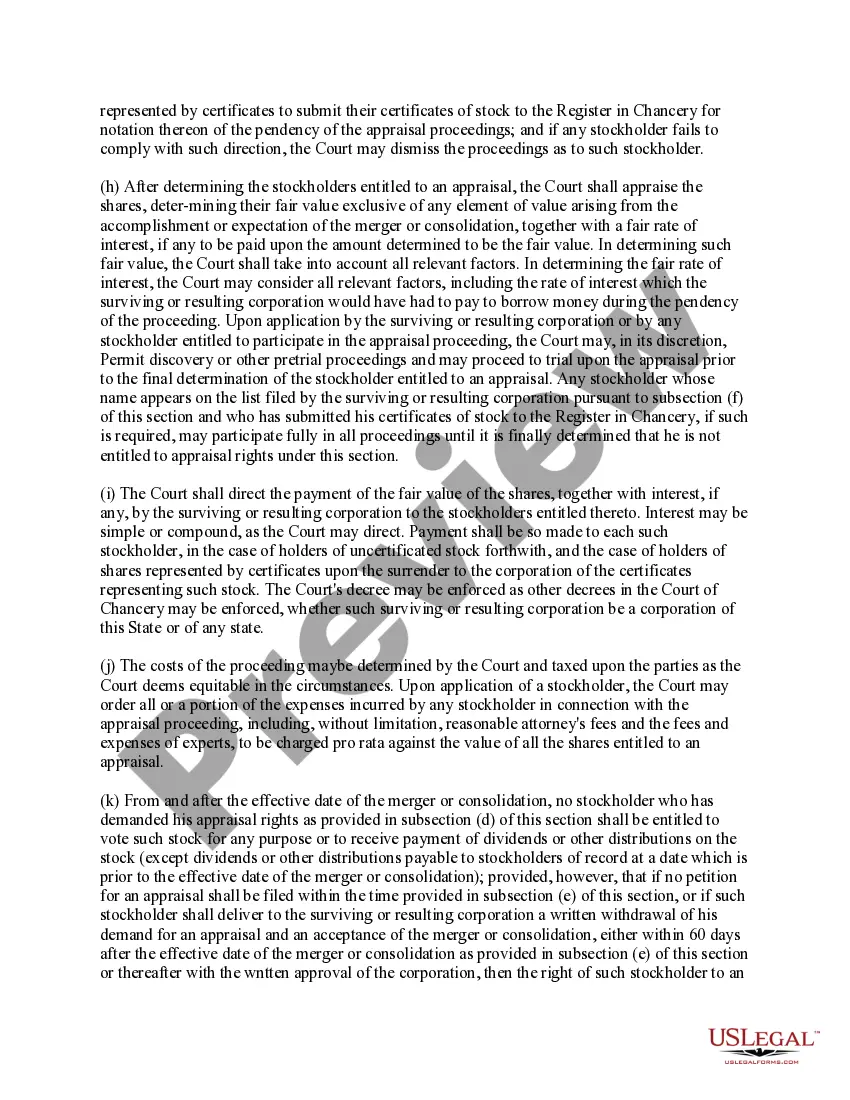
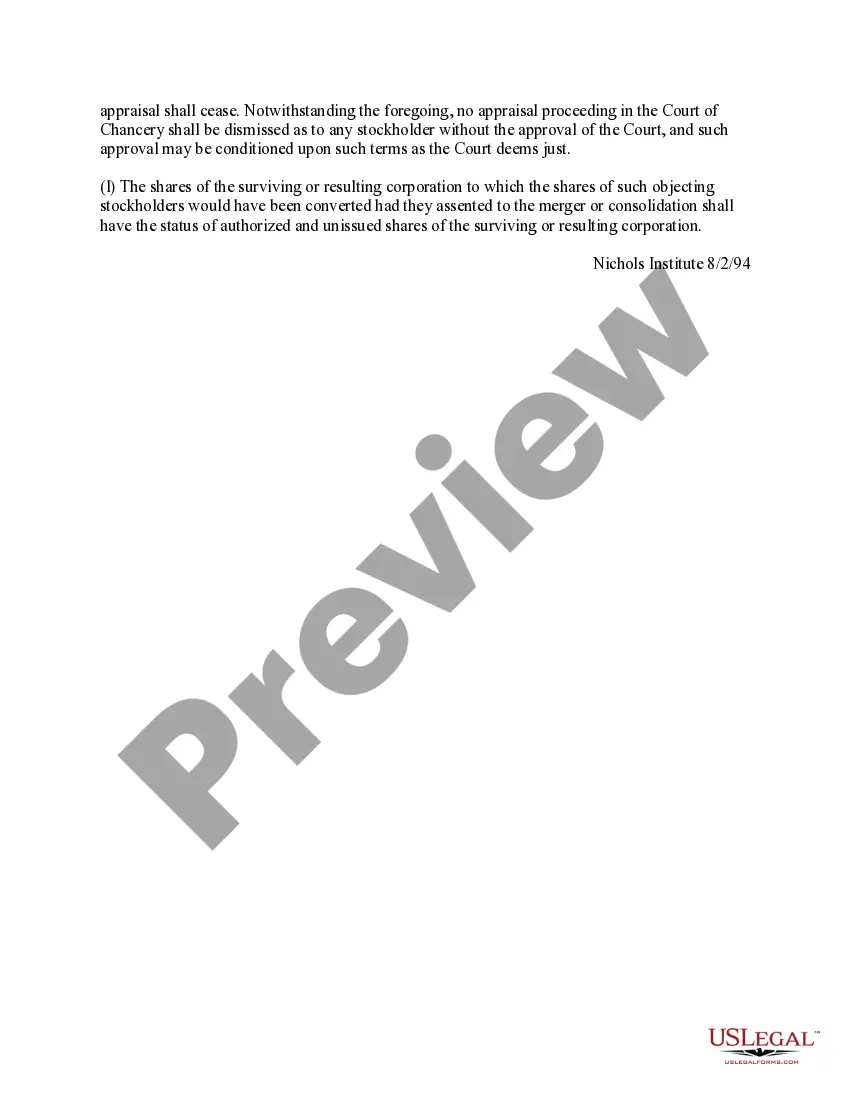
The Section 262 of the Delaware General Corporation Law form provides appraisal rights to stockholders. It allows them to seek a court determination of the fair value of their shares in specific corporate actions, such as mergers or consolidations, when they do not agree with the terms. This form is essential for stockholders who wish to dissent from a merger, ensuring their rights are protected and that they receive fair compensation for their shares. Unlike other forms, this one is specific to appraisal rights under Delaware law and must be properly executed to be effective.
Main sections of this form
- Eligibility criteria for stockholders to demand appraisal.
- Procedures for notifying stockholders about appraisal rights.
- Requirements for filing a petition in the Court of Chancery.
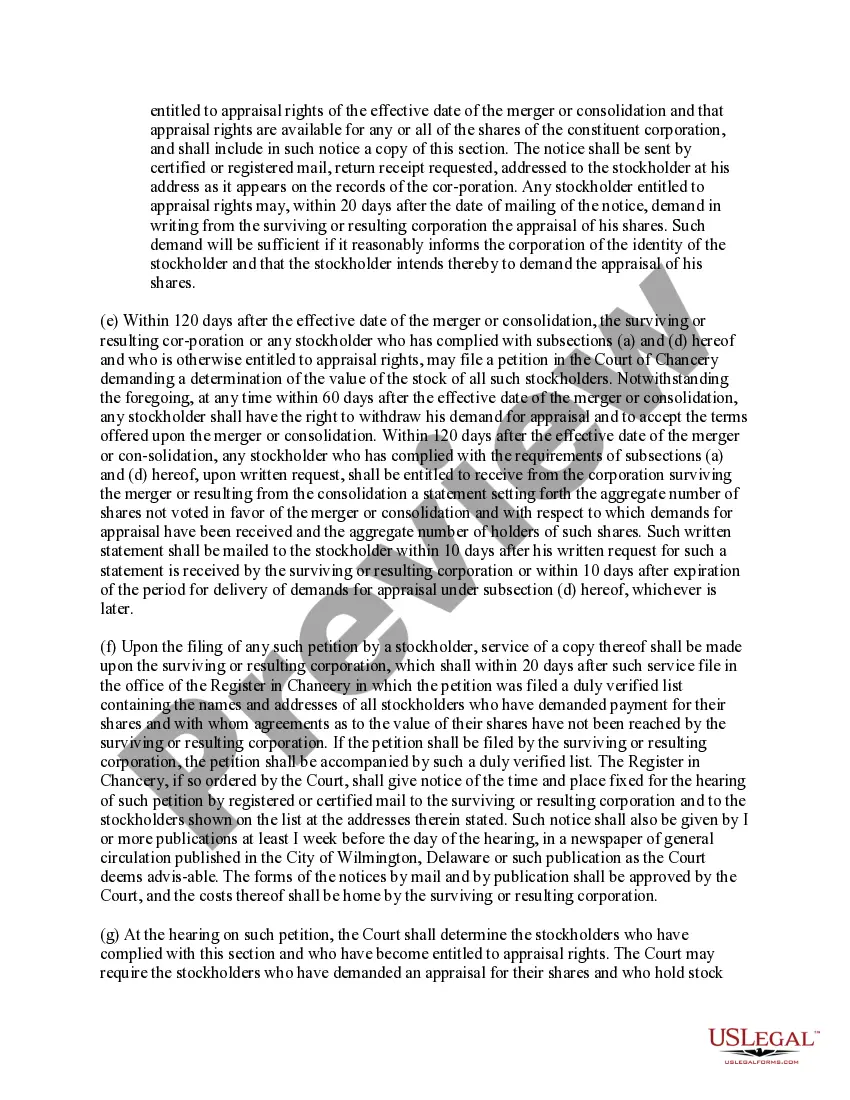
- Timeframes for submitting demands and petitions.
- Details on the appraisal process and determination of fair value.
- Provisions regarding costs and attorney fees in appraisal proceedings.
When to use this document
This form should be used when a stockholder of a Delaware corporation wishes to dissent from a proposed merger or consolidation. If a stockholder believes that the merger will undervalue their shares, they can invoke appraisal rights to seek a fair market value determination by the court. This is particularly relevant in situations where the stockholder has not voted in favor of the merger and wishes to ensure they receive just compensation for their investment.
Who this form is for
- Stockholders of Delaware corporations who oppose a merger or consolidation.
- Individuals who have maintained their shares continuously since the demand date.
- Investors looking to ensure fair treatment regarding the value of their shares during corporate changes.
Completing this form step by step
- Identify the stockholder's details and record date for appraisal rights.
- Provide written demand for appraisal with specifics about the shares held.
- Submit the demand before the stockholder meeting or timely after the merger notification.
- File a petition in the Court of Chancery if appraisal rights are not resolved.
- Maintain compliance with deadlines and procedures as outlined in the law.
Does this document require notarization?
In most cases, this form does not require notarization. However, some jurisdictions or signing circumstances might. US Legal Forms offers online notarization powered by Notarize, accessible 24/7 for a quick, remote process.
Get your form ready online
Our built-in tools help you complete, sign, share, and store your documents in one place.
Make edits, fill in missing information, and update formatting in US Legal Forms—just like you would in MS Word.
Download a copy, print it, send it by email, or mail it via USPS—whatever works best for your next step.
Sign and collect signatures with our SignNow integration. Send to multiple recipients, set reminders, and more. Go Premium to unlock E-Sign.
If this form requires notarization, complete it online through a secure video call—no need to meet a notary in person or wait for an appointment.
We protect your documents and personal data by following strict security and privacy standards.

Make edits, fill in missing information, and update formatting in US Legal Forms—just like you would in MS Word.

Download a copy, print it, send it by email, or mail it via USPS—whatever works best for your next step.

Sign and collect signatures with our SignNow integration. Send to multiple recipients, set reminders, and more. Go Premium to unlock E-Sign.

If this form requires notarization, complete it online through a secure video call—no need to meet a notary in person or wait for an appointment.

We protect your documents and personal data by following strict security and privacy standards.
Common mistakes to avoid
- Failing to submit the written demand in time.
- Not retaining shares until the effective date of the merger or consolidation.
- Confusing appraisal rights with other forms of dissent or consent.
Advantages of online completion
- Convenient access to legal documentation from anywhere, anytime.
- Editable templates that cater to individual circumstances.
- Reliable forms drafted by licensed attorneys to ensure compliance with laws.
Legal use & context
- Enforcable under Delaware law, assuring stockholders' rights during mergers.
- Provides legal recourse for dissatisfied shareholders through the Court of Chancery.
- Limits on timeframes necessitate prompt action by stockholders after corporate announcements.
Main things to remember
- The form allows stockholders to secure fair appraisal rights during mergers.
- Timeliness and procedural compliance are crucial to exercising appraisal rights.
- Understanding the specific provisions and limits under Delaware law is essential for effective use.
Looking for another form?


Form popularity
FAQ
Corporate code of conduct (CCC), codified set of ethical standards to which a corporation aims to adhere. Commonly generated by corporations themselves, corporate codes of conduct vary extensively in design and objective. Crucially, they are not directly subject to legal enforcement.
Corporation defined. - A corporation is an artificial being created by operation of law, having the right of succession and the powers, attributes and properties expressly authorized by law or incident to its existence.
Taxes. Corporations must file their annual tax returns. Securities. Corporations must issue stock as their security laws and articles of incorporation mandate. Bookkeeping. Board meetings. Meeting minutes. State registration. Licensing.
The Corporation Code of the Philippines (Batas Pambansa Bilang 68), which was approved and became effective on May 1, 1980, is the law that governs the rules and regulations in the establishment and operation of stock and non-stock corporations in the Philippines.The code gives the legal definition of a corporation.
A general corporation is the most common type of corporate structure. A general corporation is one that is a completely separate legal entity owned by stockholders. There is no limit to the number of the stockholders that are protected from any creditors of the corporation.
Republic Act 11232, or the Act Providing for the Revised Corporation Code of the Philippines, was signed into law by President Rodrigo R. Duterte on 21 February 2019. It amends a 38-year-old Corporation Code in an effort to improve the ease of doing business in the Philippines.
A corporation is a legal entity created through the laws of its state of incorporation.The law treats a corporation as a legal "person" that has standing to sue and be sued, distinct from its stockholders. The legal independence of a corporation prevents shareholders from being personally liable for corporate debts.
A corporation is a legal entity that is separate and distinct from its owners. 1feff Corporations enjoy most of the rights and responsibilities that individuals possess: they can enter contracts, loan and borrow money, sue and be sued, hire employees, own assets, and pay taxes. Some refer to it as a "legal person."