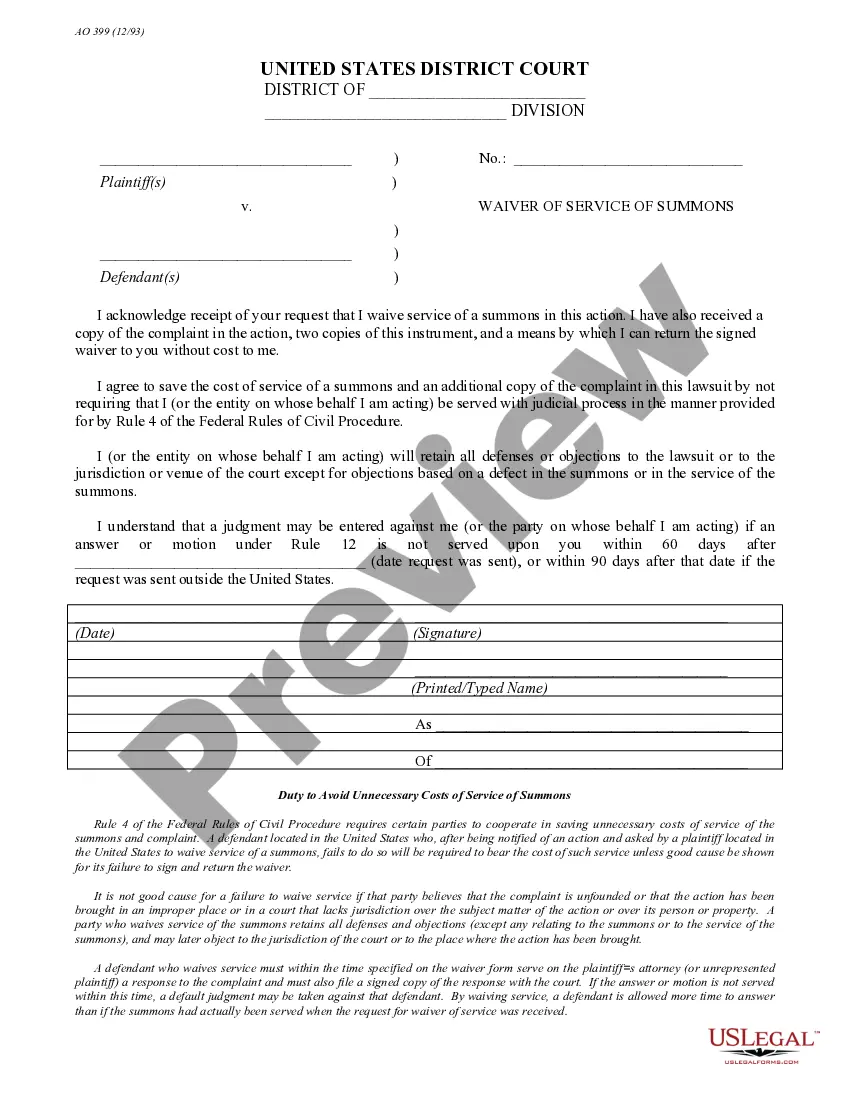
AO-399 Waiver of Service of Summons - Federal District Court Official Form
About this form
The AO-399 Waiver of Service of Summons is a legal document used in a Federal District Court case. This form allows a defendant to waive the formal service of a summons, enabling them to avoid the costs associated with serving the summons and complaint. It differs from traditional summons procedures by expediting the process and allowing defendants more time to respond to the lawsuit without incurring additional fees.
Key components of this form
- Receipt acknowledgment by the defendant of the waiver and complaint.
- Statement affirming the defendant's willingness to waive formal service.
- Retention of all defenses and objections, except those related to the summons or its service.
- Important deadlines for submitting responses to the complaint.
- Signature and printed name of the defendant, along with their role.
When to use this form
This form is typically used in scenarios when a plaintiff seeks to initiate a lawsuit and wishes to streamline the process by asking the defendant to waive service of summons. It is especially useful when both parties are in agreement about the matter at hand, allowing for quicker settlement and reduced legal expenses.
Who can use this document
- Defendants who have been notified of a lawsuit and wish to avoid the costs of formal service.
- Plaintiffs looking to expedite legal proceedings and reduce the financial burden on defendants.
- Attorneys representing either party in federal civil lawsuits.
How to prepare this document
- Identify the parties involved in the lawsuit, including the plaintiff and defendant.
- Enter the case number assigned by the court.
- Complete the date when the waiver request was sent.
- Sign the waiver acknowledging receipt and willingness to forgo formal service.
- Print or type the name of the individual or entity waiving service.
- Specify the capacity in which the individual is acting, if applicable.
Notarization guidance
This form does not typically require notarization unless specified by local law. Users should confirm any specific requirements related to notary acknowledgement in their jurisdiction.
Get your form ready online
Our built-in tools help you complete, sign, share, and store your documents in one place.
Make edits, fill in missing information, and update formatting in US Legal Forms—just like you would in MS Word.
Download a copy, print it, send it by email, or mail it via USPS—whatever works best for your next step.
Sign and collect signatures with our SignNow integration. Send to multiple recipients, set reminders, and more. Go Premium to unlock E-Sign.
If this form requires notarization, complete it online through a secure video call—no need to meet a notary in person or wait for an appointment.
We protect your documents and personal data by following strict security and privacy standards.

Make edits, fill in missing information, and update formatting in US Legal Forms—just like you would in MS Word.

Download a copy, print it, send it by email, or mail it via USPS—whatever works best for your next step.

Sign and collect signatures with our SignNow integration. Send to multiple recipients, set reminders, and more. Go Premium to unlock E-Sign.

If this form requires notarization, complete it online through a secure video call—no need to meet a notary in person or wait for an appointment.

We protect your documents and personal data by following strict security and privacy standards.
Mistakes to watch out for
- Failing to sign and date the form, which can invalidate the waiver.
- Not including the case number, leading to confusion in court records.
- Assuming the waiver will automatically extend the response time without proper acknowledgment.
Advantages of online completion
- Convenience of accessing and completing the form from any location.
- Editability ensures users can fill in information accurately and save a draft.
- Speedy processing by eliminating the need for mailing physical documents.
Looking for another form?
Form popularity
FAQ
An Entry of Appearance is a legal document that says that an attorney represents one party in a case.A waiver of service or summons means that a party voluntarily enters a lawsuit without requiring the opposing party to serve them with a summons and petition.
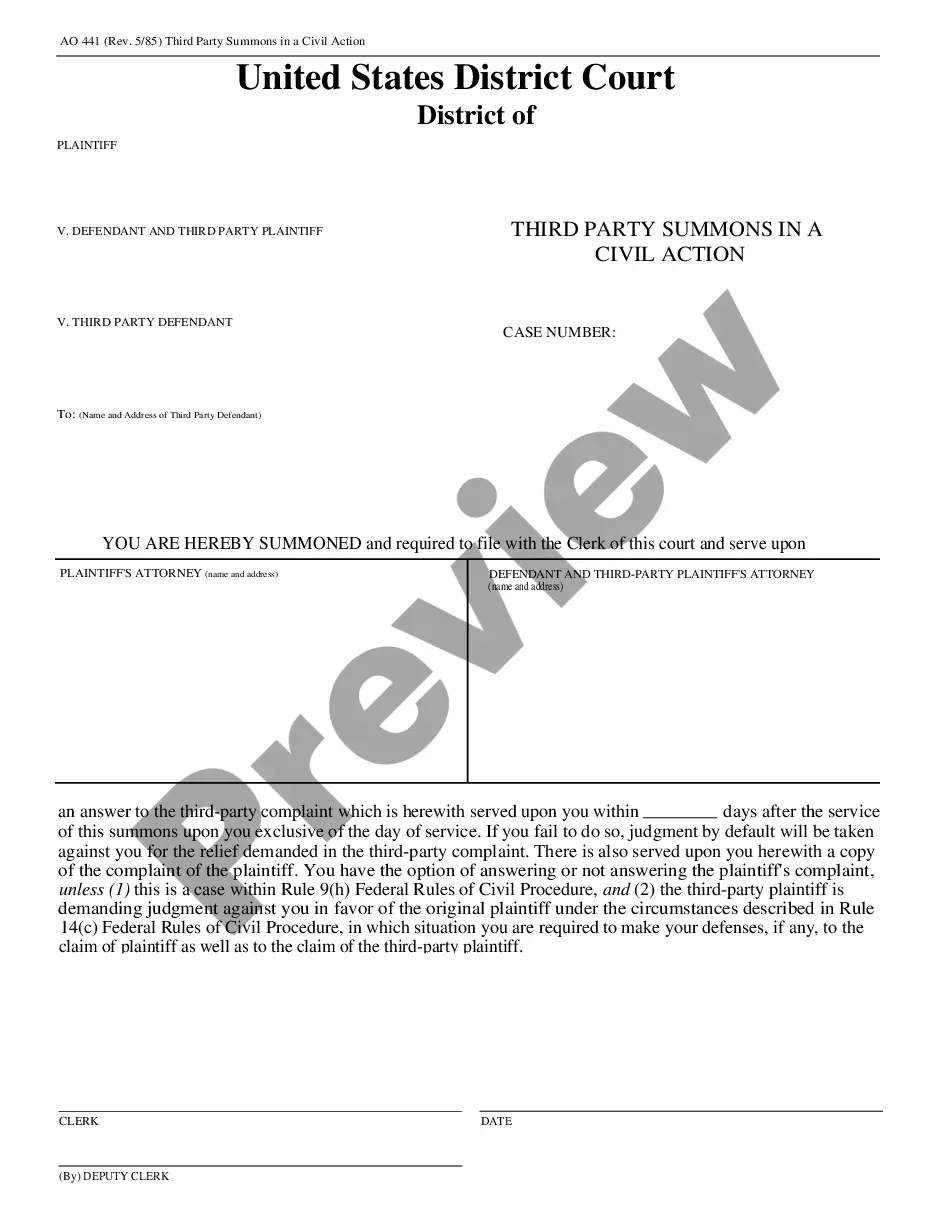
A summons is a writ, a formal command from the court, that accompanies the complaint and notifies the defendant(s) that a civil proceeding has been filed and that a response is required within a certain time limit. The clerk's office issues summons to a plaintiff or plaintiff's attorney when a paid complaint is filed.
Any person who is at least 18 years old and not a party may serve a summons and complaint. (3) By a Marshal or Someone Specially Appointed. At the plaintiff's request, the court may order that service be made by a United States marshal or deputy marshal or by a person specially appointed by the court.
Under FRCP 4, an individual within the U.S. may be served by delivering a copy of the summons and complaint to the individual personally; leaving a copy at the individual's dwelling or usual place of abode with someone of suitable age and discretion who resides there; or delivering a copy to an agent authorized or
Unless service is waived, proof of service must be made to the court. Except for service by a United States marshal or deputy marshal, proof must be by the server's affidavit.
A waiver of service or summons means that a party voluntarily enters a lawsuit without requiring the opposing party to serve them with a summons and petition.Most people do not want to be served by a sheriff's deputy or special process server and so elect to sign a waiver of service.
For the waiver to be effective, the defendant or the defendant's counsel must sign the waiver of service and return it to the plaintiff within the time allowed and the plaintiff must file the executed waiver with the court within 120 days after the action was commenced (FRCP 4(d)(4) and 4(m)).
P.; colloquially FRCP) govern civil procedure in United States district courts. The FRCP are promulgated by the United States Supreme Court pursuant to the Rules Enabling Act, and then the United States Congress has seven months to veto the rules promulgated or they become part of the FRCP.
You do not file anything with the federal court. relating to your initial disclosures. Sign the disclosures, include a certificate of service on the disclosures and keep a copy for your files as evidence that you served the disclosures should...