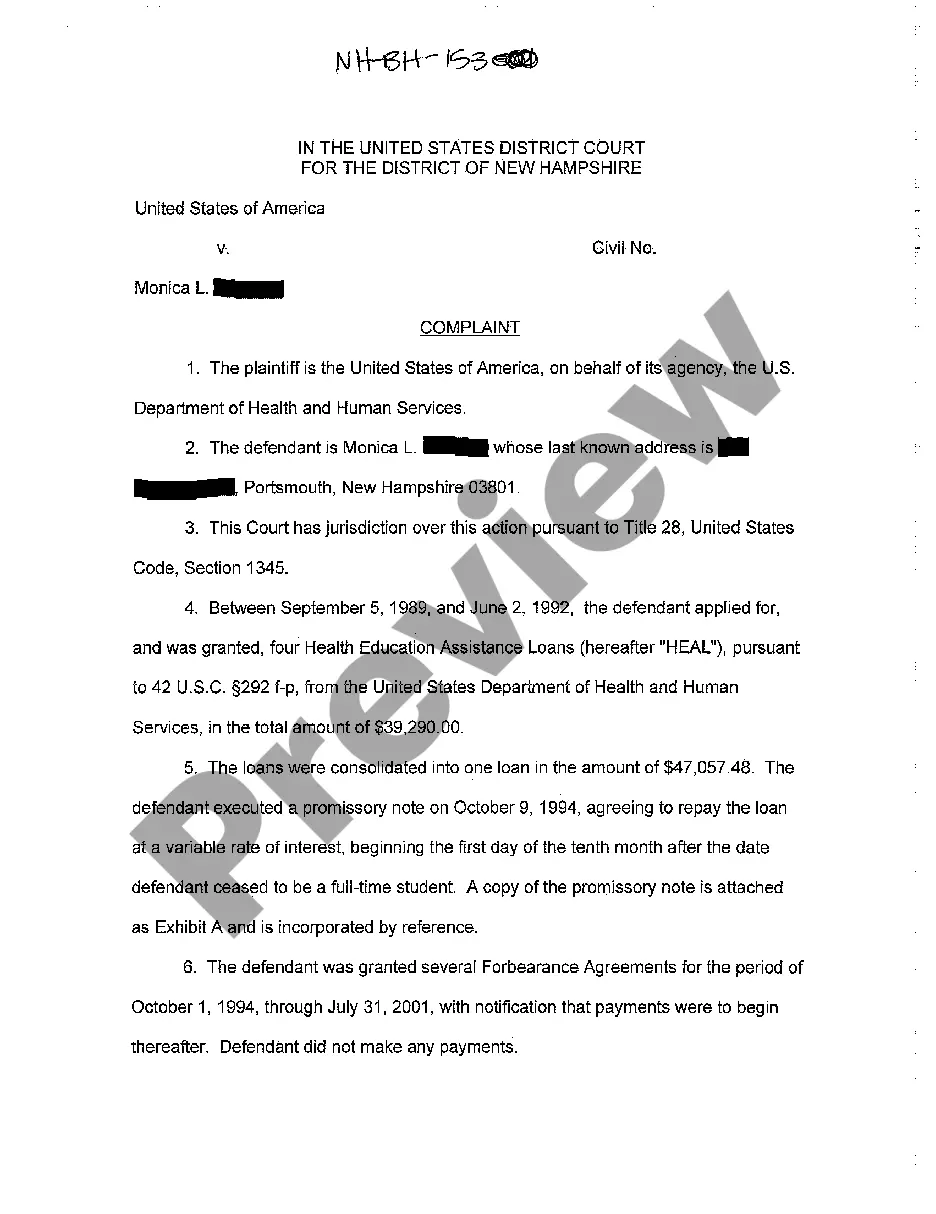
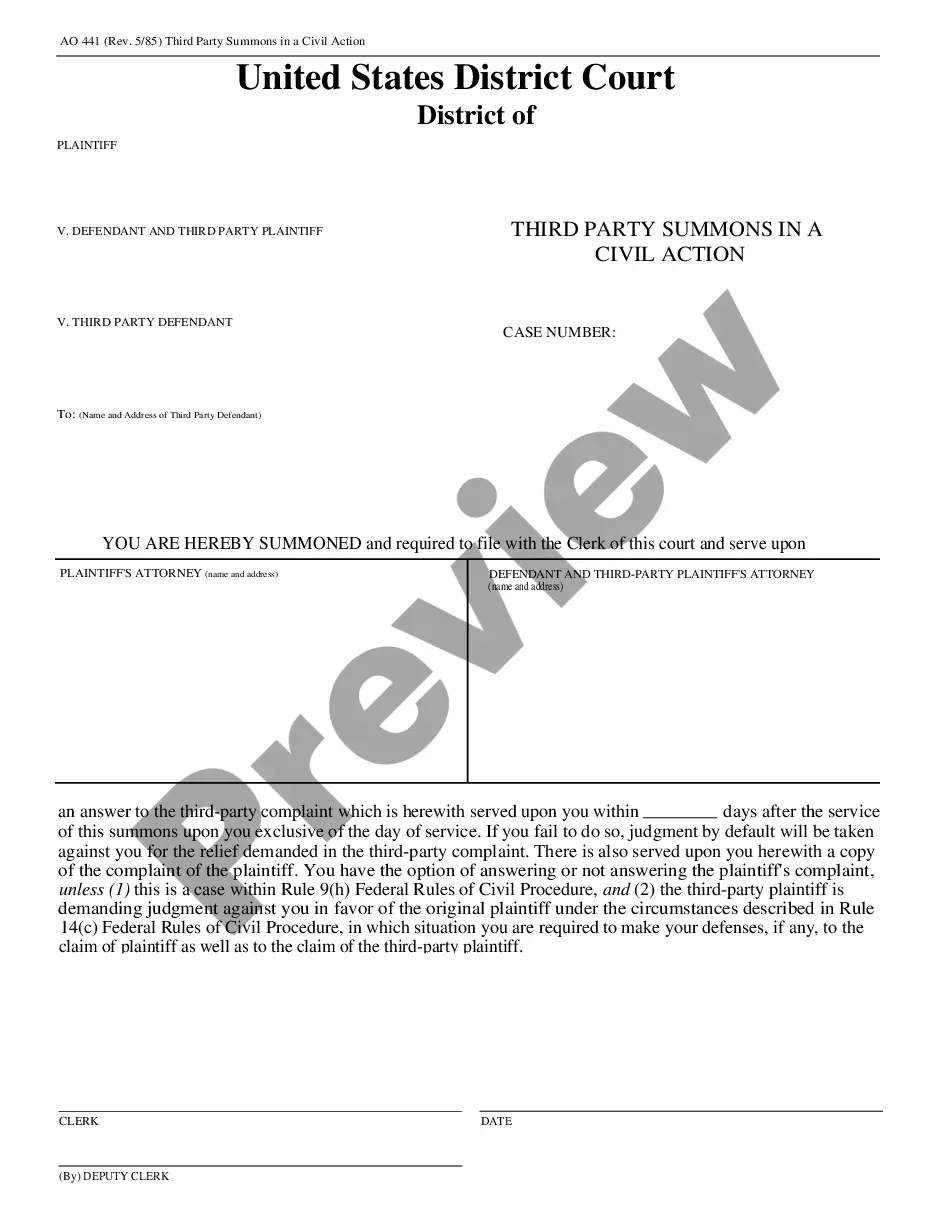
AO-441 Third Party Summons - Civil Action - Federal District Court Official Form
What this document covers
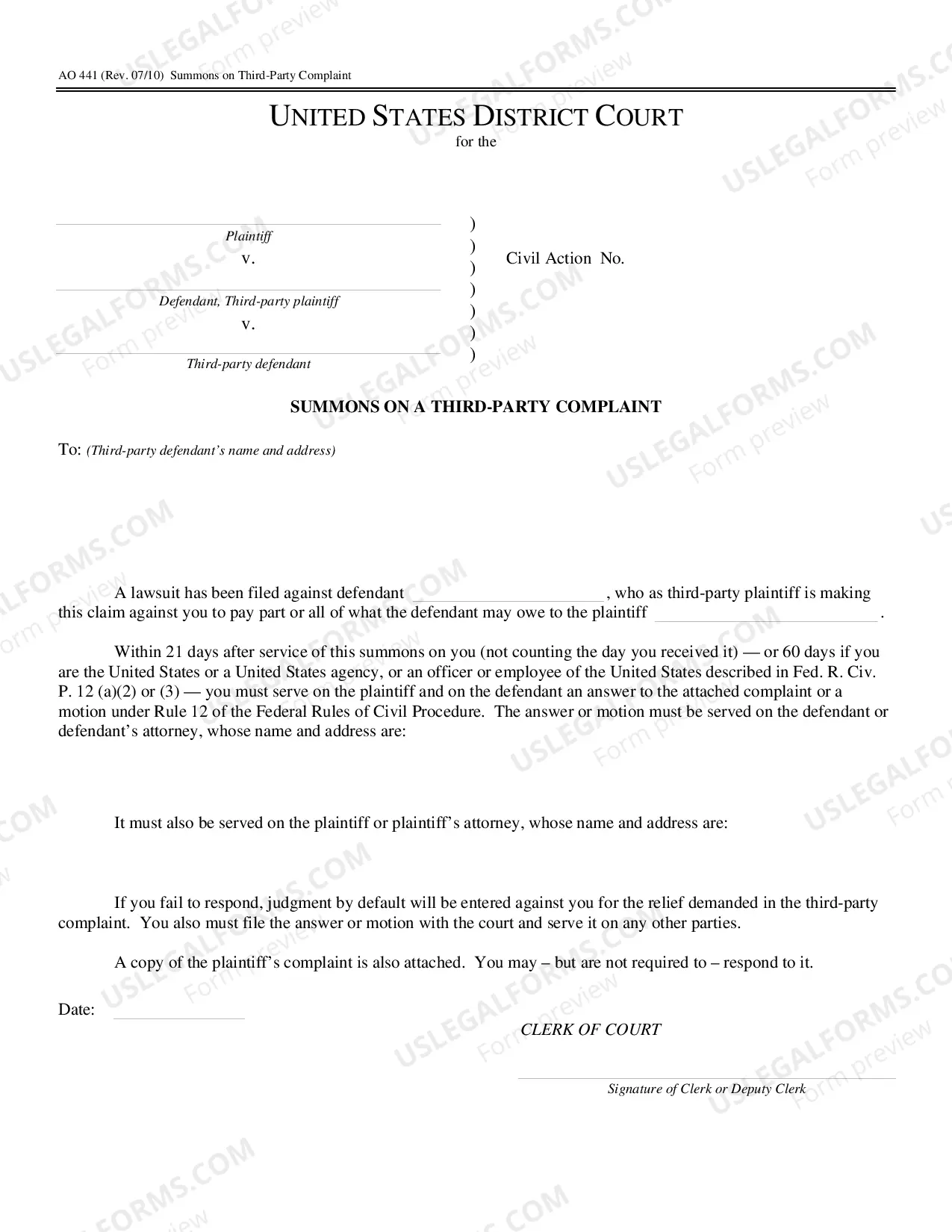
The AO-441 Third Party Summons is an official legal document used in federal civil court proceedings. This form serves to summon a third party to answer claims in a civil action. Unlike a standard summons, which notifies a primary defendant of a lawsuit, this summons specifically addresses a third party involved, allowing them to respond to the third-party complaint and potentially hold them accountable.
Main sections of this form
- Parties involved: Names and addresses of the plaintiff, defendant, and third-party defendant.
- Summons details: Instructions on how and when the third-party defendant must respond.
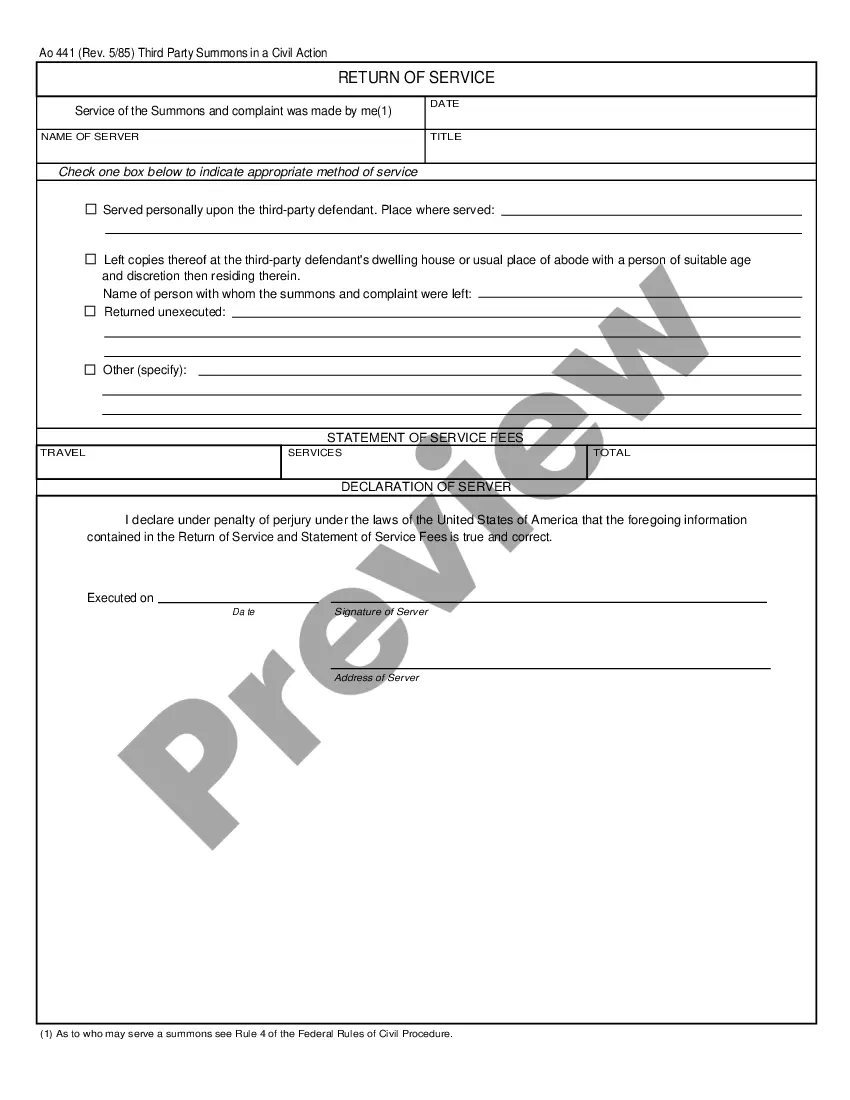
- Return of service section: Confirms how the summons was served to the third-party defendant.
- Statement of service fees: Details any fees incurred during the service process.
- Declaration of server: Affirms the server's identity and method of service.
Common use cases
This form is utilized in scenarios where a defendant in a federal civil action believes that a third party is liable for all or part of the plaintiff's claim against them. It is particularly relevant when the original defendant needs to pass on liability or involve another party that may have relevant information or obligations related to the case.
Intended users of this form
- Defendants in federal civil court looking to bring in a third party.
- Attorneys representing clients who need to establish claims against third parties.
- Litigants involved in complex cases where multiple parties may share liability.
Steps to complete this form
- Identify the parties: Fill in the names and addresses of the plaintiff, defendant, and third-party defendant.
- Specify the response deadline: Indicate the number of days the third-party defendant has to respond to the summons.
- Complete the return of service: Check the appropriate method of service used to deliver the summons.
- Document the server's information: Include the name, title, and signature of the person who served the summons.
- Review for accuracy: Ensure all information is correct and complete before filing with the court.
Does this document require notarization?
This form does not typically require notarization unless specified by local law. It is important to check the guidelines of your federal jurisdiction to ensure compliance.
Get your form ready online
Our built-in tools help you complete, sign, share, and store your documents in one place.
Make edits, fill in missing information, and update formatting in US Legal Forms—just like you would in MS Word.
Download a copy, print it, send it by email, or mail it via USPS—whatever works best for your next step.
Sign and collect signatures with our SignNow integration. Send to multiple recipients, set reminders, and more. Go Premium to unlock E-Sign.
If this form requires notarization, complete it online through a secure video call—no need to meet a notary in person or wait for an appointment.
We protect your documents and personal data by following strict security and privacy standards.

Make edits, fill in missing information, and update formatting in US Legal Forms—just like you would in MS Word.

Download a copy, print it, send it by email, or mail it via USPS—whatever works best for your next step.

Sign and collect signatures with our SignNow integration. Send to multiple recipients, set reminders, and more. Go Premium to unlock E-Sign.

If this form requires notarization, complete it online through a secure video call—no need to meet a notary in person or wait for an appointment.

We protect your documents and personal data by following strict security and privacy standards.
Mistakes to watch out for
- Failing to include all necessary partiesâ information.
- Not specifying the correct response time for the third-party defendant.
- Omitting to properly complete the return of service section.
- Neglecting to have the server sign the declaration of server.
Benefits of completing this form online
- Convenience: Easily download and fill out the form from anywhere.
- Editability: Modify the form as needed before finalizing.
- Reliability: Forms are prepared by licensed attorneys and designed to meet legal standards.
Looking for another form?
Form popularity
FAQ
Third-party defendant. SUMMONS ON A THIRD-PARTY COMPLAINT. To: (Third-party defendant's name and address) A lawsuit has been filed against defendant , who as third-party plaintiff is making this claim against you to pay part or all of what the defendant may owe to the plaintiff .
You may issue a third party notice if you claim the third party needs to be involved in the proceedings that the plaintiff issued against you, or that the third party owes you something that is connected with the proceedings. For more details, see Rule 4.4 of the District Court Rules 2014.
This is because in 2004 Part VIIIAA was introduced to the Family Law Act, giving the Court powers to make orders and injunctions against third parties.A third party can be defined as a person or entity other than the two people in the intimate relationship.
2 attorney answersThird party claim requires you to add a party. Cross claim is against another defendant already in the case.
The Clerk will endorse the Complaint, the Cover Sheet and the Summons, and give them back to you with something called a Civil Lawsuit Notice. This tells the date and time of your first Court hearing, and which Department (courthouse and courtroom) and Judge your case is assigned to.
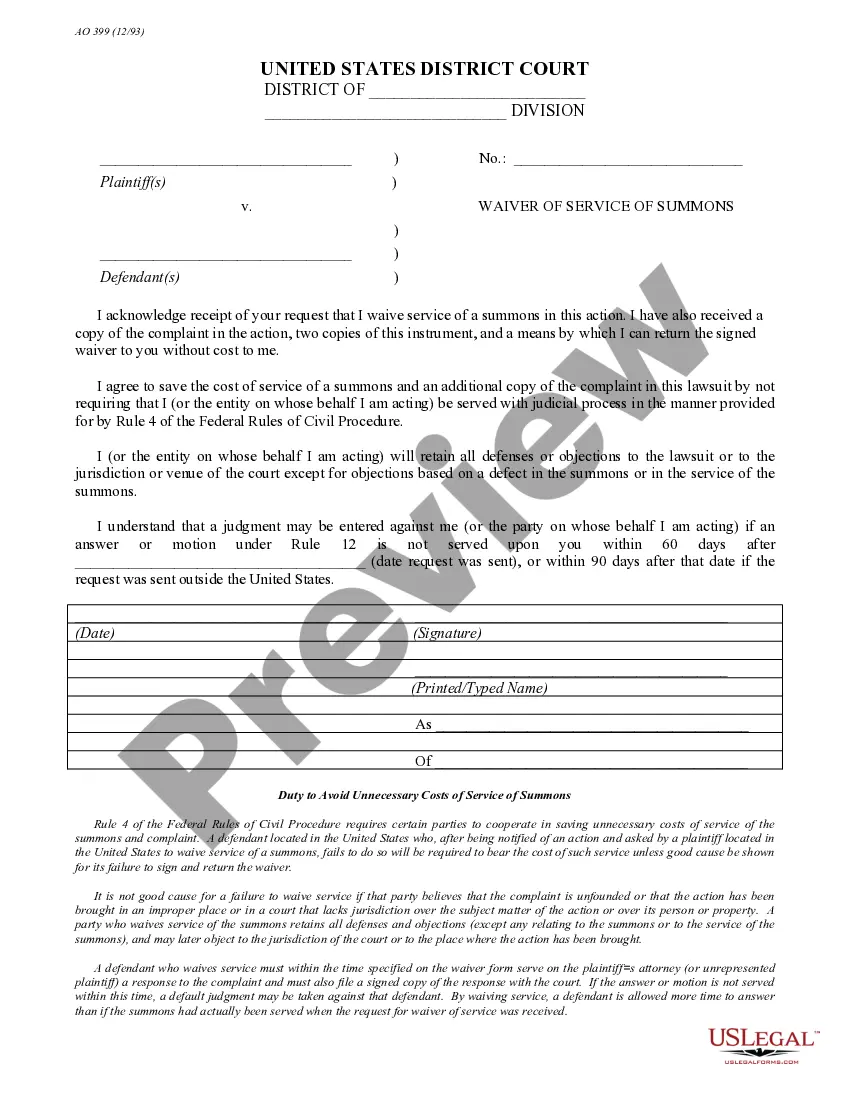
Under FRCP 4, an individual within the U.S. may be served by delivering a copy of the summons and complaint to the individual personally; leaving a copy at the individual's dwelling or usual place of abode with someone of suitable age and discretion who resides there; or delivering a copy to an agent authorized or
While a summons is an invitation for a person to appear in court, it is not an order. If the individual does not wish to go to court and simply does not appear or answer the complaint, the judge can decide the case without him or her there. In many cases, this results in a default judgment against the defendant.
The legal way to give formal notice is to have the other side served with a copy of the paperwork that you have filed with the court. "Service of court papers" means that the other side must get copies of any paper you file with the court.The person who does this is called the server or process server.
A third-party complaint is a claim asserted by a defendant ("Third-party Plaintiff") against a nonparty (now a third-party defendant) who is or may be liable to the defendant for all or part of the claim it.