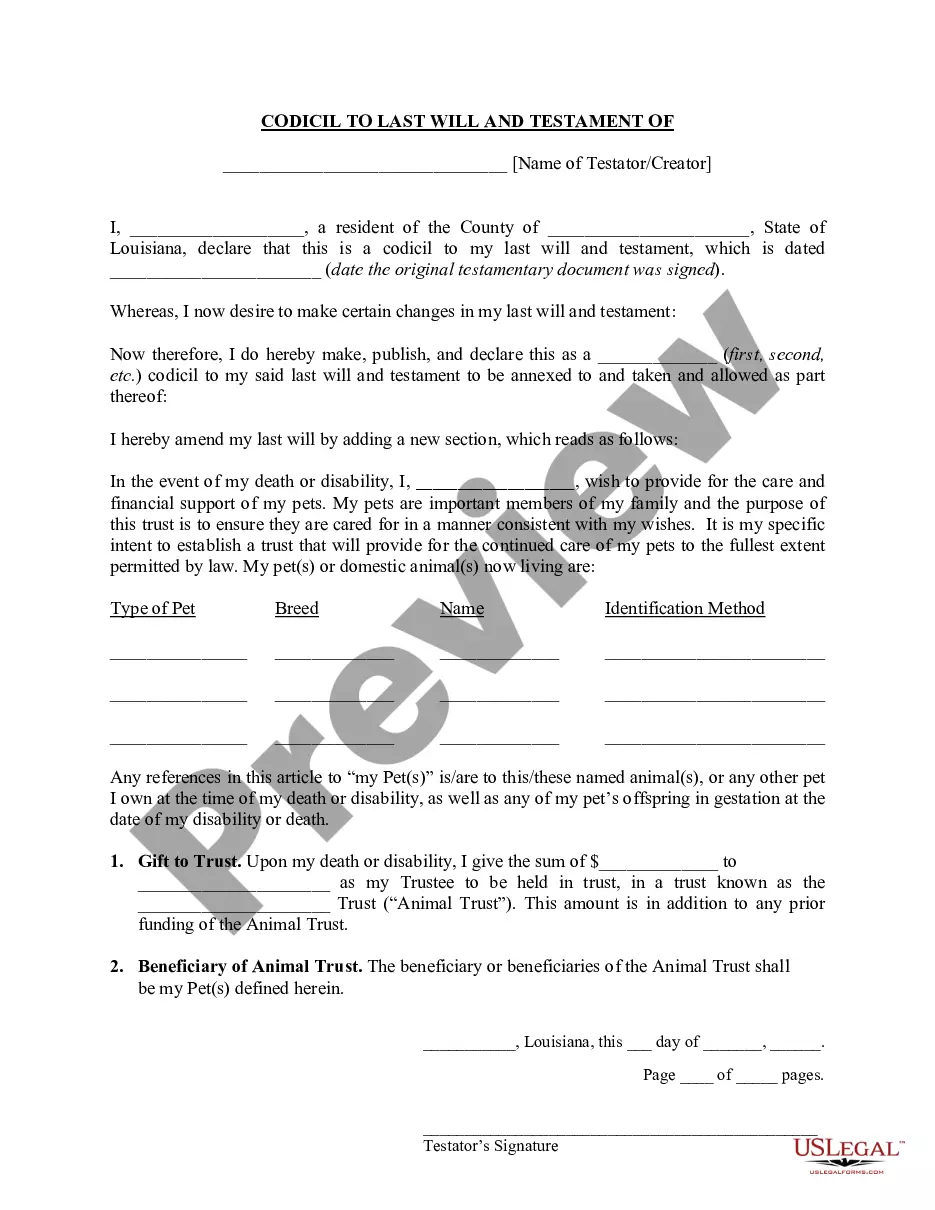
Paid Time Off Policy - PTO
What is this form?
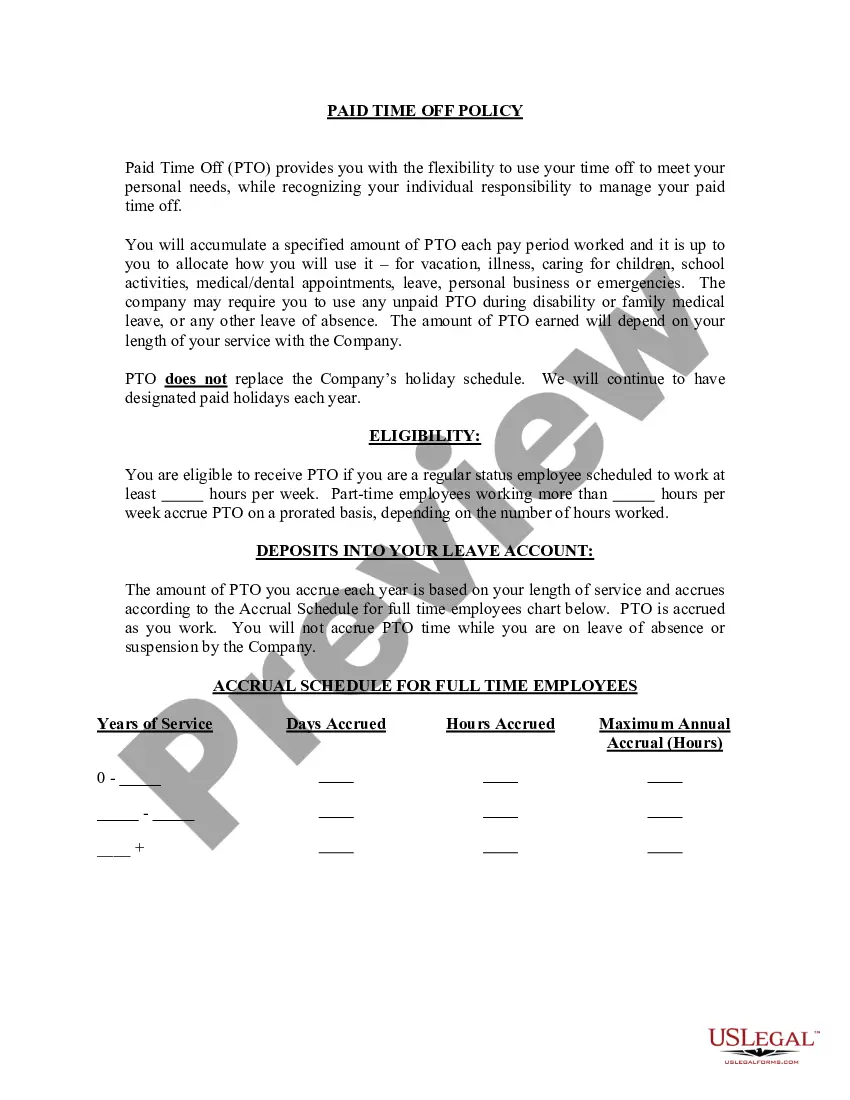
The Paid Time Off Policy (PTO) is a document that outlines a company's procedure for providing employees with paid time off. This policy allows employees to manage their time off according to personal needs, such as vacation, illness, or personal business. Unlike standard vacation policies, the PTO policy offers more flexibility by allowing employees to unify various leave types under one system. This document ensures clarity about how PTO is accrued and used within the organization.
Main sections of this form
- Accrual schedule: Details how PTO is accumulated based on length of service.
- Eligibility criteria: Defines who qualifies for PTO and under what conditions.
- Usage guidelines: Explains how employees can use their PTO for various personal needs.
- Interaction with other leave types: Clarifies the relationship between PTO and unpaid leave or other types of leave.
- Holiday policy: Emphasizes that PTO does not replace company-designated holidays.

When to use this document
This form is necessary when a company wants to implement a structured policy for Paid Time Off. It should be used during the employee onboarding process, when updating existing leave policies, or when communicating changes to PTO accrual and usage to current employees.
Who should use this form
- Human Resources personnel seeking to establish or revise a PTO policy.
- Business owners looking to formalize time-off allowances for their employees.
- Managers and team leaders needing clear guidelines for employee leave requests.
Completing this form step by step
- Identify the company name and the effective date of the PTO policy.
- Outline the accrual schedule based on employee length of service.
- Define eligibility criteria and conditions under which PTO can be utilized.
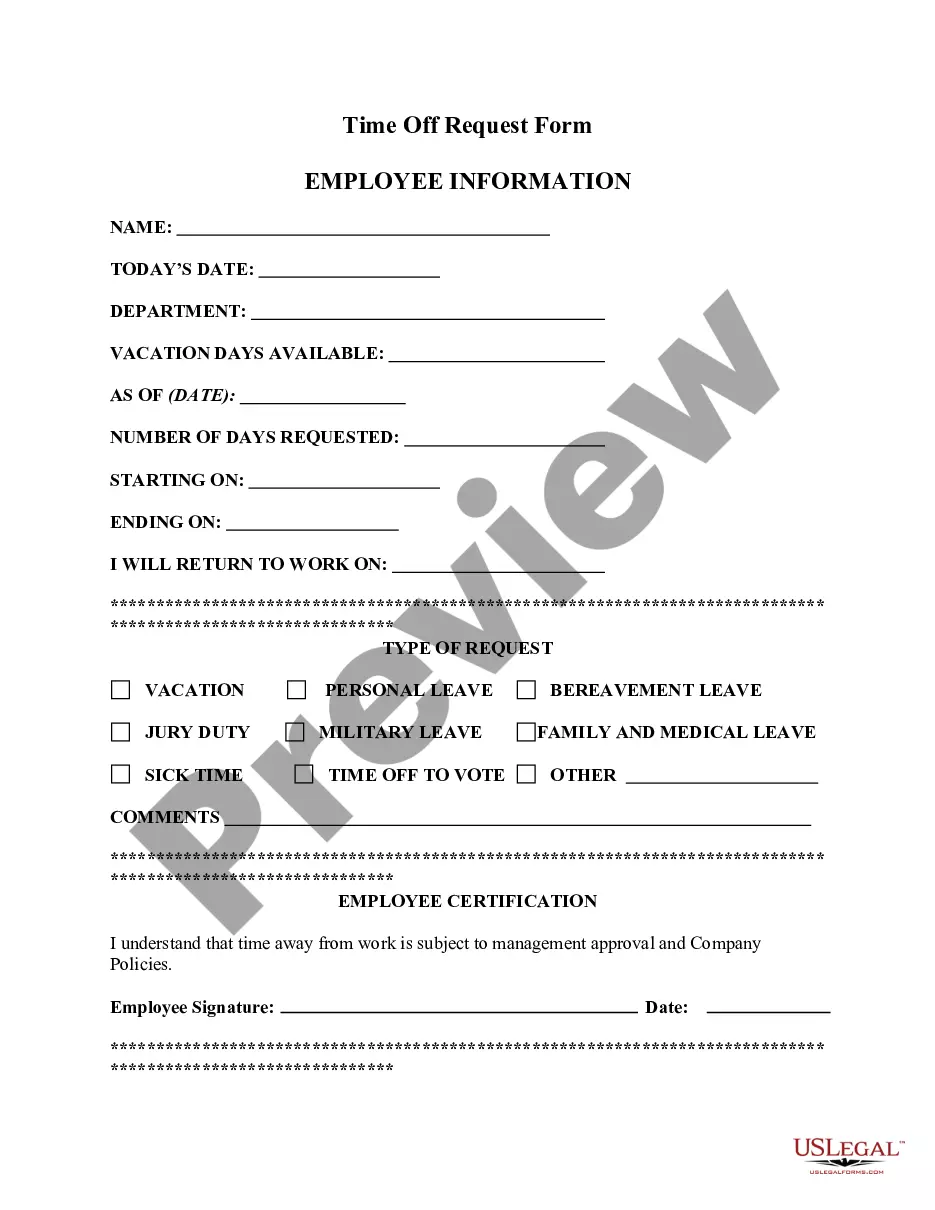
- Clarify procedures for requesting and approving time off.
- Include a section on how PTO interacts with holiday leave and other types of leave.
Does this form need to be notarized?
In most cases, this form does not require notarization. However, some jurisdictions or signing circumstances might. US Legal Forms offers online notarization powered by Notarize, accessible 24/7 for a quick, remote process.
Get your form ready online
Our built-in tools help you complete, sign, share, and store your documents in one place.
Make edits, fill in missing information, and update formatting in US Legal Forms—just like you would in MS Word.
Download a copy, print it, send it by email, or mail it via USPS—whatever works best for your next step.
Sign and collect signatures with our SignNow integration. Send to multiple recipients, set reminders, and more. Go Premium to unlock E-Sign.
If this form requires notarization, complete it online through a secure video call—no need to meet a notary in person or wait for an appointment.
We protect your documents and personal data by following strict security and privacy standards.

Make edits, fill in missing information, and update formatting in US Legal Forms—just like you would in MS Word.

Download a copy, print it, send it by email, or mail it via USPS—whatever works best for your next step.

Sign and collect signatures with our SignNow integration. Send to multiple recipients, set reminders, and more. Go Premium to unlock E-Sign.

If this form requires notarization, complete it online through a secure video call—no need to meet a notary in person or wait for an appointment.

We protect your documents and personal data by following strict security and privacy standards.
Common mistakes to avoid
- Not clearly defining eligibility criteria for PTO usage, leading to employee confusion.
- Failing to specify how PTO accrual is calculated based on service length.
- Overlooking the integration of PTO with other leave types, which can create policy conflicts.
Benefits of using this form online
- Convenience: Employees can access and review the policy at any time.
- Editability: Quick updates can be made as company policies or laws change.
- Reliability: Standardized format ensures consistent communication of PTO policies across the organization.
Legal use & context
- PTO policies are increasingly recognized as standard practice in modern employment settings.
- Ensure compliance with federal and state labor laws when implementing PTO policies to avoid legal disputes.
- This form serves to provide clarity and legality to time-off arrangements in the workplace.
Main things to remember
- The Paid Time Off Policy provides flexible leave options to employees.
- Clear guidelines are essential for the effective management of PTO.
- Adjustments may be needed based on state laws to ensure compliance.
Looking for another form?
Form popularity
FAQ
Paid time off (PTO) is an employer-provided benefit that grants employees compensation for personal time off, vacation days, federal holidays, sick leave, and maternity and paternity leave. Paid time off policies are not a requirement of the Fair Labor Standards Act (FLSA).
Depending on your business's personal time off policy, employees may earn PTO after a certain number of hours worked, weeks, or months. For example, an employee earns one hour of paid time off for every 20 hours worked. After working 400 hours, the employee has 20 hours of accrued time off.
No, you must pay the employee for a full 40 hours for the week. It's called Paid Time Off (PTO) because the employee is paid for the time that they've taken off.Only specific situations will allow you to dock a salaried employee's pay for taking hours or even a partial work week off.
Paid time off (PTO) is an employer-provided benefit that grants employees compensation for personal time off, vacation days, federal holidays, sick leave, and maternity and paternity leave.
One metric that employers can follow to calculate PTO is to divide the annual PTO hours by annual work hours. For example, if an hourly employee earns 80 hours of PTO each year and works 40 hours a week, or 2,080 hours per year, divide 80 by 2,080.
Paid time off (also known as PTO or personal time off) is compensated time away from work, provided by an employer to employees for them to use as they see fit. PTO is often measured in hours and classified for different types of absences like sickness, vacation time, and personal time.
A paid time off (PTO) policy combines vacation, sick time, and personal time into a single bank of days for employees to use when they take paid time off from work. A PTO policy creates a pool of days that an employee may use at his or her discretion.
Calculate the amount of vacation time earned through the beginning of the accounting period. Add the number of hours earned in the current accounting period. Subtract the number of vacation hours used in the current period.
Accounting for Paid Time Off (PTO).It is the way PTO is treated. Think about it this way: employees get paid twelve months of the year but they work only eleven months of the year. That month they are paid but not working is very significant and can distort the financial reports.