Jury Instruction - Good Faith Reliance Upon Advice of Counsel
About this form
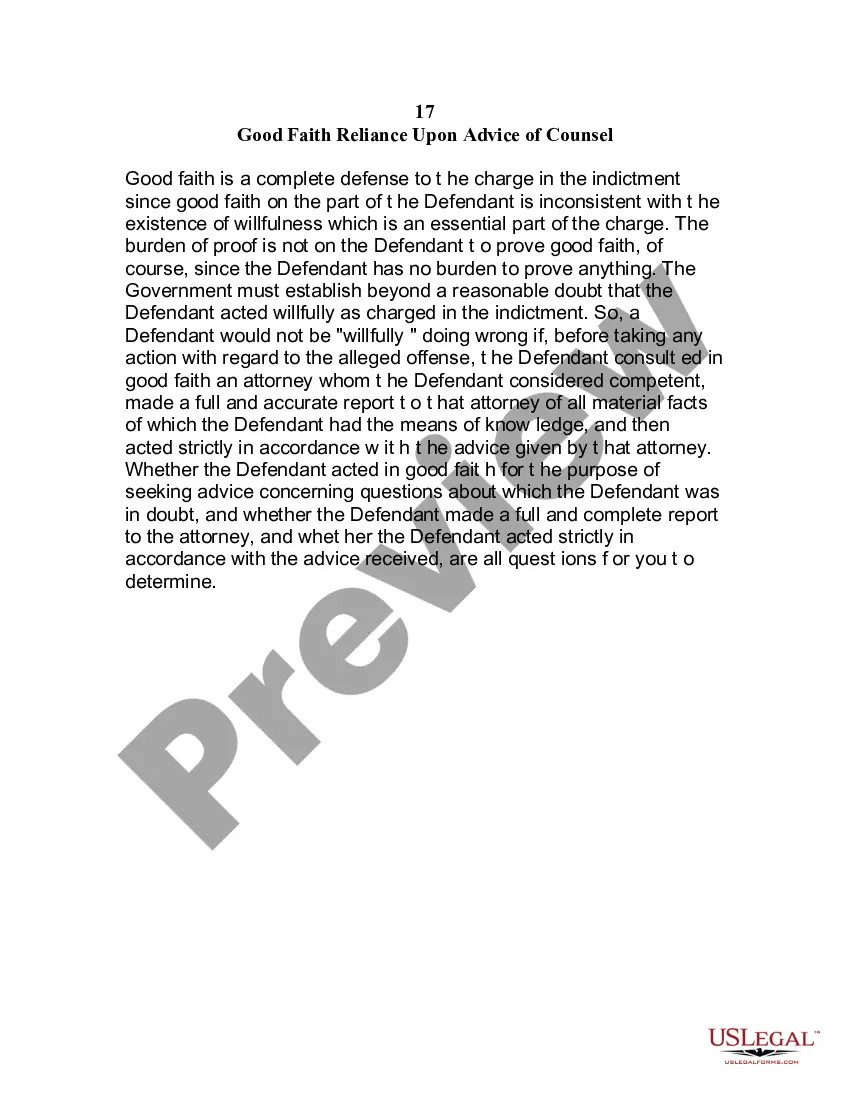
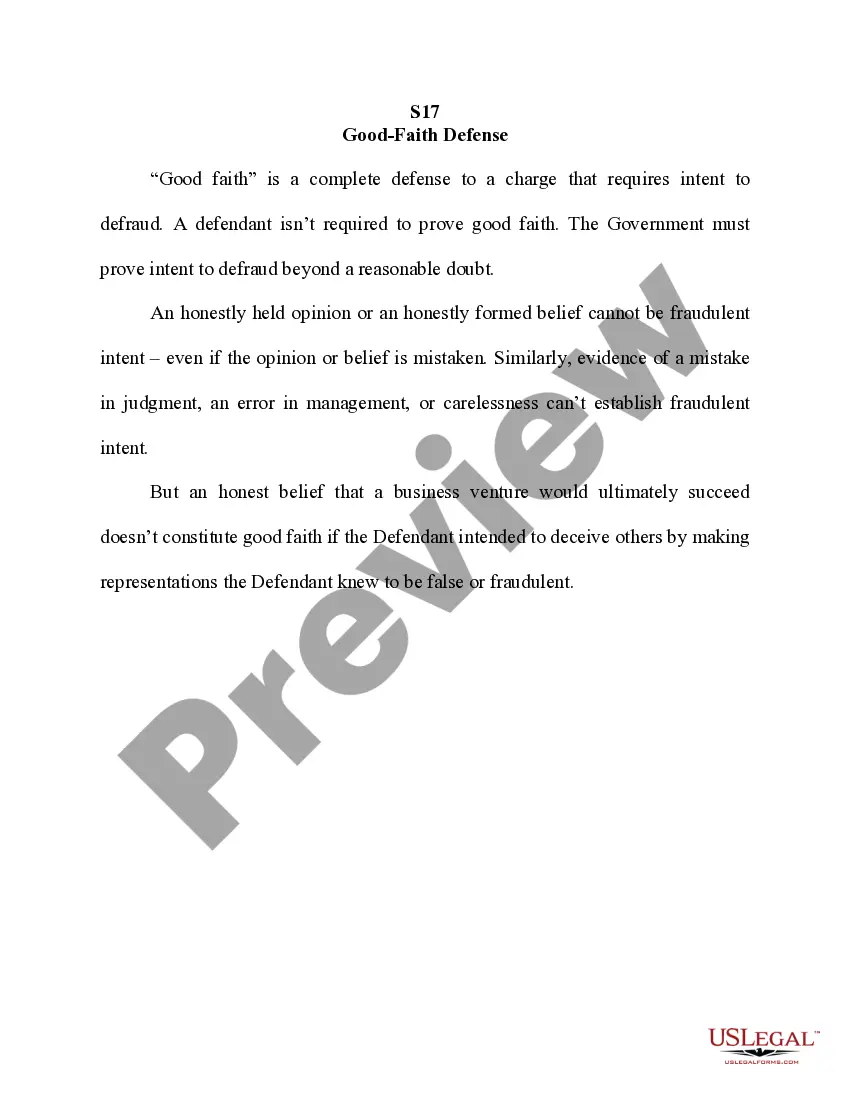
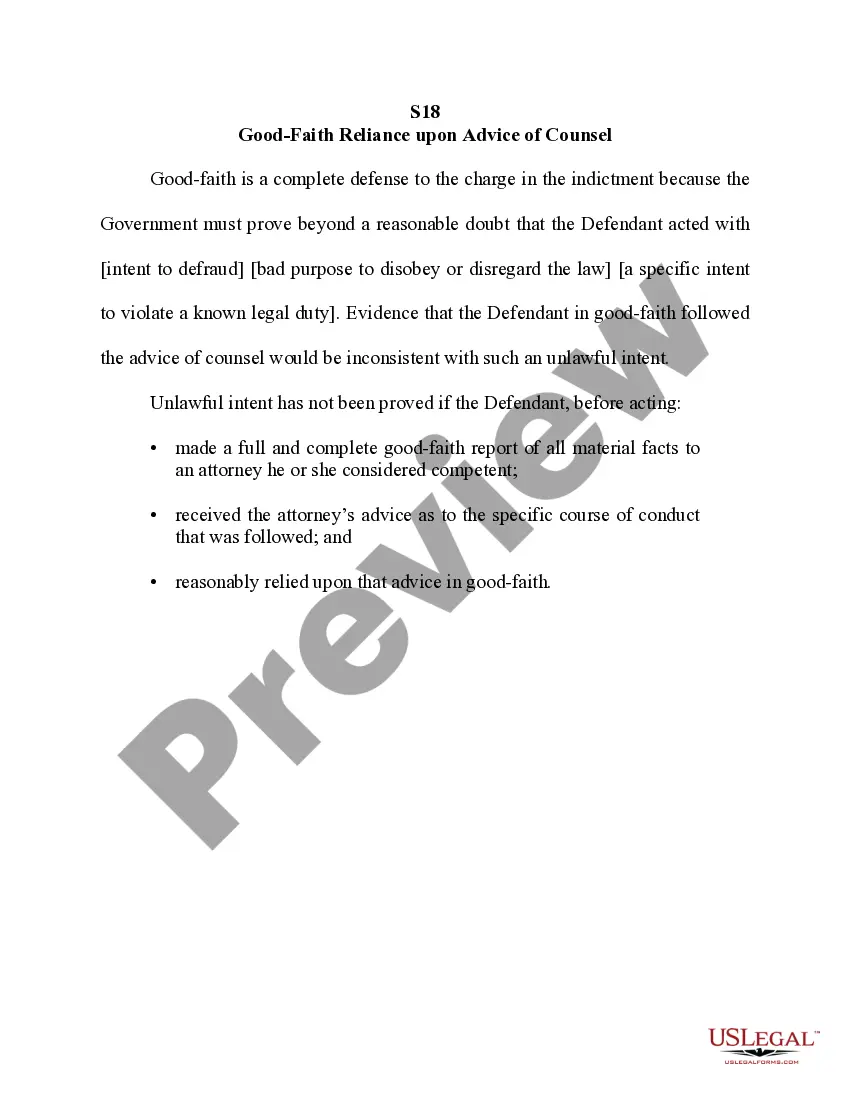
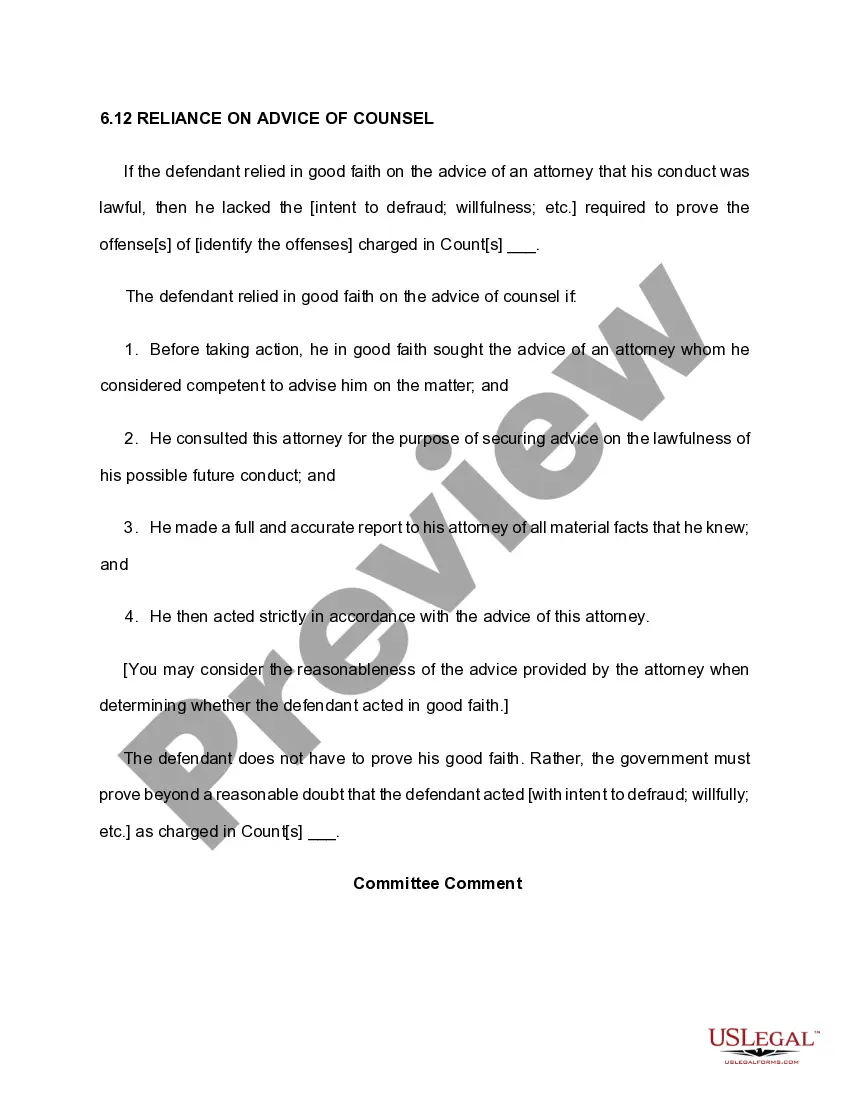
The Jury Instruction - Good Faith Reliance Upon Advice of Counsel form provides sample jury instructions that outline the legal concept of good faith reliance on an attorney's advice as a defense in criminal cases. This form is designed as a model and can be adjusted to better suit specific legal circumstances. Unlike other jury instructions, this one emphasizes the defendantâs right to rely on competent legal counsel before acting on uncertain legal matters.
Form components explained
- Definition of good faith as a complete defense to willful misconduct.
- Clarification of the burden of proof resting on the government, not the defendant.
- Instructions on how to assess the defendantâs actions in relation to advice given by an attorney.
- Questions directed at determining the good faith of the defendant.
- Reference to legal precedent from United States v. Eisenstein.

When to use this document
This form is used when a defendant in a criminal case wants to argue that they acted in good faith based on the advice of counsel. It is applicable in scenarios where the defendant has consulted an attorney about their actions and seeks to establish that they followed the attorney's advice to demonstrate lack of willfulness in their conduct.
Who this form is for
- Defendants in criminal cases facing charges that include willful wrongdoing.
- Legal representatives seeking to prepare jury instructions for a trial.
- Attorneys looking for a reliable template to articulate good faith defenses.
Instructions for completing this form
- Identify the specific charge against the defendant as outlined in the indictment.
- Review the model questions and tailor them to the unique facts of the case.
- Ensure that the instructions clearly articulate the standard of proving good faith.
- Consult legal precedents that may influence the interpretation of good faith in your jurisdiction.
- Prepare the instructions for presentation to the jury, ensuring clarity and adherence to applicable legal standards.
Is notarization required?
This form does not typically require notarization unless specified by local law. Always check your jurisdiction's requirements to ensure compliance.
Get your form ready online
Our built-in tools help you complete, sign, share, and store your documents in one place.
Make edits, fill in missing information, and update formatting in US Legal Forms—just like you would in MS Word.
Download a copy, print it, send it by email, or mail it via USPS—whatever works best for your next step.
Sign and collect signatures with our SignNow integration. Send to multiple recipients, set reminders, and more. Go Premium to unlock E-Sign.
If this form requires notarization, complete it online through a secure video call—no need to meet a notary in person or wait for an appointment.
We protect your documents and personal data by following strict security and privacy standards.

Make edits, fill in missing information, and update formatting in US Legal Forms—just like you would in MS Word.

Download a copy, print it, send it by email, or mail it via USPS—whatever works best for your next step.

Sign and collect signatures with our SignNow integration. Send to multiple recipients, set reminders, and more. Go Premium to unlock E-Sign.

If this form requires notarization, complete it online through a secure video call—no need to meet a notary in person or wait for an appointment.

We protect your documents and personal data by following strict security and privacy standards.
Common mistakes
- Failing to adjust the sample instructions to fit the specific facts of the case.
- Overlooking the burden of proof, which lies with the prosecution.
- Misrepresenting the defendantâs consultation with their attorney.
Benefits of using this form online
- Convenience of accessing a professionally drafted form at any time.
- Ability to customize the instructions to fit unique legal facts.
- Reliability, as the form is drafted by licensed attorneys.
Looking for another form?

Form popularity
FAQ
A term that generally describes honest dealing. Depending on the exact setting, good faith may require an honest belief or purpose, faithful performance of duties, observance of fair dealing standards, or an absence of fraudulent intent.
Good faith has generally been defined as honesty in a person's conduct during the agreement. The obligation to perform in good faith exists even in contracts that expressly allow either party to terminate the contract for any reason. Fair dealing usually requires more than just honesty.
It means acting as much within the spirit of an agreement and in accordance with a justified expectation rather than the letter of the contract, and being faithful to an agreed common purpose.
Honesty; a sincere intention to deal fairly with others. Good faith is an abstract and comprehensive term that encompasses a sincere belief or motive without any malice or the desire to defraud others.The term good faith is used in many areas of the law but has special significance in Commercial Law.
A term that generally describes honest dealing. Depending on the exact setting, good faith may require an honest belief or purpose, faithful performance of duties, observance of fair dealing standards, or an absence of fraudulent intent.
The Principle of Good Faith in Contract Law It is a settled principle of contract law that a contracting party must perform her contractual duties in good faith. The meaning of the duty of good faith is complex.
A good faith clause refers to the manner in which parties in an agreement act with each other. It is often for an employer and employee relationship, where good faith would cause both parties to act respectfully to one another.
In contract law, the implied covenant of good faith and fair dealing is a general presumption that the parties to a contract will deal with each other honestly, fairly, and in good faith, so as to not destroy the right of the other party or parties to receive the benefits of the contract.
GOOD FAITH: A Good Faith argument or discussion is one in which both parties agree on the terms on which they engage, are honest and respectful of the other person's dignity, follow generally-accepted norms of social interaction, and genuinely want to hear what the other person thinks and has to say.