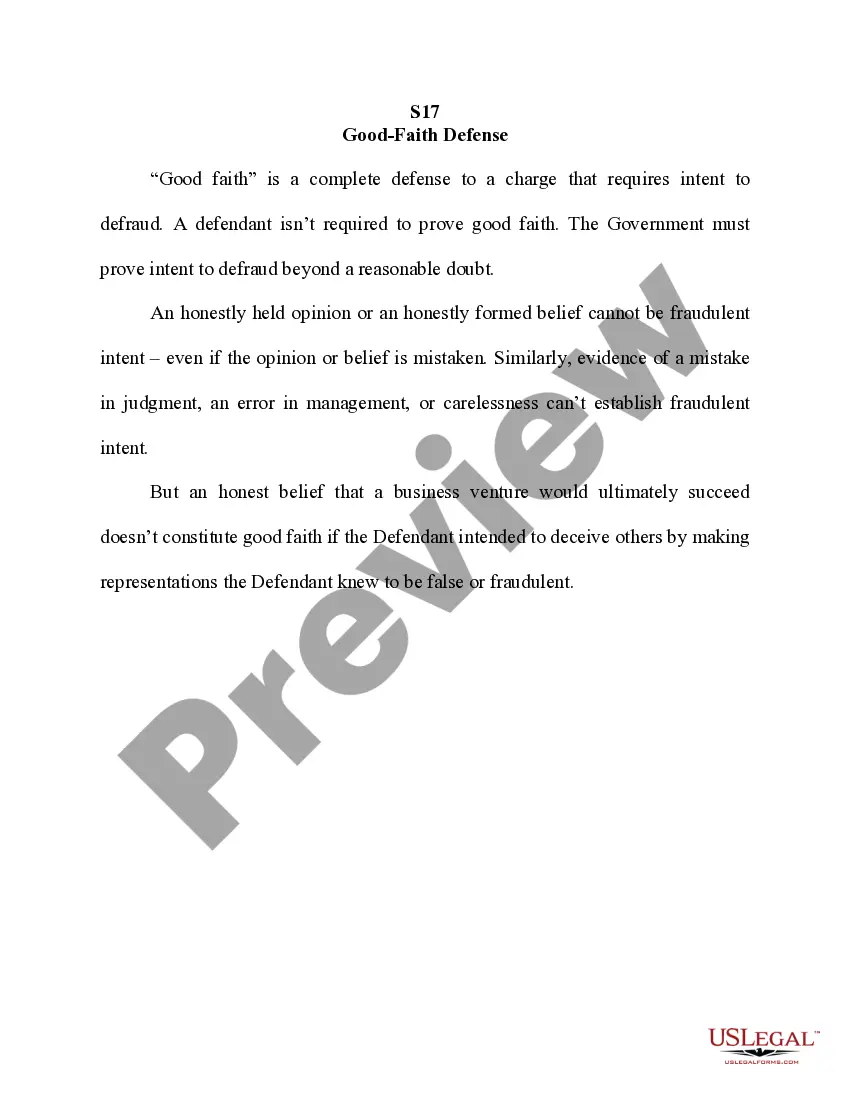
Good-Faith Defense
Understanding this form
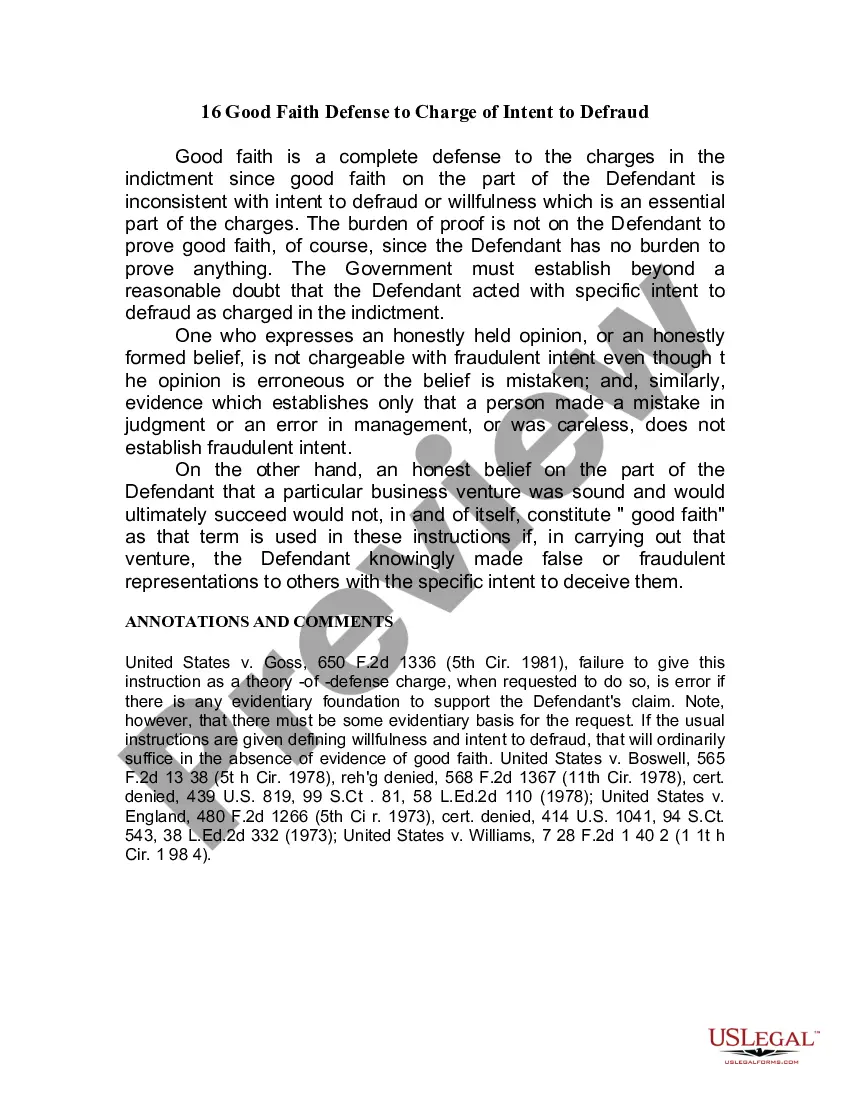
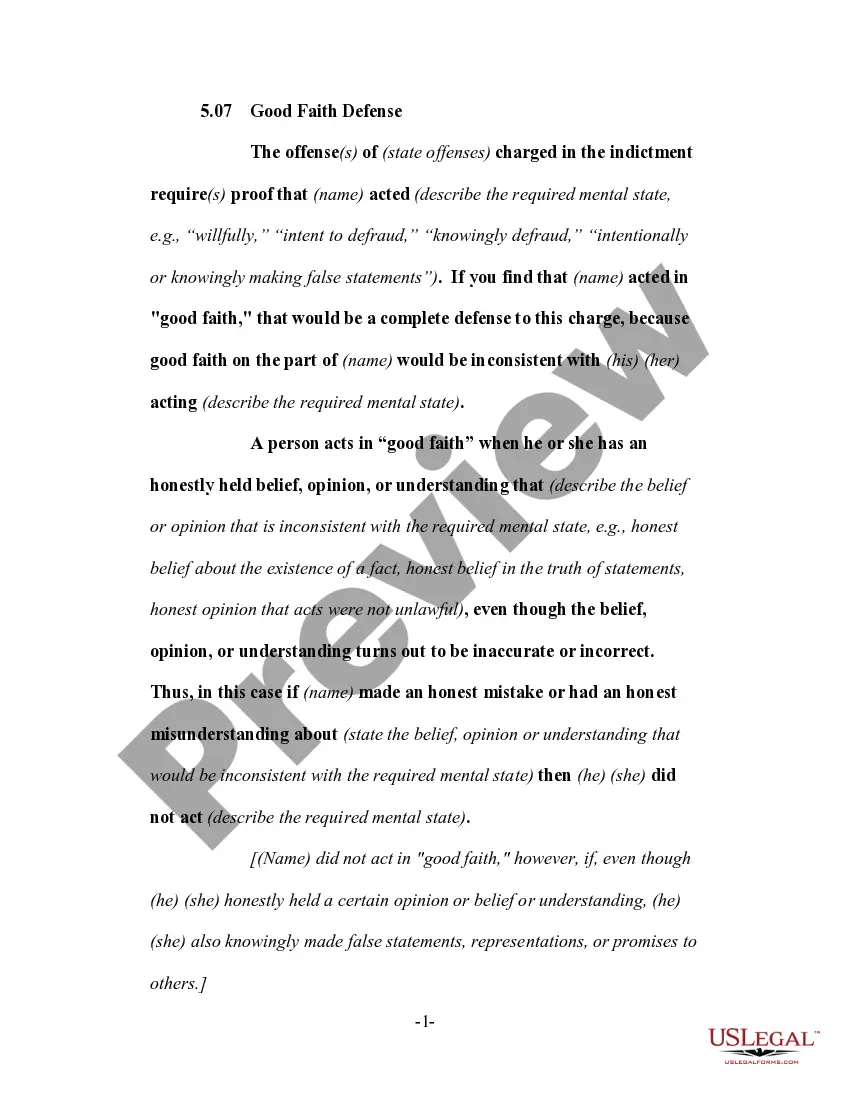
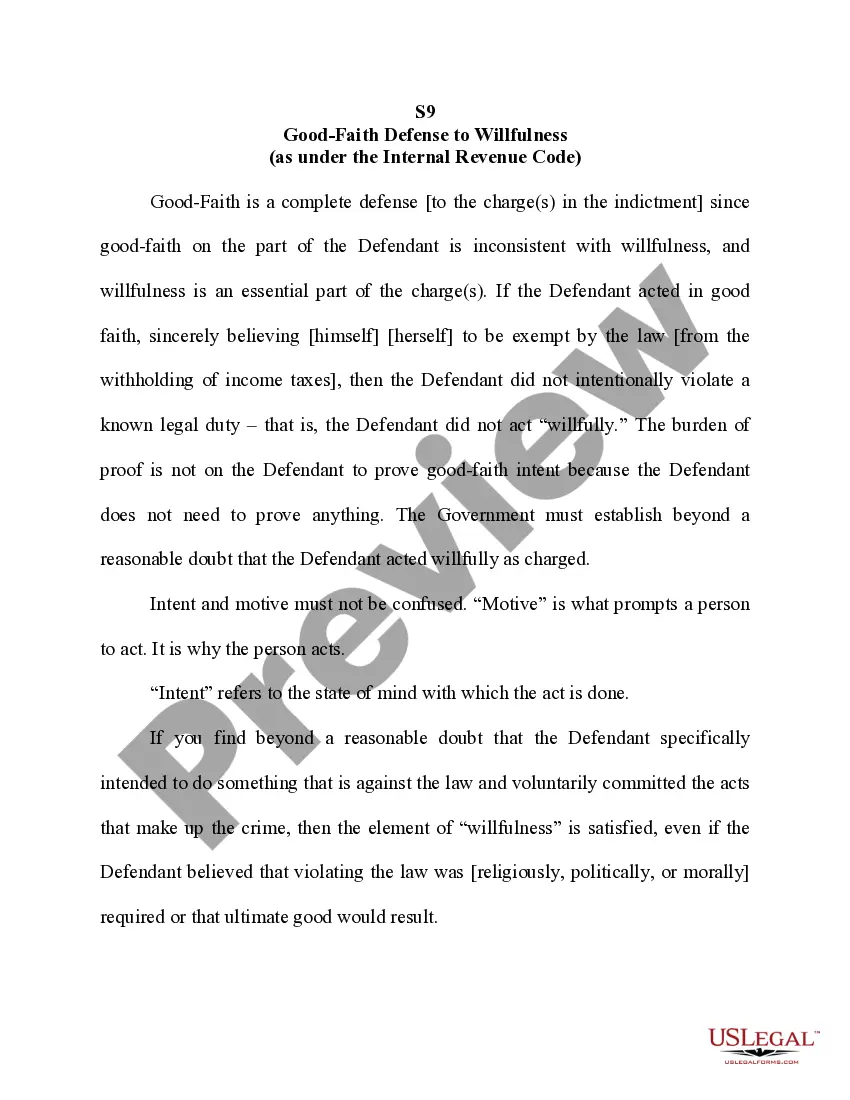
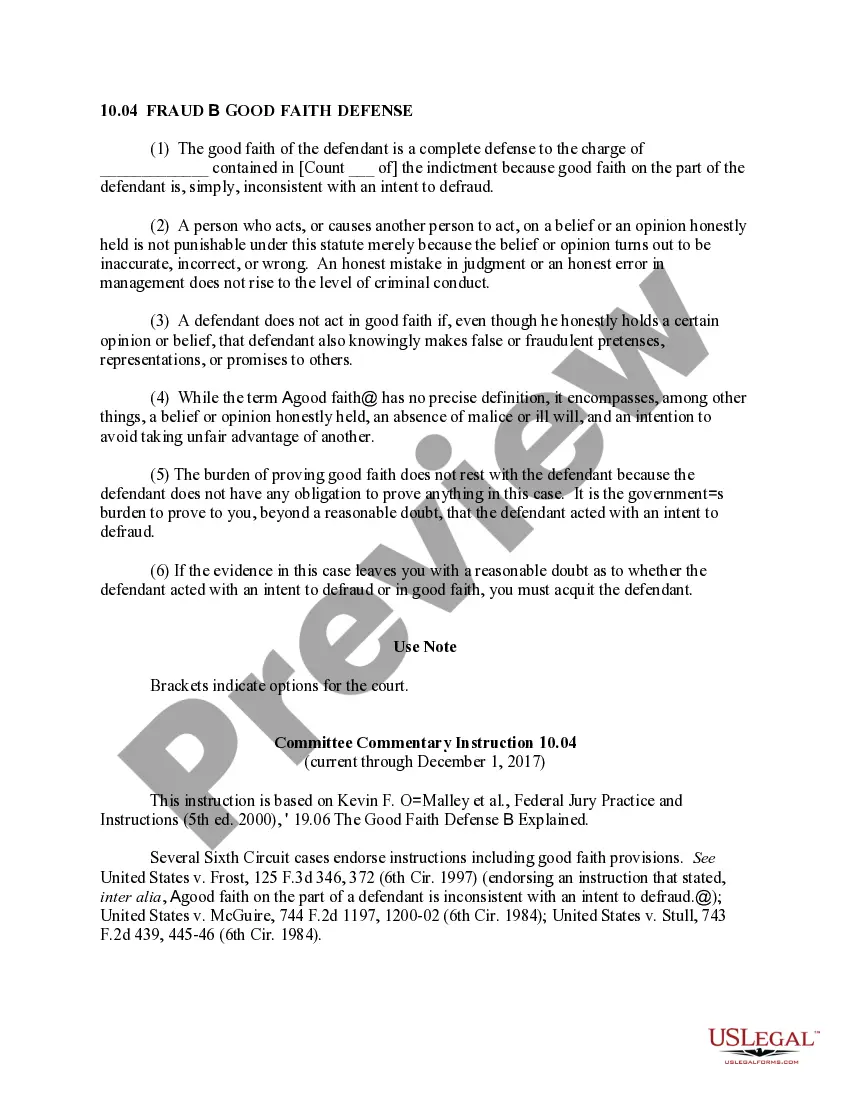
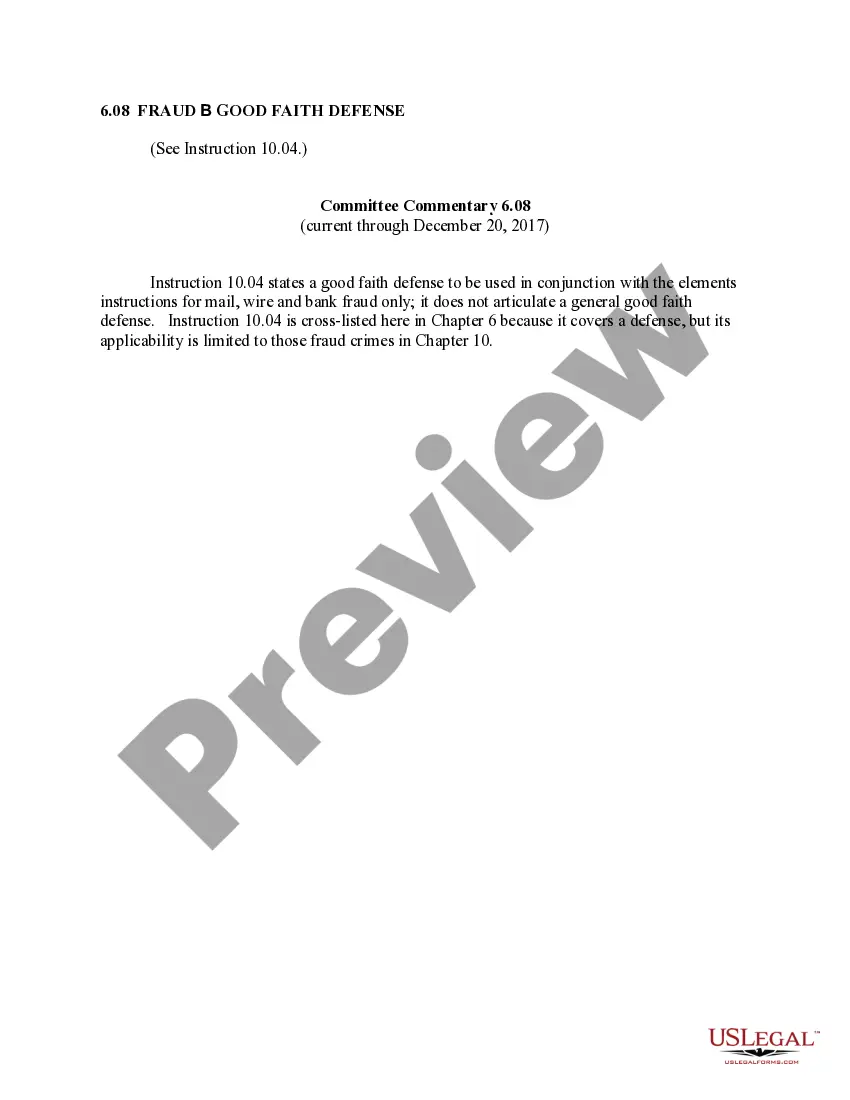
The Good-Faith Defense form is a legal template designed to outline the criteria for establishing a good faith defense in charges that require intent to defraud. This form clarifies that a defendant does not have to prove good faith; instead, the burden lies with the government to demonstrate fraudulent intent beyond a reasonable doubt. The Good-Faith Defense is distinct from other defenses as it specifically addresses situations relating to honest beliefs and opinions in business practices.
Key parts of this document
- Definition of good faith as a complete defense against claims of intent to defraud.
- Explanation of what constitutes honest opinion or belief and how it relates to fraudulent intent.
- Clarification that mistakes in judgment or management do not imply fraudulent intent.
- Emphasis on the condition that an honest belief in a business venture does not equate to good faith if deception is involved.
Common use cases
This form is useful in legal situations where a defendant faces charges requiring proof of fraudulent intent. It is applicable when a defendant needs to establish that any opinions or beliefs they held were honest and not intended to deceive, particularly in business contexts. Scenarios may involve disputes over business practices, fraud allegations, or other legal matters where good faith is a relevant defense.
Who can use this document
- Defendants facing fraud allegations who wish to assert a good faith defense.
- Legal practitioners helping clients prepare defenses against charges of fraudulent intent.
- Individuals involved in business disputes surrounding allegations of misleading statements or actions.
Steps to complete this form
- Identify the parties involved in the legal matter.
- Clearly state the nature of the charges being faced.
- Provide an explanation outlining the honestly held beliefs or opinions relevant to the case.
- Include any evidence or documentation supporting claims of good faith.
- Review and ensure all details are accurate before submission.
Is notarization required?
This form does not typically require notarization unless specified by local law. It is advisable to verify any specific state requirements regarding notarization when utilizing this form in a legal context.
Get your form ready online
Our built-in tools help you complete, sign, share, and store your documents in one place.
Make edits, fill in missing information, and update formatting in US Legal Forms—just like you would in MS Word.
Download a copy, print it, send it by email, or mail it via USPS—whatever works best for your next step.
Sign and collect signatures with our SignNow integration. Send to multiple recipients, set reminders, and more. Go Premium to unlock E-Sign.
If this form requires notarization, complete it online through a secure video call—no need to meet a notary in person or wait for an appointment.
We protect your documents and personal data by following strict security and privacy standards.

Make edits, fill in missing information, and update formatting in US Legal Forms—just like you would in MS Word.

Download a copy, print it, send it by email, or mail it via USPS—whatever works best for your next step.

Sign and collect signatures with our SignNow integration. Send to multiple recipients, set reminders, and more. Go Premium to unlock E-Sign.

If this form requires notarization, complete it online through a secure video call—no need to meet a notary in person or wait for an appointment.

We protect your documents and personal data by following strict security and privacy standards.
Common mistakes
- Failing to clearly articulate honest beliefs, making the defense harder to prove.
- Assuming good faith can be proven without supporting evidence.
- Mixing up good faith with other defenses, leading to unclear arguments.
Benefits of using this form online
- Convenient access to a legally vetted template at any time.
- Editable format allows for customization based on individual circumstances.
- Immediate downloading ensures you have the form when you need it.
Looking for another form?


Form popularity
FAQ
Good faith dispute means a dispute in which the trier of fact finds that the party refusing to return the deposited funds had a reasonable belief of his or her legal entitlement to withhold the deposited funds. The existence of a "good faith dispute" shall be determined by the trier of fact.
GOOD FAITH EXCEPTION TO FOURTH AMENDMENT In State v. Leon, the U.S. Supreme Court held that evidence would not be excluded from a criminal trial even if seized pursuant to an invalid warrant if the officers executing the search obtained the evidence in objectively reasonable reliance on the warrant.
Good Faith Is Ordinarily Not a Defense Wrongful intention is not essential, however; nor is it material, except as to the question of damages, that the defendant acted in good faith or under a mistaken belief as to his rights.? A mistake as to ownership is not a defense to a claim of conversion.
A good faith defense is used against legal charges that involve intentional fraud. This type of defense won't include an intention or willingness to defraud since those are essential to the filed charges.
For example, if an officer made in error while maintaining their databases of warrants and a police officer searches the wrong person, good faith can be invoked. Also, if an officer does rely on a law that later changes, good faith can be invoked in that circumstance too.
The good faith defense is that the defendant acted in good faith and did not have the necessary intent to defraud anyone. It does not matter that a person's statement or belief is wrong, there is no action for fraud unless the intent is to deceive is present.
Good faith is a broad term that's used to encompass honest dealing. Depending on the exact setting, good faith may require an honest belief or purpose, faithful performance of duties, observance of fair dealing standards, or an absence of fraudulent intent.