Jury Instruction - Concealing Proceeds Of Specified Unlawful Activity Or Avoiding Transaction Reporting Requirement
Overview of this form
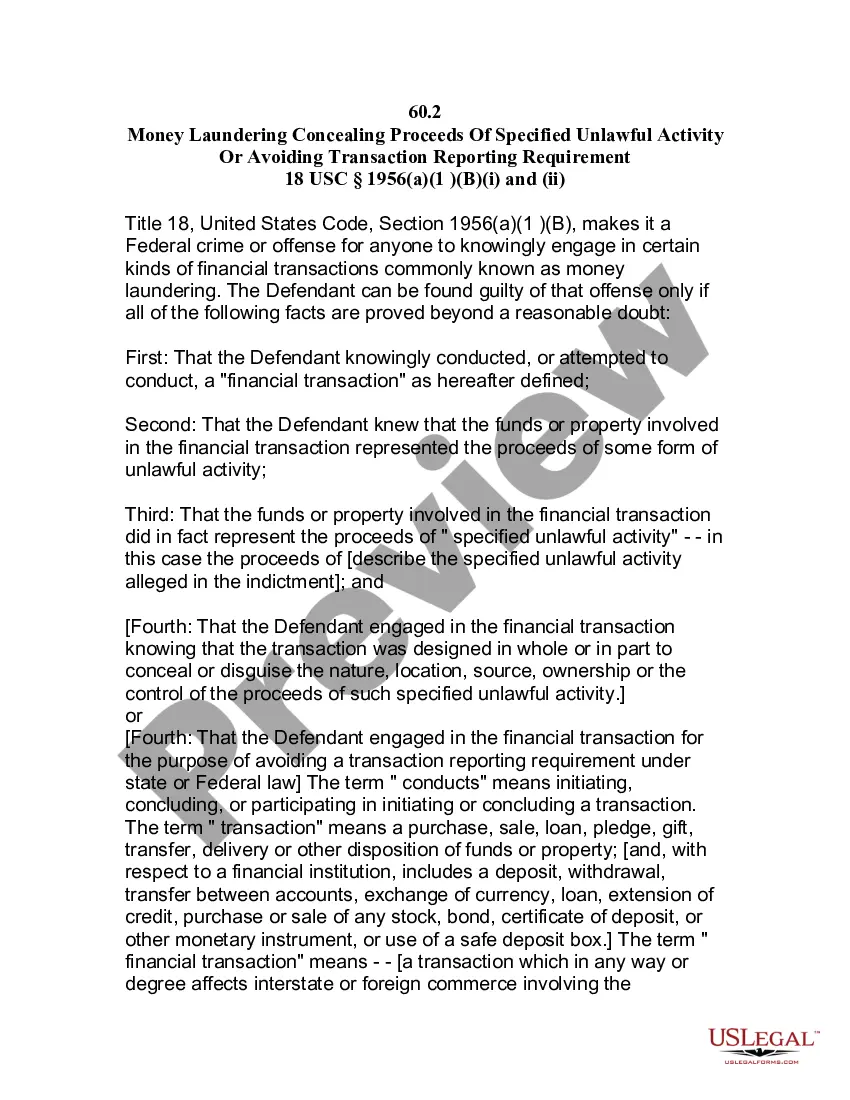
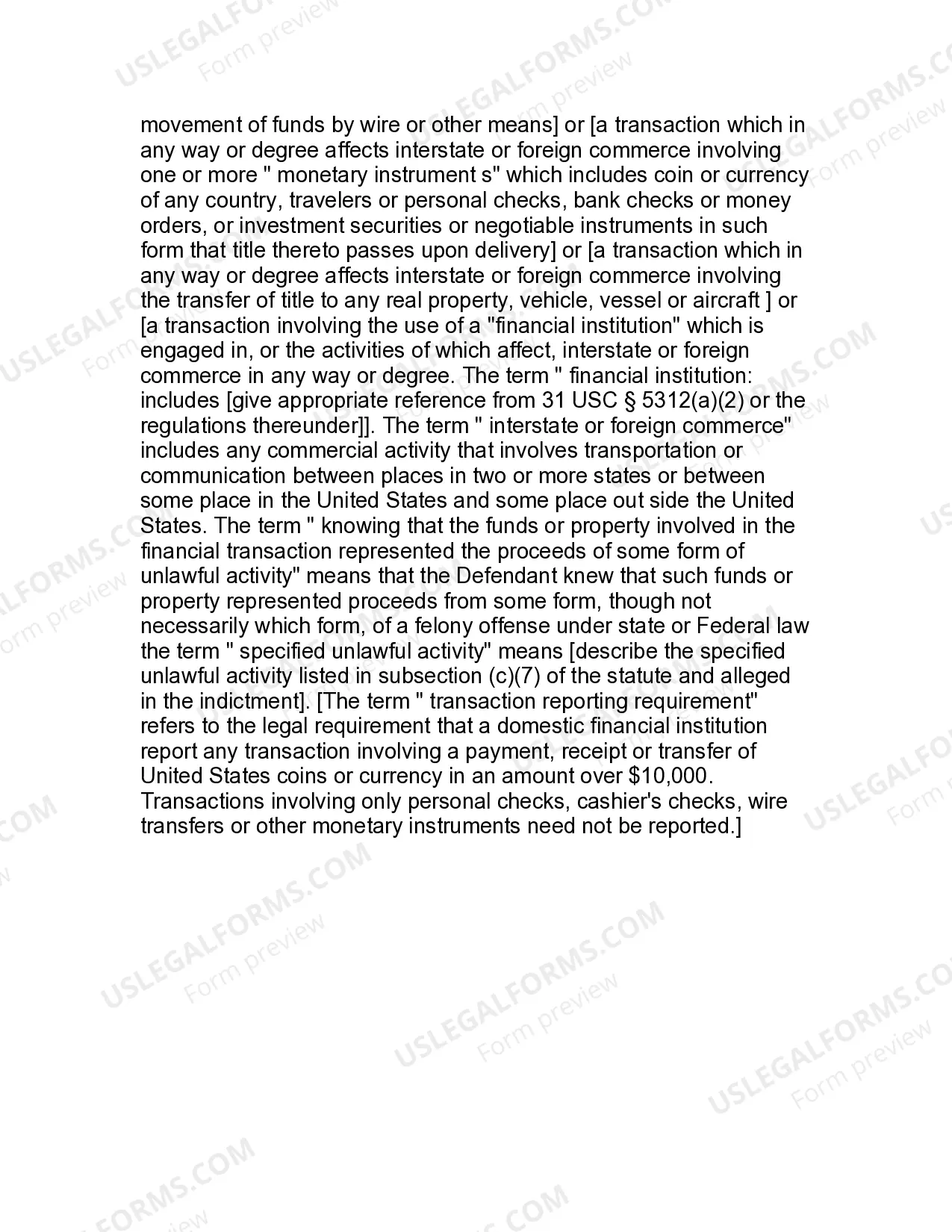
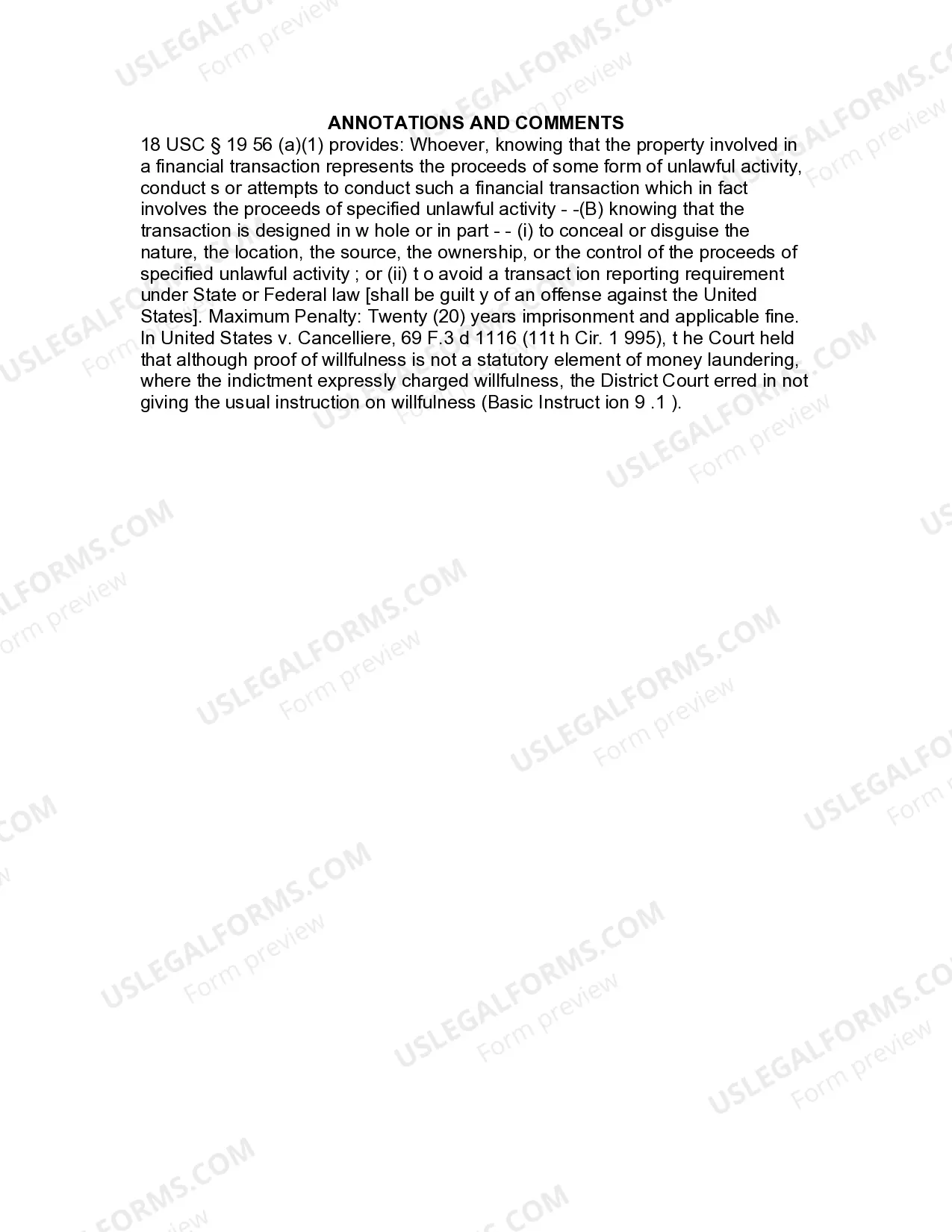
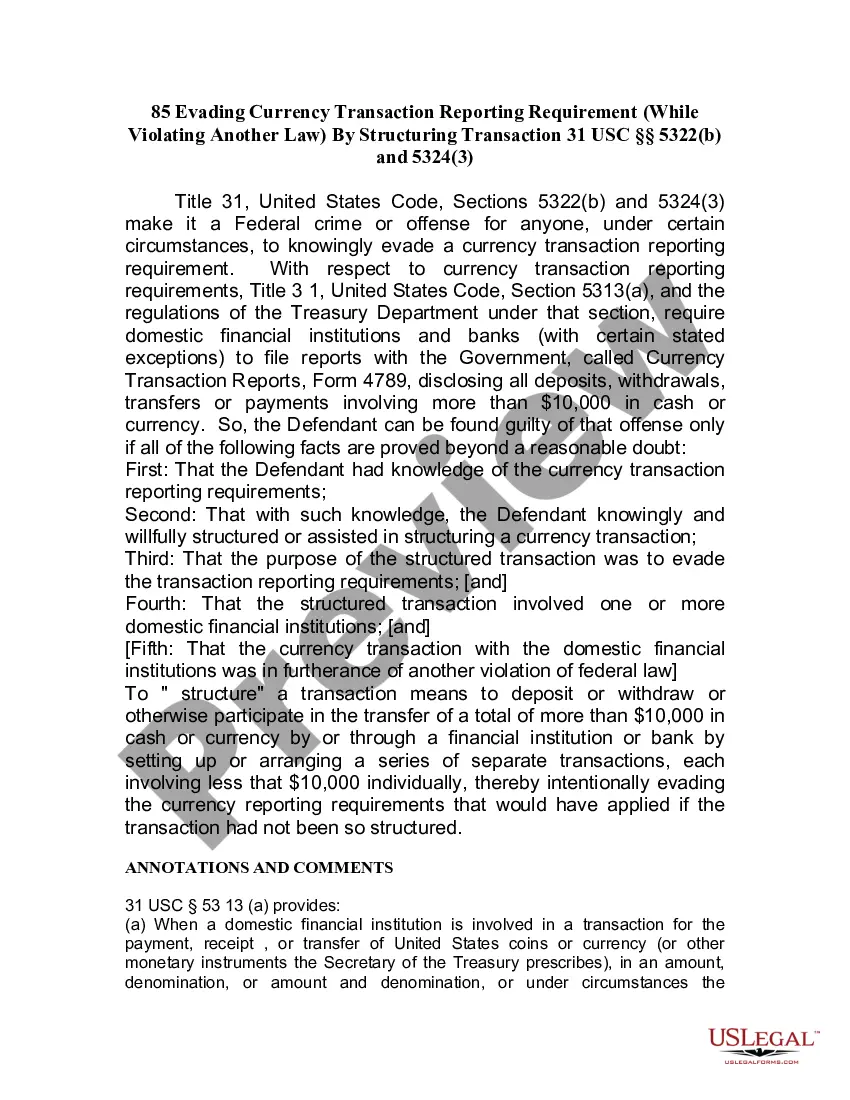
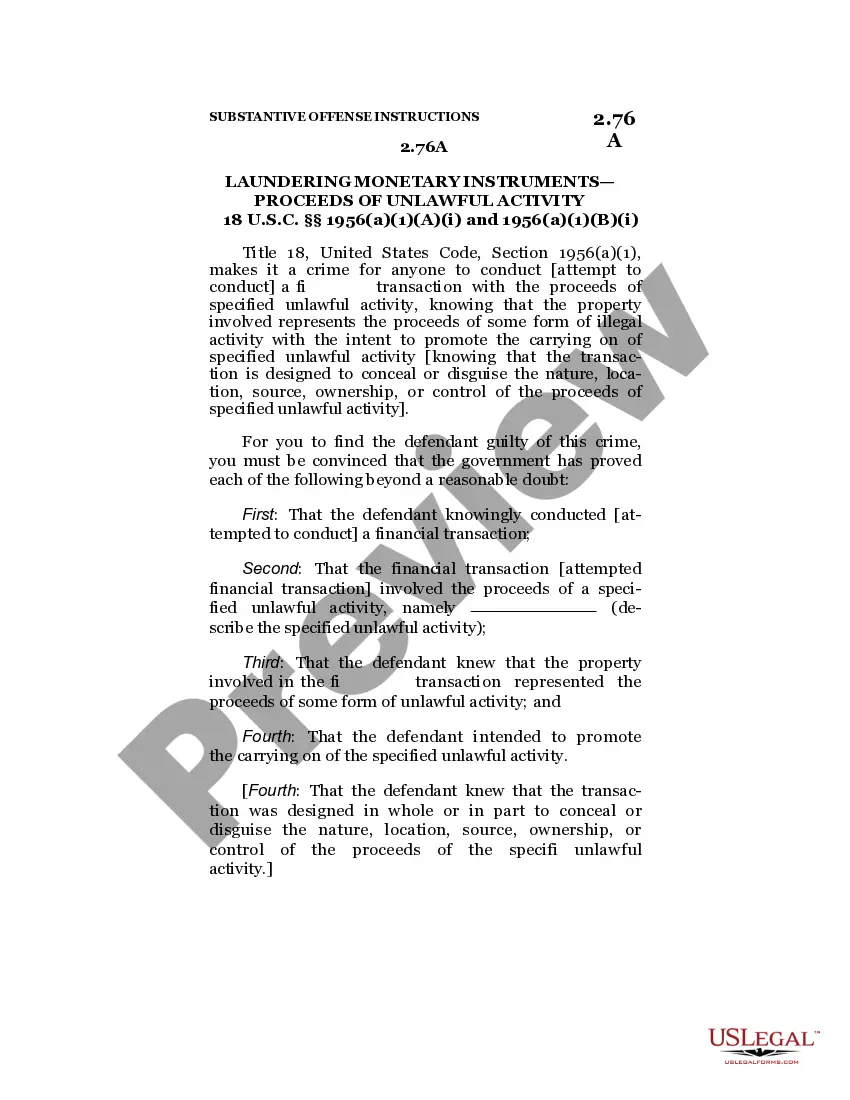
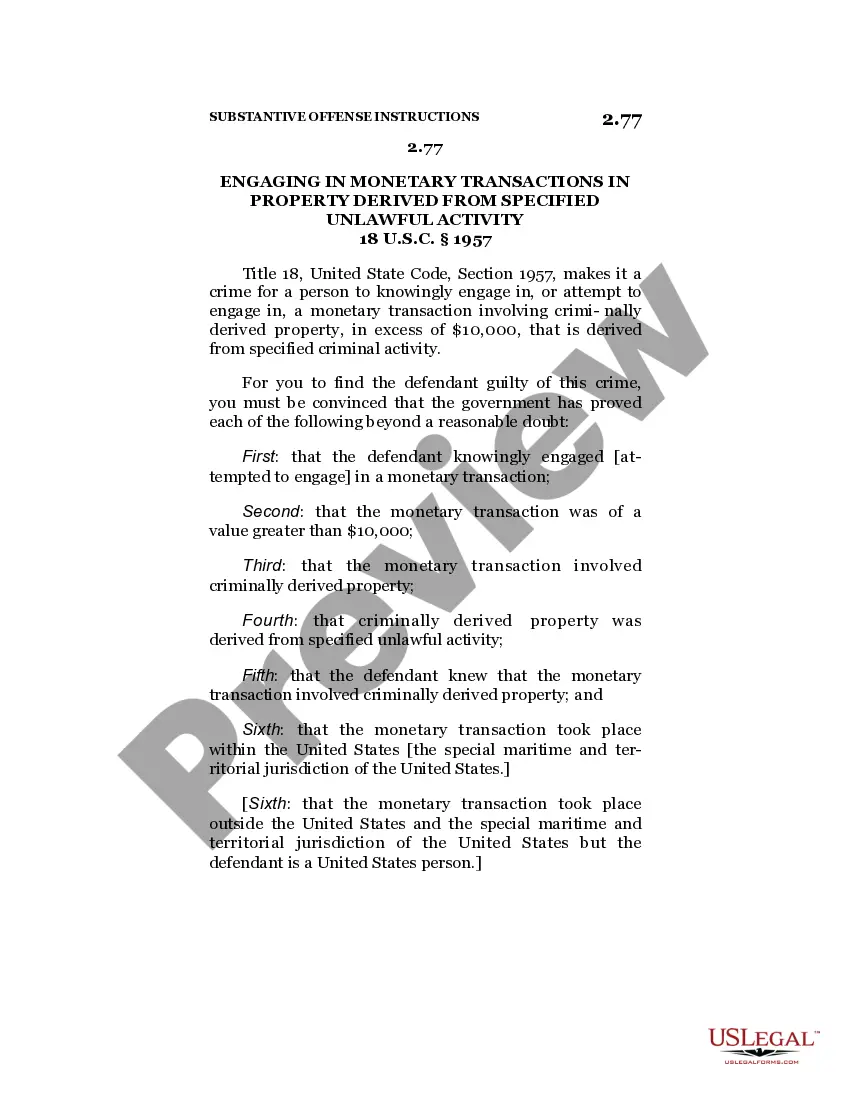
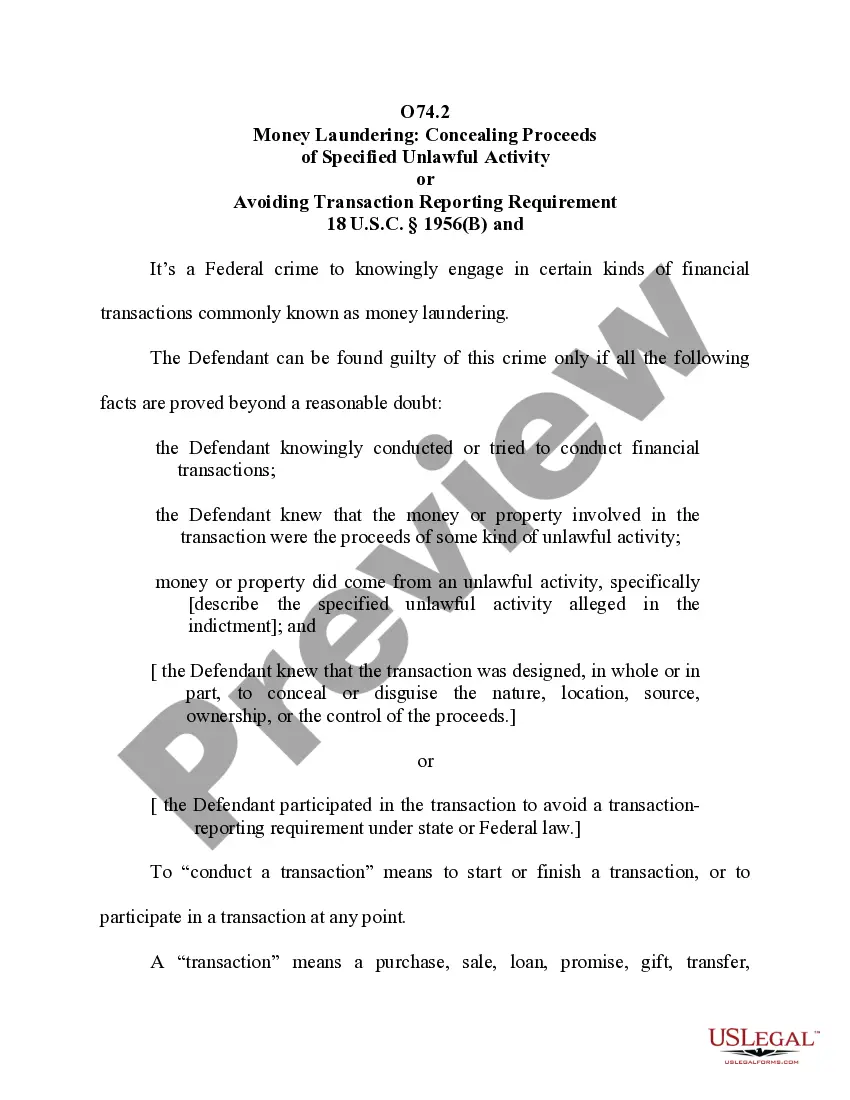
The Jury Instruction for Concealing Proceeds of Specified Unlawful Activity or Avoiding Transaction Reporting Requirement provides legal guidelines for jury members in federal cases related to money laundering. This form is essential in judicial proceedings as it clarifies the elements the prosecution must prove to establish a defendant's guilt. Unlike other legal forms, this one focuses specifically on jury instructions, aiming to ensure a fair trial by educating jurors about their roles and the evidentiary requirements in money laundering cases under 18 USC 1956(a)(1)(B).
Key parts of this document
- Definition of key terms related to financial transactions and money laundering.
- Elements that must be proven beyond a reasonable doubt for conviction.
- Guidance on jury evaluation of the defendant's knowledge and intent.
- Clarifications on what constitutes specified unlawful activity and financial transactions.
- Legal penalties associated with violations under the applicable statutes.
Situations where this form applies
This form should be used in federal court cases involving charges of money laundering. It is applicable when juries must determine if a defendant knowingly engaged in financial transactions that concealed illegal proceeds or avoided reporting requirements. Situations necessitating this form may include cases where the source of funds is suspected to be from activities such as drug trafficking, fraud, or other specified unlawful activities.
Who can use this document
- Legal professionals and attorneys preparing for trial.
- Judges needing to provide jury instructions in relevant cases.
- Jurors assigned to cases involving money laundering allegations.
- Defendants facing charges related to money laundering who wish to understand the jury's instructions.
How to complete this form
- Review the elements of the crime as outlined in the instructions.
- Familiarize with the definitions of terms such as "financial transaction" and "specified unlawful activity."
- Consider the evidence presented in the case to apply these elements accurately.
- Ensure that all jury members understand their responsibilities and the legal requirements for the verdict.
- Complete any necessary documentation reflecting the jury's decision following deliberation.
Is notarization required?
Notarization is generally not required for this form. However, certain states or situations might demand it. You can complete notarization online through US Legal Forms, powered by Notarize, using a verified video call available anytime.
Get your form ready online
Our built-in tools help you complete, sign, share, and store your documents in one place.
Make edits, fill in missing information, and update formatting in US Legal Forms—just like you would in MS Word.
Download a copy, print it, send it by email, or mail it via USPS—whatever works best for your next step.
Sign and collect signatures with our SignNow integration. Send to multiple recipients, set reminders, and more. Go Premium to unlock E-Sign.
If this form requires notarization, complete it online through a secure video call—no need to meet a notary in person or wait for an appointment.
We protect your documents and personal data by following strict security and privacy standards.

Make edits, fill in missing information, and update formatting in US Legal Forms—just like you would in MS Word.

Download a copy, print it, send it by email, or mail it via USPS—whatever works best for your next step.

Sign and collect signatures with our SignNow integration. Send to multiple recipients, set reminders, and more. Go Premium to unlock E-Sign.

If this form requires notarization, complete it online through a secure video call—no need to meet a notary in person or wait for an appointment.

We protect your documents and personal data by following strict security and privacy standards.
Common mistakes to avoid
- Failing to fully understand the definitions of financial transactions.
- Overlooking the requirement to prove knowledge of the unlawful source of funds.
- Misinterpreting the role of jurors in evaluating evidence.
- Assuming that all financial transactions are illegal without considering context.
- Neglecting to discuss jury instructions thoroughly before deliberation.
Advantages of online completion
- Instant access to up-to-date legal templates drafted by licensed attorneys.
- Convenience of downloading and printing from anywhere at any time.
- Flexibility to adapt the form to suit specific case requirements easily.
- Reliable format ensuring all necessary legal components are included.
Legal use & context
- This form is crucial in ensuring that jurors are adequately informed about legal standards in money laundering cases.
- Use of an accurate jury instruction can prevent appeals based on juror misunderstanding.
- Adherence to federal guidelines is necessary for the effective prosecution of money laundering offenses.
Looking for another form?

Form popularity
FAQ
Is a 14 a good ACT score? A score of 14 is definitely low. It places you in the bottom 13th percentile nationally out of the 2 million test takers of the ACT entrance exam. The score indicates you've done a very poor job answering the questions on the English, Math, Reading and Science sections of the test.
A score of 24 means you've scored better than about 74% of students. A 28 means you've scored better than 88% of students, and a 30 means you've scored better than 93% of them! Anything 35 or above is in the 99th percentilea truly phenomenal score.
Students who earned an ACT Composite score of 12 in 7th grade scored at the national mean (an ACT Composite score of 211), on average, in grade 11 or 12. For 7th grade scores of 20 or higher, median scores for grades 11/12 are 30 or higher.
Is a 17 a good ACT score? A score of 17 is pretty low. It places you in the bottom 31st percentile nationally out of the 2 million test takers of the ACT entrance exam. The score indicates you've done a well below average job answering the questions on the English, Math, Reading and Science sections of the test.
Nationally, What's a Bad ACT Score? If you look at the ACT percentiles, any composite score below 20 (the 50th percentile) is below average. (For more on how the ACT is scored and how the composite is calculated, see our guide.) In other words, to be above average nationally, you need at least a 21 ACT composite score.
Both ACT and SAT scores are used for college admissions decisions and awarding merit-based scholarships. Most colleges do not prefer one test over the other. Neither the SAT or ACT is harder than the other. Different students tend to do better on one test over the other.
With a 12 ACT score, you're already strongly competitive for these schools. You're very likely to get admitted if you apply. If you improve your ACT score, your Safety Schools will get better and better.
Students who earned an ACT Composite score of 12 in 7th grade scored at the national mean (an ACT Composite score of 211), on average, in grade 11 or 12. For 7th grade scores of 20 or higher, median scores for grades 11/12 are 30 or higher.
Composite ACT score which is 20 or below 20 is known to be below average in terms of National average.So, nationally stating, 17 ACT scores may be considered as bad ACT scores. This indicates that you got to score more than 17 as an ACT score if you don't want it to be considered below average.
Even if you don't think you're eligible for scholarships, it doesn't hurt to check2026and double-check. With a GPA of 3.0 and a 24 ACT score (remember, the average is 21), you could still get up to $7,000 a year at Oklahoma State University. Get that score even higherabove 30and you can get up to $12,500 a year.