Jury Instruction - Threatening a Juror
What this document covers
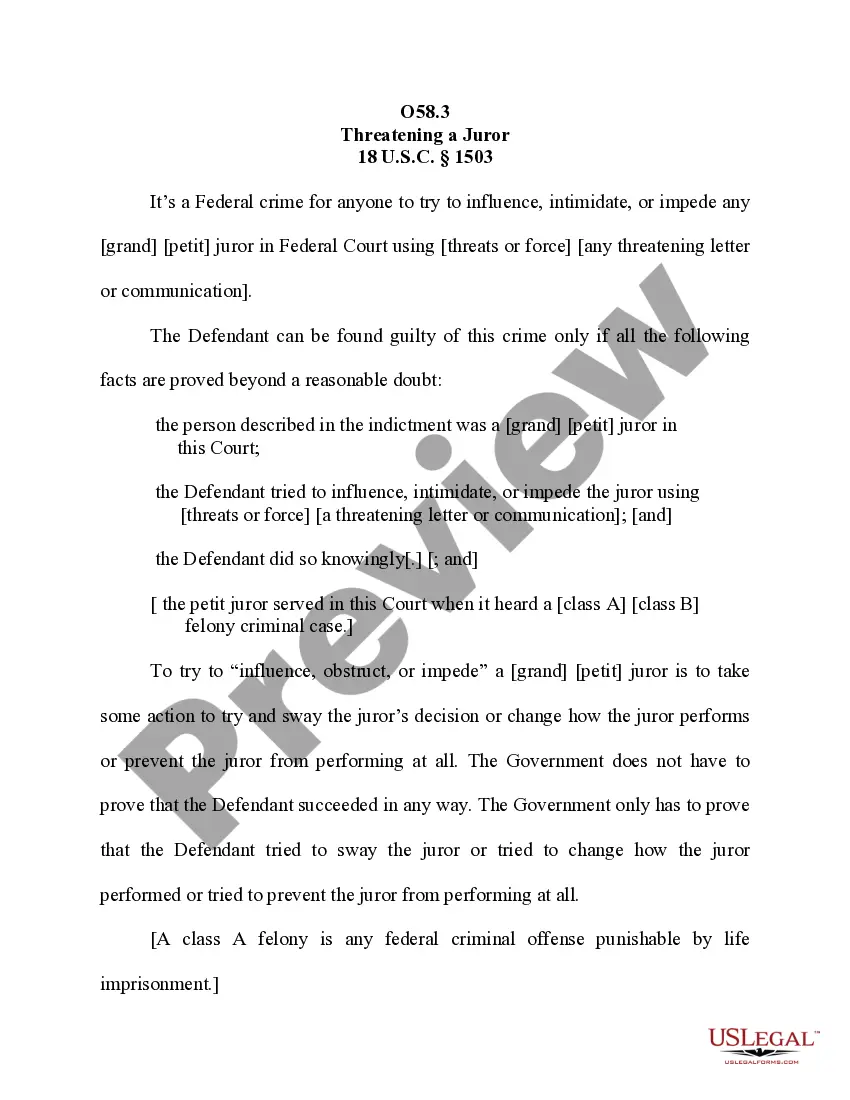
The Jury Instruction - Threatening a Juror form provides specific guidelines for court cases involving threats made against jurors. This form is essential for ensuring that jurors can perform their duties without fear of intimidation. Unlike general jury instruction forms, this template focuses specifically on the legal ramifications of influencing jurors through threats or coercion, making it vital for federal court proceedings.
What’s included in this form
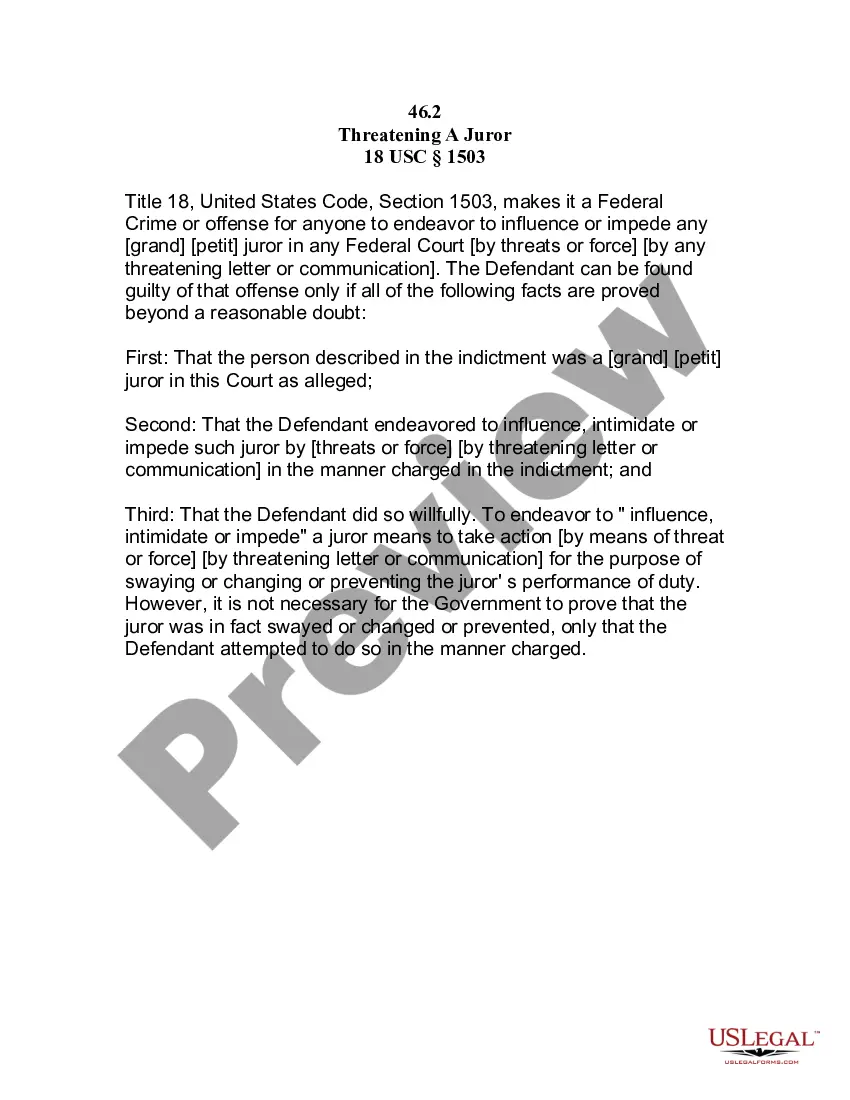
- Definition of the offense under Title 18, United States Code, Section 1503.
- Conditions under which a defendant can be found guilty.
- Clarification of what constitutes influence or intimidation of a juror.
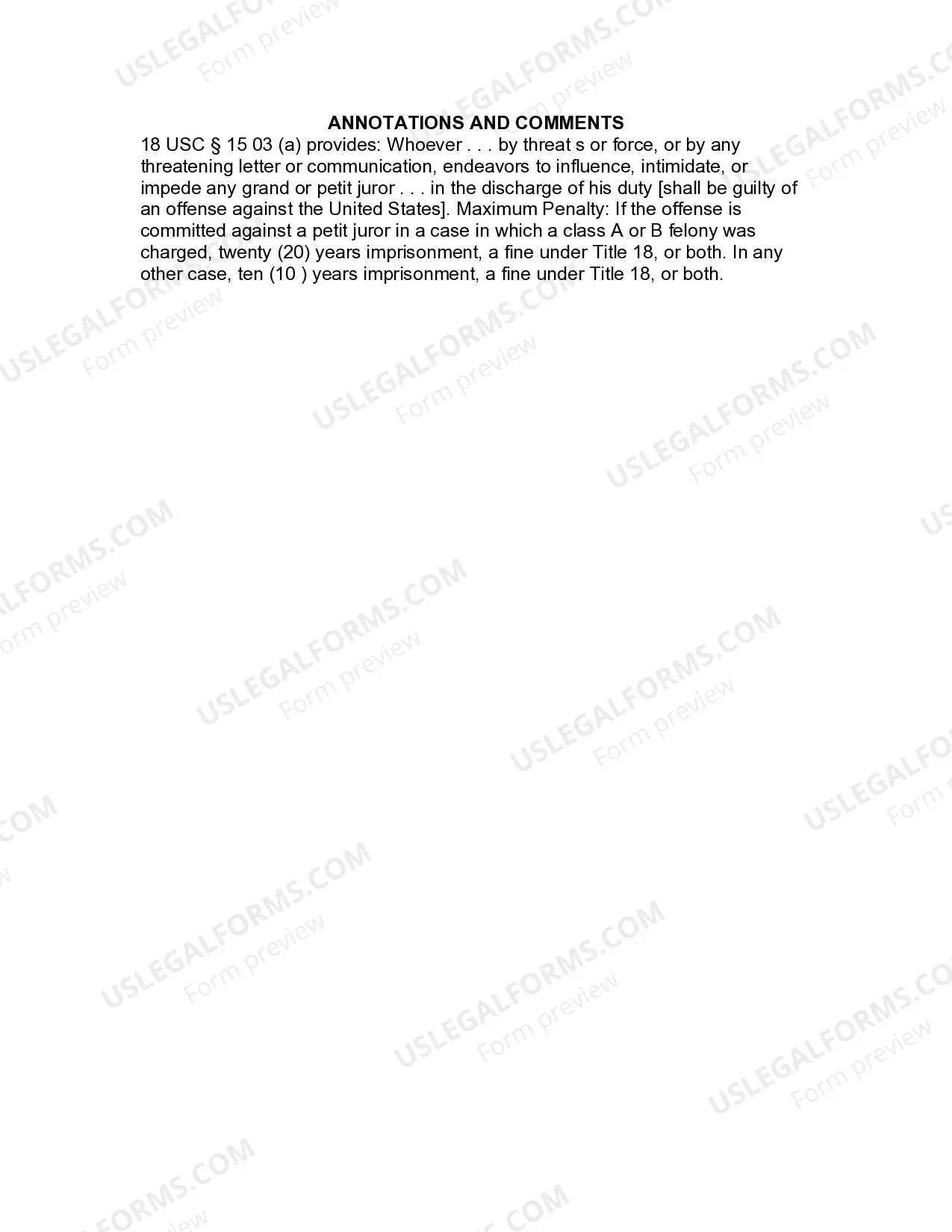
- Maximum penalties for offenses against grand and petit jurors.
- Guidance on the prosecutors' burden of proof in such cases.
When this form is needed
This form should be used in federal court cases where there is a concern about juror intimidation or threats. It is applicable in scenarios involving criminal charges that could affect the integrity of trial proceedings and juror impartiality. Use this form to instruct a jury on the legal implications of threatening a juror, aiding in the court's emphasis on protecting jurors from undue influence.
Who this form is for
- Prosecutors presenting cases involving juror intimidation.
- Defense attorneys representing clients accused of threatening jurors.
- Judges who need to provide specific jury instructions related to juror protection.
- Legal educators teaching about juror rights and protections under federal law.
Steps to complete this form
- Review the key elements of the offense as defined in the instruction.
- Identify the relevant case facts to tailor the instruction to your specific situation.
- Ensure all juror definitions are accurate according to federal law.
- Summarize the potential consequences for juror intimidation.
- Finalize the instruction text and confirm clarity for the jurors.
Notarization guidance
This form does not typically require notarization unless specified by local law. However, it is advisable to check local regulations to ensure compliance.
Get your form ready online
Our built-in tools help you complete, sign, share, and store your documents in one place.
Make edits, fill in missing information, and update formatting in US Legal Forms—just like you would in MS Word.
Download a copy, print it, send it by email, or mail it via USPS—whatever works best for your next step.
Sign and collect signatures with our SignNow integration. Send to multiple recipients, set reminders, and more. Go Premium to unlock E-Sign.
If this form requires notarization, complete it online through a secure video call—no need to meet a notary in person or wait for an appointment.
We protect your documents and personal data by following strict security and privacy standards.

Make edits, fill in missing information, and update formatting in US Legal Forms—just like you would in MS Word.

Download a copy, print it, send it by email, or mail it via USPS—whatever works best for your next step.

Sign and collect signatures with our SignNow integration. Send to multiple recipients, set reminders, and more. Go Premium to unlock E-Sign.

If this form requires notarization, complete it online through a secure video call—no need to meet a notary in person or wait for an appointment.

We protect your documents and personal data by following strict security and privacy standards.
Common mistakes
- Failing to specify the exact nature of the threats against jurors.
- Not aligning the jury instructions with the charged offenses.
- Overcomplicating the legal language instead of using plain and clear terms.
Why complete this form online
- Convenient access to professionally drafted jury instructions.
- Easy to edit the content to suit specific case needs.
- Reliable templates ensure compliance with federal legal standards.
Legal use & context
- The form is based on federal law under Title 18, United States Code, Section 1503.
- Ensures jurors' safety and integrity of the judicial process.
- Supports legal defense and prosecution in cases involving juror threats.
Summary of main points
- This form provides essential instructions for jury handling cases involving threats.
- It is a critical tool for both prosecutors and defense attorneys in federal court.
- Understanding and appropriately applying this form can safeguard juror rights.
Looking for another form?





Form popularity
FAQ
When the jury's verdict contradicts the great weight of the evidence, the trial judge is authorized to set aside that verdict and order a new trial. This power, sometimes called the thirteenth juror rule, dates back to the Blackstonian era. It exists in both civil and criminal cases, in both state and federal court.
Jury tampering is the crime of unduly attempting to influence the composition and/or decisions of a jury during the course of a trial. Once selected, jurors could be bribed or intimidated to act in a certain manner on duty.
A judge generally should but need not consult with counsel before dismissing a juror. Jurors can be dismissed during deliberations. A judge may not hear requests and reasons for requests to be excused from members of the jury off the record and without the presence of the accused.
Yes. For the system to work, citizens must respond when summoned for jury service. Even if you may not qualify for service, you must respond to the summons. If you do not, you could be held in contempt of court and be fined and/or sent to jail.
Economic Hardship. One of the more common reasons people are excused from jury duty is because serving on the jury presents that person with an economic hardship. Personal Opinions. Felony Conviction. Family Issues. Physical/Mental Disabilities.
A classic example of tampering is bribing or threatening a juror to decide a case a certain way. More subtle examples are leaving jurors anonymous notes, slipping them photographs, and telling them information that's been excluded at trial.
Jurors must also be mentally aware enough to comprehend and apply the judge's legal instructions. Any person who doesn't meet these criteria will be dismissed for cause. Judges will also dismiss jurors who can't put aside their feelings and apply the law impartiallythat is, without actual or implied bias.
Personal knowledge about a party to the case or someone connected to the case. Personal experiences that might affect the person's ability to judge the case.
An innominate jury, also known as an anonymous jury, is a jury whose members are kept anonymous by court order. This may be requested by the prosecution or defense in order to protect the jury from the media, potential jury tampering, or social pressure to return a particular verdict.