Jury Instruction - Receipt Of Bribe By Public Official - Or Juror
What is this form?
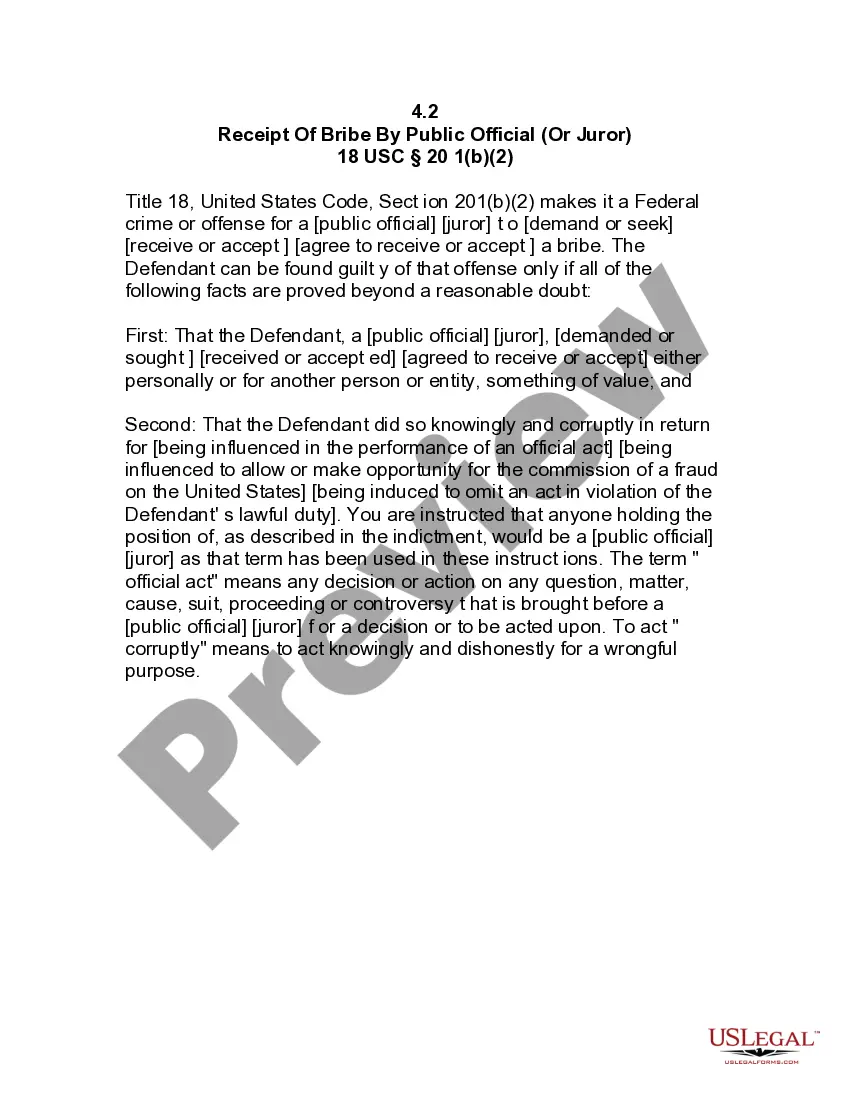
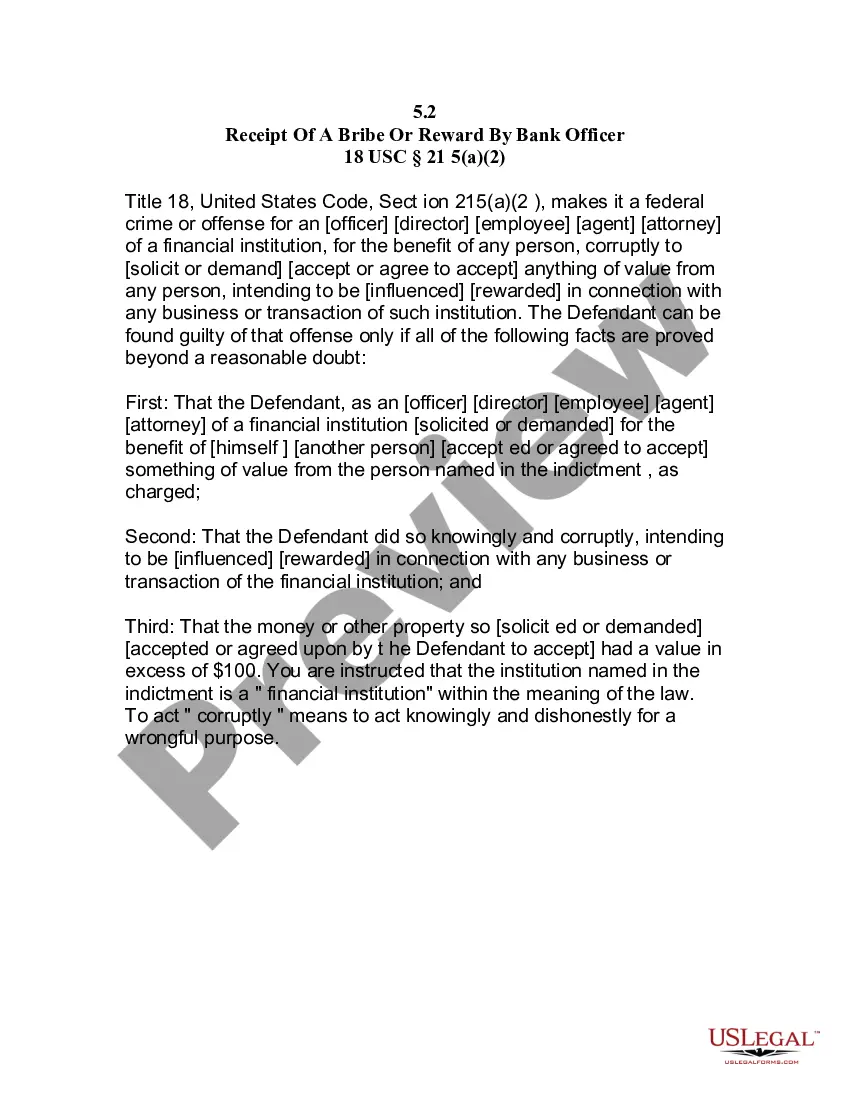
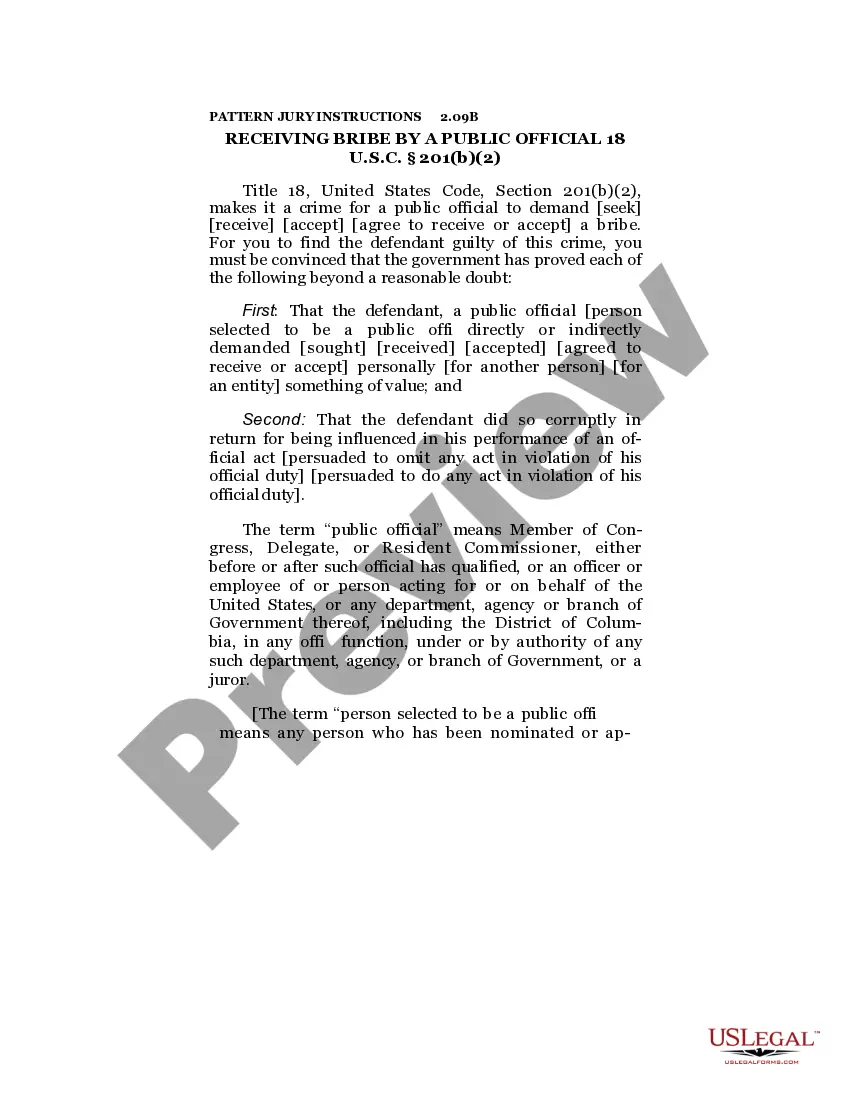
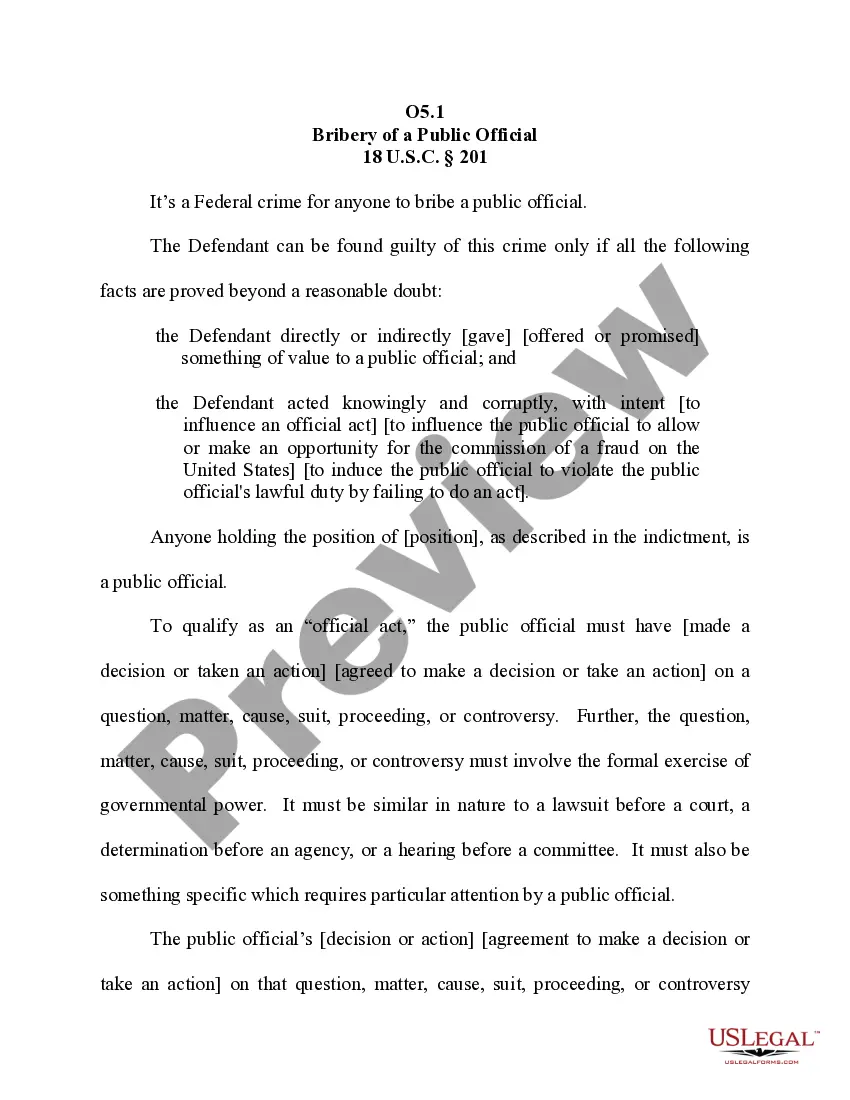
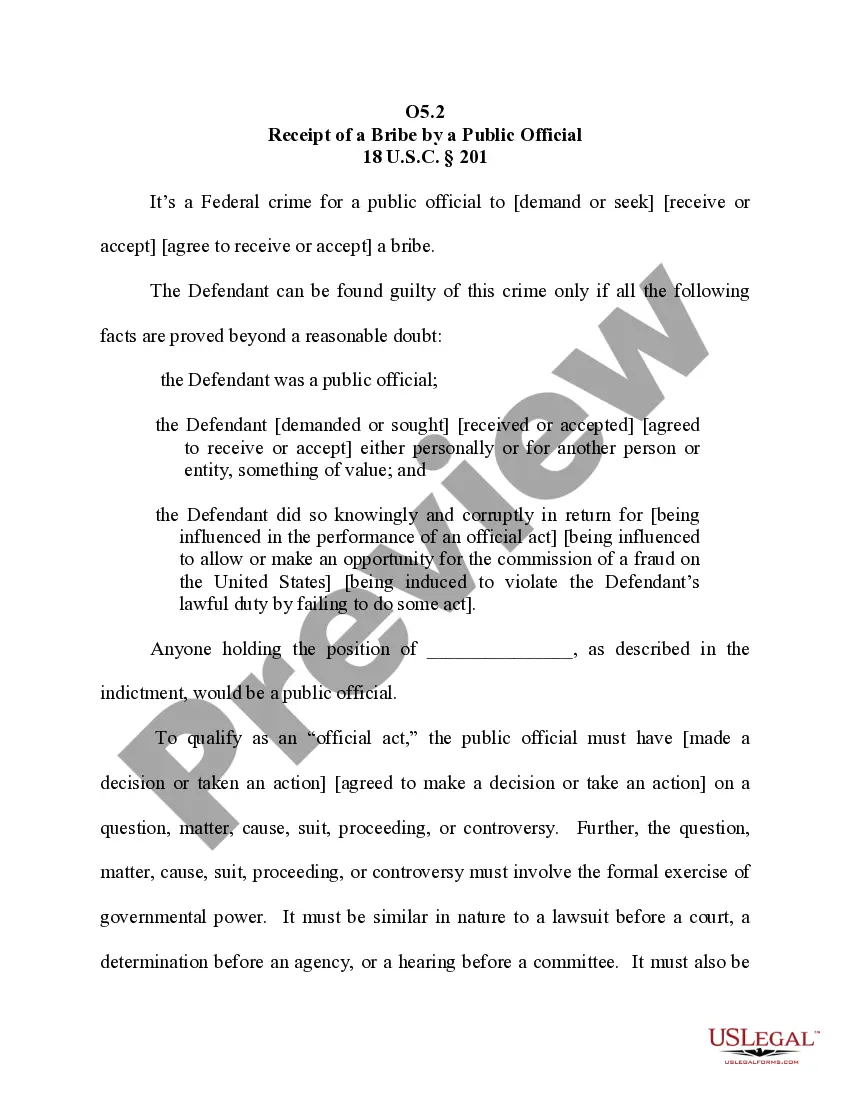
This Jury Instruction form for Receipt of Bribe by Public Official (or Juror) is designed to provide standard jury instructions relevant to federal bribery laws in the United States. It outlines the legal definitions and criteria necessary for establishing the guilt of a public official or juror involved in bribery. This form is specifically tailored to meet the requirements set forth in Title 18, United States Code, Section 201(b)(2), differentiating it from other legal forms that may address bribery in different contexts or jurisdictions.
Form components explained
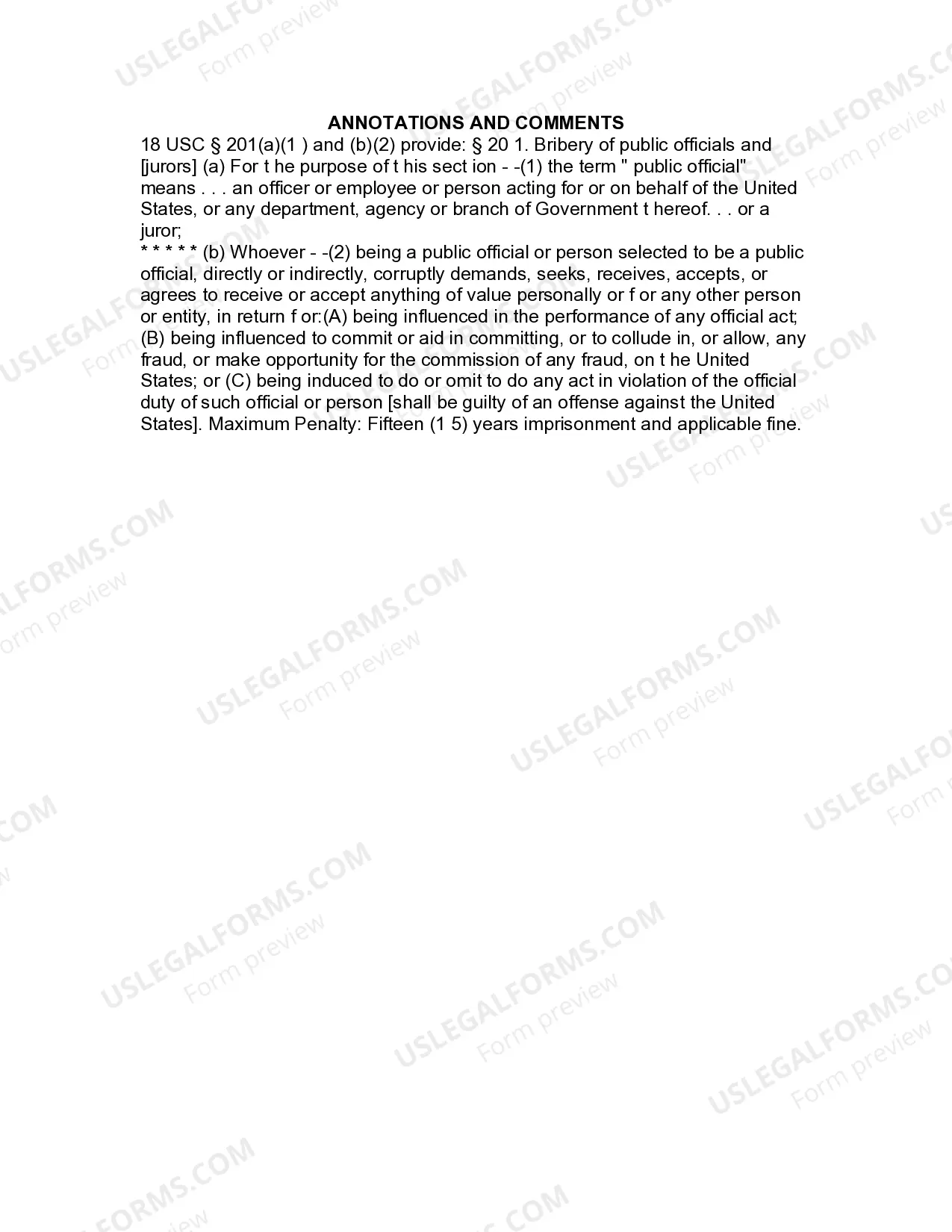
- Definition of a public official and juror under federal law.
- Criteria for establishing a bribe, including the actions of demanding, receiving, or accepting something of value.
- Explanation of "corruptly" acting to fulfill the legal definitions.
- Consequences of bribery, including the maximum penalty of fifteen years imprisonment and applicable fines.
- Clarification of what constitutes an official act.
Situations where this form applies
This form should be used in legal proceedings involving allegations of bribery against public officials or jurors. It is applicable when charges are brought against a defendant for demanding or accepting bribes, influencing their official duties, committing fraud against the United States, or failing to perform lawful duties due to corruption. It serves as a guideline for juries to understand the legal standards they must consider in such cases.
Who can use this document
- Judges overseeing bribery cases involving public officials or jurors.
- Legal practitioners requiring standardized jury instructions for federal bribery cases.
- Jurors who need clear guidance on the elements of bribery they are to deliberate upon.
How to prepare this document
- Review the legal definition of "public official" and "juror" as outlined.
- Ensure all allegations meet the criteria for bribery specified in the form.
- Clarify which acts are considered as "official acts" within the context of the case.
- Provide an explanation of how the defendant's actions amounted to "acting corruptly."
- Include details on the penalties that may be imposed if found guilty.
Notarization guidance
Notarization is not commonly needed for this form. However, certain documents or local rules may make it necessary. Our notarization service, powered by Notarize, allows you to finalize it securely online anytime, day or night.
Get your form ready online
Our built-in tools help you complete, sign, share, and store your documents in one place.
Make edits, fill in missing information, and update formatting in US Legal Forms—just like you would in MS Word.
Download a copy, print it, send it by email, or mail it via USPS—whatever works best for your next step.
Sign and collect signatures with our SignNow integration. Send to multiple recipients, set reminders, and more. Go Premium to unlock E-Sign.
If this form requires notarization, complete it online through a secure video call—no need to meet a notary in person or wait for an appointment.
We protect your documents and personal data by following strict security and privacy standards.

Make edits, fill in missing information, and update formatting in US Legal Forms—just like you would in MS Word.

Download a copy, print it, send it by email, or mail it via USPS—whatever works best for your next step.

Sign and collect signatures with our SignNow integration. Send to multiple recipients, set reminders, and more. Go Premium to unlock E-Sign.

If this form requires notarization, complete it online through a secure video call—no need to meet a notary in person or wait for an appointment.

We protect your documents and personal data by following strict security and privacy standards.
Avoid these common issues
- Failing to accurately define what constitutes a "public official" or "juror."
- Omitting critical elements that must be proven beyond a reasonable doubt.
- Misinterpreting what "acting corruptly" entails in legal terms.
Benefits of using this form online
- Convenient access to standardized jury instructions anytime.
- Easy editing to tailor instructions to specific cases as needed.
- Reliability of forms drafted by licensed attorneys keeping in mind federal laws.
Legal use & context
- The form serves as an official guideline for jury deliberations in bribery cases.
- Non-compliance with this instructional form can lead to legal repercussions for juries and the justice process.
Quick recap
- The Jury Instruction form is crucial for clarifying the legal standards of proving bribery.
- Understanding the definitions and actions involved helps ensure fair jury deliberations.
- Availability of this form online simplifies access to essential legal instructions.
Looking for another form?


Form popularity
FAQ
The elements of Indirect Bribery are as follows: 1. that the offender is a public officer; 2. that that he accepts gifts; and 3. that the said gifts are offered to him by reason of his office.?
What Are the Legal Defenses to Bribery? There are several defenses available against bribery because it is a specific intent crime.This means that a defendant cannot be convicted of bribery if they did not mean to influence the official through offering something of value.
The judge instructs the jury about the relevant laws that should guide its deliberations. (In some jurisdictions, the court may instruct the jury at any time after the close of evidence.The judge reads the instructions to the jury. This is commonly referred to as the judge's charge to the jury.
California law defines the crime of bribery as offering, giving or taking something of value, with corrupt intent, in order unlawfully to influence a person in any public or official capacity. Bribery is typically prosecuted as a felony and is punishable by up to 4 years in jail or prison.
Bribing a public official thus requires proof of five essential elements: (1) a public official; (2) the defendant's corrupt intent; (3) a benefit-"anything of value"-given, offered, or promised to the public official; (4) a relationship between the thing of value and some official act (or fraud or omission of duty);
These are civil or criminal jury instructions approved by a state court, bench committee, or bar association. They are commonly used by courts in the relevant jurisdiction, as they ease the process of drafting fair jury instructions and theoretically do not have errors.
To prove a bribery case, the government must demonstrate that a thing of value was offered and accepted, that there was an illegal intent, and the intent was to pay money and receive something in return that was illegal. That could be an illegal advantage in a bidding process to get a contract.
In general, every crime involves three elements: first, the act or conduct (actus reus); second, the individual's mental state at the time of the act (mens rea); and third, the causation between the act and the effect (typically either "proximate causation" or "but-for causation").
Overview. Bribery refers to the offering, giving, soliciting, or receiving of any item of value as a means of influencing the actions of an individual holding a public or legal duty.Bribery constitutes a crime and both the offeror and the recipient can be criminally charged.