Jury Instruction - Withdrawal From Conspiracy - For Use With General Conspiracy Charge
What is this form?
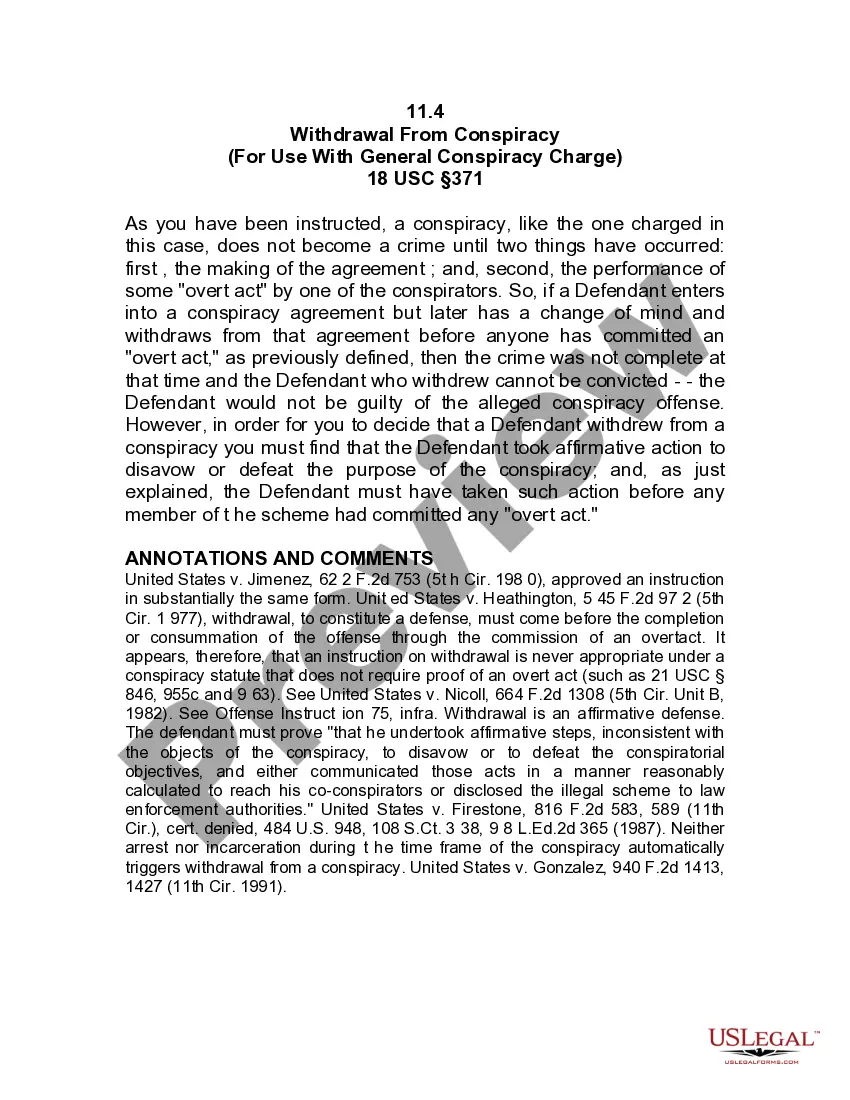
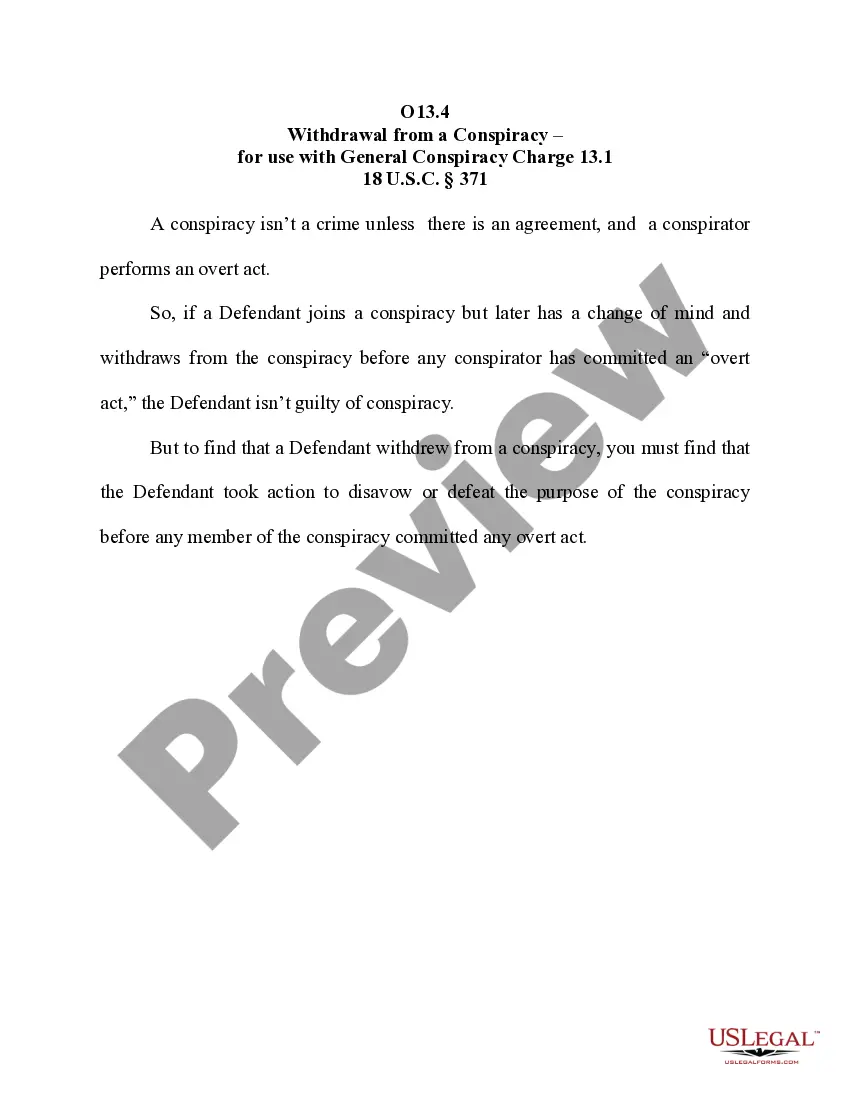
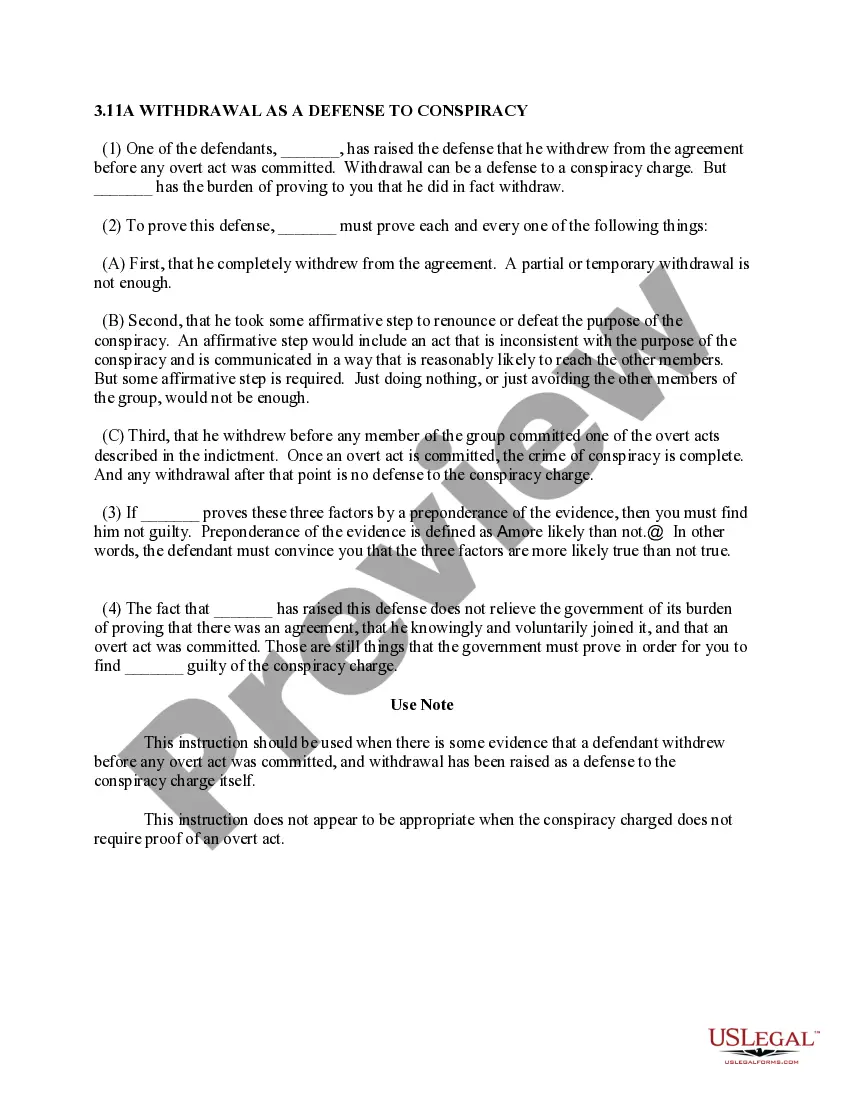
The Jury Instruction - Withdrawal From Conspiracy is a legal document used in court to guide jurors on the conditions under which a defendant may withdraw from a conspiracy. This instruction clarifies that a conspiracy does not constitute a crime unless an agreement is made and an overt act is performed. If a defendant withdraws before any overt act occurs, they cannot be convicted of conspiracy. This form helps ensure that jurors understand the nuances of withdrawal as a defense in conspiracy cases, making it different from general jury instructions for other charges.
Key components of this form
- Definition of conspiracy and the elements required for conviction.
- Explanation of withdrawal from conspiracy and the necessity for affirmative action.
- Details on timing for withdrawal, emphasizing it must occur before any overt act.
- Reference to relevant legal precedents that support the instruction.
When this form is needed
This form is utilized in criminal cases involving conspiracy charges. It provides essential guidance during jury deliberations, specifically when a defendant claims they withdrew from a conspiracy. Legal representatives and judges may use it to ensure jurors correctly apply the law regarding withdrawal and understand the implications of a defendant's actions prior to any overt acts of the conspiracy.
Who this form is for
- Judges overseeing conspiracy cases.
- Attorneys representing defendants in conspiracy trials.
- Jurors involved in cases with conspiracy charges.
- Legal scholars studying conspiracy law and jury instructions.
Completing this form step by step
- Review the conspiracy charge against the defendant.
- Understand the legal definition of withdrawal and its requirements.
- Determine if the defendant took any affirmative steps to withdraw.
- Assess whether these steps occurred before any overt act took place.
- Make necessary adjustments to the instructions based on the specifics of the case.
Is notarization required?
This form does not typically require notarization to be legally valid. However, some jurisdictions or document types may still require it. US Legal Forms provides secure online notarization powered by Notarize, available 24/7 for added convenience.
Get your form ready online
Our built-in tools help you complete, sign, share, and store your documents in one place.
Make edits, fill in missing information, and update formatting in US Legal Forms—just like you would in MS Word.
Download a copy, print it, send it by email, or mail it via USPS—whatever works best for your next step.
Sign and collect signatures with our SignNow integration. Send to multiple recipients, set reminders, and more. Go Premium to unlock E-Sign.
If this form requires notarization, complete it online through a secure video call—no need to meet a notary in person or wait for an appointment.
We protect your documents and personal data by following strict security and privacy standards.

Make edits, fill in missing information, and update formatting in US Legal Forms—just like you would in MS Word.

Download a copy, print it, send it by email, or mail it via USPS—whatever works best for your next step.

Sign and collect signatures with our SignNow integration. Send to multiple recipients, set reminders, and more. Go Premium to unlock E-Sign.

If this form requires notarization, complete it online through a secure video call—no need to meet a notary in person or wait for an appointment.

We protect your documents and personal data by following strict security and privacy standards.
Common mistakes to avoid
- Failing to clarify what constitutes an overt act in relation to conspiracy.
- Overlooking the requirement for the defendant to show affirmative action for withdrawal.
- Using vague language that may confuse jurors regarding the withdrawal process.
- Neglecting to reference relevant case laws that support the withdrawal defense.
Why use this form online
- Immediate access to professionally drafted jury instructions.
- Easy customization to fit case specifics and jurisdictional requirements.
- High reliability as the forms are created by licensed attorneys.
- Convenience of downloading and using forms on various devices from anywhere.
Legal use & context
- Provides jurors with essential information on how to assess claims of withdrawal in conspiracy cases.
- Helps ensure compliance with legal standards for conspiracy trials.
- Facilitates a clearer understanding of affirmative defenses by jurors.
What to keep in mind
- This form is essential in explaining the withdrawal defense in conspiracy cases.
- Jurors must understand the importance of overt acts and the timing of withdrawal.
- Customization to suit the specific case is crucial for effective use of the form.
Looking for another form?

Form popularity
FAQ
In most U.S. jurisdictions, for a person to be convicted of conspiracy, not only must he or she agree to commit a crime, but at least one of the conspirators must commit an overt act (the actus reus) in furtherance of the crime.
Penalties. Under the federal conspiracy statute, the offense is punishable by up to five years imprisonment, plus fines.
Put simply, a criminal conspiracy is an agreement to commit an unlawful act. The agreement itself is the crime, but at least one co-conspirator must take an overt act in furtherance of the conspiracy. Under the federal conspiracy statute: The agreement by two or more persons is the essence of the crime.
It is fairly difficult for a defendant to withdraw from a criminal conspiracy; the defendant must prove that he, in fact, walked away; and. withdrawal is a complete defense only if it occurred more than five years before the indictment.
Unlike conspiracy or attempt, which require an additional act in furtherance of the crime itself, solicitation does not require that the solicited party actually take any action to commit the crime. Simply asking a person to commit a crime is enough.
(2) an act which is not illegal by illegal means, such an agreement is designated a criminal conspiracy: Provided that no agreement except an agreement to commit an offence shall amount to a criminal conspiracy unless some act besides the agreement is done by one or more parties to such agreement in pursuance thereof.
Federal conspiracies are punishable by up to five years in jail plus fines. Some of the most common conspiracies charged at the federal level include money laundering or the manufacturing of drugs or weapons. Misdemeanor conspiracies typically carry whatever sentence is the maximum for that misdemeanor.
By law, attempt or conspiracy to commit a crime are crimes of the same grade and degree as the most serious offense which is attempted or is an object of the conspiracy, except that an attempt or conspiracy to commit a class A felony is a class B felony (CGC § 53a-51).