Jury Instruction - Assaulting A Federal Officer - Without Use Of A Deadly Weapon
About this form
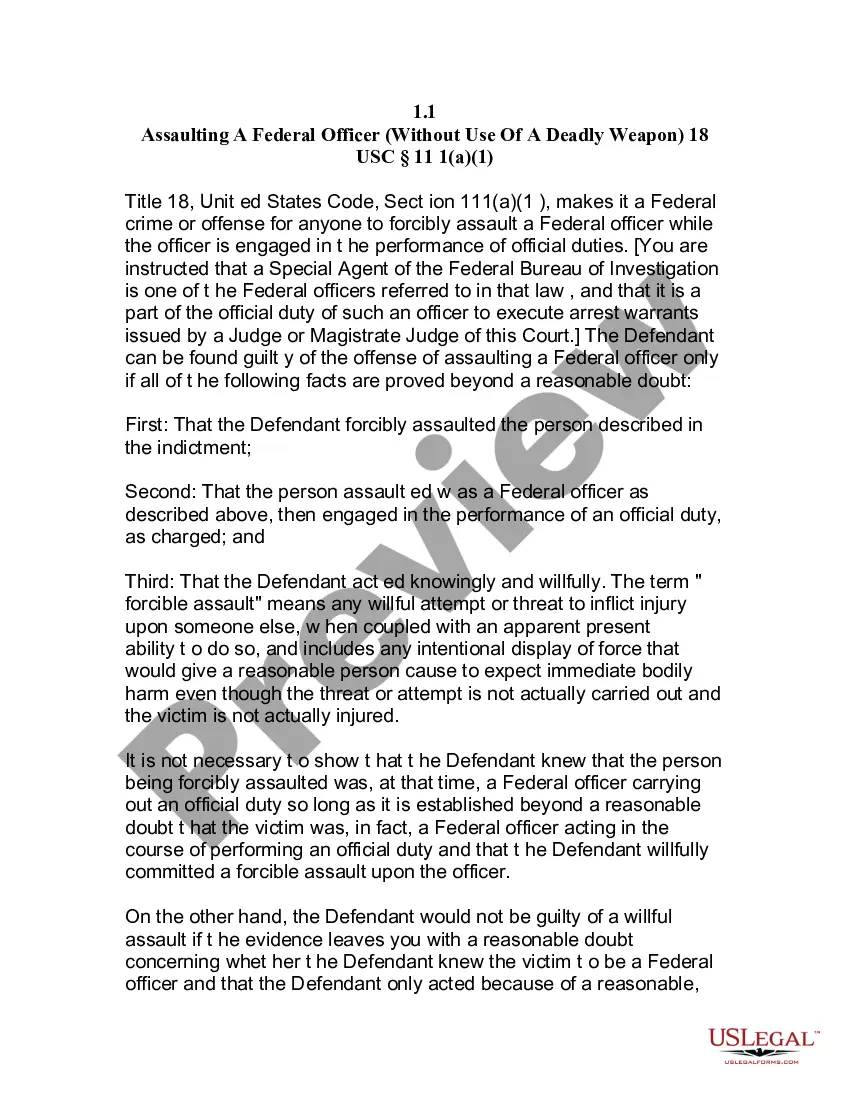
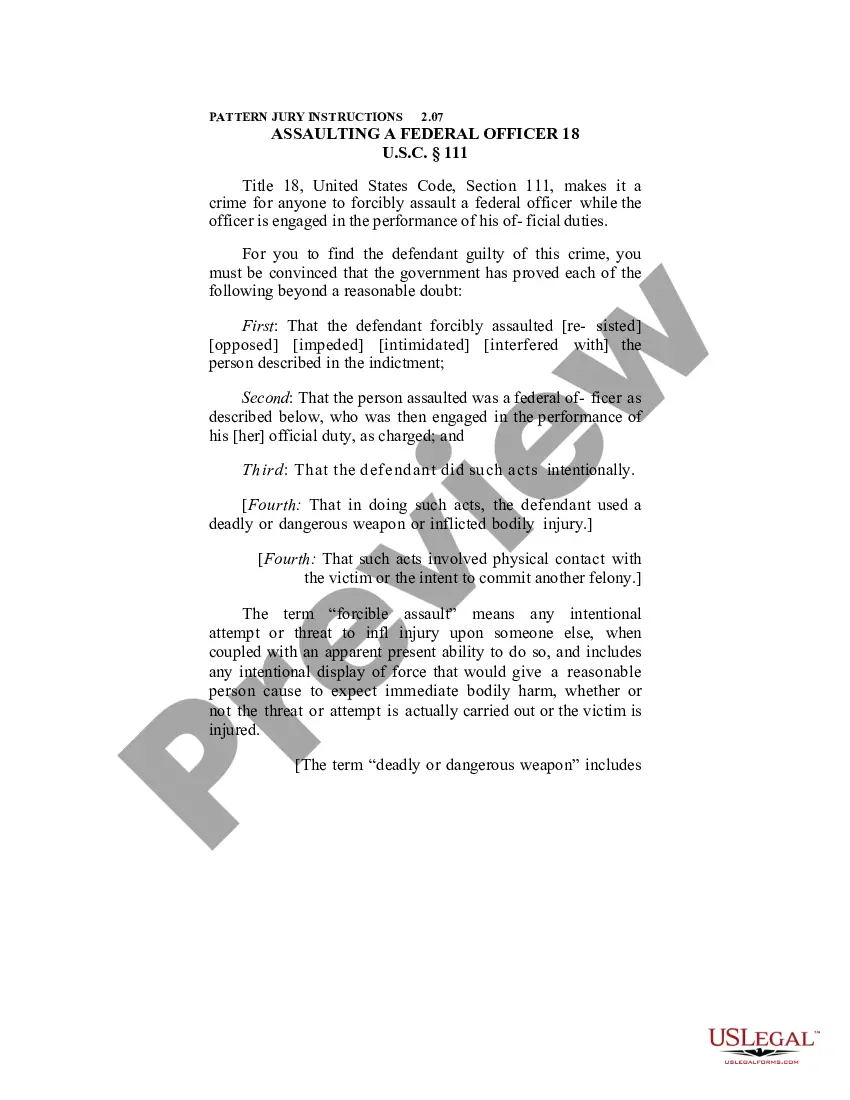
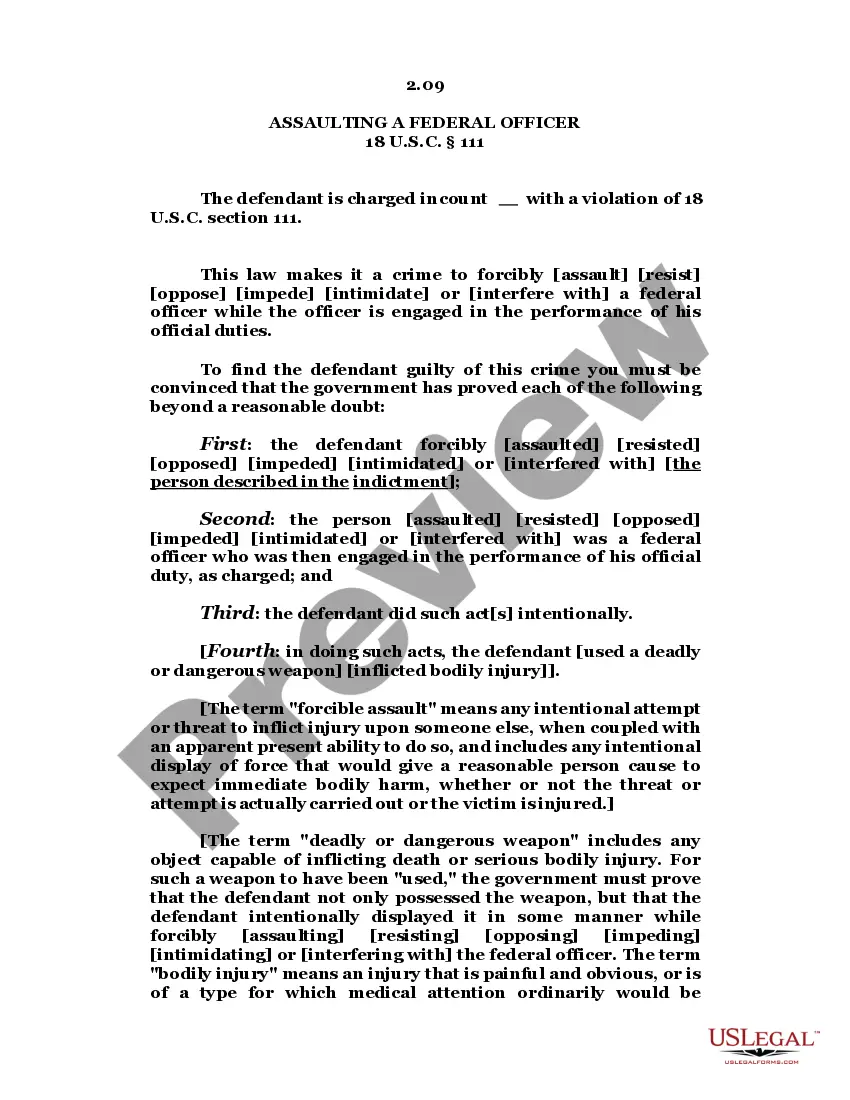
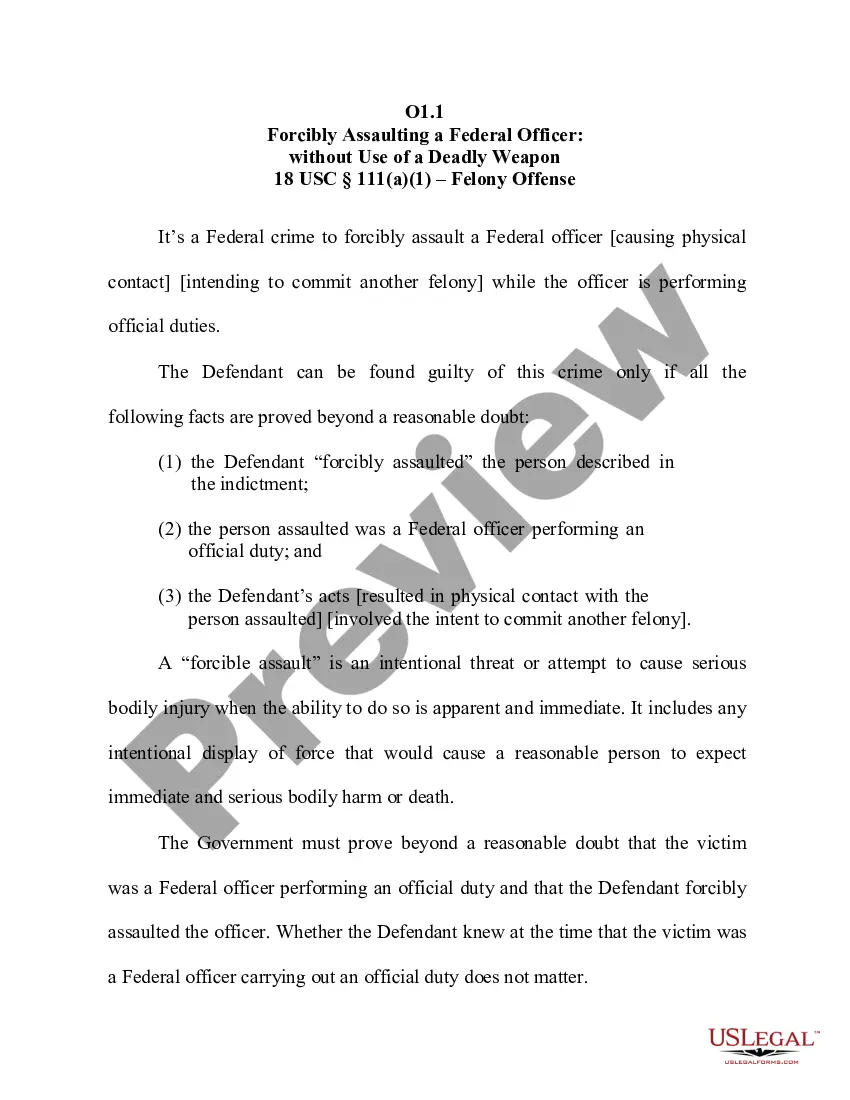
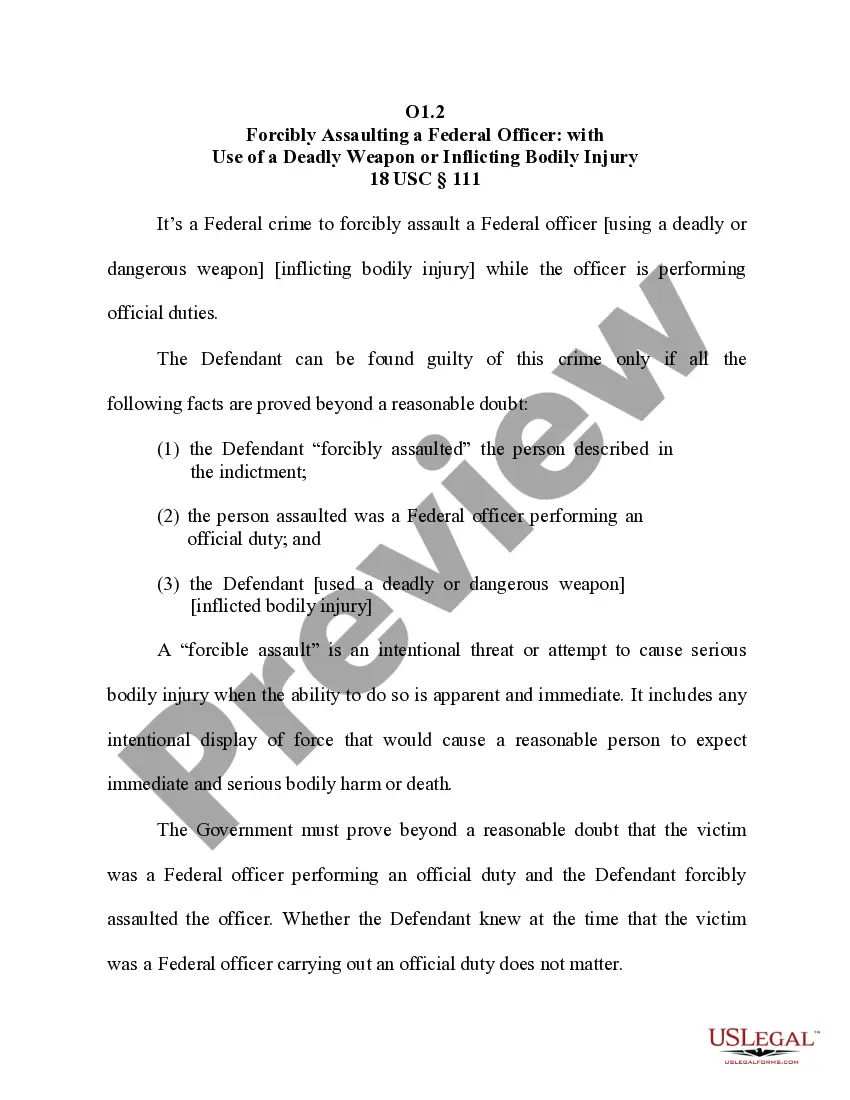
The Jury Instruction for Assaulting A Federal Officer - Without Use Of A Deadly Weapon provides essential guidance for jurors in cases involving charges under 18 USC Section 111(a)(1). This form outlines the criteria needed to establish guilt in cases where a federal officer was assaulted without the use of a deadly weapon. It serves as a model that can be tailored to specific legal cases but should be used carefully to ensure it fits individual circumstances, distinguishing it from other jury instructions that may cover different crimes or circumstances.
Main sections of this form
- Definition of a federal officer and their official duties.
- Criterions for proving that the defendant committed a forcible assault.
- Clarification on the concept of a willful assault and its implications.
- Details on the defendant's knowledge regarding the victim's status as a federal officer.
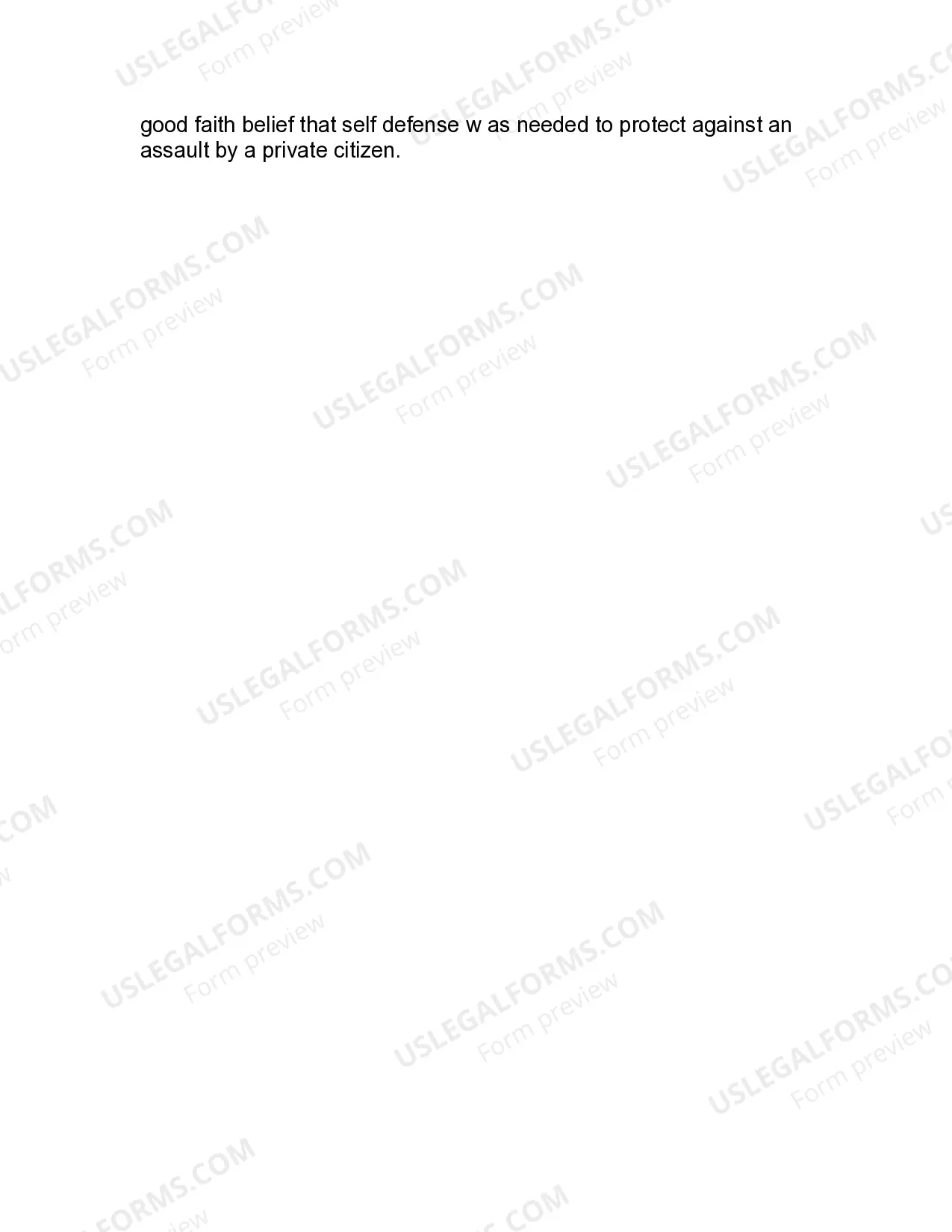
- Exemptions for self-defense and misunderstanding of the victim's identity.
Common use cases
This jury instruction form is relevant in federal criminal cases where the defendant faces charges for assaulting a federal officer without the use of a deadly weapon. It should be used when crafting jury instructions that need to reflect the specific elements of the crime as defined under federal law. Situations may include cases being prosecuted for assaults against FBI agents or other federal agents executing their official duties.
Who can use this document
- Judges presiding over federal assault cases involving federal officers.
- Prosecutors preparing jury instructions for federal court cases.
- Defense attorneys who wish to have a comprehensive understanding of jury instructions relevant to their case.
- Legal scholars or students studying federal assault laws.
How to prepare this document
- Identify the specific facts related to the alleged assault.
- Establish the role of the alleged victim as a federal officer engaged in official duties.
- Gather evidence to prove whether the assault was committed willfully.
- Review the elements of self-defense as applicable to the case.
- Modify the jury instructions to suit the specific facts and evidence of the case.
Does this form need to be notarized?
Notarization is not commonly needed for this form. However, certain documents or local rules may make it necessary. Our notarization service, powered by Notarize, allows you to finalize it securely online anytime, day or night.
Get your form ready online
Our built-in tools help you complete, sign, share, and store your documents in one place.
Make edits, fill in missing information, and update formatting in US Legal Forms—just like you would in MS Word.
Download a copy, print it, send it by email, or mail it via USPS—whatever works best for your next step.
Sign and collect signatures with our SignNow integration. Send to multiple recipients, set reminders, and more. Go Premium to unlock E-Sign.
If this form requires notarization, complete it online through a secure video call—no need to meet a notary in person or wait for an appointment.
We protect your documents and personal data by following strict security and privacy standards.

Make edits, fill in missing information, and update formatting in US Legal Forms—just like you would in MS Word.

Download a copy, print it, send it by email, or mail it via USPS—whatever works best for your next step.

Sign and collect signatures with our SignNow integration. Send to multiple recipients, set reminders, and more. Go Premium to unlock E-Sign.

If this form requires notarization, complete it online through a secure video call—no need to meet a notary in person or wait for an appointment.

We protect your documents and personal data by following strict security and privacy standards.
Common mistakes to avoid
- Failing to clearly establish that the victim was acting in the capacity of a federal officer.
- Not adequately defining what constitutes a forcible assault.
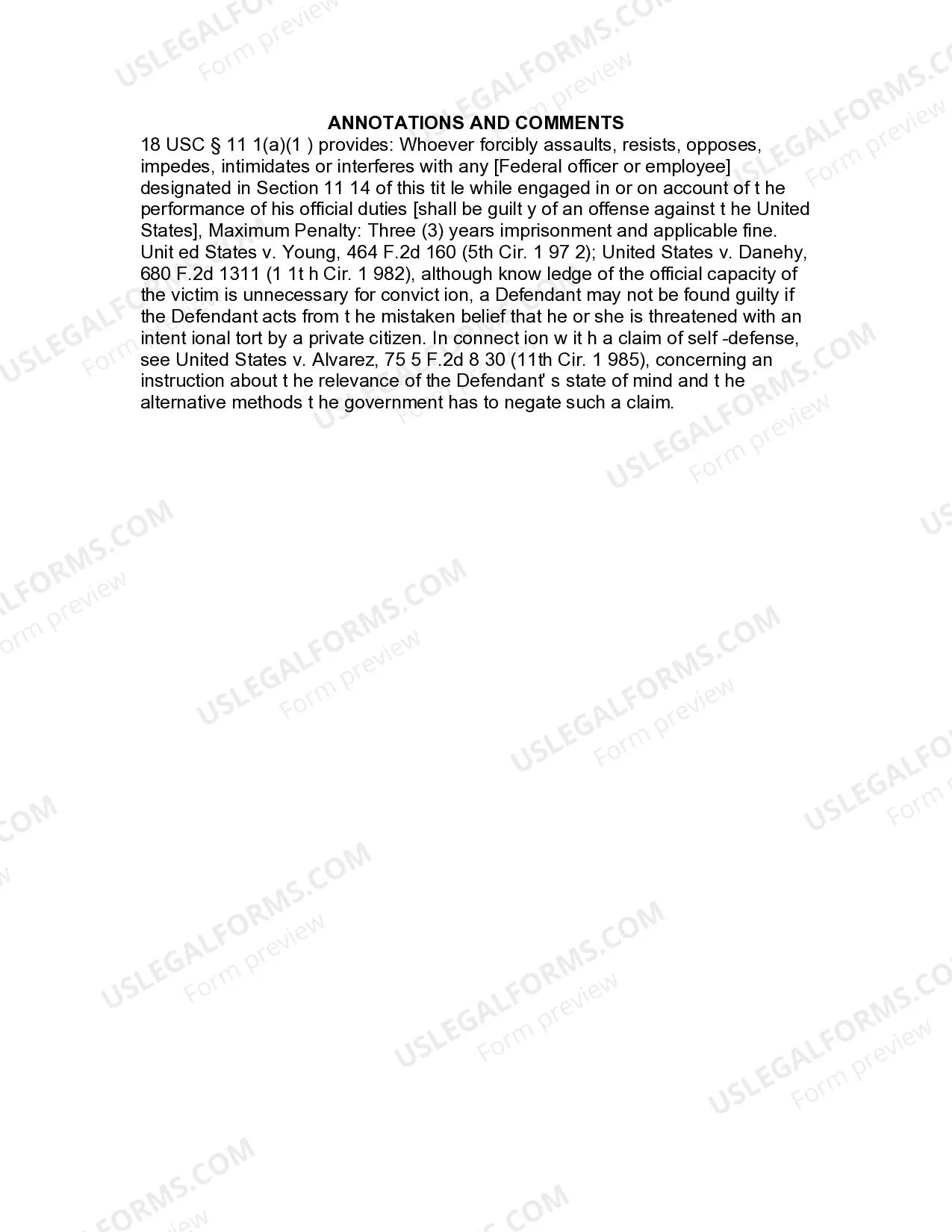
- Overlooking the relevance of the defendant's state of mind regarding self-defense claims.
- Using boilerplate jury instructions without tailoring them to the specific case facts.
Advantages of online completion
- Quick access to professionally drafted jury instructions.
- Easy customization to fit specific case facts and legal interpretations.
- Time-saving compared to creating jury instructions from scratch.
- Provides confidence that the language meets federal legal standards.
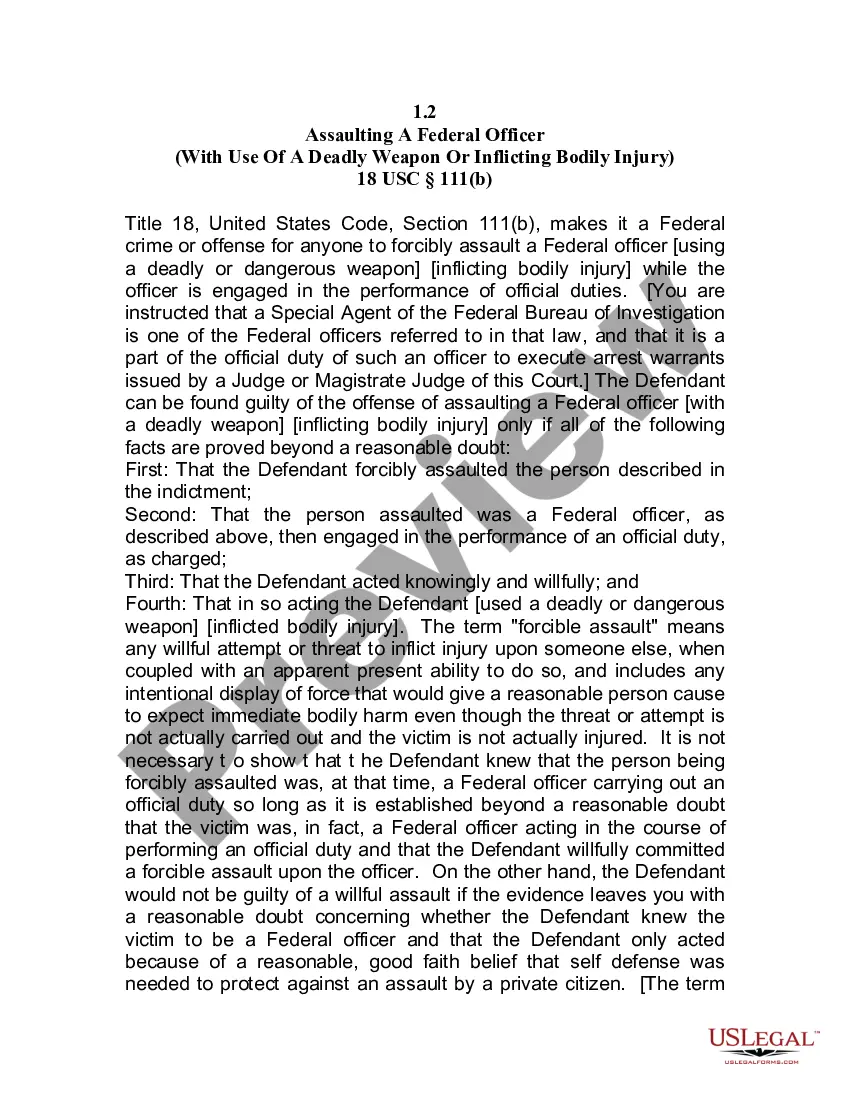
Looking for another form?







Form popularity
FAQ
In the federal criminal system, an assault is an attempt to hit another person or an act that causes someone to reasonably expect impending harm.An assault requires neither harm nor physical contactthe crime is complete whether the assailant succeeds in hitting the other person or actually fires the gun.
Assault with a deadly weapon is usually a felony punishable by one to twenty years in prison, depending on the specific provisions of each state's sentencing statute or sentencing guidelines.
Whoever forcibly assaults, resists, opposes, impedes, intimidates, or interferes with any person designated in section 1114 of this title while engaged in or on account of the performance of his official duties, shall be fined not more than $5,000 or imprisoned not more than three years, or both.
Hitting or touching someone in an unwanted, offensive manner -- even threatening or attempting to do so -- is referred to as assault and/or battery and can lead to criminal charges. Those convicted of the crime may face fines or even jail time, depending on the severity of the offense.
An assault also qualifies as a federal crime if it occurs in the course of an attempt to rob or steal mail, or money or property belonging to the U.S. government. (18 U.S.C. § 2114(a).)
Depending on your situation, assault with a deadly weapon can be fall under state or federal criminal law. In most situations, it is the state that prosecutes such allegations. Only should such an alleged assault take place on U.S. property is the crime a federal crime.
If you are convicted of assault of a police officer in violation of California Penal Code Section 241(c), you could face up to one year in a Los Angeles County jail and a fine up to $1,000.
Assaulting, resisting, or impeding certain United States Government officers or employees is an offense under 18 U.S.C. § 111. Simple assault is a class A misdemeanor, but if physical contact occurs, the offense is a class D felony. If a deadly weapon is used or bodily injury is inflicted, it is a class C felony.