Sample Letter for Creditor Notification of Estate Opening
Understanding this form
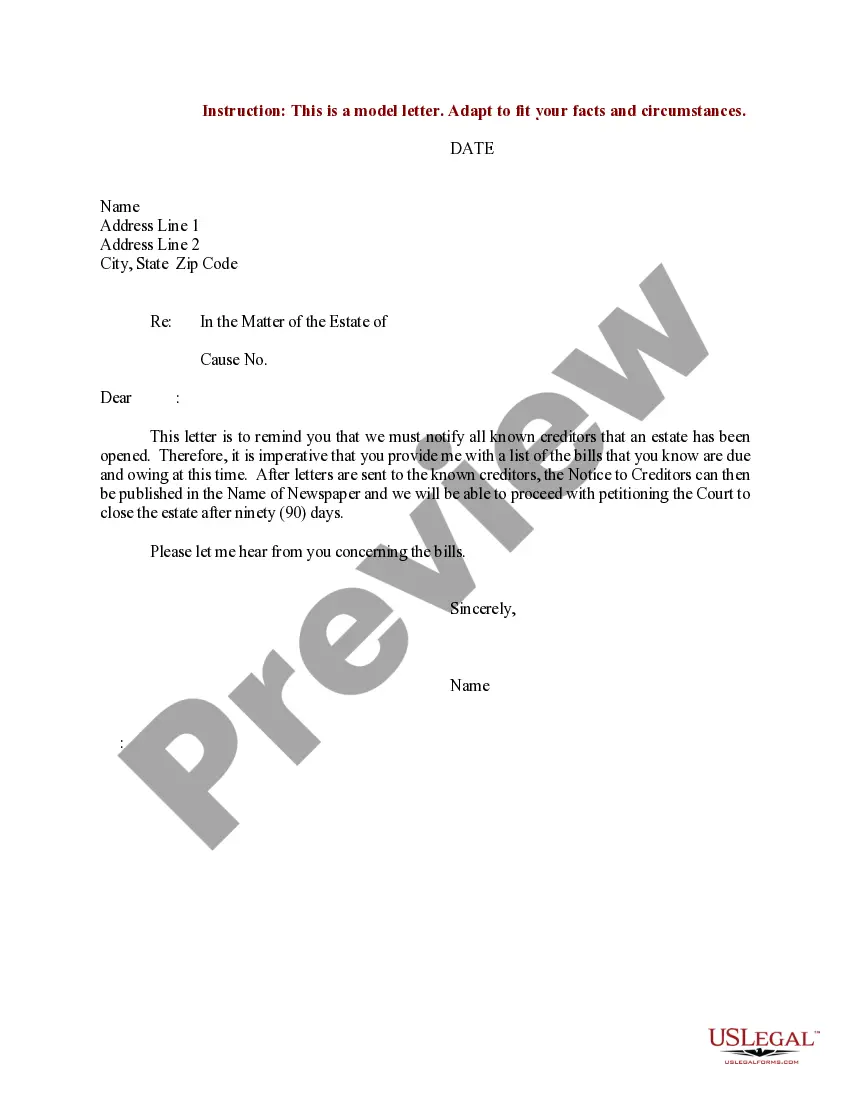
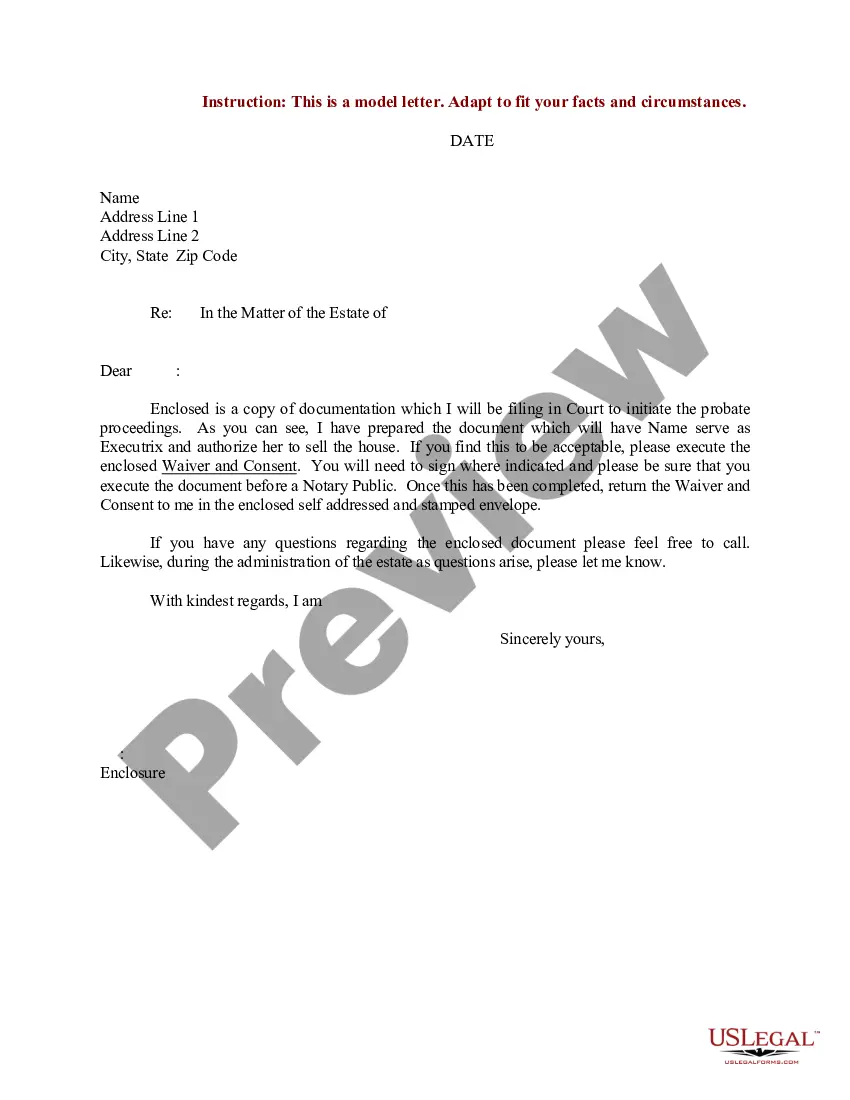
This Sample Letter for Creditor Notification of Estate Opening is a template that helps inform creditors about the opening of an estate. It allows the executor or administrator of the estate to formally notify creditors regarding the estate's initiation, which is crucial for settling any outstanding debts. This letter is designed to provide a clear and professional communication, differentiating it from other estate-related forms by focusing specifically on creditor notification.
Key parts of this document
- Date of the notification.
- Name and address of the creditor.
- Description of the estate matter.
- Request for the creditor to respond regarding any outstanding bills.
- Signature of the executor or administrator.

When to use this document
This form should be used when an estate is officially opened and the executor or administrator needs to notify creditors. It is particularly useful for ensuring that all creditors are informed about the estate proceedings, allowing them to submit claims or bills for payment in a timely manner. Using this letter helps maintain transparency and facilitates the proper settlement of debts associated with the estate.
Who needs this form
This letter is intended for:
- Executors or administrators of an estate.
- Individuals responsible for managing the debts of a deceased person.
- Personal representatives seeking to communicate with creditors during the probate process.
Instructions for completing this form
- Enter the date at the top of the letter.
- Fill in the creditor's name and address, including all relevant details.
- Specify the estate name or matter in question after "In the Matter of the Estate of."
- Clearly request that the creditor respond promptly regarding any outstanding bills.
- Sign the letter with your name as the executor or administrator.
Does this document require notarization?
This form does not typically require notarization unless specified by local law. However, it's advisable to check state-specific requirements as some jurisdictions may have different rules regarding notarization of estate-related notifications.
Get your form ready online
Our built-in tools help you complete, sign, share, and store your documents in one place.
Make edits, fill in missing information, and update formatting in US Legal Forms—just like you would in MS Word.
Download a copy, print it, send it by email, or mail it via USPS—whatever works best for your next step.
Sign and collect signatures with our SignNow integration. Send to multiple recipients, set reminders, and more. Go Premium to unlock E-Sign.
If this form requires notarization, complete it online through a secure video call—no need to meet a notary in person or wait for an appointment.
We protect your documents and personal data by following strict security and privacy standards.

Make edits, fill in missing information, and update formatting in US Legal Forms—just like you would in MS Word.

Download a copy, print it, send it by email, or mail it via USPS—whatever works best for your next step.

Sign and collect signatures with our SignNow integration. Send to multiple recipients, set reminders, and more. Go Premium to unlock E-Sign.

If this form requires notarization, complete it online through a secure video call—no need to meet a notary in person or wait for an appointment.

We protect your documents and personal data by following strict security and privacy standards.
Common mistakes to avoid
- Not including the date of the letter.
- Failing to address the creditor correctly.
- Omitting the estate details, which may confuse the recipient.
- Neglecting to ask for a timely response from creditors.
Advantages of online completion
- Easy access to a downloadable template allows for convenience and quick use.
- Edit the form to fit specific needs without the hassle of creating from scratch.
- Reliable legal template drafted by licensed attorneys ensures compliance with legal standards.
Looking for another form?
Form popularity
FAQ
Your inventory should include the number of shares of each type of stock, the name of the corporation, and the name of the exchange on which the stock is traded. Meanwhile, you should note the total gross amount of a bond, the name of the entity that issued it, the interest rate on the bond, and its maturity date.
Generally speaking, creditors try to collect on what's owed them by going after the estate of the decedent in a process called probate. However, there are instances where the surviving spouse (or other heir) may be legally responsible. Not all assets are counted as part of a person's estate for probate purposes.
A notice to creditors refers to a public notice that is addressed to potential creditors and debtors of an estate of a deceased individual. The notice is published by the estate executor in local and national newspapers with a national circulation for several weeks, depending on the estate laws of the state.
A notice to creditors is a public statement noting the death of an individual in order to alert potential creditors to the situation. Still published in local newspapers, the notice is filed by the estate's executor and meant to facilitate the probate proceedings.
Inform the creditor that the deceased passed away; reference the prior call you made. Ask the creditor to place a formal death notice on the deceased credit file and to close the account. Provide information about the decedent, such as his full name, address, Social Security number, birth date and account number.
How to Notify Creditors of Death. Once your debts have been established, your surviving family members or the executor of your estate will need to notify your creditors of your death. They can do this by sending a copy of your death certificate to each creditor.
If you or your loved one has completed a beneficiary form for each account such as your life insurance policy and 401(k) unsecured creditors typically cannot collect any money from those sources of funds.
Timespan for Creditors to Make Claim For unsecured debts, the time limit ranges from 3-6 months in most states. State laws require executors to post notice of the death, either in a newspaper or directly to known creditors to give them a chance to file a claim. No claims are accepted after the time frame has expired.
Mail the letter first class. You should send the letter first class, return receipt requested. The receipt will serve as proof that the creditor received the letter. Be sure to attach any supporting documentation, such as a copy of your credit report.