Disclaimer with regard to Website of Licensed Counselor of Social Work or Similar such Therapist
What this document covers
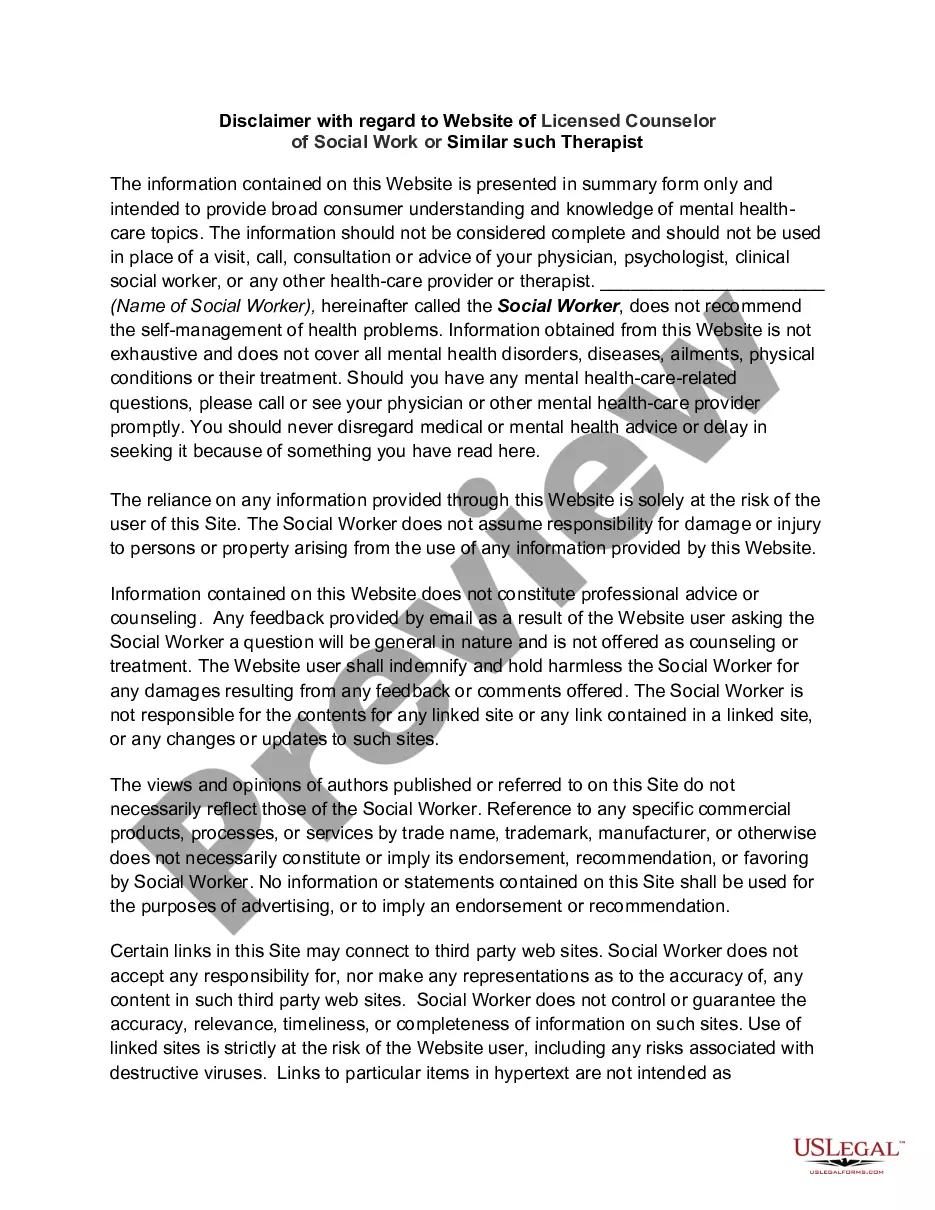
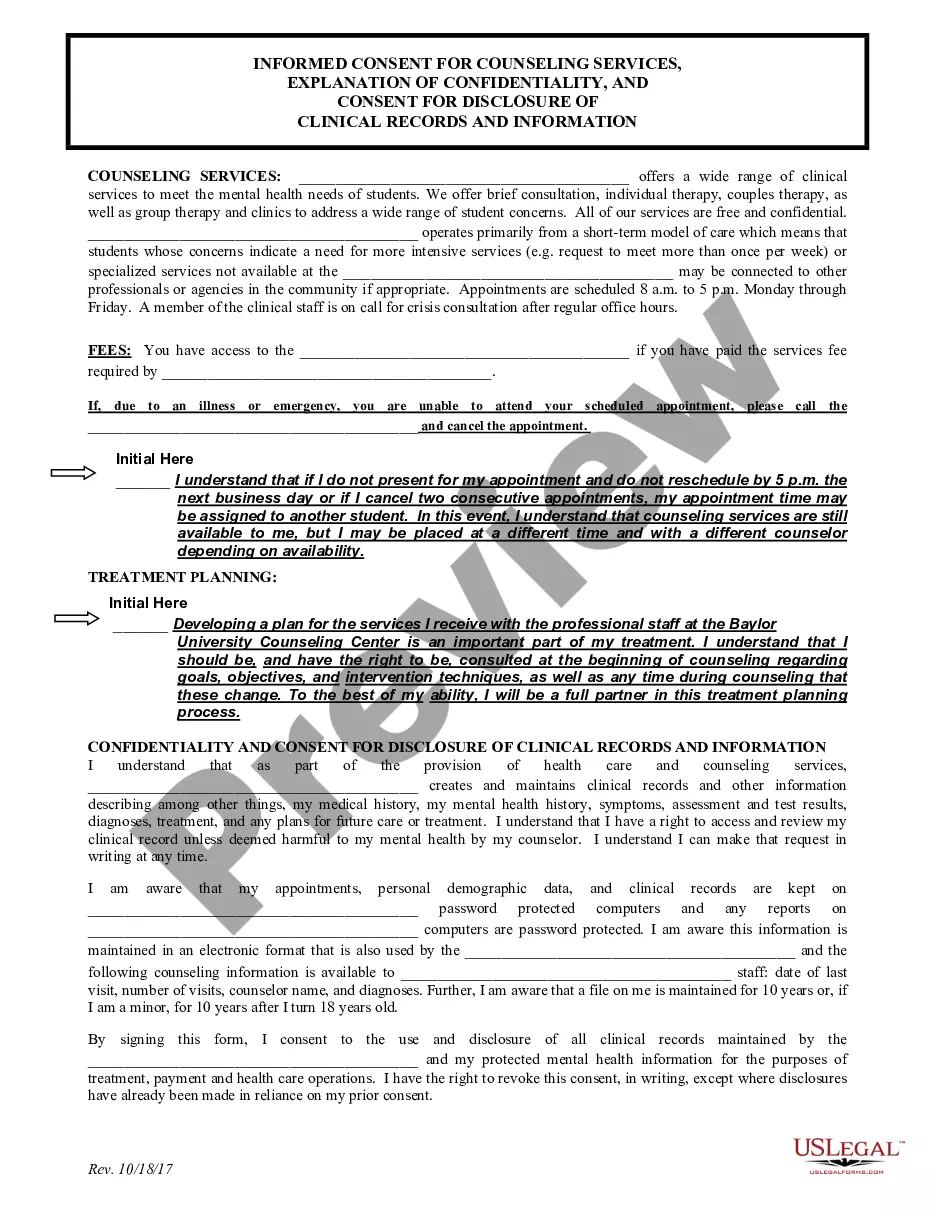
This form is a Disclaimer with regard to the Website of a Licensed Counselor of Social Work or Similar Therapist. It serves to clarify the limitations of information provided on the website and to disavow any liability associated with the content. Unlike other forms that might provide specific advice or treatment, this disclaimer emphasizes the importance of professional guidance from a licensed healthcare provider.
Main sections of this form
- A statement that the website's information is intended for general understanding and not as a substitute for professional advice.
- A disavowal of responsibility for any errors or omissions in the information provided.
- Clarification that the Social Worker does not endorse any external links or related products.
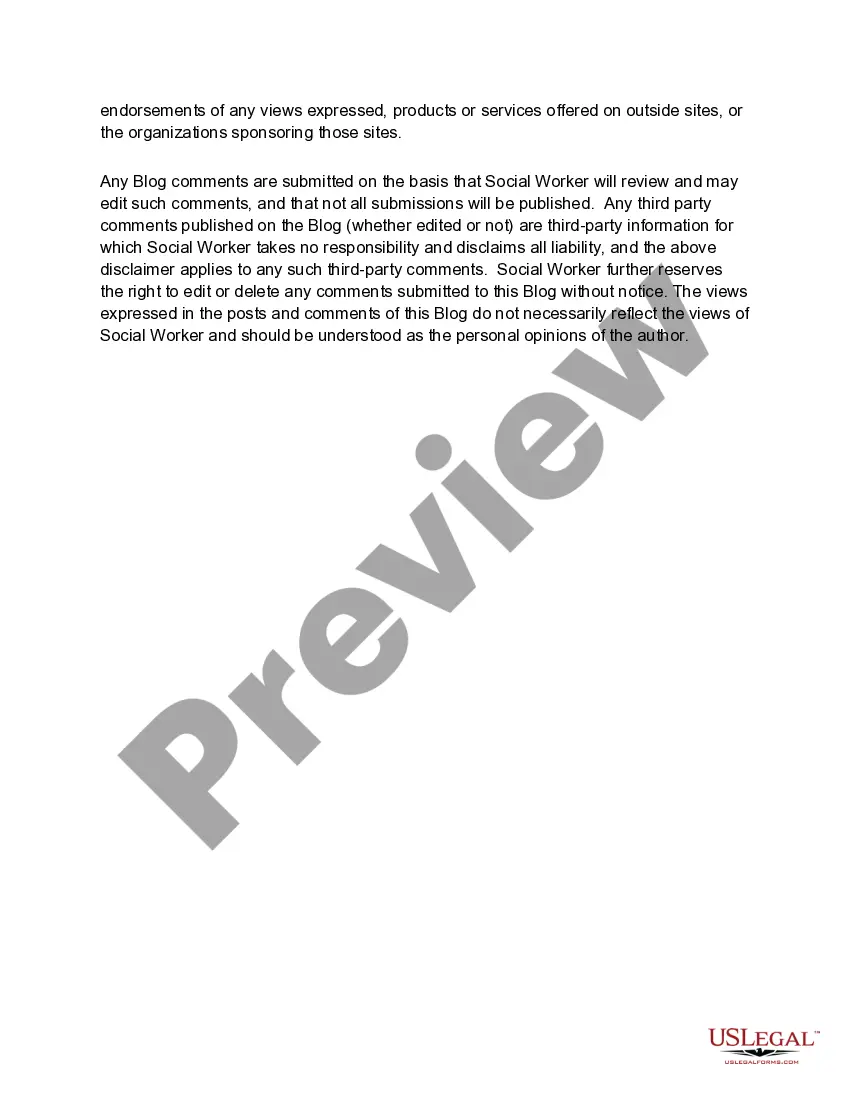
- A disclaimer regarding third-party comments and their responsibility for content.
- Note on the potential risks of using linked websites, including viruses.
When this form is needed
This disclaimer form is essential to use whenever a website offers information related to mental health but does not substitute professional counseling. It mitigates legal risks when providing a platform for discussion about health topics and reminds users to seek qualified advice for their specific mental health needs.
Who can use this document
- Website owners or managers providing mental health resources.
- Licensed counselors or therapists looking to limit their liability.
- Organizations or individuals sharing educational content about mental health.
How to prepare this document
- Identify the name of the Social Worker or therapist associated with the website.
- Clearly state the purpose of the information on the website and its limitations.
- Include a disclaimer about third-party links and comments.
- Sign and date the form to confirm its applicability and acceptance.
- Ensure accessibility of this disclaimer on your website's pages where health-related information is presented.
Does this form need to be notarized?
In most cases, this form does not require notarization. However, some jurisdictions or signing circumstances might. US Legal Forms offers online notarization powered by Notarize, accessible 24/7 for a quick, remote process.
Get your form ready online
Our built-in tools help you complete, sign, share, and store your documents in one place.
Make edits, fill in missing information, and update formatting in US Legal Forms—just like you would in MS Word.
Download a copy, print it, send it by email, or mail it via USPS—whatever works best for your next step.
Sign and collect signatures with our SignNow integration. Send to multiple recipients, set reminders, and more. Go Premium to unlock E-Sign.
If this form requires notarization, complete it online through a secure video call—no need to meet a notary in person or wait for an appointment.
We protect your documents and personal data by following strict security and privacy standards.

Make edits, fill in missing information, and update formatting in US Legal Forms—just like you would in MS Word.

Download a copy, print it, send it by email, or mail it via USPS—whatever works best for your next step.

Sign and collect signatures with our SignNow integration. Send to multiple recipients, set reminders, and more. Go Premium to unlock E-Sign.

If this form requires notarization, complete it online through a secure video call—no need to meet a notary in person or wait for an appointment.

We protect your documents and personal data by following strict security and privacy standards.
Common mistakes
- Failing to specify the limitations of the information provided.
- Not updating the disclaimer when changes are made to website content.
- Neglecting to include a clear explanation about third-party links.
Why complete this form online
- Easy adaptability for individual websites offering similar content.
- Helps establish clear communication regarding the intent and limitations of the information.
- Provides legal protection against potential liabilities related to misleading information.
Quick recap
- This disclaimer is crucial for protecting mental health professionals when sharing information online.
- It emphasizes that users should seek professional advice instead of relying solely on the website's content.
- Consulting state-specific regulations is essential for best practices regarding such disclaimers.
- Regular updates and clear language will enhance the disclaimer's effectiveness and user understanding.
Looking for another form?

Form popularity
FAQ
Licensed Professional Counselor (LPC) This is the license title used in 24 US states and the District of Columbia, according to this data from the American Counseling Association.Licensed Professional Clinical Counselor (LPCC) This is used in six states, the largest of which is California.
An LPC is a licensed professional counselor. LPCs provide mental health services that focus on behavioral, emotional and mental issues in various healthcare settings. Depending on the state, they may be called a licensed clinical professional counselor, licensed mental health counselor or something similar.
LCSW has the advantage in all areas except for one: training. LPCs and LMHCs are better trained in therapy. However, the LCSW has more flexibility in doing private practice and working for an employer.
Although some jurisdictions use the term certification as signifying governmental authority to practice a profession, the difference between licensure and certification is essentially the difference between governmental regulation and self-regulation of a profession. and effectively practice the regulated profession.
Meet the educational requirements put forth by the Florida Department of Health. Complete a practicum during your graduate studies. Apply for internship. Fulfill the supervised experience component.
Is a social worker a counselor? While social workers provide therapy and counseling to their clients, they follow different pathways to licensure and different job titles. Counselors specialize in providing guidance, while social workers focus on different capacities of therapy, depending on their licensure.
LCSW has the advantage in all areas except for one: training. LPCs and LMHCs are better trained in therapy. However, the LCSW has more flexibility in doing private practice and working for an employer. Whatever program you choose, just make sure the social work program is CSWE accredited.
How to Become a Counselor in Florida. Counselors in Florida are required to be licensed according to the rules set by various boards. Most types of counselor licensure require a master's degree and significant clinical training during an approved internship.
Board certification helps potential clients and members of the public recognize professionals who have voluntarily met standards set by the counseling profession.Licensure is designed to legally define who can use the title of a licensed counselor and/or who can provide counseling services in a particular state.